Building Blocks
Sous-catégories appartenant à la catégorie "Building Blocks"
- Acides boroniques et dérivés de l'acide boronique(5.774 produits)
- Building Blocks Chiraux(1.237 produits)
- Building Blocks Hydrocarbonés(6.098 produits)
- Building Blocks organiques(60.970 produits)
205134 produits trouvés pour "Building Blocks"
2-Hydroxy-3-(pyridin-2-yl)propanoic acid hydrochloride
CAS :Versatile small molecule scaffoldFormule :C8H10ClNO3Degré de pureté :Min. 95%Masse moléculaire :203.6 g/mol5-Benzo[1,3]dioxol-5-yl-2H-pyrazole-3-carboxylic acid methyl ester
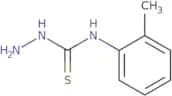
CAS :Versatile small molecule scaffoldFormule :C12H10N2O4Degré de pureté :Min. 95%Masse moléculaire :246.22 g/mol4-(2-Methylphenyl)-3-thiosemicarbazide
CAS :4-(2-Methylphenyl)-3-thiosemicarbazide is a crystalline solid that belongs to the group of benzoic acid derivatives. It has an orthorhombic crystal structure, with a yellow color. The crystals are measured at room temperature, and it has an atomic weight of 197.11 g/mol. 4-(2-Methylphenyl)-3-thiosemicarbazide is stable in air and in solution, but decomposes at temperatures above 250°C. This compound has been studied by using X-ray diffraction measurements and Bruker parameters. Its isotropic radiation is recorded at the following wavelength: 1.5418 Å (1).
Formule :C8H11N3SDegré de pureté :Min. 95%Masse moléculaire :181.26 g/mol2-[(3-Nitrophenyl)formamido]acetic acid
CAS :2-[(3-Nitrophenyl)formamido]acetic acid (2NPA) is a modifying agent that has been used in the modification of carboxyl groups. It can react with nucleophiles to form adducts and with carbodiimides to form ureas. 2NPA reacts with amino acids, peptides, and other nitrogenous compounds at their carboxyl groups to form ester or amide bonds. The nature of the residues after modification varies depending on the nature of the carboxyl group that was modified.
Formule :C9H8N2O5Degré de pureté :Min. 95%Masse moléculaire :224.17 g/molAcetic acid, dibromo-, ethyl ester
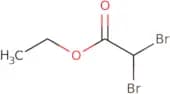
CAS :Acetic acid, dibromo-, ethyl ester is a reactive molecule that can be used as a nucleophilic substituent. It has hydroxyl group and ruthenium complex. It is a particle that can be used in the production of monoclonal antibodies. Acetic acid, dibromo-, ethyl ester also has viscosity and polycarboxylic acid. This chemical reacts with β-unsaturated ketones to form polymerization initiator. Acetic acid, dibromo-, ethyl ester also has carbonyl group and monoclonal antibodies. Acetic acid, dibromo-, ethyl ester can be conjugated with ethyl bromoacetate to produce conjugates.
Formule :C4H6Br2O2Degré de pureté :Min. 95%Masse moléculaire :245.9 g/mol5-Ethenyl-2-methoxyphenol
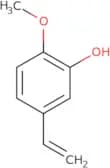
CAS :5-Ethenyl-2-methoxyphenol is a volatile compound that has been isolated from the bark of the cinnamon tree. It has shown anticancer activities "in vitro" and "in vivo". 5-Ethenyl-2-methoxyphenol has been shown to be demethylated by cytochrome P450 enzymes, which may result in its antitumor activity. This active compound can also be detected in postharvested fruit and vegetables as well as processed foods such as apple juice, tomato sauce, and dried fruits. 5-Ethenyl-2-methoxyphenol is responsible for the characteristic flavor of cinnamon, so it is often used as a flavoring agent in food processing.
Formule :C9H10O2Degré de pureté :Min. 95%Couleur et forme :PowderMasse moléculaire :150.17 g/molRef: 3D-AAA62158
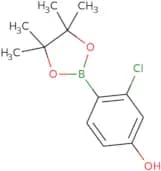
Produit arrêté3-Chloro-4-(4,4,5,5-tetramethyl-1,3,2-dioxaborolan-2-yl)phenol
CAS :Versatile small molecule scaffold
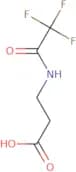
Formule :C12H16BClO3Degré de pureté :Min. 95%Masse moléculaire :254.52 g/mol3-(Trifluoroacetamido)propanoic acid
CAS :Versatile small molecule scaffold
Formule :C5H6F3NO3Degré de pureté :Min. 95%Masse moléculaire :185.1 g/molRef: 3D-ACA63282
Produit arrêté4-[2-(4-Iodophenyl)ethyl]morpholine
CAS :Versatile small molecule scaffold
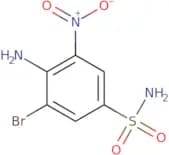
Formule :C12H16INODegré de pureté :Min. 95%Masse moléculaire :317.17 g/mol4-Amino-3-bromo-5-nitro-benzenesulfonamide
CAS :Versatile small molecule scaffold
Formule :C6H6BrN3O4SDegré de pureté :Min. 95%Masse moléculaire :296.1 g/mol4-(Dimethyl-1,2-oxazol-4-yl)phenol
CAS :Versatile small molecule scaffold
Formule :C11H11NO2Degré de pureté :Min. 95%Masse moléculaire :189.21 g/mol2-[3-(Propan-2-yl)phenoxy]acetic acid
CAS :2-[3-(Propan-2-yl)phenoxy]acetic acid is a chemical compound that is used as an additive in benzene, and is a phytotoxic chemical. It prevents the formation of chlorophyll by blocking electron transport and inhibiting photosynthesis. 2-[3-(Propan-2-yl)phenoxy]acetic acid is used to induce callus tissue from lettuce, radish, and other plants. This compound also inhibits the growth of various bacteria including Escherichia coli and Pseudomonas aeruginosa.
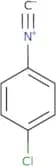
Formule :C11H14O3Degré de pureté :Min. 95%Masse moléculaire :194.23 g/mol1-Chloro-4-isocyanobenzene
CAS :1-Chloro-4-isocyanobenzene (1CI) is an organic compound that has been used as a chemical probe for the detection of amines and other molecules on metal surfaces. The frequency shift in Raman spectra, which is observed after the addition of 1CI to the metal surface, is used to detect amines. 1CI has also been shown to be a potent inhibitor of mitochondrial function. This molecule binds to nucleophilic sites on metal surfaces and forms covalent bonds with them, leading to a high degree of inhibition.
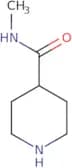
1CI can be synthesized in three steps from commercially available starting materials and is relatively easy to purify.Formule :C7H4ClNDegré de pureté :Min. 95%Masse moléculaire :137.56 g/molN-Methylpiperidine-4-carboxamide
CAS :Versatile small molecule scaffold
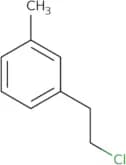
Formule :C7H14N2ODegré de pureté :Min. 95%Masse moléculaire :142.2 g/mol1-(2-Chloroethyl)-3-methylbenzene
CAS :Versatile small molecule scaffold
Formule :C9H11ClDegré de pureté :Min. 95%Masse moléculaire :154.64 g/molRef: 3D-PBA19936
Produit arrêté1-[3-(Trifluoromethyl)phenyl]cyclohexane-1-carboxylic acid
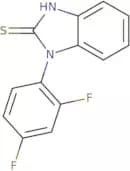
CAS :Versatile small molecule scaffoldFormule :C14H15F3O2Degré de pureté :Min. 95%Masse moléculaire :272.26 g/mol1-(2,4-Difluorophenyl)-1H-1,3-benzodiazole-2-thiol
CAS :Versatile small molecule scaffoldFormule :C13H8F2N2SDegré de pureté :Min. 95%Masse moléculaire :262.28 g/mol2-({[(9H-Fluoren-9-yl)methoxy]carbonyl}(3-methoxyphenyl)amino)acetic acid
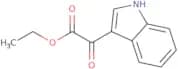
CAS :Versatile small molecule scaffoldFormule :C24H21NO5Degré de pureté :Min. 95%Masse moléculaire :403.4 g/molEthyl 2-(indol-3-yl)-2-oxoacetate
CAS :Ethyl 2-(indol-3-yl)-2-oxoacetate is a hydroxy derivative of the amino acid tyrosine. It inhibits the enzyme tyrosine hydroxylase, which catalyzes the conversion of tyrosine to L-DOPA. This in turn affects dopamine synthesis and has an inhibitory effect on rat brain. Ethyl 2-(indol-3-yl)-2-oxoacetate also inhibits methylmagnesium borohydride in vitro, which is a reagent that breaks down esters, amides, and nitriles. Tyrosine hydroxylase is inhibited by the presence of two hydroxy groups on the ethyl side chain and one hydroxy group on the indole ring. It can be used as a structural analogue for other drugs that are used to treat Parkinson's disease or depression.
Formule :C12H11NO3Degré de pureté :Min. 95%Masse moléculaire :217.22 g/molRef: 3D-BCA07910
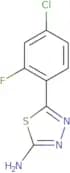
Produit arrêté5-(4-Chloro-2-fluorophenyl)-1,3,4-thiadiazol-2-amine
CAS :Versatile small molecule scaffold
Formule :C8H5ClFN3SDegré de pureté :Min. 95%Masse moléculaire :229.66 g/mol

![5-Benzo[1,3]dioxol-5-yl-2H-pyrazole-3-carboxylic acid methyl ester](/_next/image/?url=https%3A%2Fstatic.cymitquimica.com%2Fproducts%2F3D%2Fthumb-webp%2FERB10454.webp&w=3840&q=75)
![2-[(3-Nitrophenyl)formamido]acetic acid](/_next/image/?url=https%3A%2Fstatic.cymitquimica.com%2Fproducts%2F3D%2Fthumb-webp%2FAAA61710.webp&w=3840&q=75)
![4-[2-(4-Iodophenyl)ethyl]morpholine](/_next/image/?url=https%3A%2Fstatic.cymitquimica.com%2Fproducts%2F3D%2Fthumb-webp%2FAEA83946.webp&w=3840&q=75)

![2-[3-(Propan-2-yl)phenoxy]acetic acid](/_next/image/?url=https%3A%2Fstatic.cymitquimica.com%2Fproducts%2F3D%2Fthumb-webp%2FBAA87852.webp&w=3840&q=75)
![1-[3-(Trifluoromethyl)phenyl]cyclohexane-1-carboxylic acid](/_next/image/?url=https%3A%2Fstatic.cymitquimica.com%2Fproducts%2F3D%2Fthumb-webp%2FNRB71916.webp&w=3840&q=75)
![2-({[(9H-Fluoren-9-yl)methoxy]carbonyl}(3-methoxyphenyl)amino)acetic acid](/_next/image/?url=https%3A%2Fstatic.cymitquimica.com%2Fproducts%2F3D%2Fthumb-webp%2FNKD54880.webp&w=3840&q=75)