Building Blocks
Cette section contient des produits fondamentaux pour la synthèse de composés organiques et biologiques. Building blocks sont les matériaux de départ essentiels utilisés pour construire des molécules complexes à travers diverses réactions chimiques. Ils jouent un rôle crucial dans la découverte de médicaments, la science des matériaux et la recherche chimique. Chez CymitQuimica, nous offrons une gamme diversifiée de building blocks de haute qualité pour soutenir vos recherches innovantes et projets industriels, en vous assurant de disposer des composants essentiels pour une synthèse réussie.
Sous-catégories appartenant à la catégorie "Building Blocks"
- Acides boroniques et dérivés de l'acide boronique(5.778 produits)
- Building Blocks Chiraux(1.242 produits)
- Building Blocks Hydrocarbonés(6.098 produits)
- Building Blocks organiques(61.059 produits)
199580 produits trouvés pour "Building Blocks"
Trier par
Degré de pureté (%)
0
100
|
0
|
50
|
90
|
95
|
100
Xylenesulfonic Acid Sodium Salt
CAS :<p>Applications Xylenesulfonic Acid is a hydrotrope used to solubilise hydrophobic compounds and in aqueous solutions as well is in the study of liposome systems.<br>References Friberg, S.E. et al.: J. Disp. Sci. Technol., 19, 19 (1998); Odeh, F. et al.: J. Disp. Sci. Technol., 27, 665 (2006);<br></p>Formule :C8H9NaO3SCouleur et forme :Off WhiteMasse moléculaire :208.214-Mercaptobenzoic Acid, Technical Grade
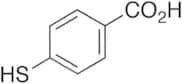
CAS :Produit contrôlé<p>Stability Store Under Argon; Air Sensitive<br>Applications 4-Mercaptobenzoic Acid, Technical Grade (cas# 1074-36-8) is a compound useful in organic synthesis.<br> Not a dangerous good if item is equal to or less than 1g/ml and there is less than 100g/ml in the package<br></p>Formule :C7H6O2SCouleur et forme :NeatMasse moléculaire :154.19Pinacolyl Methylphosphonate
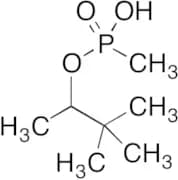
CAS :Produit contrôléFormule :C7H17O3PCouleur et forme :NeatMasse moléculaire :180.1818N-(1-Pyrenyl) Maleimide
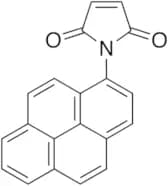
CAS :Produit contrôlé<p>Applications A fluorescent sulfhydryl reagent that can form excited-state dimers which emit at longer wavelenghts than the lone excited fluorophore.<br></p>Formule :C20H11NO2Couleur et forme :NeatMasse moléculaire :297.31DL-Lactide
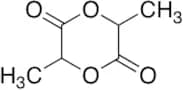
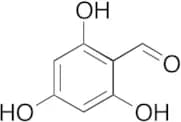
CAS :Produit contrôlé<p>Applications DL-Lactide (cas# 95-96-5) is a useful research chemical.<br></p>Formule :C6H8O4Couleur et forme :NeatMasse moléculaire :144.132,4,6-Trihydroxybenzaldehyde
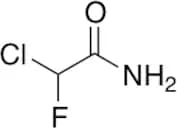
CAS :Produit contrôléFormule :C7H6O4Couleur et forme :NeatMasse moléculaire :154.12Chlorofluoroacetamide
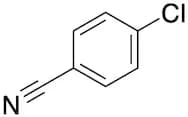
CAS :Produit contrôlé<p>Applications CHLOROFLUOROACETAMIDE (cas# 431-09-4) is a useful research chemical.<br></p>Formule :C2H3ClFNOCouleur et forme :NeatMasse moléculaire :111.5034-Chlorobenzonitrile
CAS :Produit contrôlé<p>Applications 4-Chlorobenzonitrile<br></p>Formule :C7H4ClNCouleur et forme :NeatMasse moléculaire :137.572-Phenylbenzothiazole
CAS :Produit contrôlé<p>Applications 2-Phenylbenzothiazole is an organic compound that was detected in water and sediment from sedimentation ponds as a contaminant.<br>References Grung, M., et al.: Sci. Total Environ., 751, 141808 (2021)<br></p>Formule :C13H9NSCouleur et forme :NeatMasse moléculaire :211.28Tiglic Acid
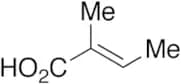
CAS :<p>Applications Tiglic acid is the stable isomer of angelic acid. Tiglic acid was found as glyceride in croton oil, as butyl ester in the oil of the Roman camomile, and as geranyl tiglate in oil of geranium. Tiglic acid is formed during the charcoaling of maple wood.<br> Not a dangerous good if item is equal to or less than 1g/ml and there is less than 100g/ml in the package<br>References Bueding, et al.: J. Biol. Chem., 202, 505 (1953),<br></p>Formule :C5H8O2Couleur et forme :NeatMasse moléculaire :100.12cis-Linalool Oxide
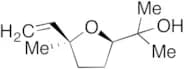
CAS :Produit contrôlé<p>Applications cis-Linalool Oxide is a derivative of Linalool (L465950), which is a terpene alcohol common in various flowers and spice plants. cis-Linalool Oxide has been employed to assess the effect of vine on the glycosylated flavour procurers in grapes.<br> Not a dangerous good if item is equal to or less than 1g/ml and there is less than 100g/ml in the package<br>References Baratta, M. T., et al.: J Essent Oil Res 10, 618 (1998); Bureau, S. M., et al.: J. Agric. Food Chem. 48, 1290 (2000)<br></p>Formule :C10H18O2Couleur et forme :NeatMasse moléculaire :170.25Citraconic Acid
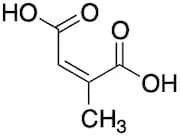
CAS :Produit contrôlé<p>Applications Citraconic Acid (cas# 498-23-7) is a useful research chemical.<br></p>Formule :C5H6O4Couleur et forme :NeatMasse moléculaire :130.09rac-Citronellal (>90%)
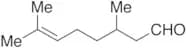
CAS :Produit contrôlé<p>Stability Hygroscopic<br>Applications rac-Citronellal is a monoterpenoid and the major isolate in citronella oil. Citronella oil is an essential oil bearing insecticidal properties. rac-Citronellal is also often used as a fragrance ingredient.<br>References Waliwitiya, R., et al.: J. Med. Entomol., 49, 614 (2012);<br></p>Formule :C10H18ODegré de pureté :>90%Couleur et forme :NeatMasse moléculaire :154.25Nonanoyl Chloride
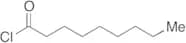
CAS :Produit contrôlé<p>Applications Nonanoyl Chloride is used in the synthesis of immunosuppressants involving 2-aminoethanols and aminopropane-1,2-diols. Also used in the synthesis of Vanilloids with antinociceptive and antiinflammatory compounds.<br> Not a dangerous good if item is equal to or less than 1g/ml and there is less than 100g/ml in the package<br>References Kiuchi, M. et al.: J. Med. Chem., 43, 2946 (2000); Janusz, J. et al.: J. Med. Chem., 36, 2595 (1993);<br></p>Formule :C9H17ClOCouleur et forme :NeatMasse moléculaire :176.68(+)-Citronellal
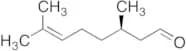
CAS :Produit contrôlé<p>Applications (+)-Citronellal is a monoterpene compound that is formed by the metabolism of plants. (+)-Citronellal is a natural insect repellant, and is the main component of citronellal oil. (+)-Citronellal is also used as a starting material in the one pot synthesis of (-)-Menthol (M218875).<br>References Kwon, Y., et al.: Curr. Biol., 20, 1672 (2010); Lenardão, E., et al.: Tetrahedron, 63, 6671 (2007); Milone, C., et al.: Appl. Catal. A-Gen., 199, 239 (2000)<br></p>Formule :C10H18ODegré de pureté :>90%Couleur et forme :NeatMasse moléculaire :154.25N,N,N’,N’-Tetramethylethylenediamine
CAS :<p>Applications N,N,N',N'-Tetramethylethylenediamine is used as polymerization accelerator in gel electrophoresis, solvent and oxidizing reagent.<br> Not a dangerous good if item is equal to or less than 1g/ml and there is less than 100g/ml in the package<br>References Bassam, B.J., et al.: BioTechniques, 19, 568 (1995), Moham, D., et al.: J. Chromatogr., 979, 271 (2002),<br></p>Formule :C6H16N2Couleur et forme :Colourless To Light YellowMasse moléculaire :116.22,5-Dimethylaniline(2,5-Xylidine)
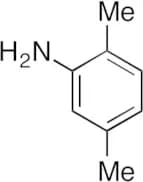
CAS :Produit contrôlé<p>Applications 2,5-Xylidine, is a Vanillin derivative, used as as potential inhibitors of FtsZ. These compounds were also assayed for antibacterial activity against Escherichia coli, Pseudomonas aeruginosa, etc.<br> Not a dangerous good if item is equal to or less than 1g/ml and there is less than 100g/ml in the package<br>References Sun, J., et al.: Med. Chem. Res. (2013);<br></p>Formule :C8H11NCouleur et forme :Light BrownMasse moléculaire :121.18trans-Linalool Oxide
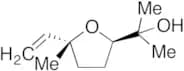
CAS :<p>Applications trans-Linalool Oxide is a derivative of Linalool (L465950), which is a terpene alcohol common in various flowers and spice plants. trans-Linalool Oxide is also an isomer of cis-Linalool Oxide, which has been employed to assess the effect of vine on the glycosylated flavour procurers in grapes.<br> Not a dangerous good if item is equal to or less than 1g/ml and there is less than 100g/ml in the package<br>References Baratta, M. T., et al.: J Essent Oil Res 10, 618 (1998); Bureau, S. M., et al.: J. Agric. Food Chem. 48, 1290 (2000)<br></p>Formule :C10H18O2Couleur et forme :NeatMasse moléculaire :170.25