Building Blocks
Cette section contient des produits fondamentaux pour la synthèse de composés organiques et biologiques. Building blocks sont les matériaux de départ essentiels utilisés pour construire des molécules complexes à travers diverses réactions chimiques. Ils jouent un rôle crucial dans la découverte de médicaments, la science des matériaux et la recherche chimique. Chez CymitQuimica, nous offrons une gamme diversifiée de building blocks de haute qualité pour soutenir vos recherches innovantes et projets industriels, en vous assurant de disposer des composants essentiels pour une synthèse réussie.
Sous-catégories appartenant à la catégorie "Building Blocks"
- Acides boroniques et dérivés de l'acide boronique(5.784 produits)
- Building Blocks Chiraux(1.244 produits)
- Building Blocks Hydrocarbonés(6.105 produits)
- Building Blocks organiques(61.076 produits)
205454 produits trouvés pour "Building Blocks"
Trier par
Degré de pureté (%)
0
100
|
0
|
50
|
90
|
95
|
100
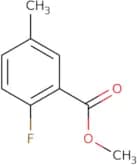
Methyl 2-Fluoro-5-methylbenzoate
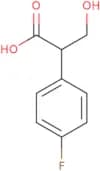
CAS :Versatile small molecule scaffoldFormule :C9H9FO2Degré de pureté :Min. 95%Masse moléculaire :168.17 g/mol2-(4-Fluorophenyl)-3-hydroxypropanoic acid
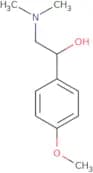
CAS :Versatile small molecule scaffoldFormule :C9H9FO3Degré de pureté :Min. 95%Masse moléculaire :184.16 g/mol2-(Dimethylamino)-1-(4-methoxyphenyl)ethanol
CAS :Versatile small molecule scaffold
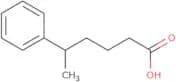
Formule :C11H17NO2Degré de pureté :Min. 95%Masse moléculaire :195.26 g/mol5-Phenylhexanoic acid
CAS :5-Phenylhexanoic acid is an organic compound that belongs to the group of alcohols. It can be synthesised by a two-step process, which involves oxidation of benzylic alcohols and fission of the resulting aldehydes. The kinetic analysis of this reaction has shown that it proceeds with a rate law that follows first order kinetics. The analyses have also shown that 5-phenylhexanoic acid is oxidised in the presence of cobaltic perchlorate, which leads to the formation of cyanide as well as alkyl bromides and hydrocarbons.Formule :C12H16O2Degré de pureté :Min. 95%Masse moléculaire :192.25 g/mol2,2-Dimethyl-3,4-dihydronaphthalen-1-one
CAS :Versatile small molecule scaffoldFormule :C12H14ODegré de pureté :Min. 95%Masse moléculaire :174.24 g/mol2,2-Dimethylpent-4-enenitrile
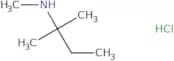
CAS :2,2-Dimethylpent-4-enenitrile is an organic compound that can be synthesized by the reaction of bromomethyl cyclopropane with a Grignard reagent. It is a useful synthetic intermediate for the synthesis of imines and carbonitriles. Grignard reagents are nucleophilic and react with alkenes to form addition products called imines. 2,2-Dimethylpent-4-enenitrile is a cyclic molecule that reacts with nucleophiles such as Grignard reagents in a nucleophilic substitution reaction. The addition product formed is known as an imine.Formule :C7H11NDegré de pureté :Min. 95%Masse moléculaire :109.17 g/molMethyl(2-methylbutan-2-yl)amine hydrochloride
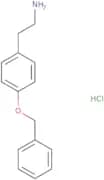
CAS :Versatile small molecule scaffoldFormule :C6H16ClNDegré de pureté :Min. 95%Masse moléculaire :137.65 g/mol4-Benzyloxy-Phenethylamine hydrochloride
CAS :Versatile small molecule scaffoldFormule :C15H18ClNODegré de pureté :Min. 95%Masse moléculaire :263.77 g/molEthyl 2-Ethylbutyrate
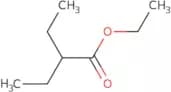
CAS :Ethyl 2-ethylbutyrate is a fatty acid ester that is synthesized from butyric acid and ethanol. It has been shown to have anti-inflammatory properties, which may be due to its ability to suppress pro-inflammatory cytokines such as IL-6 and TNF-α. This compound also suppresses the production of IL-10, an anti-inflammatory cytokine. The activity index of this product is 1.5.Formule :C8H16O2Degré de pureté :Min. 95%Masse moléculaire :144.21 g/mol3-(Cyclopropylmethoxy)propan-1-amine
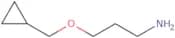
CAS :Versatile small molecule scaffoldFormule :C7H15NODegré de pureté :Min. 95%Masse moléculaire :129.2 g/mol(6-Aminohexyl)(methyl)amine
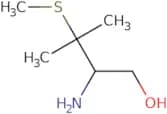
CAS :Versatile small molecule scaffoldFormule :C7H18N2Degré de pureté :Min. 95%Masse moléculaire :130.23 g/mol(2S)-2-Amino-3-methyl-3-(methylsulfanyl)butan-1-ol
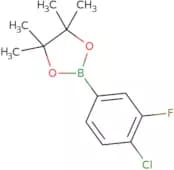
CAS :Versatile small molecule scaffoldFormule :C6H15NOSDegré de pureté :Min. 95%Masse moléculaire :149.3 g/mol2-(4-Chloro-3-fluorophenyl)-4,4,5,5-tetramethyl-1,3,2-dioxaborolane
CAS :Versatile small molecule scaffoldFormule :C12H15BClFO2Degré de pureté :Min. 95%Masse moléculaire :256.51 g/mol3-(Trifluoromethyl)-5-fluorophenylboronic acid pinacol ester
CAS :Versatile small molecule scaffold
Formule :C13H15BF4O2Degré de pureté :Min. 95%Masse moléculaire :290.06 g/mol2-[3-(Difluoromethyl)phenyl]-4,4,5,5-tetramethyl-1,3,2-dioxaborolane
CAS :Versatile small molecule scaffoldFormule :C13H17BF2O2Degré de pureté :Min. 95%Masse moléculaire :254.08 g/mol2-[3-(Difluoromethyl)-5-fluorophenyl]-4,4,5,5-tetramethyl-1,3,2-dioxaborolane
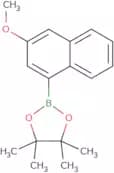
CAS :Versatile small molecule scaffoldFormule :C13H16BF3O2Degré de pureté :Min. 95%Masse moléculaire :272.07 g/mol2-(3-Methoxynaphthalen-1-yl)-4,4,5,5-tetramethyl-1,3,2-dioxaborolane
CAS :Versatile small molecule scaffoldFormule :C17H21BO3Degré de pureté :Min. 95%Masse moléculaire :284.2 g/mol2-[2-Fluoro-3-(trifluoromethyl)phenyl]-4,4,5,5-tetramethyl-1,3,2-dioxaborolane
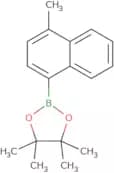
CAS :Versatile small molecule scaffoldFormule :C13H15BF4O2Degré de pureté :Min. 95%Masse moléculaire :290.06 g/mol4-Methylnaphthalene-1-boronic acid pinacol ester
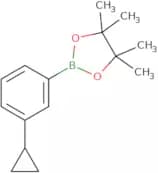
CAS :Versatile small molecule scaffoldFormule :C17H21BO2Degré de pureté :Min. 95%Masse moléculaire :268.16 g/mol2-(3-Cyclopropylphenyl)-4,4,5,5-tetramethyl-1,3,2-dioxaborolane
CAS :Versatile small molecule scaffoldFormule :C15H21BO2Degré de pureté :Min. 95%Masse moléculaire :244.14 g/mol



![2-[3-(Difluoromethyl)phenyl]-4,4,5,5-tetramethyl-1,3,2-dioxaborolane](/_next/image/?url=https%3A%2Fstatic.cymitquimica.com%2Fproducts%2F3D%2Fthumb-webp%2FCAB52589.webp&w=3840&q=75)
![2-[3-(Difluoromethyl)-5-fluorophenyl]-4,4,5,5-tetramethyl-1,3,2-dioxaborolane](/_next/image/?url=https%3A%2Fstatic.cymitquimica.com%2Fproducts%2F3D%2Fthumb-webp%2FCAB52604.webp&w=3840&q=75)
![2-[2-Fluoro-3-(trifluoromethyl)phenyl]-4,4,5,5-tetramethyl-1,3,2-dioxaborolane](/_next/image/?url=https%3A%2Fstatic.cymitquimica.com%2Fproducts%2F3D%2Fthumb-webp%2FCAB52648.webp&w=3840&q=75)