Building Blocks
Cette section contient des produits fondamentaux pour la synthèse de composés organiques et biologiques. Building blocks sont les matériaux de départ essentiels utilisés pour construire des molécules complexes à travers diverses réactions chimiques. Ils jouent un rôle crucial dans la découverte de médicaments, la science des matériaux et la recherche chimique. Chez CymitQuimica, nous offrons une gamme diversifiée de building blocks de haute qualité pour soutenir vos recherches innovantes et projets industriels, en vous assurant de disposer des composants essentiels pour une synthèse réussie.
Sous-catégories appartenant à la catégorie "Building Blocks"
- Acides boroniques et dérivés de l'acide boronique(5.784 produits)
- Building Blocks Chiraux(1.244 produits)
- Building Blocks Hydrocarbonés(6.105 produits)
- Building Blocks organiques(61.070 produits)
205437 produits trouvés pour "Building Blocks"
Trier par
Degré de pureté (%)
0
100
|
0
|
50
|
90
|
95
|
100
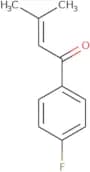
1-(4-Fluorophenyl)-3-methylbut-2-en-1-one
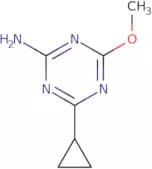
CAS :1-(4-Fluorophenyl)-3-methylbut-2-en-1-one is a conformationally constrained analogue of diethyl malonate. It is an analog of diethyl malonate that has been stabilized by the addition of a fluorine atom in the para position. This molecule has three chiral centers, and its crystal structure has been determined using X-ray crystallography. The molecule has a planar surface with one hydroxyl group and one methyl group on each side of the plane. The molecule can be used as a fingerprinting probe and as an intermediate for organic synthesis.Formule :C11H11FODegré de pureté :Min. 95%Masse moléculaire :178.2 g/mol4-Cyclopropyl-6-methoxy-1,3,5-triazin-2-amine
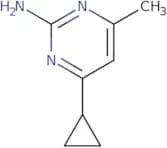
CAS :Versatile small molecule scaffoldFormule :C7H10N4ODegré de pureté :Min. 95%Masse moléculaire :166.18 g/mol4-Cyclopropyl-6-methylpyrimidin-2-amine
CAS :4-Cyclopropyl-6-methylpyrimidin-2-amine is a nitrogenous compound that can be taken up by plants through their roots and transported to other parts of the plant. It is used as a fungicide and is labelled for use on anaerobic soils, which are not suitable for many agricultural purposes. The uptake of 4-cyclopropyl-6-methylpyrimidin-2-amine has been shown to be initially high in the presence of oxygen, but decreases with time. It is also radioactive, emitting γ rays at a rate of 0.0003% per hour. 4-Cyclopropyl-6-methylpyrimidin-2-amine reacts with cyprodinil to form a pyrimidine intermediate, which then reacts with oxygen to form a final product that can be detected by radioactivity. In addition, this molecule has been found to have antiinflammatory effects in mice.Formule :C8H11N3Degré de pureté :Min. 95%Masse moléculaire :149.19 g/mol3-Methoxy-4-nitrobenzamide
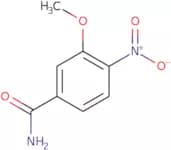
CAS :3-Methoxy-4-nitrobenzamide is an intermediate in the synthesis of drugs, dyes, and other organic chemicals. It is produced by the reaction of methoxyacetic acid with nitric acid. This compound is used as a starting material for the production of many pharmaceuticals, such as 3-methoxy-4-(2-chlorophenyl)benzamide, 3-methoxy-4-(2,6-dichlorophenyl)benzamide, and 3-methoxy-4-(3,4,5-trimethoxyphenyl)benzamide. 3MMB can also be used to synthesize acrylonitrile.Formule :C8H8N2O4Degré de pureté :Min. 95%Masse moléculaire :196.16 g/mol1-Bromo-2-methyl-4-(propan-2-yl)benzene
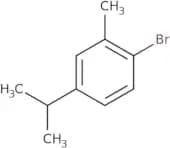
CAS :Geosmin is a volatile organic compound that is produced by certain types of bacteria, such as actinomycetes, and can be found in soil, water, and air. Geosmin has been identified as the cause of "earthy" or "musty" flavors in drinking water. Geosmin can be detected by olfactometry techniques and quantified using gas chromatography-mass spectrometry (GC-MS). The technique involves spiking a sample with an appropriate amount of geosmin to achieve the desired concentration for analysis. Geosmin can also be removed from samples using desorption methods. This process involves heating the sample at a high temperature to release geosmin from the surface adsorbed on the solid phase into the vapor phase where it can be collected on a trap. This method is used to analyze geosmin levels in environmental samples such as groundwater or surface water.Formule :C10H13BrDegré de pureté :Min. 95%Masse moléculaire :213.11 g/molMethyl decahydroquinoline-3-carboxylates
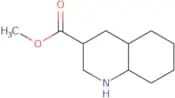
CAS :Versatile small molecule scaffold
Formule :C11H19NO2Degré de pureté :Min. 95%Masse moléculaire :197.3 g/mol1-(4-Chlorophenyl)-2-phenylethan-1-amine hydrochloride
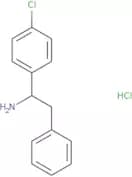
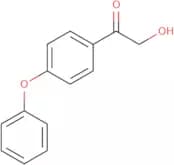
CAS :Versatile small molecule scaffoldFormule :C14H15Cl2NDegré de pureté :Min. 95%Masse moléculaire :268.2 g/mol2-Hydroxy-1-(4-phenoxyphenyl)ethan-1-one
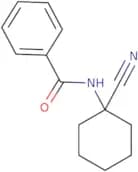
CAS :Versatile small molecule scaffoldFormule :C14H12O3Degré de pureté :Min. 95%Masse moléculaire :228.24 g/molN-(1-Cyanocyclohexyl)benzamide
CAS :Versatile small molecule scaffold
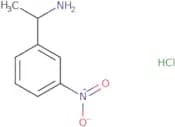
Formule :C14H16N2ODegré de pureté :Min. 95%Masse moléculaire :228.29 g/mol1-(3-Nitrophenyl)ethanamine hydrochloride
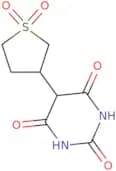
CAS :Versatile small molecule scaffoldFormule :C8H11ClN2O2Degré de pureté :Min. 95%Masse moléculaire :202.64 g/mol5-(1,1-Dioxidotetrahydrothien-3-yl)pyrimidine-2,4,6(1H,3H,5H)-trione
CAS :Versatile small molecule scaffoldFormule :C8H10N2O5SDegré de pureté :Min. 95%Masse moléculaire :246.24 g/molValrocemide
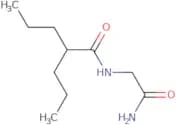
CAS :Valrocemide is an amide laxative that is used to treat bowel disease. It is a long-term drug that can be used in the treatment of inflammatory bowel disease, but it only has short-term efficacy. Valrocemide works by increasing water content in the colon and by stimulating nerve endings in the colon, causing contraction of the muscle cells and expelling contents. Valrocemide also reduces inflammation by inhibiting prostaglandin synthesis. The drug interactions with valproic acid, carbamazepine, and phenobarbital are not well understood. This medication may cause diarrhea, nausea, vomiting, abdominal pain, or headache. Valrocemide also causes allergic reactions in some patients.Formule :C10H20N2O2Degré de pureté :Min. 95%Masse moléculaire :200.28 g/mol1-(Benzylsulfanyl)propan-2-amine
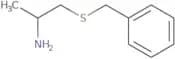
CAS :Versatile small molecule scaffoldFormule :C10H15NSDegré de pureté :Min. 95%Masse moléculaire :181.3 g/mol1-[2-(Methylsulfanyl)phenyl]propan-2-amine hydrochloride
CAS :Produit contrôléVersatile small molecule scaffoldFormule :C10H16ClNSDegré de pureté :Min. 95%Masse moléculaire :217.76 g/mol2-[4-(2-Oxo-1,3-oxazolidin-3-yl)phenyl]acetic acid
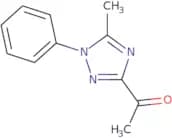
CAS :Versatile small molecule scaffoldFormule :C11H11NO4Degré de pureté :Min. 95%Masse moléculaire :221.21 g/mol1-(5-Methyl-1-phenyl-1H-1,2,4-triazol-3-yl)ethanone
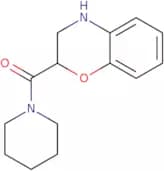
CAS :Versatile small molecule scaffoldFormule :C11H11N3ODegré de pureté :Min. 95%Masse moléculaire :201.22 g/mol2-(Piperidine-1-carbonyl)-3,4-dihydro-2H-1,4-benzoxazine
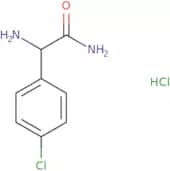
CAS :Versatile small molecule scaffoldFormule :C14H18N2O2Degré de pureté :Min. 95%Masse moléculaire :246.3 g/mol2-Amino-2-(4-chlorophenyl)acetamide hydrochloride
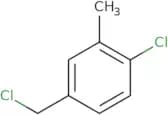
CAS :Versatile small molecule scaffoldFormule :C8H10Cl2N2ODegré de pureté :Min. 95%Masse moléculaire :221.08 g/mol1-chloro-4-(chloromethyl)-2-methylbenzene
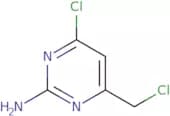
CAS :Versatile small molecule scaffoldFormule :C8H8Cl2Degré de pureté :Min. 95%Masse moléculaire :175.05 g/mol4-Chloro-6-(chloromethyl)pyrimidin-2-amine
CAS :Versatile small molecule scaffoldFormule :C5H5Cl2N3Degré de pureté :Min. 95%Masse moléculaire :178.02 g/mol

![1-[2-(Methylsulfanyl)phenyl]propan-2-amine hydrochloride](/_next/image/?url=https%3A%2Fstatic.cymitquimica.com%2Fproducts%2F3D%2Fthumb-webp%2FSDA28671.webp&w=3840&q=75)
![2-[4-(2-Oxo-1,3-oxazolidin-3-yl)phenyl]acetic acid](/_next/image/?url=https%3A%2Fstatic.cymitquimica.com%2Fproducts%2F3D%2Fthumb-webp%2FSDA28870.webp&w=3840&q=75)