Building Blocks
Cette section contient des produits fondamentaux pour la synthèse de composés organiques et biologiques. Building blocks sont les matériaux de départ essentiels utilisés pour construire des molécules complexes à travers diverses réactions chimiques. Ils jouent un rôle crucial dans la découverte de médicaments, la science des matériaux et la recherche chimique. Chez CymitQuimica, nous offrons une gamme diversifiée de building blocks de haute qualité pour soutenir vos recherches innovantes et projets industriels, en vous assurant de disposer des composants essentiels pour une synthèse réussie.
Sous-catégories appartenant à la catégorie "Building Blocks"
- Acides boroniques et dérivés de l'acide boronique(5.778 produits)
- Building Blocks Chiraux(1.243 produits)
- Building Blocks Hydrocarbonés(6.099 produits)
- Building Blocks organiques(61.038 produits)
205376 produits trouvés pour "Building Blocks"
Trier par
Degré de pureté (%)
0
100
|
0
|
50
|
90
|
95
|
100
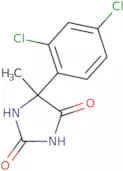
5-(2,4-Dichlorophenyl)-5-methylimidazolidine-2,4-dione
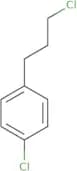
CAS :Versatile small molecule scaffoldFormule :C10H8Cl2N2O2Degré de pureté :Min. 95%Masse moléculaire :259.09 g/mol1-Chloro-3-(4-chlorophenyl)propane
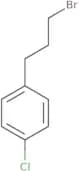
CAS :Versatile small molecule scaffoldFormule :C9H10Cl2Degré de pureté :Min. 95%Masse moléculaire :189.08 g/mol1-(3-Bromopropyl)-4-chlorobenzene
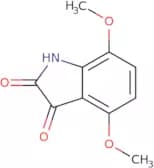
CAS :1-(3-Bromopropyl)-4-chlorobenzene is an expedited source of chlorine that is used in the oxidation of aromatic compounds. The chlorination of 1-(3-bromopropyl)-4-chlorobenzene occurs with a yield of about 98% and has high selectivity for the chlorination product. In a photoredox process, this compound can be used as an oxidant to produce an intermediate that can then be used in the oxidative chlorination reactions. This compound has been shown to have bioactivity and is used as a science catalyst.Formule :C9H10BrClDegré de pureté :Min. 95%Masse moléculaire :233.54 g/mol4,7-Dimethoxy-2,3-dihydro-1H-indole-2,3-dione
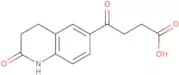
CAS :Versatile small molecule scaffoldFormule :C10H9NO4Degré de pureté :Min. 95%Masse moléculaire :207.18 g/mol4-Oxo-4-(2-oxo-1,2,3,4-tetrahydroquinolin-6-yl)butanoic acid
CAS :Versatile small molecule scaffoldFormule :C13H13NO4Degré de pureté :Min. 95%Masse moléculaire :247.25 g/molN-[(3-Chlorophenyl)methyl]-2-cyanoacetamide
CAS :Versatile small molecule scaffoldFormule :C10H9ClN2ODegré de pureté :Min. 95%Masse moléculaire :208.64 g/mol2-Cyano-N-[(3-methylphenyl)methyl]acetamide
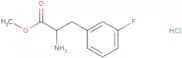
CAS :Versatile small molecule scaffoldFormule :C11H12N2ODegré de pureté :Min. 95%Masse moléculaire :188.23 g/molMethyl 2-amino-3-(3-fluorophenyl)propanoate hydrochloride
CAS :Versatile small molecule scaffold
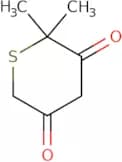
Formule :C10H13ClFNO2Degré de pureté :Min. 95%Masse moléculaire :233.67 g/mol2,2-Dimethylthiane-3,5-dione
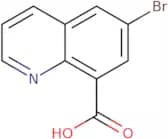
CAS :Versatile small molecule scaffoldFormule :C7H10O2SDegré de pureté :Min. 95%Masse moléculaire :158.22 g/mol6-bromoquinoline-8-carboxylic acid
CAS :Versatile small molecule scaffold
Formule :C10H6BrNO2Degré de pureté :Min. 95%Masse moléculaire :252.06 g/mol2-[(Cyclopropylcarbonyl)amino]acetic acid
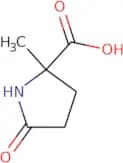
CAS :2-[(Cyclopropylcarbonyl)amino]acetic acid is a carboxylic acid that is used as an oral drug for the treatment of cardiac and renal diseases. It has been shown to be effective in the treatment of angiotensin-dependent hypertension and congestive heart failure. The therapeutic effects may be due to its ability to inhibit angiotensin-converting enzyme (ACE) and block the conversion of angiotensin I to angiotensin II, which causes vasoconstriction and increased blood pressure. 2-[(Cyclopropylcarbonyl)amino]acetic acid also inhibits phosphodiesterase, which may lead to improved cardiac function.Formule :C6H9NO3Degré de pureté :Min. 95%Masse moléculaire :143.14 g/mol2-Methyl-5-oxopyrrolidine-2-carboxylic acid
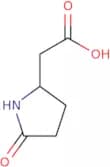
CAS :2-Methyl-5-oxopyrrolidine-2-carboxylic acid (2MOP) is a levulinic acid derivative with a carboxylic acid group on the side chain. It can be synthesized from levulinic acid, which is produced from the hydrolysis of cellulose. 2MOP is used as a plasticizer and an intermediate in the synthesis of esters such as methyl acetate and ethyl acetate. 2MOP has been found to have good compatibility with polyvinyl chloride, polystyrene, and polyolefins. This compound has been used to produce plastics that are flexible, tough, and resistant to heat degradation.Formule :C6H9NO3Degré de pureté :Min. 95%Masse moléculaire :143.14 g/mol5-Oxo-2-pyrrolidineacetic Acid
CAS :Versatile small molecule scaffold
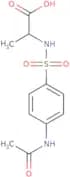
Formule :C6H9NO3Degré de pureté :Min. 95%Masse moléculaire :143.14 g/mol(2S)-2-(4-Acetamidobenzenesulfonamido)propanoic acid
CAS :Versatile small molecule scaffold
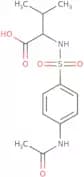
Formule :C11H14N2O5SDegré de pureté :Min. 95%Masse moléculaire :286.31 g/mol2-(4-Acetamidobenzenesulfonamido)-3-methylbutanoic acid
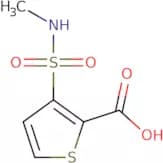
CAS :2-(4-Acetamidobenzenesulfonamido)-3-methylbutanoic acid is a disordered molecule that has an isopropanol group at the 4th carbon. The benzene ring and methyl groups are in the 2nd and 3rd positions, respectively. The orientation of the isopropyl group determines how the molecule folds. This molecule has hydrogen bonds between its N-H and C=O groups, as well as intramolecular hydrogen bonds along with coplanar dihedral angles. 2-(4-Acetamidobenzenesulfonamido)-3-methylbutanoic acid is used for research purposes to study benzene rings, methyl groups, and acetamide orientations.Formule :C13H18N2O5SDegré de pureté :Min. 95%Masse moléculaire :314.36 g/mol3-(Methylsulfamoyl)thiophene-2-carboxylic acid
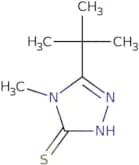
CAS :Versatile small molecule scaffoldFormule :C6H7NO4S2Degré de pureté :Min. 95%Masse moléculaire :221.3 g/mol5-tert-Butyl-4-methyl-4H-1,2,4-triazole-3-thiol
CAS :Versatile small molecule scaffoldFormule :C7H13N3SDegré de pureté :Min. 95%Masse moléculaire :171.27 g/mol4-Bromo-N-[2-(morpholin-4-yl)ethyl]benzamide
CAS :Versatile small molecule scaffoldFormule :C13H17BrN2O2Degré de pureté :Min. 95%Masse moléculaire :313.19 g/mol4-(Pyridin-4-ylsulfanyl)phenol
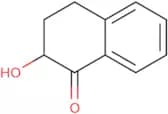
CAS :Versatile small molecule scaffoldFormule :C11H9NOSDegré de pureté :Min. 95%Masse moléculaire :203.26 g/mol2-Hydroxy-1,2,3,4-tetrahydronaphthalen-1-one
CAS :2-Hydroxy-1,2,3,4-tetrahydronaphthalen-1-one is a synthetic drug that binds to the opioid receptor and is used as an analgesic. It has been shown to have a strong affinity for opioid receptors in the central nervous system and intestine. 2-Hydroxy-1,2,3,4-tetrahydronaphthalen-1-one has been found to have an uptake of 40% in the brain and intestine. This drug also has a high affinity for opioid receptors in the brain and intestinal tissue and acts as a full agonist on these sites. 2-Hydroxy-1,2,3,4-tetrahydronaphthalen-1-one also has been found to be effective in treating Alzheimer's disease. This drug can be administered orally or intravenously.Formule :C10H10O2Degré de pureté :Min. 95%Masse moléculaire :162.18 g/mol

![N-[(3-Chlorophenyl)methyl]-2-cyanoacetamide](/_next/image/?url=https%3A%2Fstatic.cymitquimica.com%2Fproducts%2F3D%2Fthumb-webp%2FPCA48808.webp&w=3840&q=75)
![2-Cyano-N-[(3-methylphenyl)methyl]acetamide](/_next/image/?url=https%3A%2Fstatic.cymitquimica.com%2Fproducts%2F3D%2Fthumb-webp%2FPCA48811.webp&w=3840&q=75)
![2-[(Cyclopropylcarbonyl)amino]acetic acid](/_next/image/?url=https%3A%2Fstatic.cymitquimica.com%2Fproducts%2F3D%2Fthumb-webp%2FPCA51370.webp&w=3840&q=75)
![4-Bromo-N-[2-(morpholin-4-yl)ethyl]benzamide](/_next/image/?url=https%3A%2Fstatic.cymitquimica.com%2Fproducts%2F3D%2Fthumb-webp%2FPCA54419.webp&w=3840&q=75)