Alcools
Sous-catégories appartenant à la catégorie "Alcools"
5818 produits trouvés pour "Alcools"
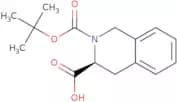
Boc-(3S)-1,2,3,4-Tetrahydroisoquinoline-3-carboxylic acid
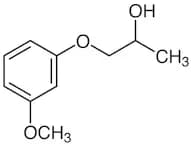
CAS :Boc-(3S)-1,2,3,4-Tetrahydroisoquinoline-3-carboxylic acid is an amino acid that has the δ-opioid receptor antagonist activity. It can be synthesized by a stepwise synthesis with an asymmetric center. The δ-opioid receptor antagonist activity of Boc-(3S)-1,2,3,4-Tetrahydroisoquinoline-3-carboxylic acid was found to be comparable to naloxone in terms of affinity constants and functional groups.Formule :C15H19NO4Degré de pureté :Min. 95%Couleur et forme :SolidMasse moléculaire :277.32 g/mol1-(3-Methoxyphenoxy)-2-propanol
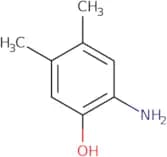
CAS :Formule :C10H14O3Degré de pureté :>90.0%(GC)Couleur et forme :Colorless to Light yellow to Light orange clear liquidMasse moléculaire :182.222-Amino-4,5-dimethylphenol
CAS :2-Amino-4,5-dimethylphenol is a compound that exhibits anticancer activity. It is an arylimine that has been shown to inhibit the proliferation of cancer cells in vitro and in vivo. The mechanism of action is not fully understood, but it is believed that 2-amino-4,5-dimethylphenol may act as a nucleophile in reverse Michael addition reactions with electrophiles. This compound also has been shown to be potent against some cancer cell lines and to induce apoptosis through caspase activation. 2-Amino-4,5-dimethylphenol interacts with aminophenols in vitro, forming supramolecular complexes that are cytotoxic to cancer cells.
Formule :C8H11NODegré de pureté :Min. 95%Couleur et forme :Brown SolidMasse moléculaire :137.18 g/mol2-(2,2-Diethoxyethyl)-1,3-propanediol
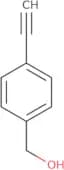
CAS :Formule :C9H20O4Degré de pureté :>88.0%(GC)Couleur et forme :Colorless to Light yellow clear liquidMasse moléculaire :192.264-Ethynylbenzyl alcohol
CAS :4-Ethynylbenzyl alcohol is an organic compound that has a molecular weight of 170.4 g/mol and a density of 1.1 g/cm3. It is synthesized by reacting acetophenone with sodium metal in the presence of ethanol and sodium ethoxide. The terminal alkyne groups are responsible for its high reactivity, which can be seen through its fluorescence properties. 4-Ethynylbenzyl alcohol has been shown to inhibit the growth of human liver cancer cells in vitro, making it a potential palliative treatment for liver cancer. This compound has also been shown to have reactive sites on its surface, which make it useful for surface modification techniques such as kinetic or imaging techniques. 4-Ethynylbenzyl alcohol has helical structure with hydrogen bonding interactions between adjacent molecules that stabilize the molecule's 3D structure.Formule :C9H8ODegré de pureté :Min. 95%Couleur et forme :White To Yellow To Brown SolidMasse moléculaire :132.16 g/mol8-Methoxycarbonyloctanol
CAS :8-Methoxycarbonyloctanol (8MCO) is a fatty acid molecule that has been shown to have significant inhibitory activities against Streptococcus pneumoniae in human serum. 8MCO is a synthetic molecule that can be synthesized from galactose and chloride. It has been found to have a molecular weight of 190.08 g/mol, melting point of -2°C, and boiling point of 217°C at 1 mmHg. 8MCO is soluble in water, methanol, and ethanol. This molecule can be used as an analytical tool for the detection of fatty acids by gas chromatography-mass spectrometry (GC-MS). It also exhibits enzymatic activity when incorporated into enzyme preparations such as esterases and lipases. 8MCO contains functional groups such as carbonyl (-CO), hydroxyl (-OH), carboxylic acid (-COOH), ether (-O-) and alcohol (-
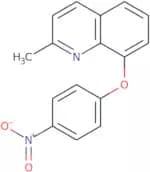
Formule :C10H20O3Degré de pureté :Min. 95%Couleur et forme :Clear LiquidMasse moléculaire :188.26 g/mol4-(2-methyl(8-quinolyloxy))-1-nitrobenzene
CAS :Please enquire for more information about 4-(2-methyl(8-quinolyloxy))-1-nitrobenzene including the price, delivery time and more detailed product information at the technical inquiry form on this page
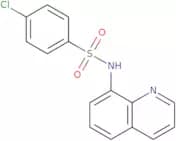
Degré de pureté :Min. 95%((4-Chlorophenyl)sulfonyl)-8-quinolylamine
CAS :Please enquire for more information about ((4-Chlorophenyl)sulfonyl)-8-quinolylamine including the price, delivery time and more detailed product information at the technical inquiry form on this pageFormule :C15H11ClN2O2SDegré de pureté :Min. 95%Couleur et forme :PowderMasse moléculaire :318.78 g/mol2-Chloro-1-(6-methyl(1,2,3,4-tetrahydroquinolyl))propan-1-one
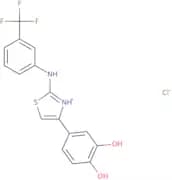
Please enquire for more information about 2-Chloro-1-(6-methyl(1,2,3,4-tetrahydroquinolyl))propan-1-one including the price, delivery time and more detailed product information at the technical inquiry form on this pageDegré de pureté :Min. 95%4-(4-((3-(trifluoromethyl)phenyl)amino)-3,5-thiazolyl)benzene-1,2-diol, hydrochloride
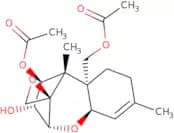
CAS :Please enquire for more information about 4-(4-((3-(trifluoromethyl)phenyl)amino)-3,5-thiazolyl)benzene-1,2-diol, hydrochloride including the price, delivery time and more detailed product information at the technical inquiry form on this pageFormule :C16H11F3N2O2S·ClHDegré de pureté :Min. 95%Couleur et forme :PowderMasse moléculaire :388.79 g/molDiacetoxyscirpenol
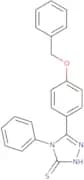
CAS :Produit contrôléDiacetoxyscirpenol is a mycotoxin that is found in wastewater and has been shown to have the ability to inhibit certain enzyme activities. It is a glucuronide conjugate that is excreted by humans, and can be detected in urine samples. The metabolite of Diacetoxyscirpenol, 4-hydroxy-2,3-dihydroxymethyl-5-(2H)-furanone (4OH-DMF), has been shown to induce antibody response in mice. The LC-MS/MS method for detecting Diacetoxyscirpenol uses a monoclonal antibody that recognizes the toxin. This antibody binds to the toxin and activates an enzyme cascade that leads to the production of a fluorescent dye. The intensity of fluorescence can be quantified using fluorometry or spectrophotometry. /nowiki>/pre>Formule :C19H26O7Degré de pureté :Min. 95%Masse moléculaire :366.41 g/mol4-phenyl-5-(4-(benzyloxy)phenyl)-1,2,4-triazole-3-thiol
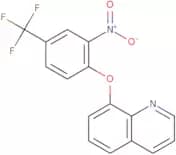
CAS :Please enquire for more information about 4-phenyl-5-(4-(benzyloxy)phenyl)-1,2,4-triazole-3-thiol including the price, delivery time and more detailed product information at the technical inquiry form on this pageFormule :C21H17N3OSDegré de pureté :Min. 95%Couleur et forme :PowderMasse moléculaire :359.44 g/mol2-Nitro-1-(8-quinolyloxy)-4-(trifluoromethyl)benzene
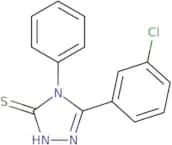
CAS :Please enquire for more information about 2-Nitro-1-(8-quinolyloxy)-4-(trifluoromethyl)benzene including the price, delivery time and more detailed product information at the technical inquiry form on this pageFormule :C16H9F3N2O3Degré de pureté :Min. 95%Couleur et forme :PowderMasse moléculaire :334.25 g/mol5-(3-Chlorophenyl)-4-phenyl-4H-1,2,4-triazole-3-thiol
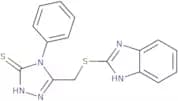
CAS :Please enquire for more information about 5-(3-Chlorophenyl)-4-phenyl-4H-1,2,4-triazole-3-thiol including the price, delivery time and more detailed product information at the technical inquiry form on this pageFormule :C14H10ClN3SDegré de pureté :Min. 95%Couleur et forme :PowderMasse moléculaire :287.77 g/mol5-(Benzimidazol-2-ylthiomethyl)-4-phenyl-1,2,4-triazole-3-thiol
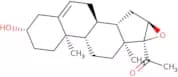
CAS :Please enquire for more information about 5-(Benzimidazol-2-ylthiomethyl)-4-phenyl-1,2,4-triazole-3-thiol including the price, delivery time and more detailed product information at the technical inquiry form on this pageFormule :C16H13N5S2Degré de pureté :Min. 95%Couleur et forme :PowderMasse moléculaire :339.44 g/mol16α,17α-Epoxypregnenolone
CAS :16alpha,17alpha-Epoxypregnenolone is a synthetic insect odorant that binds to the odorant binding protein (OBP) and has been used in research to investigate the relationship between odorant binding and olfaction. The OBPs are thought to play an important role in the detection of odors by binding to specific odorants, which then initiate a sensory response. 16alpha,17alpha-Epoxypregnenolone has also been shown to bind with recombinant OBP and have fluorescence properties, making it useful for biosensors. This compound may be useful as an experimental or research tool for investigating olfactory receptors in insects or other organisms.
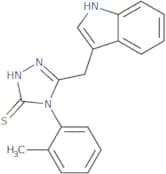
Formule :C21H30O3Degré de pureté :Min. 95%Masse moléculaire :330.47 g/mol5-(indol-3-ylmethyl)-4-(2-methylphenyl)-1,2,4-triazole-3-thiol
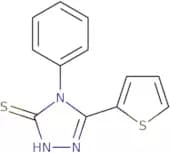
CAS :Please enquire for more information about 5-(indol-3-ylmethyl)-4-(2-methylphenyl)-1,2,4-triazole-3-thiol including the price, delivery time and more detailed product information at the technical inquiry form on this pageFormule :C18H16N4SDegré de pureté :Min. 95%Couleur et forme :PowderMasse moléculaire :320.41 g/mol4-Phenyl-5-(2-thienyl)-4H-1,2,4-triazole-3-thiol
CAS :Please enquire for more information about 4-Phenyl-5-(2-thienyl)-4H-1,2,4-triazole-3-thiol including the price, delivery time and more detailed product information at the technical inquiry form on this pageFormule :C12H9N3S2Degré de pureté :Min. 95%Couleur et forme :PowderMasse moléculaire :259.35 g/molEthyl 4-oxo-7-(benzyloxy)hydroquinoline-3-carboxylate
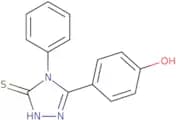
CAS :Please enquire for more information about Ethyl 4-oxo-7-(benzyloxy)hydroquinoline-3-carboxylate including the price, delivery time and more detailed product information at the technical inquiry form on this pageDegré de pureté :Min. 95%4-(5-Phenyl-4-thioxo-2,3,5-triazolinyl)phenol
CAS :Please enquire for more information about 4-(5-Phenyl-4-thioxo-2,3,5-triazolinyl)phenol including the price, delivery time and more detailed product information at the technical inquiry form on this pageFormule :C14H11N3OSDegré de pureté :Min. 95%Couleur et forme :PowderMasse moléculaire :269.32 g/mol