Cyano-, Nitrile-
9687 produits trouvés pour "Cyano-, Nitrile-"
4-Hydroxycyclohexanecarbonitrile
CAS :Formule :C7H11NODegré de pureté :97%Couleur et forme :Liquid, OilMasse moléculaire :125.1716-Bromo-1H-pyrrolo[3,2-b]pyridine-3-carbonitrile
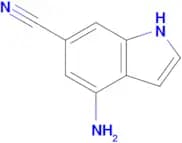
CAS :Formule :C8H4BrN3Degré de pureté :97%Couleur et forme :SolidMasse moléculaire :222.0454-Amino-1H-indole-6-carbonitrile
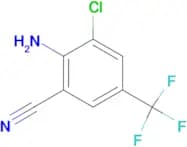
CAS :Formule :C9H7N3Degré de pureté :98%Couleur et forme :SolidMasse moléculaire :157.1762-Amino-3-chloro-5-trifluoromethyl-benzonitrile
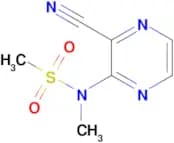
CAS :Formule :C8H4ClF3N2Degré de pureté :98%Masse moléculaire :220.58N-(3-cyanopyrazin-2-yl)-N-methylmethanesulfonamide
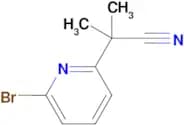
CAS :Degré de pureté :98%Masse moléculaire :212.22999572-(6-Bromopyridin-2-yl)-2-methylpropanenitrile
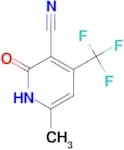
CAS :Degré de pureté :98%Masse moléculaire :225.08900456-METHYL-2-OXO-4-(TRIFLUOROMETHYL)-1,2-DIHYDROPYRIDINE-3-CARBONITRILE
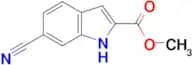
CAS :Degré de pureté :98%Masse moléculaire :202.1360016Methyl 6-cyano-1H-indole-2-carboxylate
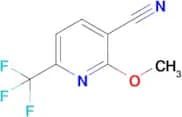
CAS :Formule :C11H8N2O2Degré de pureté :97%Couleur et forme :SolidMasse moléculaire :200.1972-Methoxy-6-(trifluoromethyl)pyridine-3-carbonitrile
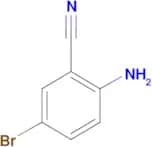
CAS :Degré de pureté :95%Masse moléculaire :202.13600162-Amino-5-bromobenzonitrile
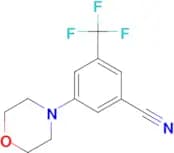
CAS :Formule :C7H5BrN2Degré de pureté :95%Couleur et forme :SolidMasse moléculaire :197.0353-Morpholino-5-(trifluoromethyl)benzonitrile
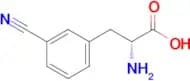
CAS :Formule :C12H11F3N2ODegré de pureté :98%Masse moléculaire :256.228(R)-2-Amino-3-(3-cyanophenyl)propanoic acid
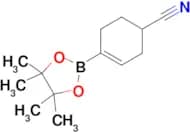
CAS :Formule :C10H10N2O2Degré de pureté :97%Couleur et forme :SolidMasse moléculaire :190.2024-(4,4,5,5-Tetramethyl-1,3,2-dioxaborolan-2-yl)cyclohex-3-enecarbonitrile
CAS :Formule :C13H20BNO2Degré de pureté :97%Couleur et forme :SolidMasse moléculaire :233.12Methyl 3-cyano-1H-indole-7-carboxylate
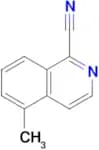
CAS :Formule :C11H8N2O2Degré de pureté :98%Couleur et forme :SolidMasse moléculaire :200.1975-Methylisoquinoline-1-carbonitrile
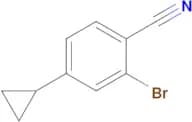
CAS :Formule :C11H8N2Degré de pureté :97%Masse moléculaire :168.1992-Bromo-4-cyclopropylbenzonitrile
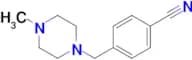
CAS :Formule :C10H8BrNDegré de pureté :97.0%Couleur et forme :LiquidMasse moléculaire :222.0854-((4-Methylpiperazin-1-yl)methyl)benzonitrile
CAS :Formule :C13H17N3Degré de pureté :97%Masse moléculaire :215.32-Cyanophenylacetonitrile
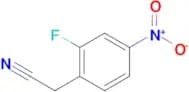
CAS :Formule :C9H6N2Degré de pureté :95%Couleur et forme :SolidMasse moléculaire :142.1612-(2-Fluoro-4-nitrophenyl)acetonitrile
CAS :Formule :C8H5FN2O2Degré de pureté :95%Couleur et forme :SolidMasse moléculaire :180.1382,2-Bis((3aS,8aR)-8,8a-dihydro-3aH-indeno[1,2-d]oxazol-2-yl)acetonitrile
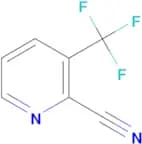
CAS :Degré de pureté :98%Masse moléculaire :355.39700323-(Trifluoromethyl)picolinonitrile
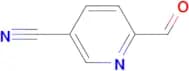
CAS :Formule :C7H3F3N2Degré de pureté :97%Couleur et forme :LiquidMasse moléculaire :172.116-Formylnicotinonitrile
CAS :Formule :C7H4N2ODegré de pureté :95%Couleur et forme :SolidMasse moléculaire :132.122Imidazo[1,2-a]pyridine-3-carbonitrile
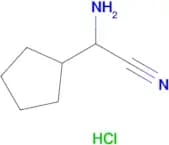
CAS :Formule :C8H5N3Degré de pureté :98%Couleur et forme :SolidMasse moléculaire :143.1492-Amino-2-cyclopentylacetonitrile hydrochloride
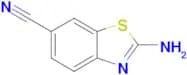
CAS :Degré de pureté :97%Masse moléculaire :160.64999392-Aminobenzothiazole-6-carbonitrile
CAS :Formule :C8H5N3SDegré de pureté :96%Couleur et forme :SolidMasse moléculaire :175.212-Cyano-N-((furan-2-ylmethyl)carbamoyl)acetamide
CAS :Produit contrôléApplications 2-Cyano-N-((furan-2-ylmethyl)carbamoyl)acetamide is an intermediate in the synthesis of novel 1- and 8-substituted-3-furfuryl xanthines as adenosine receptor antagonists.
References Balo, M. C., et al.: Bioorg. Med. Chem., 17, 6755 (2009);Formule :C7H14O6·C3H8OCouleur et forme :NeatMasse moléculaire :254.278Diethyl (2-cyanoethyl)phosphonate
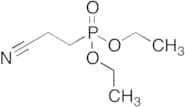
CAS :Produit contrôléApplications Diethyl (2-cyanoethyl)phosphonate, is a useful reactant used in various chemical synthesis such as in synthesis of lipophilic oxoamides with activity against phospholipase A2, Triose phosphate isomerase of muscle inhibitors, and also in base-catalyzed stereospecific anti-Markovnikov addition.
Formule :C7H14NO3PCouleur et forme :NeatMasse moléculaire :191.16N-(3-Chloro-4-fluorophenyl)-2-cyanoacetamide
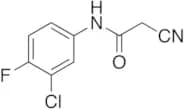
CAS :Produit contrôléApplications N-(3-Chloro-4-fluorophenyl)-2-cyanoacetamide (cas# 219529-31-4) is a compound useful in organic synthesis.
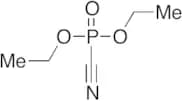
Formule :C9H6ClFN2OCouleur et forme :NeatMasse moléculaire :212.61Diethyl Cyanophosphonate
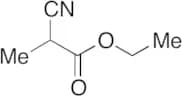
CAS :Produit contrôléFormule :C5H10NO3PCouleur et forme :NeatMasse moléculaire :163.11Ethyl 2-Cyanopropanoate
CAS :Produit contrôléApplications Ethyl 2-Cyanopropanoate is a building block used in many organic reactions such as the preparation of highly substituted benzenes.
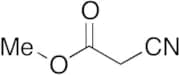
References Zhang, X., et. al.: Organic Lett., 13, 5024 (2011)Formule :C21H26N2OCouleur et forme :NeatMasse moléculaire :322.444Methyl Cyanoacetate
CAS :Produit contrôléApplications Methyl Cyanoacetate is often used as a nucleophile in the electrochemical oxidation of catechols. Methyl Cyanoacetate is also a reagent in the synthesis of Methyl 2-Amino-4-trifluoromethylthiophene-3-carboxylate (M287290); a compound used in the synthesis of DPP-IV inhibitors for treating type 2 diabetes.
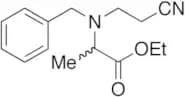
References Rafiee, M., et al.: J. Electroanal. Chem., 626, 36 (2009); Deng, J., et al.: Eur. J. Med. Chem., 46, 71 (2010)Formule :C4H5NO2Couleur et forme :NeatMasse moléculaire :99.09N-(beta-Cyanoethyl)-N-(ethoxycarbonylethyl)benzylamine
CAS :Produit contrôléApplications N-(β-Cyanoethyl)-N-(ethoxycarbonylethyl)benzylamine is a compound useful in organic synthesis.
Not a dangerous good if item is equal to or less than 1g/ml and there is less than 100g/ml in the packageFormule :C15H20N2O2Couleur et forme :NeatMasse moléculaire :260.33Methyl Cyanoformate
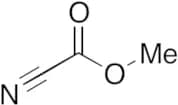
CAS :Produit contrôléApplications Methyl cyanoformate is a reagent that is used in the preparation of XEN907, which is a spiro-oxindole blocker of Nav1.7 for the treatment of pain.
Not a dangerous good if item is equal to or less than 1g/ml and there is less than 100g/ml in the package
References Chowdhury, S., et al.: Bioorg. Med. Chem. Lett., 21, 3676 (2011);Formule :C3H3NO2Couleur et forme :NeatMasse moléculaire :85.06Ethyl Cyanoformate
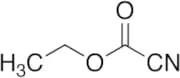
CAS :Produit contrôléApplications Ethyl Cyanoformate (cas# 623-49-4) is a compound useful in organic synthesis.
Formule :C4H5NO2Couleur et forme :NeatMasse moléculaire :99.094-Butoxyphthalonitrile
CAS :Formule :C12H12N2ODegré de pureté :>96.0%(GC)Couleur et forme :White to Light yellow powder to crystalMasse moléculaire :200.242-Cyanopyridine
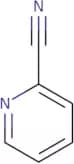
CAS :2-Cyanopyridine is a chelate ligand that is structurally related to picolinic acid. It binds to the active site of IDO1 and prevents the enzyme from converting tryptophan into kynurenine. This leads to an increase in tryptophan levels, which can then be used for protein synthesis. 2-Cyanopyridine has been shown to have antimicrobial activity against Gram-positive bacteria in vitro and in vivo. It also inhibits the growth of Gram-negative bacteria, yeast, and fungi by binding to the iron atom of their heme molecules. 2-Cyanopyridine has shown potential as a pharmacological agent or as a biochemical probe for transfer reactions.
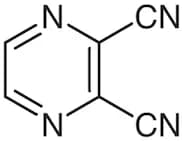
Formule :C6H4N2Degré de pureté :Min. 95%Couleur et forme :PowderMasse moléculaire :104.11 g/mol2,3-Dicyanopyrazine
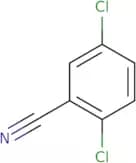
CAS :Formule :C6H2N4Degré de pureté :>99.0%(GC)Couleur et forme :White to Light yellow to Light orange powder to crystalMasse moléculaire :130.112,5-Dichlorobenzonitrile
CAS :2,5-Dichlorobenzonitrile is a chemical compound that contains a nitrile group. It is used as an intermediate in organic synthesis, as well as for the production of various pharmaceuticals and pesticides. 2,5-Dichlorobenzonitrile is oxidized to form 2,5-dichlorophenol which can be further converted to 2,5-dichloroquinone. This redox cycle is reversible and can be used to synthesize other compounds. The reaction time of this process is about one hour at room temperature. Maleate has been shown to inhibit the hepatic metabolism of 2,5-Dichlorobenzonitrile. This may lead to accumulation of 2,5-Dichlorobenzonitrile in the liver and potentially cause hepatitis or even liver cancer. Chloromethylation of 2,5-Dichlorobenzonitrile leads to the formation of chlor
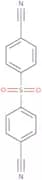
Formule :C7H3Cl2NDegré de pureté :Min. 95%Couleur et forme :PowderMasse moléculaire :172.01 g/mol4,4'-Dicyanodiphenylsulphone
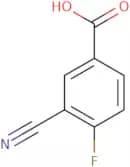
CAS :Dicyanodiphenylsulphone is an inhibitory agent that prevents the HIV-2 virus from entering cells. It binds to the viral envelope, forming a sealant that blocks the virus from entering the cell and infecting it. Dicyanodiphenylsulfone also has immunosuppressive properties, but can be used in conjunction with sulfa drugs and polysulfides to prevent the development of bacterial resistance. The efficacy of dicyanodiphenylsulfone has been demonstrated in cellular assays and in human immunodeficiency virus (HIV) infected patients. This drug is not active against other types of viruses, such as herpes simplex, influenza A, or cytomegalovirus.Formule :C14H8N2O2SDegré de pureté :Min. 95%Masse moléculaire :268.29 g/mol3-Cyano-4-fluorobenzoic acid
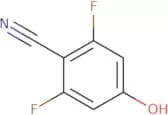
CAS :3-Cyano-4-fluorobenzoic acid is a fluorinated analog of 3-cyano-4-fluorobenzoic acid, which has been shown to be effective in the treatment of prostate cancer. It is a prodrug that is metabolized by activated esterases to release the active form. The 18F radiolabeled form of 3-Cyano-4-fluorobenzoic acid has a high affinity for prostate carcinoma cells and has been used as a diagnostic agent. This drug also has an excellent pharmacokinetic profile and can be used as a nonradioactive tracer for imaging tumor cells in vivo.Formule :C8H4FNO2Degré de pureté :Min. 95%Couleur et forme :White To Off-White SolidMasse moléculaire :165.12 g/mol4-Cyano-3,5-difluorophenol
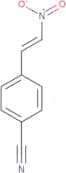
CAS :4-Cyano-3,5-difluorophenol (4CF) is a mesomorphic compound that has a number of reactions with chloride. 4CF is synthesized from 3,5-difluoroaniline and the reaction product is then heated with chlorine to produce 4CF. The optimal reaction temperature is between 100°C and 120°C. When exposed to light, 4CF will react with chloride ions in the presence of heat to form a hydrophobic chlorinated product. This product reacts with proton donors such as NaOH or KOH to produce hydrogen gas. At room temperature, 4CF can be used as a gas sensor.Formule :C7H3F2NODegré de pureté :Min. 95 Area-%Masse moléculaire :155.1 g/mol1-(4-Cyanophenyl)-2-nitroethene
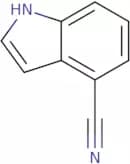
CAS :1-(4-Cyanophenyl)-2-nitroethene is a reactive intermediate that belongs to the group of carboxylic acids. It is an unsaturated compound with a cinnamic acid derivative. The nitration of 1-(4-cyanophenyl)-2-nitroethene leads to the formation of 1,2-dinitrobenzene, which can be used for the synthesis of other heterocyclic compounds. This intermediate has been shown to have catalytic activity in biomolecules, including carboxylic and phenolic groups, and can be used for the synthesis of other organic compounds.Formule :C9H6N2O2Degré de pureté :Min. 95%Masse moléculaire :174.16 g/mol4-Cyanoindole
CAS :The 4-cyanoindole is a fluorescent molecule that binds to proteins and affects protein homeostasis. It has been shown to bind to the sodium salt form of proteins, which are typically found in human liver cells. The binding of 4-cyanoindole to these proteins leads to its reduction by borohydride and fluorescence resonance energy transfer (FRET) between the molecule and the protein. This binding can be detected using a fluorescence lifetime spectroscopy technique, which detects changes in the fluorescence's lifetime as well as intensity. The binding of 4-cyanoindole to proteins has been shown to have anti-cancer properties. It has also been used for detection of monoclonal antibodies against cancer cells or for fluorescent labeling of cancer cells for immunofluorescent microscopy.Formule :C9H6N2Couleur et forme :White PowderMasse moléculaire :142.16 g/mol


![6-Bromo-1H-pyrrolo[3,2-b]pyridine-3-carbonitrile](/_next/image/?url=https%3A%2Fstatic.cymitquimica.com%2Fproducts%2F10%2Fthumb-webp%2FF221478.webp&w=3840&q=75)


![2,2-Bis((3aS,8aR)-8,8a-dihydro-3aH-indeno[1,2-d]oxazol-2-yl)acetonitrile](/_next/image/?url=https%3A%2Fstatic.cymitquimica.com%2Fproducts%2F10%2Fthumb-webp%2FF864771.webp&w=3840&q=75)
![Imidazo[1,2-a]pyridine-3-carbonitrile](/_next/image/?url=https%3A%2Fstatic.cymitquimica.com%2Fproducts%2F10%2Fthumb-webp%2FF046107.webp&w=3840&q=75)