Amides
Les amides sont une vaste gamme de composés chimiques qui contiennent au moins un anneau hétérocyclique, lequel possède des atomes d'au moins deux éléments différents dans la structure de l'anneau, et au moins un groupe amide (-CONH2). Ces composés sont cruciaux dans la synthèse de produits pharmaceutiques, de polymères et d'agrochimiques. Les amides présentent des propriétés et une réactivité uniques, ce qui en fait des intermédiaires précieux dans la synthèse organique. Chez CymitQuimica, nous proposons une sélection complète d'amides de haute qualité pour soutenir vos besoins en recherche et en applications industrielles.
16485 produits trouvés pour "Amides"
Trier par
Degré de pureté (%)
0
100
|
0
|
50
|
90
|
95
|
100
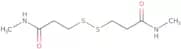
N,N'-Dimethyl-3,3'-dithiodipropionamide
CAS :<p>N,N'-Dimethyl-3,3'-dithiodipropionamide (DTDPA) is a strong oxidizing agent that is used as a catalyst in organic synthesis. It can be used to convert xylene and benzene into products that are less toxic and more easily removed from the environment. DTDPA can also be used to remove 2-methyl-4-isothiazolin-3-one, chloroform, and other pollutants from water. DTDPA has been shown to react with hydrogen peroxide or hydrochloric acid to produce oxygen gas and chlorine, which is an effective disinfectant against bacteria such as Staphylococcus aureus or Pseudomonas aeruginosa. This chemical also reacts with toluene or chloroform to produce peroxides which have been shown to have an anti-inflammatory effect on cells.</p>Formule :C8H16N2O2S2Degré de pureté :(Q-1H Nmr) Min 95%Couleur et forme :White/Off-White SolidMasse moléculaire :236.36 g/molN-[1-[2-(4-Ethyl-5-Oxotetrazol-1-Yl)Ethyl]-4-Phenylpiperidin-4-Yl]-N-(2-Fluorophenyl)Propanamide
CAS :Produit contrôlé<p>N-[1-[2-(4-Ethyl-5-Oxotetrazol-1-Yl)Ethyl]-4-Phenylpiperidin-4-Yl]-N-(2-Fluorophenyl)Propanamide is a drug that is used clinically for the treatment of depression. It is an analog of amitriptyline, an antidepressant and a tricyclic compound. N-[1-[2-(4-Ethyl-5-Oxotetrazol-1-Yl)Ethyl]-4-Phenylpiperidin-4-Yl]-N-(2-Fluorophenyl)Propanamide has been shown to increase the concentration of plasma drug levels by increasing transporter gene expression in muscle tissue. This drug also has clinical pharmacology and thermal expansion properties.</p>Formule :C25H31FN6O2Degré de pureté :Min. 95%Masse moléculaire :466.55 g/mol3-Hydroxybenzamide
CAS :3-Hydroxybenzamide is a potent inhibitor of the enzyme synthetase and has been shown to inhibit the synthesis of adenosine diphosphate (ADP) ribose. It has been shown to have potent inhibitory activity against the enzyme in both solid and liquid phases. 3-Hydroxybenzamide binds to the carbonyl group of ADP ribose, which prevents it from binding to ATP. This inhibition of the synthesis of nucleotides limits cell proliferation by preventing DNA replication and protein synthesis. 3-Hydroxybenzamide has also been shown to inhibit the growth of mouse leukemia cells in vitro, as well as inhibiting l1210 murine leukemia cells grown in vivo. The mechanism for this inhibition is not yet known, but may be due to its ability to bind with hydrogen bonds or intramolecular hydrogen bonds. 3-Hydroxybenzamide also has a skeleton that can be synthesized asymmetrically by using a chiralFormule :C7H7NO2Degré de pureté :Min. 95%Couleur et forme :PowderMasse moléculaire :137.14 g/mol2-Hydroxysalicylamide
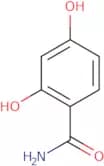
CAS :<p>2-Hydroxysalicylamide is a low-energy, small molecule that has shown to be an effective inhibitor of serine proteases. It binds to the active site of the protease, blocking catalysis and inhibiting the growth of cancer cells. 2-Hydroxysalicylamide has been shown to inhibit the transcriptional regulation of pro-inflammatory genes in a patterning assay and it inhibits tumor growth in a pain model. This drug also suppresses the expression of suppressor genes and can be used as an analgesic without causing side effects.<br>2-Hydroxysalicylamide is also a polarizer for tissues, meaning that it preferentially accumulates in tissues with high water content such as breast tissue. This property has been shown to be useful for imaging cancerous tumors.</p>Formule :C7H7NO3Degré de pureté :Min. 95%Couleur et forme :PowderMasse moléculaire :153.14 g/molPantethine
CAS :Pantethine is a dietary supplement, which is a derivative of pantothenic acid, sourced from vitamin B5. As a biologically active compound, it undergoes conversion to pantetheine, which then forms coenzyme A (CoA) and acyl-carrier proteins. This conversion is critical, as CoA is an essential cofactor involved in numerous biochemical reactions that are integral to fatty acid metabolism, among other processes.Formule :C22H42N4O8S2Degré de pureté :Min. 95%Couleur et forme :PowderMasse moléculaire :554.72 g/mol2-[Ethyl-[2-(3-hydroxy-2,6-dimethyl-anilino)-2-oxo-ethyl]amino]-N-(3-hydroxy-2,6-dimethyl-phenyl)acetamide
CAS :<p>2-[Ethyl-[2-(3-hydroxy-2,6-dimethyl-anilino)-2-oxo-ethyl]amino]-N-(3-hydroxy-2,6-dimethylphenyl)acetamide is a reaction component that is used in the synthesis of complex compounds. It is a versatile building block and useful intermediate for the synthesis of fine chemicals. This chemical has been shown to be an effective reagent for the preparation of high quality research chemicals. CAS No. 2200280-96-0</p>Formule :C22H29N3O4Degré de pureté :Min. 95%Couleur et forme :White to off-white solid.Masse moléculaire :399.48 g/mol1-Methyl-1,4-dihydronicotinamide
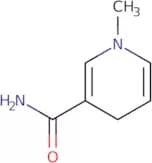
CAS :1-Methyl-1,4-dihydronicotinamide (1MDNA) is a flavine adenine dinucleotide analog that has been shown to be a potent inhibitor of the enzyme catalase. 1MDNA binds to the active site of the enzyme and prevents hydrogen peroxide from being converted into water and oxygen. This inhibition slows down or stops the reaction, which leads to reduced production of reactive oxygen species. 1MDNA inhibits other enzymes in a similar manner, including transferases and kinases. The kinetic properties of 1MDNA have been studied by performing kinetic studies on model systems at different temperatures. X-ray crystal structures have also been obtained for 1MDNA bound to catalase and ferredoxin.Formule :C7H10N2ODegré de pureté :Min. 95%Couleur et forme :PowderMasse moléculaire :138.17 g/molDorzolamide hydrochloride
CAS :Carbonic anhydrase inhibitor; anti-glaucoma agentFormule :C10H16N2O4S3•HClDegré de pureté :Min. 95%Couleur et forme :PowderMasse moléculaire :360.9 g/molL-Alaninamide
CAS :<p>L-Alaninamide is a protonated amino acid that reacts with the bacterial cell membrane and causes it to rupture. L-Alaninamide is synthesized by hydrolysis of the ester bond between butyric acid and serine protease in the presence of immobilized d-alanine. The reaction is carried out at a pH of 5.5, and the release of pressor is observed. This reaction takes place in an aqueous solution containing fatty acids as solvents. The type strain of this amino acid is E. coli.</p>Formule :C3H8N2ODegré de pureté :Min. 95%Couleur et forme :PowderMasse moléculaire :88.11 g/molN,N-Dimethylmorpholine-4-carboxamide
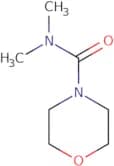
CAS :<p>Dimethylmorpholine-4-carboxamide (DMMC) is an unsymmetrical, synthetic carbamate that has antiviral properties. The antiviral properties of DMMC are due to its ability to inhibit the synthesis of viral proteins by binding to a site on the enzyme RNA polymerase and blocking the formation of a functional enzyme. This agent also has been shown to inhibit the production of nitric oxide in k562 cells. DMMC is marketed for use as an insecticide, but it has not been approved for this use. In crystallography studies, DMMC was found to have high yield and low melting point.</p>Formule :C7H14N2O2Degré de pureté :Min. 95%Couleur et forme :Colorless PowderMasse moléculaire :158.2 g/molAcetazolamide
CAS :Produit contrôlé<p>Inhibits carbonic anhydrase; diuretic</p>Formule :C4H6N4O3S2Degré de pureté :98.00 To 102.00%Couleur et forme :White PowderMasse moléculaire :222.25 g/molC2 dihydroceramide
CAS :C2 dihydroceramide is a lipid that belongs to the group of sphingolipids and is involved in neuronal death. It is a precursor for ceramide, which can also induce apoptosis. C2 dihydroceramide has been shown to inhibit axonal growth by interfering with the polymerase chain reaction, as well as inducing autophagy through toll-like receptor 4 signaling. This lipid has also been shown to inhibit intracellular Ca2+ levels, mitochondrial functions, and bowel disease. C2 dihydroceramide was identified in HL-60 cells and may be used as an analytical method for detecting other sphingolipids.Formule :C20H41NO3Degré de pureté :Min. 95%Couleur et forme :White PowderMasse moléculaire :343.54 g/molDeacetamide linezolid phthalimide
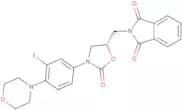
CAS :<p>Deacetamide linezolid phthalimide is a chemical compound that is used as an intermediate in the synthesis of a variety of pharmaceuticals. It has been shown to be useful for the production of a number of compounds, including antibiotics, anti-inflammatory agents, and anticancer drugs. The substance has been shown to be effective in the treatment of bacterial infections and was first discovered in research chemicals. This compound also has a high quality and is used as a reagent for chemical reactions.</p>Formule :C22H20FN3O5Degré de pureté :Min. 95%Couleur et forme :Slightly Yellow PowderMasse moléculaire :425.41 g/mol3,4-Dichlorobenzamide
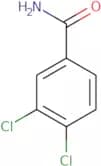
CAS :<p>3,4-Dichlorobenzamide is a synthetic opioid analgesic that binds to the μ-opioid receptor. It has a side-effect profile that is similar to other opioids, with an addiction risk and potential for abuse. 3,4-Dichlorobenzamide has been used in the synthesis of new drugs, such as phenazepam (a benzodiazepine) and etizolam (a thienodiazepine). This drug is chiral and can be synthesized in two stereoisomeric forms: 3-(+)-chloro-N-(2-chlorophenyl)benzamide and 3-(−)-chloro-N-(2-chlorophenyl)benzamide. The former form is marketed under the trade name Analgin, while the latter form is marketed under the trade name Etilex. The (+) form of this drug has a higher affinity for μ receptors than the (−) form.</p>Formule :C7H5Cl2NODegré de pureté :Min. 95%Masse moléculaire :190.03 g/molFlutamide
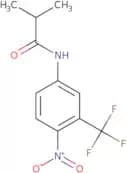
CAS :<p>Non-steroidal androgen receptor antagonist</p>Formule :C11H11F3N2O3Degré de pureté :Min. 95%Couleur et forme :Off-White PowderMasse moléculaire :276.21 g/molN-Dechloroethyl cyclophosphamide
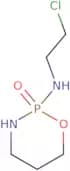
CAS :<p>N-Dechloroethyl cyclophosphamide is a metabolic inhibitor that is used in the treatment of cancer. It is classified as an alkylating agent and inhibits ribonucleotide reductase, which prevents the production of DNA, RNA, and protein. The chemical ionization technique has been used to measure the concentration of this compound in human liver and urine samples. N-Dechloroethyl cyclophosphamide can be analyzed using chromatography or mass spectrometry methods.</p>Formule :C5H12ClN2O2PDegré de pureté :Min. 95%Couleur et forme :PowderMasse moléculaire :198.59 g/mol(3-(2,6-dichlorophenyl)-5-methylisoxazol-4-yl)-N-(2-indol-3-ylethyl)formamide
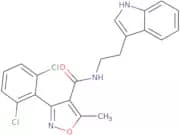
CAS :Please enquire for more information about (3-(2,6-dichlorophenyl)-5-methylisoxazol-4-yl)-N-(2-indol-3-ylethyl)formamide including the price, delivery time and more detailed product information at the technical inquiry form on this pageDegré de pureté :Min. 95%N-[4-(2-Hydrazino-2-oxoethoxy)phenyl]acetamide
CAS :<p>N-[4-(2-Hydrazino-2-oxoethoxy)phenyl]acetamide is a phenolic compound that has been shown to have an antimicrobial effect. It has been shown to have antitubercular activity against Mycobacterium tuberculosis and the ability to inhibit the growth of cancer cells in vitro. N-[4-(2-Hydrazino-2-oxoethoxy)phenyl]acetamide is also known as monastrol. The pharmacophore of this drug is based on the structure of paracetamol, which is a member of the class of drugs known as analgesics, antipyretics, and antiinflammatory agents. Paracetamol has been used for decades in humans and animals for relief from pain, fever, and inflammation. N-[4-(2-Hydrazino-2-oxoethoxy)phenyl]acetamide may be useful for treating diseases such as cancer or tuberculosis due to its antic</p>Formule :C10H13N3O3Degré de pureté :Min. 95%Couleur et forme :PowderMasse moléculaire :223.23 g/molN-α-[2,4-Dinitro-5-fluorophenyl]-L-valine amide
CAS :N-alpha-[2,4-Dinitro-5-fluorophenyl]-L-valine amide is an acidic amino acid that is used as a reagent in organic synthesis. It has been shown to have amide and hydrogen bond properties. This compound has been shown to be involved in the biosynthesis of carboxylic acids and primary amino acids. It also absorbs UV light at 265 nm and can be used for determination of uv absorption using high performance liquid chromatography (HPLC).Formule :C11H13N4O5FDegré de pureté :Min. 95%Couleur et forme :Yellow PowderMasse moléculaire :300.24 g/mol2-Amino-4-chlorobenzamide
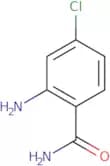
CAS :<p>2-Amino-4-chlorobenzamide is a chemical compound that has been shown to be an effective oxidant in biological systems. It is an oxidative condensation product of 4-chloro-2-nitrobenzoic acid and ammonium chloride, which is formed by the reaction of these two compounds at room temperature. The nature of the functional group on 2-amino-4-chlorobenzamide allows it to be used as a transition state analogue for the study of reactions involving amines and nitrates. This compound can also be used in experiments with isatins, due to its ability to react with ammonia hydroxide to form 2-amino-4,6 dichlorobenzamide.</p>Formule :C7H7ClN2ODegré de pureté :Min. 95%Couleur et forme :PowderMasse moléculaire :170.6 g/mol

![N-[1-[2-(4-Ethyl-5-Oxotetrazol-1-Yl)Ethyl]-4-Phenylpiperidin-4-Yl]-N-(2-Fluorophenyl)Propanamide](/_next/image/?url=https%3A%2Fstatic.cymitquimica.com%2Fproducts%2F3D%2Fthumb-webp%2FFE102162.webp&w=3840&q=75)


![2-[Ethyl-[2-(3-hydroxy-2,6-dimethyl-anilino)-2-oxo-ethyl]amino]-N-(3-hydroxy-2,6-dimethyl-phenyl)a…](/_next/image/?url=https%3A%2Fstatic.cymitquimica.com%2Fproducts%2F3D%2Fthumb-webp%2FFE145458.webp&w=3840&q=75)




![N-[4-(2-Hydrazino-2-oxoethoxy)phenyl]acetamide](/_next/image/?url=https%3A%2Fstatic.cymitquimica.com%2Fproducts%2F3D%2Fthumb-webp%2FFH131261.webp&w=3840&q=75)
![N-α-[2,4-Dinitro-5-fluorophenyl]-L-valine amide](/_next/image/?url=https%3A%2Fstatic.cymitquimica.com%2Fproducts%2F3D%2Fthumb-webp%2FFD48428.webp&w=3840&q=75)