


Acides carboxyliques
Les acides carboxyliques sont des molécules organiques caractérisées par un groupe fonctionnel de type carboxyle (-COOH). Ces acides sont fondamentaux dans diverses réactions chimiques, y compris l'estérification, l'amidation et la décarboxylation. Les acides carboxyliques sont largement utilisés dans la production de produits pharmaceutiques, de polymères et d'agrochimiques. Dans cette section, vous pouvez trouver un grand nombre d'acides carboxyliques prêts à l'emploi. Chez CymitQuimica, nous fournissons une large gamme d'acides carboxyliques de haute qualité pour soutenir vos applications de recherche et industrielles.
12454 produits trouvés pour "Acides carboxyliques"
Trier par
Degré de pureté (%)
0
100
|
0
|
50
|
90
|
95
|
100
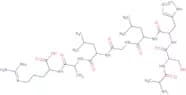
C3a (70-77)
CAS :<p>C3a is a molecule that is part of the complement system. It was first discovered in leukocytes and has since been detected in other populations. C3a is a chemotactic factor for neutrophils and eosinophils, which are types of white blood cells. C3a binds to the surface of cells by means of protein-antibody interactions, and it can also act as an anaphylatoxin by binding to mast cell receptors.</p>Formule :C35H61N13O10Degré de pureté :Min. 95%Masse moléculaire :823.94 g/molH-D-Leu-Thr-Arg-pNA acetate salt
CAS :<p>Please enquire for more information about H-D-Leu-Thr-Arg-pNA acetate salt including the price, delivery time and more detailed product information at the technical inquiry form on this page</p>Formule :C22H36N8O6Degré de pureté :Min. 95%Masse moléculaire :508.57 g/molBiotinyl-Neuromedin S (human) trifluoroacetate salt
CAS :<p>Please enquire for more information about Biotinyl-Neuromedin S (human) trifluoroacetate salt including the price, delivery time and more detailed product information at the technical inquiry form on this page</p>Formule :C183H279N55O46SDegré de pureté :Min. 95%Masse moléculaire :4,017.58 g/mol3-Fluoro-4-methoxybenzoic acid
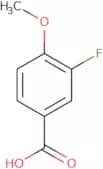
CAS :<p>3-Fluoro-4-methoxybenzoic acid is a dipolar molecule with a fluorine atom. It has been synthesized experimentally and the yields are determined by the experimental conditions. 3-Fluoro-4-methoxybenzoic acid has two isomers, which can be differentiated by their resonances. The molecule also has an asymmetric C3(CF)2Cl group in the middle of its structure that can rotate freely.</p>Formule :C8H7FO3Degré de pureté :Min. 95%Couleur et forme :PowderMasse moléculaire :170.14 g/mol2,2'-Biphenyldicarboxylic acid anhydride - 70%
CAS :<p>2,2'-Biphenyldicarboxylic acid anhydride is a diphenic anhydride that has a carboxylate group on one end and a phenyl group on the other. The nitrogen atoms in this molecule are part of the intramolecular hydrogen bonds that stabilize the molecule. 2,2'-Biphenyldicarboxylic acid anhydride is used in wastewater treatment as it reacts with amines to form ammonium salts. This process also releases hydrogen, which can be used for fuel cells or light emission. It is also used to produce other compounds such as malonic acid and phenylacetic acid.</p>Formule :C14H8O3Degré de pureté :(%) Min. 70%Couleur et forme :Brown Beige PowderMasse moléculaire :224.21 g/mol(Asp56)-pTH (1-84) (rat) trifluoroacetate salt
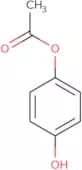
CAS :Please enquire for more information about (Asp56)-pTH (1-84) (rat) trifluoroacetate salt including the price, delivery time and more detailed product information at the technical inquiry form on this pageFormule :C405H668N122O126S3Degré de pureté :Min. 95%Masse moléculaire :9,358.58 g/mol4-Hydroxyphenyl acetate
CAS :<p>4-Hydroxyphenyl acetate is a naturally occurring fatty acid that is found in many plants. It has been isolated from the seeds of Telfairia occidentalis and has been shown to inhibit the growth of bacteria at a pH of 7.5, with an optimal pH of 8.0. 4-Hydroxyphenyl acetate is an activated form of this compound, which means it contains two hydroxyl groups and does not have to be synthesized by enzymes. 4-Hydroxyphenyl acetate inhibits bacterial enzyme activities such as DNA gyrase and RNA polymerase, which are necessary for transcription and replication. The structure analysis of 4-hydroxy phenylacetate was determined using trifluoroacetic acid (TFA) on a wild-type strain of Escherichia coli K12.</p>Formule :C8H8O3Degré de pureté :Min. 98 Area-%Couleur et forme :PowderMasse moléculaire :152.15 g/molRef: 3D-FH15475
Produit arrêtéLIP1 (human) trifluoroacetate salt
<p>Please enquire for more information about LIP1 (human) trifluoroacetate salt including the price, delivery time and more detailed product information at the technical inquiry form on this page</p>Formule :C133H229N45O37Degré de pureté :Min. 95%Masse moléculaire :3,050.52 g/molVesicular Stomatitis Virus Nucleoprotein (52-59) trifluoroacetate salt
CAS :<p>Please enquire for more information about Vesicular Stomatitis Virus Nucleoprotein (52-59) trifluoroacetate salt including the price, delivery time and more detailed product information at the technical inquiry form on this page</p>Formule :C44H66N12O12Degré de pureté :Min. 95%Masse moléculaire :955.07 g/molPeptide YY (3-36) (human) trifluoroacetate salt
CAS :<p>Peptide YY (3-36) (human) trifluoroacetate salt H-Ile-Lys-Pro-Glu-Ala-Pro-Gly-Glu-Asp-Ala-Ser-Pro-Glu-Glu-Leu-Asn -Arg -Tyr -Tyr -Ala -Ser -Leu -Arg <br>Peptide YY (3.36) is a peptide hormone that is secreted by L cells in the small intestine and colon. It has been shown to be an effective treatment for obesity, type 2 diabetes, and other metabolic disorders. Peptide YY (3.36) has been shown to increase insulin sensitivity, reduce food intake and body weight, increase metabolic rate, and improve glucose homeostasis in animal studies. In humans, it has been found to have similar effects on postprandial plasma levels of peptide YY (3.</p>Formule :C180H279N53O54Degré de pureté :Min. 95%Masse moléculaire :4,049.47 g/molLysergic acid hydrazide
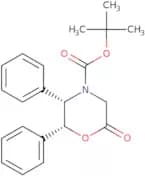
CAS :Produit contrôlé<p>Lysergic acid hydrazide is a synthetic drug with an active form of lysergic acid. It is used in the synthesis of ergocryptine and other drugs. The compound can be synthesized using methyl alcohol, trifluoromethyl group, hydroxy group, skeleton, and C1-4 alkyl as reactants. Lysergic acid hydrazide can also be synthesized from an inorganic acid such as nitrous or oxoalkyl. This compound has been used as a pharmaceutical preparation for the treatment of psychotic disorders. Lysergic acid hydrazide has shown to have reactive amide groups that may react with organic amines to form neurotoxic compounds.</p>Formule :C16H18N4ODegré de pureté :Min. 95%Masse moléculaire :282.34 g/moltert-Butyl (2R,3S)-(-)-6-oxo-2,3-diphenyl-4-morpholinecarboxylate
CAS :<p>tert-Butyl (2R,3S)-(-)-6-oxo-2,3-diphenyl-4-morpholinecarboxylate is a chiral compound that contains two stereogenic centers. It is a racemate of enantiomers. The enantiomeric purity can be determined by the preparative method. This compound is soluble in water and is stable in neutral or acidic conditions. It has been shown to act as an α-amino acid and to inhibit glycine uptake by neurons.</p>Formule :C21H23NO4Degré de pureté :Min. 95%Couleur et forme :SolidMasse moléculaire :353.41 g/molN,N-Bis(carboxymethyl)-L-glutamic acid
CAS :<p>N,N-bis(Carboxymethyl)-L-glutamic acid is a synthetic compound that functions as a disinfectant. It has been shown to be effective against bacteria and fungi in vitro, with an efficacy of over 90%. N,N-bis(Carboxymethyl)-L-glutamic acid is used as a treatment for tumors due to its ability to penetrate the tumor cells and inhibit fatty acid uptake. This compound also prevents the formation of new blood vessels by inhibiting the synthesis of DNA and RNA. N,N-bis(Carboxymethyl)-L-glutamic acid can be used in coatings for metals or metal surfaces that are exposed to water or air because it is biodegradable and noncorrosive.</p>Formule :C9H13NO8Degré de pureté :Min. 95%Couleur et forme :Clear LiquidMasse moléculaire :263.2 g/mol2-[(2,3-Dimethylphenyl)amino]nicotinic acid
CAS :<p>2-[(2,3-Dimethylphenyl)amino]nicotinic acid is an arylpropionic acid that has been designed for the treatment of cancer. It is a neutral compound that can be crystallized or sterilized and then injected or implanted into tissues. The compound can be used as a diagnostic tool to target specific tissues in the body by using iontophoresis or organic solvents. 2-[(2,3-Dimethylphenyl)amino]nicotinic acid interacts with chlorine ions to form a chloride derivative, which is then transported through the tissue. This process can be reversed by adding an acid solution to the tissue, which will cause the chloride ions to break down into hydrogen and chloride ions.</p>Formule :C14H14N2O2Degré de pureté :Min. 95%Masse moléculaire :242.27 g/mol







![2-[(2,3-Dimethylphenyl)amino]nicotinic acid](/_next/image/?url=https%3A%2Fstatic.cymitquimica.com%2Fproducts%2F3D%2Fthumb-webp%2FFD136106.webp&w=3840&q=75)