Acides carboxyliques
Les acides carboxyliques sont des molécules organiques caractérisées par un groupe fonctionnel de type carboxyle (-COOH). Ces acides sont fondamentaux dans diverses réactions chimiques, y compris l'estérification, l'amidation et la décarboxylation. Les acides carboxyliques sont largement utilisés dans la production de produits pharmaceutiques, de polymères et d'agrochimiques. Dans cette section, vous pouvez trouver un grand nombre d'acides carboxyliques prêts à l'emploi. Chez CymitQuimica, nous fournissons une large gamme d'acides carboxyliques de haute qualité pour soutenir vos applications de recherche et industrielles.
12454 produits trouvés pour "Acides carboxyliques"
Trier par
Degré de pureté (%)
0
100
|
0
|
50
|
90
|
95
|
100
Phosphomolybdic acid hydrate
CAS :<p>Phosphomolybdic acid hydrate is a molybdenum-containing compound that exhibits biological activity. It has been found to have an effect on water permeability and the biological sample, which can be detected by synchronous fluorescence. The electrochemical impedance spectroscopy can be used to measure the effects of phosphomolybdic acid hydrate on energy metabolism. This compound has also been shown to act as a catalyst in analytical methods, such as laser ablation, and can be used in a model system for hydrogen bonding interactions with zirconium oxide.</p>Formule :MoO3·H3PO4·xH2ODegré de pureté :Min. 95%Couleur et forme :Off-White To Dark Yellow SolidMasse moléculaire :1,825.49 g/mol(3,4,5-Trifluorophenyl)boronic acid
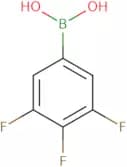
CAS :<p>The trifluorophenylboronic acid is a boronic acid that has been used in the synthesis of vitamin B12. This compound is often used as a catalyst for the Suzuki coupling reaction. It can also be used to synthesize amides and synthons. The trifluorophenylboronic acid is soluble in water, ethanol, and acetone. The pH of the solution depends on the type of base added. For example, when an amine is added to the solution, it increases to approximately 8-9. When a p-hydroxybenzoic acid is added to the solution, it decreases to approximately 2-3.</p>Formule :C6H4BF3O2Degré de pureté :Min. 95%Couleur et forme :PowderMasse moléculaire :175.9 g/molN,N-Bis(carboxymethyl)-L-glutamic acid
CAS :<p>N,N-bis(Carboxymethyl)-L-glutamic acid is a synthetic compound that functions as a disinfectant. It has been shown to be effective against bacteria and fungi in vitro, with an efficacy of over 90%. N,N-bis(Carboxymethyl)-L-glutamic acid is used as a treatment for tumors due to its ability to penetrate the tumor cells and inhibit fatty acid uptake. This compound also prevents the formation of new blood vessels by inhibiting the synthesis of DNA and RNA. N,N-bis(Carboxymethyl)-L-glutamic acid can be used in coatings for metals or metal surfaces that are exposed to water or air because it is biodegradable and noncorrosive.</p>Formule :C9H13NO8Degré de pureté :Min. 95%Couleur et forme :Clear LiquidMasse moléculaire :263.2 g/molLysergic acid hydrazide
CAS :Produit contrôlé<p>Lysergic acid hydrazide is a synthetic drug with an active form of lysergic acid. It is used in the synthesis of ergocryptine and other drugs. The compound can be synthesized using methyl alcohol, trifluoromethyl group, hydroxy group, skeleton, and C1-4 alkyl as reactants. Lysergic acid hydrazide can also be synthesized from an inorganic acid such as nitrous or oxoalkyl. This compound has been used as a pharmaceutical preparation for the treatment of psychotic disorders. Lysergic acid hydrazide has shown to have reactive amide groups that may react with organic amines to form neurotoxic compounds.</p>Formule :C16H18N4ODegré de pureté :Min. 95%Masse moléculaire :282.34 g/mol