Lactones
Les lactones sont une classe d'esters caractérisés par une structure cyclique formée par l'estérification intramoléculaire des acides hydroxyliques. Ces composés sont connus pour leurs structures annulaires distinctives, qui peuvent varier de trois à sept membres ou plus. Les lactones sont largement utilisées dans l'industrie des arômes et des parfums en raison de leurs arômes agréables, ainsi que dans les produits pharmaceutiques et agrochimiques pour leurs diverses activités biologiques. Chez CymitQuimica, nous proposons une sélection complète de lactones de haute qualité pour soutenir vos applications de recherche et industrielles, garantissant des performances fiables et efficaces dans vos projets.
490 produits trouvés pour "Lactones"
Trier par
Degré de pureté (%)
0
100
|
0
|
50
|
90
|
95
|
100
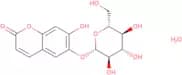
Esculin sesquihydrate
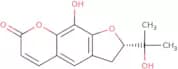
CAS :<p>Fluorescent dye used in diagnostic culture media</p>Formule :C15H16O9•(H2O)1Degré de pureté :(Uv) Min. 97.5%Couleur et forme :White Off-White PowderMasse moléculaire :367.31 g/molRutaretin
CAS :<p>Rutaretin is a polyphenolic compound, which is a derivative of natural flavonoids extracted from plant sources. It functions primarily as an antioxidant by scavenging free radicals and inhibiting oxidative stress at the cellular level. Its molecular structure allows it to interact with reactive oxygen species, mitigating the damaging effects on cellular components such as DNA, proteins, and lipids.</p>Formule :C14H14O5Degré de pureté :Min. 98 Area-%Couleur et forme :PowderMasse moléculaire :262.26 g/molOsthole
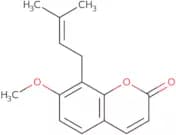
CAS :<p>Osthole is a coumarin derivative, which is a type of natural compound. It is predominantly sourced from the Cnidium monnieri plant, as well as other Apiaceae family members. Osthole exerts its effects primarily through modulation of various molecular pathways, including the suppression of inflammatory mediators and the modulation of calcium channels, which results in vasodilation and various other physiological effects.</p>Formule :C15H16O3Degré de pureté :Min. 95%Couleur et forme :PowderMasse moléculaire :244.29 g/molScopolin
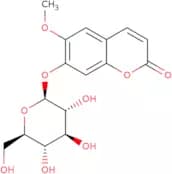
CAS :<p>Scopolin is a coumarin glucoside, which is derived from the plant secondary metabolism. It originates predominantly from species within the Solanaceae family, including tobacco and potato plants. Its biosynthesis involves the conversion of scopoline, a precursor molecule, through glucosylation. This process is catalyzed by glucosyltransferases, which facilitate the attachment of a glucose moiety.</p>Formule :C16H18O9Degré de pureté :Min. 98 Area-%Couleur et forme :White PowderMasse moléculaire :354.31 g/molIsopimpinellin - Angelica archangelica (angelica)
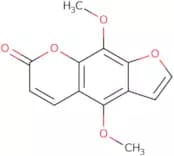
CAS :<p>Isopimpinellin is a furanocoumarin compound, which is derived from the plant Angelica archangelica, commonly known as angelica. This compound is characterized by its intricate chemical structure that includes the fusion of a furan ring to a coumarin backbone. The source, Angelica archangelica, is a biennial plant found predominantly in temperate regions and is notable for its use in traditional herbal medicine.</p>Formule :C13H10O5Degré de pureté :Min. 95%Couleur et forme :Off-White Yellow PowderMasse moléculaire :246.22 g/molUmbelliferone-3-carboxylic acid
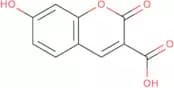
CAS :<p>Umbelliferone-3-carboxylic acid is a coumarin derivative, which is a type of natural or synthetic organic compound often utilized in biochemical research. It is sourced from modifications of natural coumarins, which are typically isolated from plants belonging to the Apiaceae family, such as parsley, celery, and carrots. This compound functions by interacting with cellular enzymes, providing a fluorescent probe that aids in the investigation of enzymatic activities and pathways.</p>Formule :C10H6O5Degré de pureté :Min. 95%Couleur et forme :PowderMasse moléculaire :206.15 g/molOxypeucedanin hydrate acetate
<p>Oxypeucedanin hydrate acetate is a furanocoumarin, primarily classified as a phytochemical. It is derived from various plant sources, particularly from species in the Apiaceae family, such as Peucedanum and Angelica. These compounds are typically isolated through advanced extraction and chromatographic techniques.</p>Degré de pureté :Min. 95%Decursinol angelate
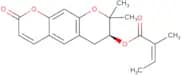
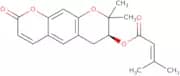
CAS :<p>Decursinol angelate is a bioactive compound, which is derived from the roots of plants such as Angelica gigas, a species commonly used in traditional Asian medicine. This compound is a coumarin derivative, known for its potential pharmacological properties. Decursinol angelate’s mode of action involves the modulation of inflammatory pathways, particularly through the inhibition of key enzymes and cytokines involved in inflammatory responses, such as COX-2 and TNF-alpha. This modulation leads to a reduction in the synthesis of pro-inflammatory mediators, which can be beneficial in managing inflammation-related conditions.</p>Formule :C19H20O5Degré de pureté :Min. 95%Couleur et forme :PowderMasse moléculaire :328.36 g/molByakangelicol
CAS :<p>Byakangelicol is a naturally occurring furanocoumarin, which is a type of organic compound found predominantly in the roots of certain plants, such as Angelica dahurica. This compound is synthesized through the plant's secondary metabolic pathways, primarily as a defense mechanism against herbivores and pathogens. Byakangelicol exerts its biological effects primarily through the inhibition of various enzymatic pathways, such as cytochrome P450s and monoamine oxidase, which are key in processes like drug metabolism and neurotransmitter regulation.</p>Formule :C17H16O6Degré de pureté :Min. 98 Area-%Couleur et forme :PowderMasse moléculaire :316.31 g/mol(+/-)-Heraclenin
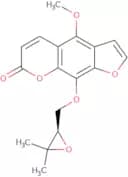
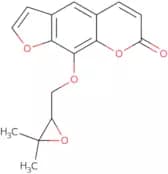
CAS :<p>(+/-)-Heraclenin is a naturally occurring coumarin, which is a class of organic compounds notable for diverse biological activities. This compound is primarily sourced from various plant species belonging to the family Apiaceae, such as Heracleum species. Coumarins like (+/-)-heraclenin are known for their ability to modify biological responses due to their chemical structure.</p>Formule :C16H14O5Degré de pureté :Min. 98 Area-%Couleur et forme :PowderMasse moléculaire :286.28 g/mol7-Methylcoumarin
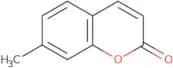
CAS :<p>7-Methylcoumarin is an organic compound classified as a coumarin derivative, which is sourced from various plants and synthesized chemically. Its basic structure consists of a benzopyrone, with a methyl group at the seventh position on the coumarin core, distinguishing it from naturally occurring coumarins.</p>Formule :C10H8O2Degré de pureté :Min. 95%Couleur et forme :White PowderMasse moléculaire :160.17 g/molMarmin
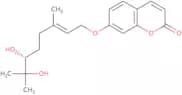
CAS :<p>Marmin is a natural bioactive compound, which is a type of limonoid. It is primarily sourced from citrus fruits, especially those belonging to the Rutaceae family, such as lemons and oranges. The compound exhibits a range of biological activities due to its multifaceted mode of action.</p>Formule :C19H24O5Degré de pureté :Min. 98 Area-%Couleur et forme :PowderMasse moléculaire :332.39 g/molDemethylsuberosin
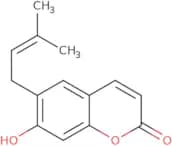
CAS :<p>Demethylsuberosin is a naturally-occurring compound, specifically a coumarin derivative, which is often extracted from plants. It originates from numerous botanical sources, including the family Rutaceae, where it serves as a secondary metabolite. Its mode of action involves the inhibition of fungal and bacterial growth, achieved by disrupting the integrity of microbial cell walls and interfering with their replication processes.</p>Formule :C14H14O3Degré de pureté :Min. 95%Couleur et forme :PowderMasse moléculaire :230.26 g/molIsoimperatorin
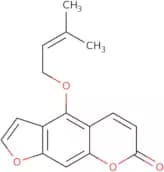
CAS :<p>Isoimperatorin is a naturally occurring furanocoumarin, which is a phytochemical compound found in certain plants, particularly within the Apiaceae family, such as Angelica dahurica. It is extracted from these botanical sources through processes like solvent extraction. Isoimperatorin exhibits a diverse mode of action, including the inhibition of various enzymes and modulation of signaling pathways. It has demonstrated significant effects on cytochrome P450 enzymes, potentially influencing drug metabolism. Additionally, Isoimperatorin has shown antioxidant properties and the ability to interfere with cell proliferation and apoptosis mechanisms.</p>Formule :C16H14O4Degré de pureté :Min. 98 Area-%Couleur et forme :PowderMasse moléculaire :270.29 g/molDecursin
CAS :<p>MAO inhibitor; neuro-protective and cognitive enhancement effects</p>Formule :C19H20O5Degré de pureté :Min. 98 Area-%Couleur et forme :White PowderMasse moléculaire :328.36 g/molPteryxin
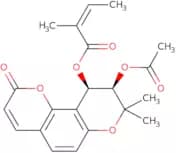
CAS :<p>Pteryxin is an alkaloid derivative, which is a natural product isolated primarily from certain plant species within the Apiaceae family. As a complex organic compound, it exhibits a range of biochemical interactions at the molecular level. The mode of action for Pteryxin primarily involves its ability to interact with specific enzymatic pathways and receptors, facilitating or inhibiting particular physiological processes. This biochemical interaction underlies its potential pharmacological effects, which are these products' primary focus of study.</p>Formule :C21H22O7Degré de pureté :Min. 95%Couleur et forme :PowderMasse moléculaire :386.4 g/molNordalbergin
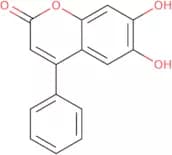
CAS :<p>Please enquire for more information about Nordalbergin including the price, delivery time and more detailed product information at the technical inquiry form on this page</p>Formule :C15H10O4Masse moléculaire :254.24 g/mol7-Methoxy-4-methylcoumarin
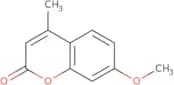
CAS :<p>7-Methoxy-4-methylcoumarin is a synthetic organic compound, which is a derivative of coumarins—a class of compounds widely found in plants. This compound is primarily synthesized through organic chemical reactions rather than extracted directly from natural sources. Its mode of action involves exhibiting fluorescence, which makes it a valuable probe in various scientific studies.</p>Formule :C11H10O3Degré de pureté :Min. 95%Couleur et forme :PowderMasse moléculaire :190.2 g/molDaphnetin dimethyl ether
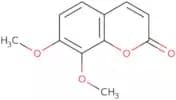
CAS :<p>Daphnetin dimethyl ether is a synthetic chemical compound, which is a derivative of the naturally occurring coumarin scaffold. It is primarily sourced through chemical synthesis rather than extraction from natural compounds, allowing for precise control over purity and structural modifications that are otherwise challenging to achieve through natural means.</p>Formule :C11H10O4Degré de pureté :Min. 95%Couleur et forme :PowderMasse moléculaire :206.19 g/molFraxidin
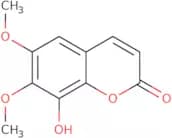
CAS :<p>Fraxidin is a naturally occurring compound, specifically an O-methylated coumarin, which is derived from certain plant sources such as the fruits of the ash tree. It is primarily obtained through the processing of various plant materials within the Rutaceae family. The mode of action of Fraxidin involves the inhibition of oxidative damage due to its capacity to scavenge free radicals, thus leading to potential antioxidant properties in biological systems.</p>Formule :C11H10O5Degré de pureté :Min. 98 Area-%Couleur et forme :PowderMasse moléculaire :222.19 g/mol