Acides benzoïques
Les acides benzoïques sont des acides carboxyliques aromatiques avec la formule moléculaire C7H6O2, caractérisés par un anneau benzénique lié à un groupe carboxyle (-COOH). Ces composés sont largement utilisés comme conservateurs, intermédiaires en synthèse organique et dans la production de divers produits chimiques, y compris les colorants et les parfums. Les acides benzoïques sont également importants dans les industries alimentaire et pharmaceutique. Chez CymitQuimica, nous offrons une gamme diversifiée d'acides benzoïques de haute qualité pour soutenir vos besoins en recherche et industriels.
5434 produits trouvés pour "Acides benzoïques"
Trier par
Degré de pureté (%)
0
100
|
0
|
50
|
90
|
95
|
100
4-Fluoro-3-hydroxybenzoic acid
CAS :<p>4-Fluoro-3-hydroxybenzoic acid is a colorless solid that can be produced through the sulfonation of 4-fluorophenol with sulfuric acid. This process usually takes place in two steps: first, the phenol is refluxed with sulfur trioxide and then aqueous potassium hydroxide is added to the mixture. The reaction produces a sulfite salt, which is then treated with sodium sulfite to produce the desired acid. 4-Fluoro-3-hydroxybenzoic acid can also be synthesized by adding sulfur dioxide to an aqueous solution of 3% hydrogen peroxide and adding potassium hydroxide dropwise until effervescence ceases. This method produces an insoluble precipitate, which is filtered out and washed with water. The product can then be purified by recrystallization from hot water or by washing with ether.</p>Formule :C7H5FO3Degré de pureté :Min. 95%Couleur et forme :White PowderMasse moléculaire :156.11 g/mol3,4-Diaminobenzoic acid
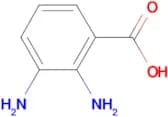
CAS :<p>3,4-Diaminobenzoic acid is a compound that is produced by the condensation of two molecules of hydrochloric acid. 3,4-Diaminobenzoic acid has been used as a reagent in the synthesis of coumarin derivatives. This chemical has been shown to be an effective proton scavenger in an optimum concentration. Benzimidazole compounds are also synthesized from 3,4-diaminobenzoic acid and have been shown to be effective against autoimmune diseases. 3,4-Diaminobenzoic acid can be used for the production of diazonium salts, which are used in the synthesis of anti-inflammatory drugs and other pharmaceuticals. The hydroxyl group on this molecule makes it chemically stable and kinetic data shows that it has high diphenolase activity.</p>Formule :C7H8N2O2Degré de pureté :Min. 96 Area-%Couleur et forme :PowderMasse moléculaire :152.15 g/molMethyl 3-bromo-2-fluorobenzoate
CAS :<p>Methyl 3-bromo-2-fluorobenzoate (MBFB) is a versatile building block in chemical synthesis. MBFB can be used as a reagent or speciality chemical. It has been used as an intermediate for the synthesis of other compounds, such as methyl 5-bromo-2-fluorobenzoate and ethyl 5-bromo-2-fluorobenzoate. MBFB is also a useful scaffold for the synthesis of complex compounds with interesting functions, such as research chemicals.</p>Formule :C8H6BrF2Degré de pureté :Min. 95%Couleur et forme :White PowderMasse moléculaire :233 g/mol2,4,6-Trihydroxybenzoic acid methyl ester
CAS :<p>2,4,6-Trihydroxybenzoic acid methyl ester is a synthetic compound that has been used in animal studies to investigate the inflammatory effects of substances. It has been shown to have anti-inflammatory properties in vitro and in vivo. Furthermore, 2,4,6-Trihydroxybenzoic acid methyl ester has been shown to inhibit the production of tumour necrosis factor-α (TNF-α) and other cytokines. This drug also has anti-fungal activity against Candida albicans and Aspergillus fumigatus. 2,4,6-Trihydroxybenzoic acid methyl ester is biodegradable.</p>Formule :C8H8O5Degré de pureté :Min. 95%Couleur et forme :PowderMasse moléculaire :184.15 g/mol2,4-Dihydroxy-3-methylbenzoic acid
CAS :<p>2,4-Dihydroxy-3-methylbenzoic acid (2,4-DMB) is a potent compound that has been shown to have chemotherapeutic properties. It is a DNA repair agent that also inhibits the activity of topoisomerase II and DNA polymerase III. 2,4-DMB can be used in the treatment of radiation and ionizing radiation induced cancers. The pharmacophore of 2,4-DMB has been identified as being composed of three hydrophobic regions and one hydrophilic region. This pharmacophore has been used to design other potent compounds with similar activity against cancer cells.</p>Formule :C8H8O4Degré de pureté :Min. 95%Couleur et forme :PowderMasse moléculaire :168.15 g/molMethyl 4-acetamido-2-methoxybenzoate
CAS :<p>Methyl 4-acetamido-2-methoxybenzoate is a chemical compound that belongs to the group of heterocycles. It is a precursor to the imidazopyridine, imidazopyrazine and thiazolopyridine classes of drugs. The protonation of methyl 4-acetamido-2-methoxybenzoate has been shown experimentally to be an important factor in its biological activity, especially for its binding affinity for DNA. Methyl 4-acetamido-2-methoxybenzoate has been used as an inotropic agent and as an atypical antipsychotic drug.</p>Formule :C11H13NO4Degré de pureté :Min. 95%Couleur et forme :PowderMasse moléculaire :223.23 g/molo-Sulfobenzoic acid anhydride
CAS :<p>Please enquire for more information about o-Sulfobenzoic acid anhydride including the price, delivery time and more detailed product information at the technical inquiry form on this page</p>Formule :C7H4O4SMasse moléculaire :184.17 g/molRef: 3D-S-9350
1kgÀ demander5kgÀ demander10kgÀ demander500gÀ demander2500gÀ demander-Unit-kgkgÀ demander2,5-Dihydroxybenzoic acid
CAS :<p>2,5-Dihydroxybenzoic acid is a natural compound that has been shown to inhibit the matrix metalloproteinase enzyme activity of α1-acid glycoprotein. The 2,5-dihydroxybenzoic acid structure is similar to p-hydroxybenzoic acid and gentisic acid. It is also an inhibitor of xanthine oxidase and caffeic acid oxidase. 2,5-Dihydroxybenzoic acid has a number of potential uses in analytical chemistry as it can be used to measure the concentrations of caffeic acids and other related compounds in biological samples.</p>Formule :C7H6O4Degré de pureté :(%) Min. 98%Couleur et forme :White PowderMasse moléculaire :154.12 g/mol5-Fluoroanthranilic acid
CAS :<p>5-Fluoroanthranilic acid is a synthetic compound that belongs to the class of anthranilic acid derivatives. It inhibits the growth of bacteria by reacting with the hydroxyl group on the bacterial cell wall and binding to its target, which is a cellular component found in Gram-positive bacteria. The molecular modeling and gene analysis have shown that this compound has an optimal reaction at pH 8.5, which is not in accordance with the natural environment of bacteria. 5-Fluoroanthranilic acid has been shown to have anticancer activity against wild-type cells but not against resistant mutants.</p>Formule :C7H6FNO2Degré de pureté :Min. 95%Couleur et forme :PowderMasse moléculaire :155.13 g/molEthyl 4-ethoxybenzoate
CAS :<p>Ethyl 4-ethoxybenzoate is an antimicrobial agent that inhibits bacterial growth by interfering with the synthesis of DNA. It also has a genotoxic potential and can induce mutations in cells. Ethyl 4-ethoxybenzoate is used as an impurity in pharmaceutical drug production, such as solanum tuberosum extract, to prevent microbial contamination. It also has been shown to inhibit the growth of bacteria in cell cultures by binding to DNA and inhibiting DNA replication. Ethyl 4-ethoxybenzoate is used as a control agent for the detection of antibiotics in natural products, such as ethanol extracts from plants.</p>Formule :C11H14O3Degré de pureté :Min. 97.5 Area-%Couleur et forme :Colorless Clear LiquidMasse moléculaire :194.23 g/mol2-Amino-5-nitrobenzoic acid
CAS :<p>2-Amino-5-nitrobenzoic acid is a plant metabolite that contains a nitro group. It has been found to be an effective inhibitor of glutamate dehydrogenase, one of the enzymes involved in the metabolism of amino acids. 2-Amino-5-nitrobenzoic acid has also been shown to have no effect on other enzyme activities such as amines and nitrosamines. This natural product has been shown to be useful as a model system for understanding how hydrochloric acid interacts with plants, by inhibiting their growth.</p>Formule :C7H6N2O4Degré de pureté :Min. 97.5%Couleur et forme :Yellow PowderMasse moléculaire :182.13 g/mol4-Bromo-3,5-dihydroxybenzoic acid methyl ester
CAS :<p>The compound 4-Bromo-3,5-dihydroxybenzoic acid methyl ester is an ether that is a natural product. It has been shown to have diastereoselective coupling with phenolic groups and unsymmetrically with lactones. This compound also undergoes epoxidation and farnesylation reactions. The intramolecular chain of the ether is methylated by formylation and reductive elimination.</p>Formule :C8H7BrO4Degré de pureté :Min. 95%Couleur et forme :PowderMasse moléculaire :247.04 g/mol2-Chloro-6-fluorobenzoic acid
CAS :<p>2-Chloro-6-fluorobenzoic acid is an aromatic compound that is used as a solvent in the production of pharmaceuticals, plastics, and dyes. The 2-chloro-6-fluorobenzoic acid molecule has an electron rich ring structure that can undergo nucleophilic attack by a nucleophile such as hydrogen chloride or hydrochloric acid. It also has a high affinity for water molecules, which may be attributed to its aromatic hydrocarbon structure. This allows 2-chloro-6-fluorobenzoic acid to act as a good solvent for many organic compounds. This chemical is classified as a possible human carcinogen and is toxic to the liver cells.</p>Formule :C7H4ClFO2Degré de pureté :Min. 95%Couleur et forme :PowderMasse moléculaire :174.56 g/mol3-Formyl-4-hydroxybenzoic acid
CAS :<p>3-Formyl-4-hydroxybenzoic acid is a synthetic compound with anticancer activity. It is an azobenzene that has been shown to have photocatalytic activity. 3-Formyl-4-hydroxybenzoic acid has a carboxylate functional group and the ethyl ester functional group. The anticancer activity of this compound may be due to hydrogen bonding interactions, as well as its ability to cause DNA damage in cells by photolysis and its antiviral potency.</p>Formule :C8H6O4Degré de pureté :90%Couleur et forme :White PowderMasse moléculaire :166.13 g/mol2,3,4-Trimethoxybenzoic acid
CAS :<p>2,3,4-Trimethoxybenzoic acid is a molecule that has been shown to stimulate epidermal growth. It is a methylating agent that can be used to produce 2-hydroxybenzoic acid from protocatechuic acid. The hydroxy group on the 2,3,4-trimethoxybenzoic acid binds to the chloride ion in the protocatechuic acid and removes it from the molecule. This reaction mechanism is supported by x-ray crystal structures of protocatechuic acid and 2,3,4-trimethoxybenzoic acid.</p>Formule :C10H12O5Degré de pureté :Min. 95%Couleur et forme :PowderMasse moléculaire :212.2 g/mol3-Chloro-5-hydroxybenzoic acid methyl ester
CAS :<p>3-Chloro-5-hydroxybenzoic acid methyl ester is a fine chemical that can be used as a versatile building block and reaction component in the synthesis of complex compounds. It is soluble in organic solvents such as dichloromethane, chloroform, and acetone. 3-Chloro-5-hydroxybenzoic acid methyl ester has CAS No. 98406-04-3 and a molecular weight of 149. 2.</p>Formule :C8H7ClO3Degré de pureté :Min. 98 Area-%Couleur et forme :White Off-White PowderMasse moléculaire :186.59 g/mol2-Methyl-3-nitrobenzoic acid
CAS :<p>Please enquire for more information about 2-Methyl-3-nitrobenzoic acid including the price, delivery time and more detailed product information at the technical inquiry form on this page</p>Formule :C8H7NO4Masse moléculaire :181.15 g/molRef: 3D-M-4209
1kgÀ demander5kgÀ demander10kgÀ demander25kgÀ demander2500gÀ demander-Unit-kgkgÀ demander3-Nitro-4-carbomethoxybenzoic acid
CAS :<p>3-Nitro-4-carbomethoxybenzoic acid is a thiophene that has been found to be an inhibitor of protein tyrosine phosphatase 1B (PTP1B). PTP1B is a key enzyme involved in the regulation of insulin secretion and blood sugar levels. 3-Nitro-4-carbomethoxybenzoic acid has been shown to inhibit PTP1B by mimicking the natural substrate of this enzyme, phosphotyrosine, and thereby preventing its dephosphorylation. It has also been shown to have anti-inflammatory properties.</p>Formule :C9H7NO6Degré de pureté :Min. 97 Area-%Couleur et forme :PowderMasse moléculaire :225.16 g/mol2,5-Dichlorobenzoic acid ethyl ester
CAS :<p>2,5-Dichlorobenzoic acid ethyl ester is a high quality, versatile building block that can be used as a reagent or intermediate. It is a useful scaffold for the synthesis of fine chemicals and research chemicals. This compound has been used in the synthesis of 2,5-dichloro-N-(2-hydroxyethyl)benzamide (CAS No. 35112-27-7), which is a speciality chemical with potential applications in pharmaceuticals and agrochemicals.<br>2,5-Dichlorobenzoic acid ethyl ester reacts with an amine to produce an N-[2-(2,5-dichlorophenyl)ethyl]amine (CAS No. 35112-27-7). The reaction proceeds via an amide bond formation by condensation of the amine with the acid chloride formed from the acid and ethyl chloride. This reaction is facilitated by heat and</p>Formule :C9H8Cl2O2Degré de pureté :Min. 95%Couleur et forme :PowderMasse moléculaire :219.06 g/mol5-Bromo-2-nitrobenzoic acid
CAS :<p>5-Bromo-2-nitrobenzoic acid is a chemical compound that belongs to the group of bromonitrobenzenes. It is an important intermediate in organic chemistry and has been used as a reagent for the synthesis of various heterocyclic compounds. 5-Bromo-2-nitrobenzoic acid can be used as a building block for pharmaceuticals, agrochemicals, dyes, and other chemicals. This versatile chemical has been widely used in research and development as a reaction component for synthesizing pharmaceuticals or speciality chemicals or as a building block to produce useful scaffolds.</p>Formule :C7H4BrNO4Degré de pureté :Min. 95%Couleur et forme :Slightly Yellow PowderMasse moléculaire :246.02 g/mol