Acides benzoïques
Les acides benzoïques sont des acides carboxyliques aromatiques avec la formule moléculaire C7H6O2, caractérisés par un anneau benzénique lié à un groupe carboxyle (-COOH). Ces composés sont largement utilisés comme conservateurs, intermédiaires en synthèse organique et dans la production de divers produits chimiques, y compris les colorants et les parfums. Les acides benzoïques sont également importants dans les industries alimentaire et pharmaceutique. Chez CymitQuimica, nous offrons une gamme diversifiée d'acides benzoïques de haute qualité pour soutenir vos besoins en recherche et industriels.
5434 produits trouvés pour "Acides benzoïques"
Trier par
Degré de pureté (%)
0
100
|
0
|
50
|
90
|
95
|
100
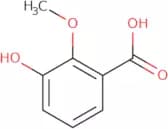
3-Hydroxy-2-methoxybenzoic acid
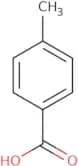
CAS :<p>3-Hydroxy-2-methoxybenzoic acid (3HMB) is a phenolic compound that is found in the heartwood of Eucalyptus trees, fruits such as apples and cherries, and some vegetables. 3HMB has been shown to inhibit tumor necrosis factor-α (TNF-α) production by proinflammatory cytokines such as IL-1β and IL-6, which are produced by cells in response to infection or tissue injury. 3HMB also inhibits the activity of tyrosol oxygenase, which converts tyrosol to vanillic acid. Vanillic acid can be converted into vanillin, an important precursor for the synthesis of pigments that give fruits their color. 3HMB has been shown to inhibit the growth of cancer cells in vitro.</p>Formule :C8H8O4Degré de pureté :Min. 95%Couleur et forme :PowderMasse moléculaire :168.15 g/mol4-Toluic acid
CAS :<p>4-Toluic acid is a chemical compound with the molecular formula CH3C6H2O2. It is a white solid that is soluble in water and alcohol. 4-Toluic acid can be produced by oxidation of benzoate, which is a reaction catalyzed by light or by using a catalyst such as trifluoroacetic acid. The reaction mechanism begins with the formation of the intramolecular hydrogen and subsequent oxidation to form an organic radical. This organic radical then reacts with oxygen to produce 4-toluic acid. 4-Toluic acid has been shown to have biochemical properties such as enzyme inhibition, DNA cleavage, and protein denaturation. The coordination geometry for this molecule is octahedral, and its redox potentials are -0.27 V (in acidic solution) and -1.06 V (in alkaline solution).</p>Formule :C8H8O2Degré de pureté :Min. 98 Area-%Couleur et forme :White PowderMasse moléculaire :136.15 g/mol4-(N,N-Diethylamino)benzoic acid
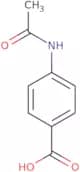
CAS :<p>4-(N,N-Diethylamino)benzoic acid is a hydrogenated product of 4-hydroxybenzoic acid. It has been shown to be an effective chemopreventive agent against chemically induced cancer in rats. The analytical method for this compound is based on the fluorescence properties of the compound and its structural studies have been reported. This drug also has bioequivalence properties, which were shown by the spectrometry analyses of human serum samples. The dipole moment of 4-(N,N-diethylamino)benzoic acid is 1.8 D and it reacts with protocatechuic acid to form 4-hydroxybenzaldehyde and diethyl ether.</p>Formule :C11H15NO2Degré de pureté :Min. 95%Couleur et forme :PowderMasse moléculaire :193.24 g/mol4-Acetamidobenzoic acid
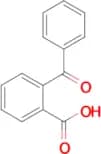
CAS :<p>4-Acetamidobenzoic acid is an aromatic organic compound that is a precursor to many pharmaceuticals, such as acetaminophen, amoxicillin, dapsone, and sulfonamide. It is an intermediate in the formation of 4-hydroxybenzoic acid from benzoic acid. This molecule is also a component of some types of plastics. The chemical's structure and properties are determined by its coordination geometry, which consists of four nitrogen atoms and one hydroxyl group. 4-Acetamidobenzoic acid has been shown to inhibit the growth of certain bacteria by interfering with their metabolic activity. It has also been found to be active against several infectious diseases such as malaria and tuberculosis. The mechanism behind its effectiveness may be due to the fact that it inhibits bacterial fatty acid synthesis or prevents the production of ATP in mitochondria cells.br>br><br>br>br><br>The reaction solution was heated for 20 minutes at 100</p>Formule :C9H9NO3Couleur et forme :White PowderMasse moléculaire :179.17 g/mol2-Benzoylbenzoic acid
CAS :Formule :C14H10O3Degré de pureté :97%Couleur et forme :SolidMasse moléculaire :226.2312-Chloro-3-nitrobenzoic acid
CAS :Formule :C7H4ClNO4Degré de pureté :98%Couleur et forme :SolidMasse moléculaire :201.562-tert-Butoxycarbonylamino-4,5-dimethyoxy-benzoic acid
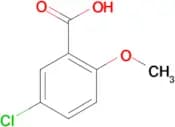
CAS :Formule :C14H19NO6Degré de pureté :97%Masse moléculaire :297.3075-Chloro-2-methoxybenzoic acid
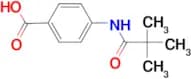
CAS :Formule :C8H7ClO3Degré de pureté :95%Couleur et forme :Off-white powderMasse moléculaire :186.594-(2,2-Dimethylpropionylamino)benzoic acid
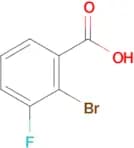
CAS :Formule :C12H15NO3Degré de pureté :95%Couleur et forme :SolidMasse moléculaire :221.2562-Bromo-3-fluorobenzoic acid
CAS :Formule :C7H4BrFO2Degré de pureté :96%Couleur et forme :Very pale yellow to pale reddish yellow powderMasse moléculaire :219.0095-Hydroxyanthranilic acid
CAS :Formule :C7H7NO3Degré de pureté :98%Couleur et forme :SolidMasse moléculaire :153.1374-tert-Butyl-3-methoxybenzoic acid
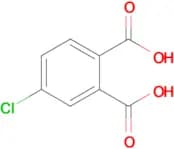
CAS :Formule :C12H16O3Degré de pureté :97%Couleur et forme :Solid, CrystallineMasse moléculaire :208.2574-Chlorophthalic acid
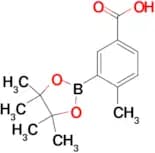
CAS :Formule :C8H5ClO4Degré de pureté :97%Couleur et forme :SolidMasse moléculaire :200.574-Methyl-3-(4,4,5,5-tetramethyl-1,3,2-dioxaborolan-2-yl)benzoic acid
CAS :Formule :C14H19BO4Degré de pureté :97.0%Couleur et forme :Solid, Off-white powderMasse moléculaire :262.115-Carboxy-2-fluorophenylboronic acid
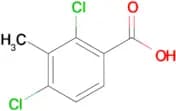
CAS :Formule :C7H6BFO4Degré de pureté :98%Couleur et forme :SolidMasse moléculaire :183.932,4-Dichloro-3-methylbenzoic acid
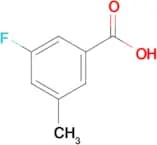
CAS :Formule :C8H6Cl2O2Degré de pureté :98%Masse moléculaire :205.033-Fluoro-5-methylbenzoic acid
CAS :Formule :C8H7FO2Degré de pureté :97%Couleur et forme :SolidMasse moléculaire :154.14