Glycosciences
Sous-catégories appartenant à la catégorie "Glycosciences"
- Aminosucres(108 produits)
- Anticorps Glyco-Related(284 produits)
- Glycolipides(46 produits)
- Glycosaminoglycanes (GAGs)(55 produits)
- Glycosides(419 produits)
- Monosaccharides(6.622 produits)
- Oligosaccharides(3.699 produits)
- Polysaccharides(506 produits)
11035 produits trouvés pour "Glycosciences"
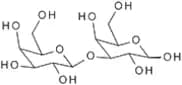
3-O-(b-D-Galactopyranosyl)-D-galactopyranose
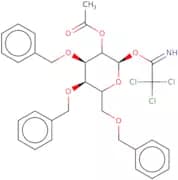
CAS :Used as enzyme substrates, analytical standards and for in vitro diagnosticsFormule :C12H22O11Degré de pureté :Min. 95%Couleur et forme :White PowderMasse moléculaire :342.3 g/mol2-O-Acetyl-3,4,6-tri-O-benzyl-a-D-glucopyranosyl trichloroacetimidate
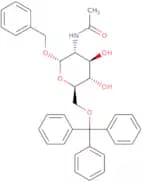
CAS :2-O-Acetyl-3,4,6-tri-O-benzyl-a-D-glucopyranosyl trichloroacetimidate is a custom synthesis. It is a modified oligosaccharide with a fluorinated carbon atom in the 2 position of the acetyl group. This chemical has been shown to be effective for click modification and glycosylation reactions. The CAS number for this chemical is 108869-64-3.Degré de pureté :Min. 95%Benzyl 2-acetamido-2-deoxy-6-O-trityl-a-D-glucopyranoside
CAS :Benzyl 2-acetamido-2-deoxy-6-O-trityl-a-D-glucopyranoside is a glycosylation of benzyl 2,3,4,6-tetraacetamido-2,3,4,6-tetra deoxyglucopyranoside. It is a complex carbohydrate that can be modified with methyl groups or fluorine atoms. This product is often used in Click chemistry and as a building block for oligosaccharides and polysaccharides. Benzyl 2-acetamido-2-deoxy 6O trityl a D glucopyranoside has CAS number 33493 71 9 and can be custom synthesized to meet individual requirements.
Formule :C34H35NO6Degré de pureté :Min. 95%Couleur et forme :White PowderMasse moléculaire :553.64 g/molEthyl 4,6-O-benzylidene-β-D-thioglucopyranoside
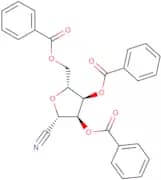
CAS :A protected thioglucose sugarFormule :C15H20O5SDegré de pureté :Min. 95%Couleur et forme :PowderMasse moléculaire :312.38 g/mol2,3,5-Tri-O-benzoyl-β-D-ribofuranosyl cyanide
CAS :Building block for C-nucleoside synthesisFormule :C27H21NO7Degré de pureté :Min. 98 Area-%Couleur et forme :White PowderMasse moléculaire :471.46 g/mol2-Acetamido-2-deoxy-a-D-galactopyranosyl serine
CAS :2-Acetamido-2-deoxy-a-D-galactopyranosyl serine (2AGPS) is a naturally occurring glycosaminoglycan. It has been shown to inhibit the growth of cancer cells and to reduce the size of mouse tumors in vivo. This compound also inhibits viral replication in vitro, and its antiviral properties have been shown to work on several different types of viruses, including herpes simplex virus type 1, human cytomegalovirus, and influenza A virus. 2AGPS is also a potent inducer of toll-like receptor 4 signaling pathways in macrophages and dendritic cells. 2AGPS can be synthesized by using a polymerase chain reaction (PCR) technique with synthetic oligosaccharides as a template.Formule :C11H20N2O8Degré de pureté :Min. 90 Area-%Couleur et forme :Off-White Yellow PowderMasse moléculaire :308.29 g/mol1-O-Methyl-beta-D-glucuronic acid, sodium salt
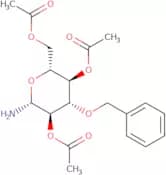
CAS :1-O-Methyl-β-D-glucuronic acid is a β-glucuronidase inducer.Formule :C7H11NaO7Masse moléculaire :230.15 g/mol2,4,6-Tri-O-acetyl-3-O-benzyl-b-D-glucopyranosylamine
CAS :Building block for 3-O-modified glucosylamide-linked glyconconjugatesFormule :C19H25NO8Degré de pureté :Min. 95%Couleur et forme :PowderMasse moléculaire :395.4 g/molD-Arabinose
CAS :D-Arabinose is a dinucleotide phosphate that is an important metabolic intermediate in the pentose phosphate pathway. It has been shown to have pharmacological effects, such as enzyme inhibition and binding to DNA. D-Arabinose has been used in biochemical studies of energy metabolism and related areas. D-Arabinose is converted to ribitol by ribitol dehydrogenase, which can be oxidized to ribulose 5-phosphate by ribulose 5-phosphate dehydrogenase. The conversion of D-arabinose to ribitol requires NAD(P)H, which provides the reducing power for this reaction. The conversion of ribitol to ribulose 5-phosphate also requires NAD(P)H, but does not produce any reducing power. A redox potential measurement was used to determine the relative reduction potentials of the two reactions and found that they are equal at -0.5 volts (V).
Formule :C5H10O5Masse moléculaire :150.13 g/molRef: 3D-A-8200
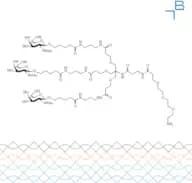
1kgÀ demander5kgÀ demander10kgÀ demander25kgÀ demander2500gÀ demander-Unit-kgkgÀ demanderTri-b-GalNAc-b-alanine-PEG3-amine
This molecule contains three terminal beta-N-acetylgalactosamine (GalNAc) sugars for efficient ASGPR binding. The beta-alanine linker separates the GalNAc unit from a PEG3 spacer, improving water solubility and potentially influencing pharmacokinetics. The terminal amine group serves as a reactive handle for conjugation to various biomolecules via amide bond formation. This multifunctional combination makes tri-b-GalNAc-b-alanine-PEG3-amine a versatile tool for researchers developing targeted therapies and diagnostics exploiting the ASGPR pathway.
Formule :C73H132N12O35Degré de pureté :Min. 95%Couleur et forme :PowderMasse moléculaire :1,689.89 g/molMethyl 2,3:4,5:6,7-Tri-O-isopropylidene-D-glycero-D-talo-heptonate
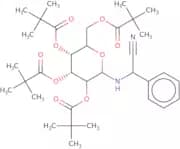
CAS :Methyl 2,3:4,5:6,7-Tri-O-isopropylidene-D-glycero-D-talo-heptonate is a methyl glycoside that can be used for the modification of saccharides and oligosaccharides. This product is also useful as an intermediate in the synthesis of complex carbohydrates.Formule :C17H28O8Degré de pureté :Min. 95%Masse moléculaire :360.4 g/molN-(2'-Phenylacetonitrile)-2,3,4,6-tetra-O-pivaloyl-D-glucopyranoside
CAS :N-(2'-Phenylacetonitrile)-2,3,4,6-tetra-O-pivaloyl-D-glucopyranoside is a synthetic glycosyl compound that has been modified with fluorine. The compound has been shown to be effective in the methylation of saccharides and oligosaccharides. It can be used for modification of polysaccharides and carbohydrates by Click chemistry. This product is offered as a custom synthesis and can be ordered in high purity.Formule :C34H50N2O9Degré de pureté :Min. 95%Masse moléculaire :630.77 g/mol1,2,3,4-Tetra-O-acetyl-6-O-(tert-butyldiphenylsilyl)-b-D-galactopyranose
1,2,3,4-Tetra-O-acetyl-6-O-(tert-butyldiphenylsilyl)-b-D-galactopyranose is a custom synthesis of an oligosaccharide. It is a polysaccharide saccharide that is a carbohydrate with the molecular formula C18H29NO9. This compound can be fluorinated or modified to create a high purity monosaccharide sugar. The methylation of this compound will lead to the production of Methyl 1,2,3,4-Tetra-O-acetyl-6-O-(tert-butyldiphenylsilyl)-b-D galactopyranoside.Formule :C20H34O10SiDegré de pureté :Min. 95%Masse moléculaire :462.56 g/mol3,4:5,6-Di-O-Isopropylidene-2-O-tert.butyldimethylsilyl-L-idonic acid methyl ester
3,4:5,6-Di-O-isopropylidene-2-O-(tert.butyldimethylsilyl)-L-idonic acid methyl ester is an organosilicon compound that is used in the preparation of oligosaccharides and polysaccharides. This compound has a CAS number of 2134160-04-6 and can be custom synthesized to meet your needs. 3,4:5,6-Di-O-isopropylidene-2-O-(tert.butyldimethylsilyl)-L-idonic acid methyl ester is available at a purity of 99% or greater, which makes it ideal for modification to produce monosaccharides or other types of sugar derivatives.Degré de pureté :Min. 95%N-(2-Furylacetonitrile)-2,3,4,6-tetra-O-pivaloyl-b-D-glucopyranoside
The compound is a custom synthesis. It is a polysaccharide that has been modified by methylation and glycosylation, as well as being click-modified at the C6 position. The compound is a complex carbohydrate with an Oligosaccharide in the center. The CAS number for this compound isFormule :C32H48N2O10Degré de pureté :Min. 95%Masse moléculaire :620.73 g/molBenzyl-2,3-anhydro-a-D-ribopyranoside
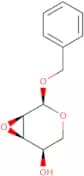
CAS :Benzyl-2,3-anhydro-a-D-ribopyranoside is a monosaccharide that is synthesized by the modification of the sugar benzyl 2,3-anhydro-a-D-ribofuranose. It is a white powder. Benzyl-2,3-anhydro-a-D-ribopyranoside is used as a reagent in glycosylation and methylation reactions. It has CAS No. 61134–24–5 and molecular weight of 230.22 g/mol. The molecule contains an anhydro group at C1 and hydroxyl groups at C6 and C8 positions. This product is soluble in water and ethanol.Formule :C12H14O4Degré de pureté :Min. 95%Masse moléculaire :222.24 g/mol2-Methoxycarbonylphenyl β-D-glucopyranoside
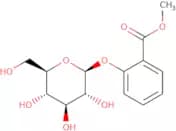
CAS :2-Methoxycarbonylphenyl b-D-glucopyranoside is a modification that can be used to synthesize complex carbohydrates. It is an oligosaccharide, which consists of a series of monosaccharides linked together by glycosidic bonds. The synthesis of this compound requires the use of methylation and fluorination reactions. This product has high purity and can be used for a variety of purposes, including as a sugar or as a polysaccharide.
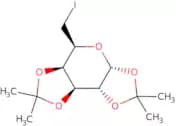
Formule :C14H18O8Degré de pureté :Min. 95%Couleur et forme :PowderMasse moléculaire :314.29 g/mol6-Deoxy-1,2:3,4-di-O-isopropylidene-6-iodo-α-D-galactopyranose
CAS :This is a carbohydrate compound with the CAS number 4026-28-2. It is a modification of the sugar galactose, which has been modified by a process called fluorination. This modification has increased its stability and resistance to hydrolysis.
Formule :C12H19IO5Degré de pureté :Min. 95%Couleur et forme :White to off-white solid.Masse moléculaire :370.18 g/mol(3aS, 4S, 6aR) Tetrahydro- 2, 2, 6a- trimethyl- 4H- 1, 3- dioxolo[4, 5- c] pyrrole- 4- methanol
(3aS, 4S, 6aR) Tetrahydro- 2, 2, 6a- trimethyl- 4H- 1, 3- dioxolo[4, 5- c] pyrrole- 4- methanol is a synthetic compound that is a member of the class of compounds known as tetrahydropyrroloquinolines. It is a monosaccharide sugar with an alkyl group at C6 and an amine group at C2. The compound has been shown to inhibit bacterial growth by inhibiting DNA synthesis. This inhibition leads to the production of less nucleotides and nucleic acids necessary for DNA replication. The methylation at C2 is critical for this inhibitory effect.Degré de pureté :Min. 95%1,2-O-Isopropylidene-α-D-glucofuranurono-6,3-lactone
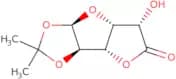
CAS :1,2-O-Isopropylidene-a-D-glucofuranurono-6,3-lactone is a compound with hepatocyte growth factor activity that is used in the diagnosis of liver diseases. It can also be used as a reagent for the detection of lactones and as an industrial chemical. 1,2-O-Isopropylidene-a-D-glucofuranurono-6,3-lactone has been shown to activate the hepatocyte growth factor receptor (HGFR) and induce cell proliferation in human hepatocytes. This compound is not toxic to cells at concentrations up to 100 mM.Formule :C9H12O6Degré de pureté :Min. 98%Couleur et forme :PowderMasse moléculaire :216.19 g/mol







![(3aS, 4S, 6aR) Tetrahydro- 2, 2, 6a- trimethyl- 4H- 1, 3- dioxolo[4, 5- c] pyrrole- 4- methanol](/_next/image/?url=https%3A%2Fstatic.cymitquimica.com%2Fproducts%2F3D%2Fthumb-webp%2FMT168716.webp&w=3840&q=75)