Glycosciences
Sous-catégories appartenant à la catégorie "Glycosciences"
- Aminosucres(108 produits)
- Anticorps Glyco-Related(284 produits)
- Glycolipides(46 produits)
- Glycosaminoglycanes (GAGs)(55 produits)
- Glycosides(419 produits)
- Monosaccharides(6.622 produits)
- Oligosaccharides(3.701 produits)
- Polysaccharides(505 produits)
11034 produits trouvés pour "Glycosciences"
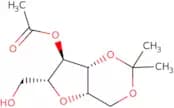
4-O-Acetyl-2,5-anhydro-1,3-isopropylidene-D-glucitol
CAS :4-O-Acetyl-2,5-anhydro-1,3-isopropylidene-D-glucitol (4AIG) is a modification of glucose. 4AIG is a white to light yellow crystalline solid that melts with decomposition at 150°C. It is soluble in water and acetone but insoluble in ether. 4AIG can be used as a raw material for the synthesis of oligosaccharides and polysaccharides.Formule :C11H18O6Degré de pureté :Min. 95%Masse moléculaire :246.26 g/molMan-8D1D3 N-Glycan
CAS :Man-8D1D3 N-Glycan is a custom synthesis carbohydrate that is used as a structural component in polysaccharides and glycoproteins. This compound is used for the modification of saccharides, methylation, glycosylation, and click chemistry. The purity of this substance is high and it has been fluorinated for synthetic purposes.
Formule :C64H108N2O51Degré de pureté :Min. 90%Couleur et forme :PowderMasse moléculaire :1,721.53 g/mol2,4-Di- C- methyl- 3, 4- O- isopropylidene-L- arabinonic acid γ-lactone
2,4-Di-C-methyl-3,4-O-isopropylidene-L-arabinonic acid gamma-lactone is a high purity synthetic chemical that has been custom synthesized for research purposes. It has a molecular weight of 556.0 and its CAS number is 133552-02-2. This chemical is used in the synthesis of saccharides and carbohydrates, including oligosaccharides and monosaccharides. 2,4 Di C methyl 3,4 O isopropylidene L arabinonic acid gamma lactone can be fluorinated or glycosylated to create new compounds with different properties. It can also be methylated to create a variety of derivatives. This chemical reacts with sugars in order to produce glycosylations that are useful in drug development. Click modification refers to the addition of a sugar molecule to an amino acid side chain followed by a rearrangement of the sugar ringDegré de pureté :Min. 95%Glucostrophanthidin
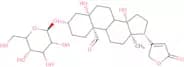
CAS :Glucostrophanthidin is a cardiac glycoside, which is derived from natural plant sources, specifically from species in the Apocynaceae family. This compound exerts its effects primarily through inhibition of the sodium-potassium ATPase enzyme, leading to an increase in intracellular sodium concentration. The downstream effect of this process involves an increase in intracellular calcium via the sodium-calcium exchange mechanism, ultimately enhancing the contractility of cardiac muscle fibers.
Formule :C29H42O11Degré de pureté :Min. 95%Masse moléculaire :566.64 g/molN-Acetyl-2,3-dehydro-2-deoxyneuraminic acid
CAS :Inhibitor of viral, bacterial and animal sialidaseFormule :C11H17NO8Degré de pureté :Min. 94 Area-%Couleur et forme :White PowderMasse moléculaire :291.25 g/molD-Galacturonic acid benzyl ester
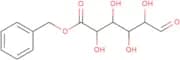
CAS :D-Galacturonic acid benzyl ester is a donor of d-galacturonic acid that is used to regulate the growth of bacterial cells. It has been shown to be an acceptor for oligosaccharides, which are substrates for glycosidases. D-Galacturonic acid benzyl ester has been shown to have anti-inflammatory effects in animal models and may be useful in the treatment of heart diseases, such as cardiac hypertrophy.
Formule :C13H16O7Degré de pureté :Min. 95%Couleur et forme :White PowderMasse moléculaire :284.26 g/mol3,5-Di-C-methyl-L-mannose
3,5-Di-C-methyl-L-mannose is a custom synthesis that is an Oligosaccharide with a CAS number of 83683-03-1. It is a polysaccharide that is modified by methylation and glycosylation. 3,5-Di-C-methyl-L-mannose has been shown to be effective in inhibiting the growth of cancer cells through modification of glycosylations on proteins and other molecules. 3,5-Di-C-methyl-L-mannose also has high purity and can be synthesized using fluorination reactions.Degré de pureté :Min. 95%Dextran sulfate sodium salt - MW 9,000-16,000
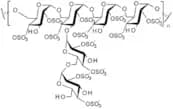
CAS :Dextran sulphate is a dextran derivative whose ulcer (colitis) -causing properties were first reported in hamsters and extrapolated a few years later to mice and rats. The exact mechanisms through which dextran sulphate induces intestinal inflammation are unclear but may be the result of direct damage of the monolayer of epithelial cells in the colon, leading to the crossing of intestinal contents (for e.g. commensal bacteria and their products) into underlying tissue and therefore induction of inflammation. The dextran sulphate sodium induced ulceration model in laboratory animals has some advantages, when compared to other animal models of colitis, due to its simplicity and similarities to human inflammatory bowel disease.Couleur et forme :PowderMetrizamide
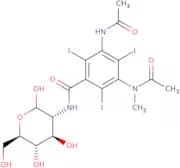
CAS :Radiopaque contrast agent; diagnostic aid for myelographyFormule :C18H22I3N3O8Degré de pureté :(%) Min. 95%Couleur et forme :White PowderMasse moléculaire :789.1 g/molDi-Lex-APE-BSA
Di-Lex-APE-BSA is a synthetic oligosaccharide with a high purity. It is synthesized from glycosylation and has been modified by fluorination, methylation, and click chemistry. This product has CAS No. 56837-19-4 and can be custom synthesized to order.Degré de pureté :Min. 95%D-Gluconic acid manganese salt
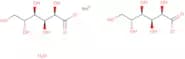
CAS :D-Gluconic acid manganese salt (DGM) is a glycol ether that is used as an antimicrobial agent in the treatment of infectious diseases. It binds to the metal ions in bacterial cell walls and disrupts their function. DGM has been shown to inhibit enzymes such as phosphoglucoisomerase, glucose-6-phosphate dehydrogenase, and pyruvate kinase. DGM also has covalent linkages that may be involved in its antimicrobial activity. The structure of DGM has been determined by X-ray diffraction data and electrochemical impedance spectroscopy, which show that it belongs to group p2.
Formule :C6H11O7·MnDegré de pureté :Min. 98%Couleur et forme :PowderMasse moléculaire :445.24 g/mol6-Cyano-6-deoxy-b-cyclodextrin
This beta-cyclodextrin (β-CD) derivative is a functionalized cyclic oligosaccharide composed of seven glucose units, characterized by a hydrophilic exterior and a lipophilic cavity (bigger than α-CD and smaller than γ-CDs), which allows it to encapsulate various guest molecules. This structural feature facilitates its use in multiple applications, including pharmaceuticals, food enhancement, and cosmetics. In the pharmaceutical industry, it enhances the solubility and stability of poorly water-soluble drugs, improving their bioavailability and efficacy while also masking unpleasant tastes. The food sector utilizes it as a stabilizer for flavors, colors, and nutrients, extending shelf life by protecting sensitive ingredients from degradation. In cosmetics, it serves as a complexing agent for fragrances and active components, ensuring their stability and controlled release. Its use expands to many other fields, including nanotechnology for drug delivery systems, environmental remediation for extracting organic pollutants, textiles for slow-release fragrances, and analytical chemistry for chiral separation.Formule :C49H63N7O28Degré de pureté :Min. 95%Masse moléculaire :1,198.05 g/mol6-Chloro-6-deoxy-D-altrose
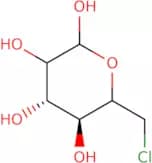
6-Chloro-6-deoxy-D-altrose is a modification of the 6-deoxy -D-altrose. It is an oligosaccharide, carbohydrate complex carbohydrate, which is synthesized using custom synthesis. The CAS No. for this product is 8863-07-8. This product has a high purity and methylation and glycosylation can be done to it. It has a molecular weight of 565.25 and its chemical formula is C12H24O11F2Na2. The molecular formula can be written as C12H22O11F2Na2 with the molecular weight being 565.25 g/mol.Formule :C6H11ClO5Degré de pureté :Min. 95%Masse moléculaire :198.6 g/mol1-O-Benzyl-2N, 3-O-carbonyl-β-D-fructofuranosylamine
CAS :The molecule is a complex carbohydrate with a glycosylation site and the following modifications: methylation, click modification, fluorination, saccharide and modification. The molecule was synthesized using custom synthesis methods. The 1-O-benzyl-2N, 3-O-carbonyl-b-D-fructofuranosylamine is available in high purity and CAS No. of 98996-97-3.Formule :C14H17NO6Degré de pureté :Min. 95%Couleur et forme :White To Off-White Viscous LiquidMasse moléculaire :295.29 g/mol1,4-Anhydro-2,O:5,6-di-O-isopropylidene-2-C-(hydroxymethyl)-D-galactitol
1,4-Anhydro-2,O:5,6-di-O-isopropylidene-2-C-(hydroxymethyl)-D-galactitol is a custom synthesis. It is commonly used in the modification of saccharides and oligosaccharides to produce fluorinated derivatives with various functional groups. The preparation of this compound has been described by Click chemistry.Degré de pureté :Min. 95%2-Azidoethyl b-D-fructopyranoside
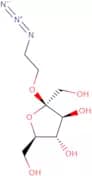
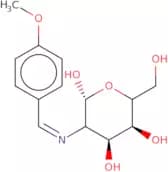
CAS :2-Azidoethyl b-D-fructopyranoside is a custom synthesis of glycogen, which is a complex carbohydrate. This product can be fluorinated or methylated at the 2’ position of the sugar moiety. It also has been modified with Click chemistry and polysaccharides. The CAS number for this product is 99042-58-7 and it has a purity of >99%.Formule :C8H15N3O6Degré de pureté :Min. 95%Couleur et forme :PowderMasse moléculaire :249.3 g/molN-(4-Methoxybenzylidene)-b-D-glucosamine
CAS :N-(4-Methoxybenzylidene)-b-D-glucosamine is a fluorinated synthetic monosaccharide. It is used in the synthesis of oligosaccharides and polysaccharides. N-(4-Methoxybenzylidene)-b-D-glucosamine can be modified with methyl groups, which are important for glycosylation, or click modification (a reaction in which a carbon atom and an oxygen atom are covalently bonded through a single bond). The sugar also has high purity and can be used as an analytical reference standard.Formule :C14H19NO6Degré de pureté :Min. 95%Masse moléculaire :297.3 g/mol2,3-O-Isopropylidene -D- ribonic acid γ-lactone
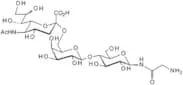
2,3-O-Isopropylidene -D- ribonic acid gamma-lactone is a Custom synthesis, Modification, Fluorination, Methylation, Monosaccharide, Synthetic, Click modification, Oligosaccharide, saccharide, CAS No., Polysaccharide. It has the following properties: CAS No., Polysaccharide. 2,3-O-Isopropylidene -D- ribonic acid gamma-lactone is a Custom synthesis.Degré de pureté :Min. 95%Glycyl-6'-sialyllactose
Glycyl-6'-sialyllactose is a custom synthesis that modifies glycyl 6'-sialyllactose. It has been fluorinated, methylated and then monosaccharide and synthetic. This product has been Click modified, which is an oligosaccharide. The CAS number for this product is 1040391-14-8. Glycyl-6'-sialyllactose is a saccharide with a complex carbohydrate structure. It is a sugar that contains the carbohydrates glucose, galactose and sialic acid.Formule :C25H43N3O19Degré de pureté :Min. 95%Masse moléculaire :689.62 g/molMethyl 3-deoxy-3-fluoro-b-D-allopyranoside
Methyl 3-deoxy-3-fluoro-b-D-allopyranoside is a modification of the carbohydrate. This product is an oligosaccharide, which is a complex carbohydrate consisting of two or more sugar molecules. Methyl 3-deoxy-3-fluoro-b-D allopyranoside has high purity and is synthetically produced. It can be used in the synthesis of glycosylated polysaccharides. This product can be modified with fluorination to generate saccharides that are not found in nature. Methyl 3-deoxy-3-fluoro b -D allopyranoside has CAS No.Formule :C7H13FO5Degré de pureté :Min. 95%Masse moléculaire :196.18 g/mol