Glycosciences
La glycosciences est l'étude des glucides et de leurs dérivés, ainsi que des interactions et des fonctions biologiques auxquelles ils participent. Ce domaine de recherche est crucial pour comprendre une grande variété de processus biologiques, y compris la reconnaissance cellulaire, la signalisation, la réponse immunitaire et le développement des maladies. La glycosciences a des applications importantes en biotechnologie, en médecine et dans le développement de nouveaux médicaments et thérapies. Chez CymitQuimica, nous proposons une large sélection de produits de haute qualité et pureté pour la recherche en glycosciences. Notre catalogue comprend des monosaccharides, des oligosaccharides, des polysaccharides, des glyconjugués et des réactifs spécifiques, conçus pour soutenir les chercheurs dans leurs études sur la structure, la fonction et les applications des glucides dans les systèmes biologiques. Ces ressources sont destinées à faciliter les découvertes scientifiques et les applications pratiques dans divers domaines des biosciences et de la médecine.
Sous-catégories appartenant à la catégorie "Glycosciences"
- Aminosucres(108 produits)
- Anticorps Glyco-Related(282 produits)
- Glycolipides(46 produits)
- Glycosaminoglycanes (GAGs)(55 produits)
- Glycosides(419 produits)
- Monosaccharides(6.622 produits)
- Oligosaccharides(3.682 produits)
- Polysaccharides(503 produits)
11041 produits trouvés pour "Glycosciences"
Trier par
Degré de pureté (%)
0
100
|
0
|
50
|
90
|
95
|
100
2,3,4,6-Tetra-O-acetyl-N-(b-D-galactopyranosyl)-N'-[(2-methanethiosulfonyl)ethyl]urea
CAS :<p>2,3,4,6-Tetra-O-acetyl-N-(b-D-galactopyranosyl)-N'-[(2-methanethiosulfonyl)ethyl]urea is a glycoside that has been custom synthesized for a sugar. This product is fluorinated and has a purity of 99%. It can be used as an intermediate in the Click modification reaction. It is available in bulk quantities and can be customized to meet customer needs.</p>Formule :C17H26N2O12S2Degré de pureté :Min. 95%Masse moléculaire :514.53 g/molUDP-D-galactosamine disodium salt
CAS :<p>UDP-D-galactosamine disodium salt is a type of sugar that is a substrate for UDP-glucuronosyltransferase (UGT), which catalyzes the transfer of galactose from UDP-D-galactose to other molecules. The product of this reaction is UDP-D-galacturonic acid. It is produced in the liver, where it participates in the synthesis of glycoproteins, glycolipids, and glycosaminoglycans. In addition, it can be found in the distal tubule of the kidney and in leukemia cells. The histological analysis of rat liver tissue showed that UDP-D-galactosamine disodium salt is present in hepatocytes. This sugar also helps with protein synthesis and activates uridine, which can be used as a carbon source. Histological analysis also revealed that UDP-D-galactosamine disodium salt plays an important role in glucose metabolism, as well as</p>Formule :C15H23N3O16P2Na2Degré de pureté :Min. 95%Couleur et forme :PowderMasse moléculaire :609.28 g/molDicyclohexylidene pinitol
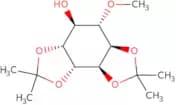
CAS :<p>Dicyclohexylidene pinitol is a synthetic, cyclic oligosaccharide with an interesting structure. It is produced by the Click modification of a sugar, followed by a fluorination step and glycosylation. The methylation of the sugar can also be performed to produce this product. Its CAS number is 1037-92-1. Dicyclohexylidene pinitol has been used as an intermediate in the synthesis of saccharides, polysaccharides and other carbohydrates.</p>Formule :C19H30O6Degré de pureté :Min. 95%Masse moléculaire :354.44 g/molPhenyl-α-D-glucopyranoside
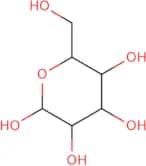
CAS :<p>Phenyl-alpha-D-glucopyranoside is a molecule that is found in the β-cell of the pancreas. It is thought to be involved in the biosynthesis of oligosaccharides and interacts with other molecules to form glycosidic bonds. The interaction between phenyl-alpha-D-glucopyranoside and other molecules has been analysed by gas chromatography, which showed that it was hydrophobic, but also interacted with carbohydrates. Phenyl-alpha-D-glucopyranoside has also been shown to inhibit gram negative bacteria, such as Escherichia coli or Salmonella enterica.</p>Formule :C12H16O6Masse moléculaire :256.25 g/mol2-epi-(-)-emtricitabine
CAS :<p>2-epi-(-)-emtricitabine is an analog of the nucleoside cytidine, which inhibits the phosphorylation and subsequent degradation of deoxycytidine kinase, thereby blocking the production of the viral DNA polymerase. The compound also inhibits tyrosine kinases, which are enzymes that play a vital role in cell signaling. This inhibition may contribute to its antiviral activity. 2-epi-(-)-emtricitabine has been shown to inhibit human immunodeficiency virus (HIV) replication in vitro and in vivo. It is a prodrug that is converted to emtricitabine, its active form, by deoxycytidine kinase and then hydrolyzed by esterases. 2-epi-(-)-emtricitabine has been shown to be effective against hepatitis B virus and cancer cells.</p>Formule :C8H10FN3O3SDegré de pureté :Min. 95%Masse moléculaire :247.25 g/molL-Idonic acid-1,4-lactone
CAS :<p>L-Idonic acid-1,4-lactone is a custom synthesis that is a glycoconjugate with a carbohydrate moiety. It can be used for the modification of glycoproteins and glycopeptides, and has shown to have anti-inflammatory properties. L-Idonic acid-1,4-lactone is a sugar that is made up of an idonic acid attached to an alpha (1→4)-linked D-glucose molecule. This product can be methylated or glycosylated and has been shown to have anticancer activity in animal models. L-Idonic acid-1,4-lactone is soluble in water and has been fluorinated at the 4 position on the glucose unit.</p>Formule :C6H10O6Degré de pureté :Min. 95%Masse moléculaire :178.14 g/mol1,2,3,4,6-Penta-O-benzoyl-a-D-glucopyranose
CAS :<p>1,2,3,4,6-Penta-O-benzoyl-a-D-glucopyranose is a natural product that has not been fully resolved or characterized. It is a carbohydrate and has a molecular weight of 532. It is found in urine as a metabolite of myo-inositol. 1,2,3,4,6-Penta-O-benzoyl-a-D-glucopyranose has been synthesized from inositol and benzoyl chloride. The compound can be separated into the two stereoisomers by fractional crystallization with chloroform and methanol.</p>Formule :C41H32O11Degré de pureté :Min. 95%Masse moléculaire :700.69 g/mol1,5-Dideoxy-1,5-imino-D-xylitol
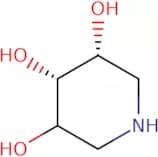
CAS :<p>1,5-Dideoxy-1,5-imino-D-xylitol is a synthetic molecule that inhibits the enzyme glycinamide ribonucleotide transformylase (GART) and blocks the synthesis of purines. 1,5-Dideoxy-1,5-imino-D-xylitol has been shown to be potent in inhibiting GART with an IC50 of 0.3 μM. This inhibitory effect was observed in Sprague Dawley rats after oral administration of 1,5-dideoxy-1,5 imino D xylitol at a dose of 10 mg/kg. The inhibition was found to be specific for amination reactions that are catalyzed by GART and not by other enzymes such as glycine amidinotransferase or adenylate kinase. It can be used to study the structure and function of tissue cells.</p>Formule :C5H11NO3Degré de pureté :Min. 95%Masse moléculaire :133.15 g/molMethyl 3,4-isopropylidene-b-L-arabinopyranoside
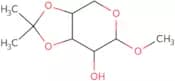
CAS :<p>Methyl 3,4-isopropylidene-b-L-arabinopyranoside is a synthetic saccharide that has been modified by the Click chemistry. Click modification is a method of modifying a complex carbohydrate with a reactive group (e.g., an azide) at one end of the molecule and an electrophile at the other end of the molecule. The resulting product can be used in glycosylation reactions to form complex carbohydrates with various properties. Methyl 3,4-isopropylidene-b-L-arabinopyranoside is used as a precursor for the synthesis of oligosaccharides and polysaccharides. It also has been shown to be effective as an inhibitor of bacterial growth in vitro by inhibiting protein synthesis.</p>Formule :C9H16O5Degré de pureté :Min. 95%Masse moléculaire :204.22 g/molD-Glucose-1,3-13C2
CAS :<p>Please enquire for more information about D-Glucose-1,3-13C2 including the price, delivery time and more detailed product information at the technical inquiry form on this page</p>Formule :C6H12O6Degré de pureté :Min. 95%Masse moléculaire :182.14 g/mol2,4,7,8,9-Penta-O-acetyl-N-acetylglycolyl-D-neuraminic acid methyl ester
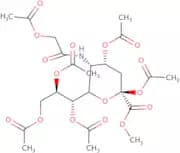
CAS :<p>2,4,7,8,9-Penta-O-acetyl-N-acetylglycolyl-D-neuraminic acid methyl ester is a glycoside that is used as a building block for the synthesis of complex carbohydrates. It can be used as an intermediate for the production of oligosaccharides and polysaccharides. This product has been shown to be highly pure and can be custom synthesized to meet your needs.</p>Formule :C24H33NO16Degré de pureté :Min. 95%Masse moléculaire :591.53 g/molMethyl 2-acetamido-2-deoxy-6-O-(b-D-galactopyranosyl)-a-D-glucopyranoside
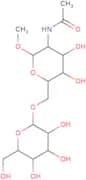
CAS :<p>Methyl 2-acetamido-2-deoxy-6-O-(b-D-galactopyranosyl)-a-D-glucopyranoside is a custom synthesis, modification and fluorination of a monosaccharide. The saccharide is modified with methylation and click modification at the 6th carbon position. This product is designed for use in the synthesis of complex carbohydrates.</p>Formule :C15H27NO11Degré de pureté :Min. 95%Masse moléculaire :397.38 g/mol5-O-tert-Butyldimethylsilyl-1,4-dideoxy-1,4-imino-2,3-O-isopropylidene-D-ribitol
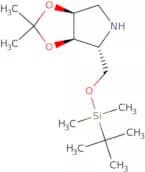
CAS :<p>5-O-tert-Butyldimethylsilyl-1,4-dideoxy-1,4-imino-2,3-O-isopropylidene-D-ribitol is a custom synthesis of a complex carbohydrate. It is an Oligosaccharide and Polysaccharide that has CAS No. 153172-31-7. 5BDSR is modified with methylation and glycosylation and can be used for the synthesis of saccharides or carbohydrates. It is high purity with a fluorination modification and click chemistry to provide synthetic products.</p>Formule :C14H29NO3SiDegré de pureté :Min. 95%Masse moléculaire :287.47 g/mol4,6-O-Benzylidene-N-Boc-2-O-p-toluenesulfonyl-1,5-imino-D-glucitol
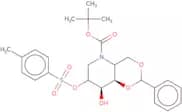
CAS :<p>4,6-O-Benzylidene-N-Boc-2-O-p-toluenesulfonyl-1,5-imino-D-glucitol is a monosaccharide that is used in the synthesis of complex carbohydrates. This compound can be custom synthesized and has a high purity. It is also available as a CAS number 1219116-88-7. 4,6-O-Benzylidene can be modified with methylation, click modification, fluorination, saccharide modification, or polysaccharide modification.</p>Formule :C25H31NO8SDegré de pureté :Min. 95%Masse moléculaire :505.58 g/molBromoxynil D-glucuronide methyl ester
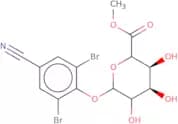
<p>Bromoxynil D-glucuronide methyl ester is a synthetic, high-purity chemical with a CAS number of 2512-06-3. It is an Oligosaccharide and sugar that is Glycosylated and Click modified. This product can be used in Custom synthesis or as a Modification to saccharides.</p>Formule :C14H13Br2NO7Degré de pureté :Min. 95%Masse moléculaire :467.06 g/molChondroitin sulphate tetrasaccharide ammonium salt
<p>Prepared by high resolution gel filtration of partial chondroitin ABC lyase digestion of mixed isomer chondroitin sulfate.Average MW ~ 992General formula:∆UA – (GalNAc,6S or 4S - GlcA)n - GalNAc,6S or 4Swhere n is number of disaccharide units n = 1 in a tetrasaccharide (dp4) Uronic acid (∆UA) at the non-reducing ends of the oligosaccharides has a C4-C5 double bond as a result of endolytic scission. The main disaccharide repeat in the original chondroitin sulphate is GlcA – GalNAc sulphated at C-6 or C-4 of the GalNAc residue; the CSD disaccharide unit (GlcA,2S – GalNAc,6S) is a minor component comprising approx. 5% of total disaccharides.</p>Couleur et forme :PowderMasse moléculaire :Average MW 992Sucrose octasulfate octatriethylammonium salt
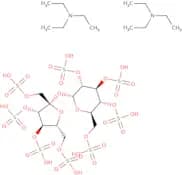
CAS :<p>Used for treatment of duodenal ulcers and gastroesophageal reflux</p>Formule :C12H22O35S8•(C6H15N)8Degré de pureté :Min. 95%Couleur et forme :PowderMasse moléculaire :982.81 g/mol3,4,6-Tri-O-acetyl-a-D-glucopyranose 1,2-(ethyl orthoacetate)
CAS :<p>3,4,6-Tri-O-acetyl-a-D-glucopyranose 1,2-(ethyl orthoacetate) is a custom synthesis that can be used as a fluorination agent or methylating agent. This compound has been modified by the click modification reaction to attach oligosaccharides and saccharides to proteins and polysaccharides. 3,4,6-Tri-O-acetyl-a-D-glucopyranose 1,2-(ethyl orthoacetate) is a high purity synthetic carbohydrate with a purity of 99.5%.</p>Formule :C16H24O10Degré de pureté :Min. 95%Masse moléculaire :376.35 g/molIvermectin monosaccharide
CAS :<p>Ivermectin monosaccharide is a molecule that has been shown to have an inhibitory effect on the uptake of glucose by cyathostomes. This molecule does not bind to inulin, but it does bind to the receptor binding site for ivermectin. Ivermectin monosaccharide has been shown to have a high affinity for the receptor binding site and can be used as an alternative method for detecting low concentrations of ivermectin.</p>Formule :C41H62O11Degré de pureté :Min. 95%Masse moléculaire :730.92 g/mol1,2-O-Isopropylidene-3-O-benzyl-5-deoxy-5-C-(2-pyridyl)-D-xylofuranose
<p>1,2-O-Isopropylidene-3-O-benzyl-5-deoxy-5-C-(2-pyridyl)-D-xylofuranose is a fluorinated sugar. This compound has been synthesized by modifying the glycosylation site of N4,N4'-diisopropylidene-1,2,3,5,5'-pentaacetamido-[1,6]hexanedioic acid methyl ester to 1,2-O-isopropylidene. The structure of this compound consists of a C(2) pyridine moiety and an O(1) protonated methyl group on the terminal carbon atom.</p>Degré de pureté :Min. 95%Masse moléculaire :341.37 g/mol
![2,3,4,6-Tetra-O-acetyl-N-(b-D-galactopyranosyl)-N'-[(2-methanethiosulfonyl)ethyl]urea](/_next/image/?url=https%3A%2Fstatic.cymitquimica.com%2Fproducts%2F3D%2Fthumb-webp%2FMT01191.webp&w=3840&q=75)