Glycosciences
La glycosciences est l'étude des glucides et de leurs dérivés, ainsi que des interactions et des fonctions biologiques auxquelles ils participent. Ce domaine de recherche est crucial pour comprendre une grande variété de processus biologiques, y compris la reconnaissance cellulaire, la signalisation, la réponse immunitaire et le développement des maladies. La glycosciences a des applications importantes en biotechnologie, en médecine et dans le développement de nouveaux médicaments et thérapies. Chez CymitQuimica, nous proposons une large sélection de produits de haute qualité et pureté pour la recherche en glycosciences. Notre catalogue comprend des monosaccharides, des oligosaccharides, des polysaccharides, des glyconjugués et des réactifs spécifiques, conçus pour soutenir les chercheurs dans leurs études sur la structure, la fonction et les applications des glucides dans les systèmes biologiques. Ces ressources sont destinées à faciliter les découvertes scientifiques et les applications pratiques dans divers domaines des biosciences et de la médecine.
Sous-catégories appartenant à la catégorie "Glycosciences"
- Aminosucres(108 produits)
- Anticorps Glyco-Related(282 produits)
- Glycolipides(46 produits)
- Glycosaminoglycanes (GAGs)(55 produits)
- Glycosides(419 produits)
- Monosaccharides(6.622 produits)
- Oligosaccharides(3.682 produits)
- Polysaccharides(503 produits)
11041 produits trouvés pour "Glycosciences"
Trier par
Degré de pureté (%)
0
100
|
0
|
50
|
90
|
95
|
100
Methyl 2,3-dideoxy-3-fluoro-5-O-pivaloyl-a-D-ribofuranoside
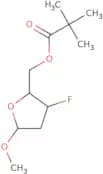
CAS :<p>Methyl 2,3-dideoxy-3-fluoro-5-O-pivaloyl-a-D-ribofuranoside is a custom synthesis of the monosaccharide methyl 2,3-dideoxy-3-fluoro-5-(O-(2,2,2,-trifluoroethoxy)carbonyl)a-D-ribofuranoside. It has been modified by the addition of a pivaloyl group in order to enhance its stability and inhibit enzymatic degradation. This product is available for purchase as a custom synthesis with high purity and modification for use in oligosaccharides and polysaccharides.</p>Degré de pureté :Min. 95%2,3,4-Tri-O-acetyl-1-azido-1-deoxy-b-D-arabinopyranosyl cyanide
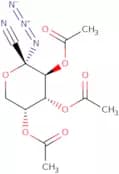
CAS :<p>2,3,4-Tri-O-acetyl-1-azido-1-deoxy-b-D-arabinopyranosyl cyanide is a synthetic carbohydrate that can be modified with fluorination, methylation and glycosylation. It is modified with acetyl groups at the 2, 3 and 4 positions of the sugar ring. This carbohydrate has been used to synthesize oligosaccharides and polysaccharides. The modification of this carbohydrate has been shown to improve its solubility in water.</p>Formule :C12H14N4O7Degré de pureté :Min. 95%Masse moléculaire :326.26 g/molTrichloroethyl 2,3,4-tri-O-acetyl-b-D-glucopyranosiduronic acid methyl ester
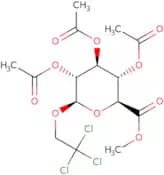
CAS :<p>Trichloroethyl 2,3,4-tri-O-acetyl-b-D-glucopyranosiduronic acid methyl ester is a synthetic carbohydrate that can be used for glycosylation reactions. Trichloroethyl 2,3,4-tri-O-acetyl-b-D-glucopyranosiduronic acid methyl ester is an intermediate in the synthesis of oligosaccharides and complex carbohydrates. It can be used to modify the sugar component of glycoproteins and glycopeptides.</p>Formule :C15H19Cl3O10Degré de pureté :Min. 95%Masse moléculaire :465.66 g/mol1,5-a-L-Arabinoheptaose
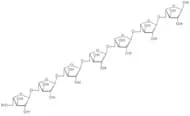
CAS :<p>1,5-a-L-Arabinoheptaose is a sugar that is found in the cell walls of bacteria. The chemical modification of this sugar has been studied extensively. The modification of this sugar with methyl groups and click chemistry has been shown to alter its properties, such as binding affinity and solubility. This modified sugar can be used for glycosylation reactions or custom synthesis. 1,5-a-L-Arabinoheptaose is also available in high purity and with a custom synthesis.</p>Formule :C35H58O29Degré de pureté :Min. 95%Couleur et forme :PowderMasse moléculaire :942.82 g/molMethyl 3,5-di-O-(p-chlorobenzoyl)-2-deoxy-D-ribofuranoside
CAS :<p>Methyl 3,5-di-O-(p-chlorobenzoyl)-2-deoxy-D-ribofuranoside is a custom synthesis. It is a complex carbohydrate that is an oligosaccharide or polysaccharide. It has been modified by methylation and glycosylation with saccharides. This product has high purity and can be used in the preparation of other compounds that require glycosylation or carbonylation reactions. The CAS number for this product is 99886-53-0.</p>Formule :C20H18Cl2O6Degré de pureté :Min. 95%Masse moléculaire :425.26 g/mol2,4-O-Ethylidene-D-erythrose
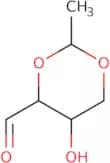
CAS :<p>2,4-O-Ethylidene-D-erythrose is a trimerization product of glyoxal and acetaldehyde. It is an aldehyde that can be used as a precursor to other compounds. The hydrated form of 2,4-O-ethylidene-D-erythrose has been rationalized by the mesoxalic acid and water molecules to form the trimer. This compound can be produced from the glycolaldehyde and sulfoxide in an oxidation reaction with hydrogen peroxide. The acetylation of 2,4-O-ethylidene-D-erythrose produces isoxazolidines which are stereoselective.</p>Formule :C6H10O4Degré de pureté :Min. 95%Masse moléculaire :146.14 g/molFulvestrant 3-b-D-glucuronide
CAS :<p>Fulvestrant 3-b-D-glucuronide is a synthetic hormone that has been modified with the Click chemistry. This modification allows for the attachment of saccharides, such as polysaccharides and oligosaccharides. The modification also provides protection against degradative enzymes, which may be useful in increasing drug stability in vivo. Fulvestrant 3-b-D-glucuronide can be custom synthesized to meet your requirements and specifications. It is a high purity product with a CAS number of 261506-27-8 and an appearance of white crystalline powder. Fulvestrant 3-b-D-glucuronide is a complex carbohydrate and sugar that can be used for methylation reactions or glycosylation reactions.</p>Formule :C38H55F5O9SDegré de pureté :Min. 95%Masse moléculaire :782.9 g/molDulcitol
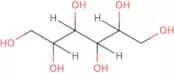
CAS :<p>Dulcitol is a sugar alcohol that is used in the food industry and as an alternative to sucrose. Dulcitol can be found in wastewater treatment and has been shown to be an inhibitor of wild-type strains of Escherichia coli and Bacteroides fragilis. It also inhibits the growth of Gram-positive bacteria, such as Staphylococcus aureus, by inhibiting their ability to synthesize DNA. Dulcitol is metabolized through a number of metabolic transformations, including hydrolysis by esterases or glucuronidases, oxidation by cytochrome P450 enzymes, reduction by glutathione reductase, or conjugation with glucuronic acid. Dulcitol can also inhibit the activity of certain enzymes such as protein kinase C (PKC).</p>Formule :C6H14O6Degré de pureté :Min. 99.0 Area-%Masse moléculaire :182.17 g/molRef: 3D-D-9500
1kgÀ demander5kgÀ demander10kgÀ demander25kgÀ demander2500gÀ demander-Unit-kgkgÀ demanderLipid A (E. Coli) triethylammonium salt
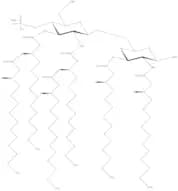
CAS :<p>The Lipid A moiety of lipopolysaccharide forms the outer monolayer of the outer membrane in most Gram-negative bacteria. Escherichia coli lipid A is synthesized on the cytoplasmic side of the inner membrane by a conserved pathway of nine constitutive enzymes. Following attachment of the core oligosaccharide, nascent core-lipid A is flipped to the outer surface of the inner membrane by the ABC transporter MsbA, where the O-antigen polymer is attached. These complex glycoforms protect bacteria from antibiotics and complement-mediated lysis. The core and O-antigen domains are required for virulence and consequently are present in most clinical and environmental isolates (Raetz, 2007).</p>Formule :C94H178N2O25P2Degré de pureté :Min. 95%Masse moléculaire :1,798.37 g/mol3-Deoxy-D-gluconic acid calcium
CAS :<p>3-Deoxy-D-gluconic acid calcium is a modification of the sugar 3-deoxy-D-glucono-1,5-lactone. It is an oligosaccharide that has been synthesized from D-glucose and D-xylose with the use of a click reaction. The monosaccharide (3DG) can be methylated to produce 3,6-dimethyl 3DG or fluorinated to make 3,6,9F 2 -3DG. This modification can be glycosylated to form a complex carbohydrate. The saccharide is also found in nature as the sugar component of glycogen and cellulose.</p>Formule :C6H12O6CaDegré de pureté :Min. 97 Area-%Masse moléculaire :400.39 g/molConiferin
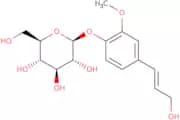
CAS :<p>Coniferin is a phenolic compound found in plants. It is a 4-hydroxycinnamic acid ester of p-hydroxybenzoic acid. Coniferin can be used as an additive for food and animal feed, as well as a preservative for cellulose. Coniferin has been shown to inhibit the growth of cancer cells, such as K562 cells, by affecting energy metabolism and polymerase chain reaction activities. The physiological effects of coniferin have not been extensively studied but it has been shown to inhibit enzyme activities in plant tissues. Coniferin has also been shown to act synergistically with crystalline cellulose and dihydroconiferyl alcohol to produce HPC powder, which is used for the preparation of HPC-cellulose membranes for protein separation.</p>Formule :C16H22O8Degré de pureté :Min. 95%Masse moléculaire :342.34 g/molGala1-2Gal-HSA
<p>Gala1-2Gal-HSA is a modified, complex carbohydrate. The carbohydrate is synthesized by methylating, glycosylating and polysaccharide synthesis to produce Gala1-2Gal-HSA. It has CAS No. and can be custom synthesized with high purity. Gala1-2Gal-HSA is a monosaccharide that can be fluorinated or saccharide that can be glycosylated or methylated. Gala1-2Gal-HSA has many applications in the biomedical field such as inhibiting inflammation and preventing cancer metastasis.</p>Degré de pureté :Min. 95%allo-Inositol
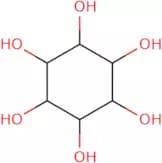
CAS :<p>Allo-inositol is a naturally occurring molecule that is classified as a vitamin. It is a member of the B-complex group of vitamins and has been shown to inhibit growth of cells in the HL-60 cell line. The optimum concentration for allo-inositol was found to be at 100 μM, with an IC50 value of 67 μM. Allo-inositol also has inhibitory properties against ovarian cancer cells and has been investigated as a potential treatment for ovarian cancer. Allo-inositol can be converted into myo-inositol in mammalian cells and may have anticancer effects through this conversion.</p>Formule :C6H12O6Degré de pureté :Min. 95%Masse moléculaire :180.16 g/mol3,4,6-Tri-O-acetyl-b-L-idopyranose 1,2-(methyl orthoacetate)
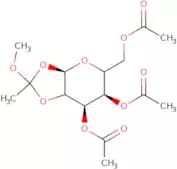
CAS :<p>3,4,6-Tri-O-acetyl-b-L-idopyranose 1,2-(methyl orthoacetate) is a methylated saccharide that is used as a building block for the synthesis of complex carbohydrates. It is synthesized by the reaction of 3,4,6-tri-O-acetyl-b-L-idopyranose with methyl orthoacetate in presence of acid catalyst. 3,4,6-Tri-O-acetyl - b - L - idopyranose 1,2-(methyl orthoacetate) has been shown to have antihyperglycemic effects when administered orally to mice and rats. The compound also has an inhibitory effect on the glycosaminoglycan production in human chondrocytes.</p>Formule :C15H22O10Degré de pureté :Min. 95%Masse moléculaire :362.33 g/mol2,3,4,6,3',4',6'-Hepta-O-benzoylsucrose
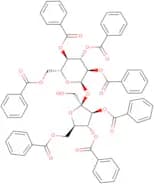
CAS :<p>2,3,4,6,3',4',6'-Hepta-O-benzoylsucrose (HBS) is a custom synthesis and modification of sucrose. The sugar is modified with 2,3,4,6-tetra-O-benzoyl groups at the 6′ position on the fructose unit and 3′ position on the glucose unit. HBS has been used in a click chemistry reaction as an acceptor for azide moieties.</p>Formule :C61H50O18Degré de pureté :Min. 95%Couleur et forme :PowderMasse moléculaire :1,071.04 g/mol1-Methyl-2-propenylbeta-D-glucopyranoside
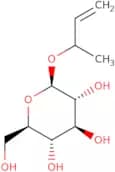
CAS :<p>1-Methyl-2-propenylbeta-D-glucopyranoside is a fluorinated carbohydrate that may be used for the modification of carbohydrates. It is a synthetic oligosaccharide that has been custom synthesized and modified with methylation, glycosylation, and click chemistry. This product is offered at high purity levels.</p>Formule :C10H18O6Degré de pureté :Min. 95%Masse moléculaire :234.25 g/molBlood Group H-BSA - 15 atom spacer
<p>The H-BSA-15-atom spacer is a synthetic polymer that can be modified to create a glycolipid or glycopeptide. The H-BSA-15-atom spacer is an oligosaccharide with a molecular weight of 3,500 daltons and has been custom synthesized for this use. This product is highly purified and does not contain any other substances, such as proteins. It has been fluorinated to increase its resistance to degradation by enzymes. Glycosylation and click modification have also been performed on the H-BSA-15 atom spacer.</p>Degré de pureté :Min. 95%Couleur et forme :Powder5-O-(5-Amino-5-deoxy-b-D-ribofuranosyl)-1-N-[(S)-4-amino-2-hydroxy-butanoyl]paromamine
<p>5-O-(5-Amino-5-deoxy-b-D-ribofuranosyl)-1-N-[(S)-4-amino-2-hydroxybutanoyl]paromamine is a Glycosylation agent that is used in the synthesis of oligosaccharides and polysaccharides. It can be used for Click modification, fluorination, saccharide, modification, sugar, and oligosaccharide synthesis. This product is CAS No. 51417-97-9 and has purity >99% (HPLC).</p>Degré de pureté :Min. 95%Man-3b N-Glycan
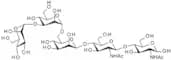
CAS :<p>Man-3b N-Glycan is a glycan with a mannose backbone and an N-acetylglucosamine branch. This glycan can be customized to the user’s specification, including the desired sugar sequence and the length of the oligosaccharide. Man-3b N-Glycans are synthesized by modification of commercially available saccharides or by custom synthesis.</p>Formule :C34H58N2O26Degré de pureté :Min. 95%Masse moléculaire :910.82 g/mol5-(Acetylamino)-5-deoxy-3-S-phenyl-3-thio-D-erythro-a-L-gluco-2-nonulopyranosonic acid methyl ester 2,4,7,8,9-pentaacetate
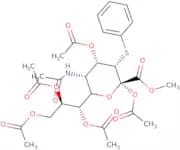
CAS :<p>5-(Acetylamino)-5-deoxy-3-S-phenyl-3-thio-D-erythro-a-L-gluco-2-nonulopyranosonic acid methyl ester 2,4,7,8,9-pentaacetate is a synthetic monosaccharide that can be used for glycosylation and polysaccharide modification. It can also be used as a click chemistry building block to modify sugars. This product has been custom synthesized for the specific needs of our customers. The purity of this compound is greater than 98%.</p>Formule :C28H35NO14SDegré de pureté :Min. 95%Masse moléculaire :641.64 g/mol




![5-O-(5-Amino-5-deoxy-b-D-ribofuranosyl)-1-N-[(S)-4-amino-2-hydroxy-butanoyl]paromamine](/_next/image/?url=https%3A%2Fstatic.cymitquimica.com%2Fproducts%2F3D%2Fthumb-webp%2FOA32030.webp&w=3840&q=75)