Glycosciences
La glycosciences est l'étude des glucides et de leurs dérivés, ainsi que des interactions et des fonctions biologiques auxquelles ils participent. Ce domaine de recherche est crucial pour comprendre une grande variété de processus biologiques, y compris la reconnaissance cellulaire, la signalisation, la réponse immunitaire et le développement des maladies. La glycosciences a des applications importantes en biotechnologie, en médecine et dans le développement de nouveaux médicaments et thérapies. Chez CymitQuimica, nous proposons une large sélection de produits de haute qualité et pureté pour la recherche en glycosciences. Notre catalogue comprend des monosaccharides, des oligosaccharides, des polysaccharides, des glyconjugués et des réactifs spécifiques, conçus pour soutenir les chercheurs dans leurs études sur la structure, la fonction et les applications des glucides dans les systèmes biologiques. Ces ressources sont destinées à faciliter les découvertes scientifiques et les applications pratiques dans divers domaines des biosciences et de la médecine.
Sous-catégories appartenant à la catégorie "Glycosciences"
- Aminosucres(108 produits)
- Anticorps Glyco-Related(282 produits)
- Glycolipides(46 produits)
- Glycosaminoglycanes (GAGs)(55 produits)
- Glycosides(419 produits)
- Monosaccharides(6.622 produits)
- Oligosaccharides(3.682 produits)
- Polysaccharides(503 produits)
11041 produits trouvés pour "Glycosciences"
Trier par
Degré de pureté (%)
0
100
|
0
|
50
|
90
|
95
|
100
1,4:3,6-Dianhydro- 2- O- methyl-D- glucitol
CAS :<p>1,4:3,6-Dianhydro-2-O-methyl-D-glucitol is a modified sugar that belongs to the group of carbohydrates. It is synthesized by the modification of 1,4:3,6-dianhydro-2,5-diO-methyl D glucitol with methyl iodide and sodium methoxide. The compound is used in pharmaceuticals as an excipient and in cosmetics as a moisturizer. It has been shown to be effective against influenza A virus.</p>Formule :C7H12O4Degré de pureté :Min. 95%Masse moléculaire :160.17 g/molA1 N-Glycan
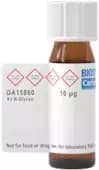
CAS :<p>A1 N-glycan is a custom synthesis, complex carbohydrate that is an oligosaccharide and polysaccharide. It is modified with saccharides, methylation, glycosylation, and fluorination. A1 N-Glycan has high purity and is custom synthesized to order.</p>Formule :C73H121N5O54Degré de pureté :Min. 95%Couleur et forme :PowderMasse moléculaire :1,932.74 g/mol4-Hydroxypropofol-4-O-b-D-glucuronide
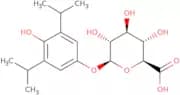
CAS :<p>4-Hydroxypropofol-4-O-b-D-glucuronide (HPG) is a synthetic carbohydrate with a 4,5-dihydroxypropyl group at C2 and an O-glycosidic bond between the hydroxyl group at C1 and the b position of a glucuronic acid. HPG is used in the synthesis of complex carbohydrates and saccharides. It can be methylated in order to produce 5,6-dimethoxycarbonyloxypropyl glycosides or glycosylated to produce mannosides. HPG has been synthesized by click modification from 4,5-dihydroxypropionic acid.</p>Formule :C18H26O8Degré de pureté :Min. 95%Masse moléculaire :370.4 g/mol2-O-Acetyl-3,4,6-tri-O-benzyl-b-D-glucopyranosyl trichloroacetimidate
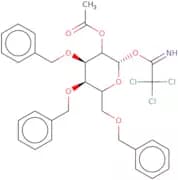
CAS :<p>2-O-Acetyl-3,4,6-tri-O-benzyl-b-D-glucopyranosyl trichloroacetimidate is a product of sugar modification. The modification is performed by the addition of acetyl groups to the hydroxyl groups on the glucose molecule. This process can be used to produce oligosaccharides and complex carbohydrates. The compound has no fluorine atoms and is not methylated or glycosylated. It has a CAS number of 180714-32-3.</p>Formule :C31H32Cl3NO7Degré de pureté :Min. 95%Masse moléculaire :636.95 g/molD-Myo-inositol-1,3,5-triphosphate
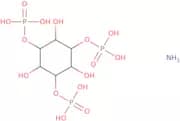
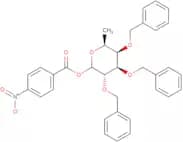
CAS :<p>D-myo-inositol-1,3,5-triphosphate is a carbohydrate that is modified with fluorine. It is a custom synthesis and can be synthesized in high purity. D-myo-inositol-1,3,5-triphosphate has several glycosylations and methylations. The modification of this compound includes click chemistry for the synthesis of oligosaccharides and saccharides. D-myo-inositol-1,3,5-triphosphate can be used as a sugar or an oligosaccharide in the modification of proteins or carbohydrates.</p>Degré de pureté :Min. 95%2,3,4-Tri-O-benzyl-1-O-(4-nitrobenzoyl)-L-fucopyranose
CAS :<p>2,3,4-Tri-O-benzyl-1-O-(4-nitrobenzoyl)-L-fucopyranose is a methylated, custom synthesized oligosaccharide. It has been modified with fluorination to give it high purity and complex carbohydrates with a saccharide backbone. This product is also a sugar and is synthesized from monosaccharides.</p>Formule :C34H33NO8Degré de pureté :Min. 95%Masse moléculaire :583.63 g/molHeparin disaccharide I-S, tetrasodium salt
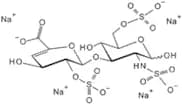
CAS :<p>Heparin disaccharide I-S, tetrasodium salt is a sodium salt of heparin that has been modified to contain two sulfate groups. The chemical modification of heparin disaccharide I-S, tetrasodium salt alters the molecule's charge and surface properties. This modification increases the molecule's ability to bind with cell surface markers and inhibits the activity of proteases. Heparin disaccharide I-S, tetrasodium salt is able to inhibit leukaemia proliferation in thp-1 cells by binding with cytoskeletal proteins such as vimentin and actin. This chemical also prevents PMA induced morphological changes in thp-1 cells. Heparin disaccharide I-S, tetrasodium salt is used as an anticoagulant in therapeutic settings. It is used to prevent blood clotting by inhibiting the activation of factors Xa and IIa. Heparin disaccharide</p>Formule :C12H15NO19S3·4NaDegré de pureté :Min. 98 Area-%Couleur et forme :White PowderMasse moléculaire :665.4 g/molMethyl 2,3,4-tri-O-benzyl-6-O-trityl-a-D-glucopyranoside
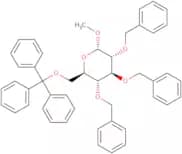
CAS :<p>Methyl 2,3,4-tri-O-benzyl-6-O-trityl-a-D-glucopyranoside is a modification of the sugar molecule. This modification process is completed by reacting the sugar with a derivative of benzyl alcohol. The result is an increase in the number of functional groups on the sugar molecule and a change in its physical properties. Methyl 2,3,4-tri-O-benzyl-6-O-trityl-a -D glucopyranoside has been used in the synthesis of oligosaccharides and polysaccharides.<br>Methyl 2,3,4 -tri -O -benzyl -6 -O -trityl--a D glucopyranoside is an organic compound that belongs to the class of carbohydrates. It is a white powder that contains water solubility and has a melting point of about 145°C. Methyl</p>Formule :C47H46O6Degré de pureté :Min. 95%Masse moléculaire :706.89 g/mol1,3,5-Tri-O-benzoyl-2-bromo-2-deoxy-a-L-arabinofuranose
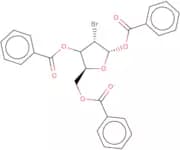
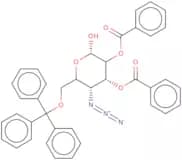
CAS :<p>1,3,5-Tri-O-benzoyl-2-bromo-2-deoxy-a-L-arabinofuranose is a synthetic sugar molecule. It is a complex carbohydrate that can be modified by methylation and glycosylation. The carbons in the sugar backbone have been fluorinated to create a high purity product. The CAS number for this compound is 2011707-39-2.</p>Formule :C26H21BrO7Degré de pureté :Min. 95%Masse moléculaire :525.34 g/mol4-Azido-2,3-di-O-benzoyl-4-deoxy-6-O-trityl-a-D-glucopyranoside
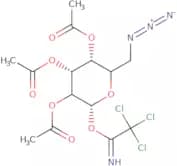
<p>4-Azido-2,3-di-O-benzoyl-4-deoxy-6-O-trityl-a-D-glucopyranoside is a synthetic glycosylation reagent that can be used for the synthesis of oligosaccharides. It is a fluorinated sugar that can be custom synthesized to order. 4A2B4D6OATG is a high purity product with CAS No. 62990-51-1 and has been modified using click chemistry to incorporate azide functional groups.</p>Formule :C39H33N3O7Degré de pureté :Min. 95%Masse moléculaire :655.7 g/mol2,3,4-Tri-O-acetyl-6-azido-6-deoxy-a-D-glucopyranosyl trichloroacetimidate
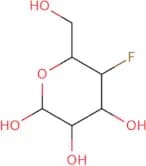
CAS :<p>2,3,4-Tri-O-acetyl-6-azido-6-deoxy-a-D-glucopyranosyl trichloroacetimidate is a modification of a carbohydrate. It can be custom synthesized to order and is available in high purity. This product is an oligosaccharide that has been methylated and glycosylated. It can also be used as a monosaccharide or polysaccharide. The 2,3,4-Tri-O-acetyl-6-azido-6-deoxy--a -D--glucopyranosyl trichloroacetimidate is fluorinated and saccharide.</p>Formule :C14H17Cl3N4O8Degré de pureté :Min. 95%Masse moléculaire :475.67 g/mol4-Deoxy-4-fluoro-a-D-glucopyranose
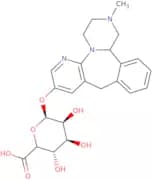
CAS :<p>4-Deoxy-4-fluoro-a-D-glucopyranose is a carbohydrate that belongs to the group of carbohydrates. It has enthalpy and entropy values of -1,865.2 kJ/mol and -3,363.6 J/(mol·K) at 298 K, respectively. This compound has been shown to interact with water molecules in solution phase. 4-Deoxy-4-fluoro-a-D-glucopyranose is soluble in water and interacts with other carbohydrate molecules at an intermolecular level. 4DFA has an extrapolated melting point of about 216 degrees Celsius.</p>Formule :C6H11FO5Degré de pureté :Min. 95%Masse moléculaire :182.15 g/mol8-Hydroxymirtazapine b-D-glucuronide
CAS :<p>8-Hydroxymirtazapine b-D-glucuronide is a fluorinated, monosaccharide, synthetic oligosaccharide. It is a complex carbohydrate that has been custom synthesized with glycosylation and polysaccharides. The sugar structure has been modified by methylation and click modification in order to produce a high purity product. CAS No. 155239-47-7</p>Formule :C23H27N3O7Degré de pureté :Min. 95%Masse moléculaire :457.49 g/molNGA4B N-Glycan
CAS :<p>NGA4B N-Glycan is a custom synthetic compound that can be modified to include methylation, fluorination, and other modifications. It is an oligosaccharide that is a polysaccharide composed of saccharides. The saccharides are monosaccharides or simple sugars. NGA4B N-Glycan is available at high purity for use in research and as a reagent.</p>Formule :C74H123N7O51Degré de pureté :Min. 95%Masse moléculaire :1,926.79 g/mol6-O-Carboxymethyl-D-glucose
CAS :<p>6-O-Carboxymethyl-D-glucose (CMG) is a trityl glucanotransferase substrate that is used in the synthesis of carboxymethylated polysaccharides. This compound can be obtained from glucose by treatment with a glucanotransferase enzyme. CMG has been shown to have an inhibitory effect on pancreatic acinar cells and also inhibits acidic proteases in saliva, which leads to its use as an anti-inflammatory drug.</p>Formule :C8H14O8Degré de pureté :Min. 95%Couleur et forme :White Off-White PowderMasse moléculaire :238.19 g/mol4-O-Acetyl-3,6-di-O-(2,3,4,6-tetra-O-acetyl-a-D-mannopyranosyl)-D-mannopyranose
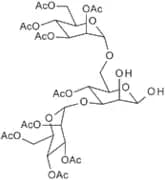
<p>4-O-Acetyl-3,6-di-O-(2,3,4,6-tetra-O-acetyl-a-D-mannopyranosyl)-D-mannopyranose is a synthetic nonreducing sugar that has been modified with an acetate group at C4 and acetyl groups at C3 and C6. This compound is a white to off white crystalline solid. It is soluble in methanol and formamide. The chemical formula of the compound is CHO.</p>Formule :C36H50O25Degré de pureté :Min. 95%Masse moléculaire :882.77 g/mol7-a,17-a-Dimethyl-5-b-androstane-3-a,17-b-diol glucuronide
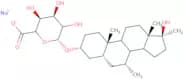
<p>7-a,17-a-Dimethyl-5-b-androstane-3-a,17-b-diol glucuronide is a monosaccharide that is found in the brain and liver of humans. It is a synthetic compound that has been modified with methylation and glycosylation. This product also has high purity and can be custom synthesized to meet customer specifications.</p>Formule :C27H43O8·NaDegré de pureté :Min. 95%Masse moléculaire :518.62 g/mol4-Chlorophenyl 2-acetamido-2-deoxy-b-D-glucopyranoside
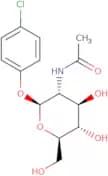
CAS :<p>4-Chlorophenyl 2-acetamido-2-deoxy-b-D-glucopyranoside is a molecule that belongs to the class of acid molecules and has been implicated in the metabolism of corynebacterium. The metabolic pathway for this molecule has been studied using databases and datasets, with population simulations and profile data being generated to help identify potential strategies for its positioning in the market. This molecule is also related to death, which may be related to its positioning.</p>Formule :C14H18ClNO6Degré de pureté :Min. 95%Masse moléculaire :331.75 g/molMethyl 2,3-di-O-benzyl-5-deoxy-5-iodo-D-xylofuranoside
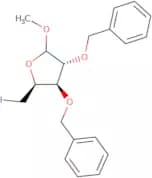
CAS :<p>Methyl 2,3-di-O-benzyl-5-deoxy-5-iodo-D-xylofuranoside is a sugar derivative that is a glycosylation product of the sugar xylose. It has been methylated and fluorinated to generate a complex carbohydrate. This product has been modified with click chemistry, which is a reaction that generates an alkyne on the C2 position of the xylose. The oligosaccharides were synthesized using custom synthesis and high purity was confirmed by HPLC analysis.</p>Degré de pureté :Min. 95%Maltododecaose
CAS :<p>α-1,4-glucododecasaccharide derived from starch by hydrolysis and chromatography</p>Formule :C72H122O61Degré de pureté :Min. 95%Couleur et forme :Clear Liquid PowderMasse moléculaire :1,962 g/mol