Glycosciences
La glycosciences est l'étude des glucides et de leurs dérivés, ainsi que des interactions et des fonctions biologiques auxquelles ils participent. Ce domaine de recherche est crucial pour comprendre une grande variété de processus biologiques, y compris la reconnaissance cellulaire, la signalisation, la réponse immunitaire et le développement des maladies. La glycosciences a des applications importantes en biotechnologie, en médecine et dans le développement de nouveaux médicaments et thérapies. Chez CymitQuimica, nous proposons une large sélection de produits de haute qualité et pureté pour la recherche en glycosciences. Notre catalogue comprend des monosaccharides, des oligosaccharides, des polysaccharides, des glyconjugués et des réactifs spécifiques, conçus pour soutenir les chercheurs dans leurs études sur la structure, la fonction et les applications des glucides dans les systèmes biologiques. Ces ressources sont destinées à faciliter les découvertes scientifiques et les applications pratiques dans divers domaines des biosciences et de la médecine.
Sous-catégories appartenant à la catégorie "Glycosciences"
- Aminosucres(108 produits)
- Anticorps Glyco-Related(282 produits)
- Glycolipides(46 produits)
- Glycosaminoglycanes (GAGs)(55 produits)
- Glycosides(419 produits)
- Monosaccharides(6.624 produits)
- Oligosaccharides(3.682 produits)
- Polysaccharides(503 produits)
11046 produits trouvés pour "Glycosciences"
Trier par
Degré de pureté (%)
0
100
|
0
|
50
|
90
|
95
|
100
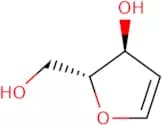
D-Ribal
CAS :<p>D-Ribal is a drug that inhibits the growth of tumor cells by binding to epidermal growth factor receptor (EGFR), which is found on the surface of most cells in the body. This binding prevents EGFR from binding to epidermal growth factor, which is needed for cell division and proliferation. The effect of D-Ribal can be enhanced if used in combination with other drugs that inhibit EGFR signaling pathways. D-Ribal has been shown to be effective against urothelial carcinoma and bladder cancer, but not against primary tumors such as breast cancer or prostate cancer.</p>Formule :C5H8O3Degré de pureté :Min. 95%Masse moléculaire :116.12 g/molO-Desmethyl galanthamine b-D-glucuronide
CAS :<p>O-Desmethyl galanthamine b-D-glucuronide is a synthetic carbonyl glycoside. It is an acetylated monosaccharide with a fluorinated sugar. O-Desmethyl galanthamine b-D-glucuronide is prepared by the click modification of N-acetylgalactosamine and D,L-galactose with ethyl diazoacetate in the presence of copper(I) iodide. The methylation of the hydroxyl group on the C2 position of the sugar moiety and glycosylation at the C3 position are also carried out to produce this compound.</p>Formule :C22H27NO9Degré de pureté :Min. 95%Masse moléculaire :449.45 g/mol4-Methoxyphenyl 2,3,4,6-tetra-O-benzyl-β-D-galactopyranoside
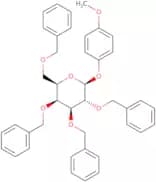
CAS :<p>4-Methoxyphenyl 2,3,4,6-tetra-O-benzyl-b-D-galactopyranoside is a matrix assisted laser desorption/ionization (MALDI) probe that is used for the detection of esophageal cancer. This probe has been shown to be resistant to non-Hodgkin's lymphoma and dna–dna hybridization. The type strain of this agent was found in a clinical sample from an esophagus biopsy. 4MPBGP has also been shown to have coagulation and waveform properties.</p>Formule :C41H42O7Degré de pureté :Min. 95%Masse moléculaire :646.77 g/molTri-b-GalNAc-C12-alkyne
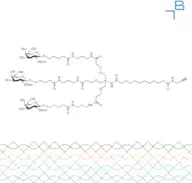
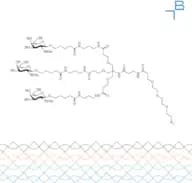
<p>Tri-b-GalNAc-C12-alkyne, also known as trebler GalNAc alkyne, is a multivalent N-acetylgalactosamine (GalNAc) compound with high-affinity to bind to the asialoglycoprotein receptor (ASGPR) found on the surface of hepatocytes in the liver. This trivalent GalNAc derivative contains a C12 alkyne linker and has been extensively studied for its potential in targeted delivery of siRNA conjugates to liver tissue. The multivalent presentation of GalNAc moieties significantly enhances the binding avidity to ASGPR making it an attractive ligand for liver-specific targeting. Researchers have reported successful conjugation of tri-b-GalNAc-C12-alkyne to various therapeutic payloads, such as small interfering RNAs (siRNAs), to facilitate their selective uptake by hepatocytes and enable targeted gene silencing in the liver.</p>Formule :C76H13N11O29Degré de pureté :Min. 95%Masse moléculaire :1,664.92 g/molGentiobiulose
CAS :<p>Gentiobiulose is a natural sweetener that is made from the sugar glucose and has a low glycemic index. It is produced by the enzymatic reaction of glucose with an acid catalyst in the presence of c1-6 alkyl groups. Gentiobiulose has a diameter of 0.5-2 micrometers and is used as a prebiotic, which promotes the growth and activity of beneficial bacteria in the gut. In addition, gentiobiulose can be used as an ingredient for detergent compositions because it has a high viscosity and particle size.</p>Formule :C12H22O11Degré de pureté :Min. 95%Couleur et forme :SolidMasse moléculaire :342.3 g/molMethyl 3,6-anhydro-a-D-galactopyranoside
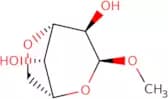
CAS :<p>Methyl 3,6-anhydro-a-D-galactopyranoside is a high purity, custom synthesis, fluorinated saccharide. It is synthesized from D-galactose by a modification of the Fischer glycosylation. Methyl 3,6-anhydro-a-D-galactopyranoside has been modified with methyl groups on the 6th and 3rd carbon atoms. This product can be used in various methods to modify carbohydrates and oligosaccharides including glycosylation, methylation and click chemistry. Methyl 3,6-anhydro-a-D-galactopyranoside is CAS No. 5540-31-8.</p>Formule :C7H12O5Degré de pureté :Min. 95%Masse moléculaire :176.17 g/mol2,6-Anhydro-3-deoxy-D-glycero-D-galacto-non-2-enoic-acid
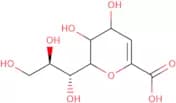
CAS :<p>2,6-Anhydro-3-deoxy-D-glycero-D-galacto-non-2-enoic acid is a carbohydrate that has been used to study the effect of immunocompromised patients on invasive aspergillosis. It has been shown to be an efficient substrate for sialidases and homologous sialidases. This carbohydrate has also been shown to have a reactive bond cleavage in the presence of catalytic enzymes, such as sialidases and glycosyltransferases. The kinetic data suggest that this carbohydrate is more accessible than other carbohydrates. The conformational change may be due to a barrier that is overcome by the catalytic enzyme.</p>Formule :C9H14O8Degré de pureté :Min. 95%Couleur et forme :White Off-White PowderMasse moléculaire :250.21 g/molN-Acetylgalactosamine-BSA
<p>N-Acetylgalactosamine-BSA is a glycoprotein that has been synthesized and purified. This product contains mannose, N-acetylglucosamine, and a variety of sugar residues. It is used as a ligand for binding to glycosidases and neoglycoproteins. N-Acetylgalactosamine-BSA also functions in the regulation of carbohydrate metabolism and the maintenance of cell membrane integrity. The product is soluble in water at millimolar concentrations.</p>Degré de pureté :Min. 95%Couleur et forme :White/Off-White SolidTri-b-GalNAc-b-alanine-PEG3-azide
<p>This molecule leverages three terminal beta-GalNAc (N-acetylgalactosamine) sugars for efficient binding to asialoglycoprotein receptors (ASGPR) expressed on liver cells (hepatocytes). The presence of the linker (beta-alanine) and the spacer (PEG3) influences the pharmacokinetics of the conjugate. The key functional group is the terminal azide, which allows for conjugation to various payloads containing alkyne groups and facilitates the development of targeted conjugates for hepatocyte delivery. Upon binding to ASGPR, tri-b-GalNAc-b-alanine-PEG3-azide conjugates are rapidly taken up by hepatocytes via endocytosis, enabling researchers to deliver therapeutic cargo (drugs, siRNA) specifically to the liver.</p>Formule :C73H130N14O32Degré de pureté :Min. 95%Masse moléculaire :1,715.9 g/moltrans-Zeatin-9-glucoside
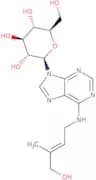
CAS :<p>Trans-zeatin-9-glucoside is a natural product that is produced by plants and is known to have a variety of biological activities. Trans-zeatin-9-glucoside has been shown to affect plant growth and development, as well as the immune system. It has also been shown to exhibit antioxidant activity and inhibit cancer cell proliferation. Trans-zeatin-9-glucoside has been found in barley, wheat, rye, oat straw, corn stover, soybean leaves, potato tubers, and composts. The biosynthesis of this compound begins with the conversion of zeatin into zeaxanthin via a series of enzymatic reactions. Zeaxanthin is then converted into trans-zeatin-9-glucoside through the action of an enzyme called β--cyclodextrin glucanotransferase.</p>Formule :C16H23N5O6Degré de pureté :Min. 98 Area-%Couleur et forme :Colorless PowderMasse moléculaire :381.38 g/mol2,3,4,6-Tetra-O-benzyl-1,5-di-O-mesyl-D-glucitol
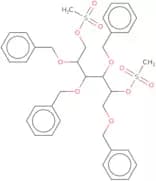
<p>2,3,4,6-Tetra-O-benzyl-1,5-di-O-mesyl-D-glucitol is a substituted sugar alcohol that can exist as either an intramolecular or an intermolecular isomer. The intramolecular isomer has a carboxylate group in the 6 position and the intermolecular isomer has a propionate group in the 6 position. 2,3,4,6-Tetra-O-benzyl-1,5-di-O-mesyl-D-glucitol has conformational properties that depend on which substituent occupies the 4 position. Benzene rings are more flexible than benzyloxy groups. The geometry of 2,3,4,6 - Tetra - O - benzyl - 1 , 5 - di - O - mesyl - D - glucitol changes from chair to boat with substitution at position</p>Formule :C36H42O10S2Degré de pureté :Min. 95%Masse moléculaire :698.84 g/mol4-Methoxyphenyl-D-ribofuranoside
<p>4-Methoxyphenyl-D-ribofuranoside is a monosaccharide that is used in the synthesis of oligosaccharides and polysaccharides. It is a synthetic compound that can be fluorinated, methylated, or glycosylated. The chemical formula for 4-methoxyphenyl-D-ribofuranoside is C6H8O5. The molecular weight of 4-methoxyphenyl-D-ribofuranoside is 184.12 g/mol. This product does not contain any hazardous chemicals and can be custom synthesized to meet your needs.</p>Degré de pureté :Min. 95%2-C-(2,3,4,6-Tetra-O-acetyl-a-D-glucopyranosyl) ethyne
CAS :<p>2-C-(2,3,4,6-Tetra-O-acetyl-a-D-glucopyranosyl) ethyne is a custom synthesis that has been modified with fluorination. It is a monosaccharide sugar with a CAS number of 1236069-71-8. This chemical is also known as Oligo(2,3,4,6-tetraacetyl aD glucopyranosyl) ethyne. The chemical is used in the synthesis of oligosaccharides and polysaccharides.</p>Formule :C16H20O9Degré de pureté :Min. 95%Masse moléculaire :356.32 g/molMethyl 2,3,4-tri-O-benzyl-b-D-glucuronide benzyl ester
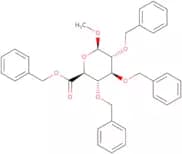
CAS :<p>Methyl 2,3,4-tri-O-benzyl-b-D-glucuronide benzyl ester is a custom synthesis that can be used as a glycosylation or methylation reagent. It has been shown to be an effective click modification reagent and can be used in the synthesis of complex carbohydrates. This compound is a carbohydrate that has been modified with fluorination and methylation. This compound has saccharide units and is a sugar. It is soluble in water and ethanol.</p>Formule :C35H36O7Degré de pureté :Min. 95%Masse moléculaire :568.66 g/mol3'-Sialyllactose-GEL
<p>3'-Sialyllactose-GEL is a custom synthesis of a complex carbohydrate. It has CAS No. and is a polysaccharide that has been modified by methylation, glycosylation, and click modification. 3'-Sialyllactose-GEL is a high purity product with fluorination. It is synthetic and has a molecular weight of 1,000 Daltons.</p>Degré de pureté :Min. 95%Tri-b-GalNAc-b-alanine-PEG3-biotin
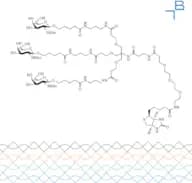
<p>Tri-b-GalNAc-b-alanine-PEG3-biotin comprises a trivalent β-GalNAc ligand, a beta-alanine-PEG3 spacer, and a biotin tag in its structure. The ligand specifically targets ASGPRs (asialoglycoprotein receptors) on hepatocyte cells due to its multivalent GalNAc residues. The flexible linker (beta-alanine-PEG3) connects the GalNAc segment to biotin, allowing researchers to attach it to streptavidin-coated surfaces. Applications include lysosomal targeting, hepatocyte studies, and drug delivery.</p>Formule :C83H146N14O34SDegré de pureté :Min. 95%Masse moléculaire :1,916.19 g/molMixture of 1,2,3,5-Tetra-O-acetyl-D-arabinofuranose and 1,2,3,4-Tetra-O-acetyl-D-arabinopyranose
CAS :<p>Tetra-O-acetyl-D-arabinose is an organic compound, a saccharide with the chemical formula C4H8O6. It is a white to off-white crystalline solid. Tetra-O-acetyl-D-arabinose is a protected form of arabinose that can be methylated and glycosylated to produce various other compounds. Tetra-O-acetyl-D-arabinose can also be modified by click chemistry or fluorination and it has been used as a synthetic intermediate for the synthesis of oligosaccharides.</p>Formule :C13H18O9Degré de pureté :(%) Min. 95%Couleur et forme :PowderMasse moléculaire :318.28 g/molTri-b-GalNAc-b-alanine-PEG4-DBCO
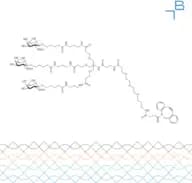
This ASGPR-targeting ligand, containing three GalNAc arms, a beta-alanine linker, a PEG spacer, and a DBCO group enables an effective conjugation to biomolecules containing azide groups via bioorthogonal CuAAC click chemistry. This strategy offers efficient and specific conjugation under mild conditions for researchers developing targeted therapeutics or probes.Formule :C94H149N13O35Degré de pureté :Min. 95%Masse moléculaire :2,021.25 g/mol5-b-Androst-1-en-17b-ol-3-one glucuronide
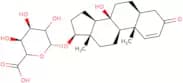
CAS :<p>5-b-Androst-1-en-17b-ol-3-one glucuronide is a carbohydrate that can be used as a building block for oligosaccharides, saccharides, and sugars. It is also a fluorinated compound that has been synthesized with high purity. This custom synthesis can be modified with methylation, glycosylation, or click chemistry.</p>Formule :C25H36O9Degré de pureté :Min. 95%Masse moléculaire :480.56 g/mol3,4,6-Tri-O-acetyl-1,2-O-isopropylidene-b-D-fructofuranose
CAS :<p>3,4,6-Tri-O-acetyl-1,2-O-isopropylidene-b-D-fructofuranose is a modification of the monosaccharide fructose. It is a complex carbohydrate that can be synthesized using custom synthesis or by modifying the monosaccharide fructose. 3,4,6-Tri-O-acetyl-1,2-O-isopropylideneb -D -fructofuranose has high purity and is available in the form of an oligosaccharide. This compound can be methylated and glycosylated and has CAS No. 7651289 5. 3,4,6 Tri O acetyl 1 2 O isopropylidene b D fructofuranose is used for research purposes as a methylating agent and for glycosylation reactions in order to modify saccharides such as sugars or polysacchar</p>Formule :C15H22O9Degré de pureté :Min. 95%Masse moléculaire :346.4 g/mol