Glycosciences
La glycosciences est l'étude des glucides et de leurs dérivés, ainsi que des interactions et des fonctions biologiques auxquelles ils participent. Ce domaine de recherche est crucial pour comprendre une grande variété de processus biologiques, y compris la reconnaissance cellulaire, la signalisation, la réponse immunitaire et le développement des maladies. La glycosciences a des applications importantes en biotechnologie, en médecine et dans le développement de nouveaux médicaments et thérapies. Chez CymitQuimica, nous proposons une large sélection de produits de haute qualité et pureté pour la recherche en glycosciences. Notre catalogue comprend des monosaccharides, des oligosaccharides, des polysaccharides, des glyconjugués et des réactifs spécifiques, conçus pour soutenir les chercheurs dans leurs études sur la structure, la fonction et les applications des glucides dans les systèmes biologiques. Ces ressources sont destinées à faciliter les découvertes scientifiques et les applications pratiques dans divers domaines des biosciences et de la médecine.
Sous-catégories appartenant à la catégorie "Glycosciences"
- Aminosucres(108 produits)
- Anticorps Glyco-Related(282 produits)
- Glycolipides(46 produits)
- Glycosaminoglycanes (GAGs)(55 produits)
- Glycosides(419 produits)
- Monosaccharides(6.622 produits)
- Oligosaccharides(3.682 produits)
- Polysaccharides(503 produits)
11042 produits trouvés pour "Glycosciences"
Trier par
Degré de pureté (%)
0
100
|
0
|
50
|
90
|
95
|
100
Blood Group B type II linear trisaccharide amine linker
<p>The linear trisaccharide amine linker is an oligosaccharide that is synthesized by glycosylation of a linear trisaccharide with an amine-containing monosaccharide. The resulting product is then methylated using the Mitsunobu reaction to yield the desired product. This product has been shown to be useful as a linker in complex carbohydrates. It has been shown to have high purity and can be custom synthesized for your specific needs.</p>Degré de pureté :Min. 95%Benzyl 2,3-O-isopropylidene-6-O-trityl-a-D-mannofuranose
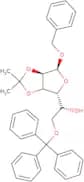
CAS :<p>Benzyl 2,3-O-isopropylidene-6-O-trityl-a-D-mannofuranose is a synthetic carbohydrate that is a modification of mannose. It has been fluorinated at the 6 position and reacted with benzyl alcohol to give the 2,3-O-isopropylidene derivative. This product is intended for use in glycosylation reactions and can be used as a sugar donor in Click chemistry.</p>Formule :C35H36O6Degré de pureté :Min. 95%Masse moléculaire :552.66 g/molAlphadolone 3-b-D-glucuronide
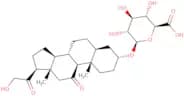
CAS :<p>Alphadolone 3-b-D-glucuronide is a compound that is synthetically derived from alphadolone. This product can be used for the synthesis of saccharides, polysaccharides, and oligosaccharides with click modification or glycosylation. It can also be used as a starting material for the preparation of methylated saccharides or glycopeptides. The chemical formula is C12H14O6F2, and it has a molecular weight of 290.20 g/mol. Alphadolone 3-b-D-glucuronide is soluble in water, methanol, and ethanol. It's CAS number is 70522-56-4.</p>Formule :C27H40O10Degré de pureté :Min. 95%Masse moléculaire :524.6 g/molPhenyl a-D-thiogalactopyranoside
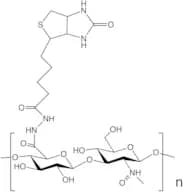
<p>Phenyl a-D-thiogalactopyranoside is a sugar with a galactose and thioglucose residue linked by an alpha-1,6 glycosidic bond. It is obtained from the hydrolysis of starch or starch derivatives such as maltodextrin. This compound can be modified through various reactions, including fluorination, glycosylation, methylation, and modification. Phenyl a-D-thiogalactopyranoside has CAS number 5664-77-5 and molecular weight of 288.24 g/mol.</p>Formule :C12H16O5SDegré de pureté :Min. 95%Masse moléculaire :272.32 g/molHyaluronate biotin - Molecular Weight - 10kDa
<p>Hyaluronate biotin is a custom synthesis of a 10kDa molecule. This product is modified and fluorinated, with methylation of the hydroxyl group and the glycosylation of the sugar monosaccharide. It is a synthetic oligosaccharide that is saccharide-containing. This product has CAS number and belongs to the group of polysaccharides or glycosylations. The carbohydrate in this product is complex.</p>Degré de pureté :Min. 95%Couleur et forme :White PowderBlood group A trisaccharide-GEL
<p>ABO trisaccharide immobilised on Fractogel with glycosylamine formation</p>Degré de pureté :Min. 95%Estrone D5 b-D-glucuronide
<p>Estrone D5 b-D-glucuronide is a synthetic compound. It is a methylated estrone derivative with the D5 configuration of the steroid nucleus. Estrone D5 b-D-glucuronide is also known as estrone 5-O-(2,3,4,5,6-pentafluorobenzoyl)glucuronide and has CAS number 70630-03-6. This compound is used in research on oligosaccharides and polysaccharides because it can be used to modify the sugar moiety at the reducing end of the saccharide chain. It can also be used to synthesize complex carbohydrate structures with fluorinated substituents. The chemical structure is shown below:</p>Degré de pureté :Min. 95%Moexiprilat acyl D-glucuronide
<p>Moexiprilat acyl D-glucuronide is a modification of the parent drug moexipril. It is an oligosaccharide that is synthesized by custom synthesis and has a high purity. The CAS number for this substance is 59710-80-0. Moexiprilat acyl D-glucuronide is a modified form of moexipril. It is a carbohydrate that contains glycosyls, saccharides, and other organic compounds with a variety of chemical structures. The name "glycosyl" refers to the sugar at the end of glycosidic linkage. Moexiprilat acyl D-glucuronide can be synthesized by methylation, glycosylation, or fluorination reactions on either monosaccharides or polysaccharides.</p>Degré de pureté :Min. 95%Silodosin b-D-glucuronide sodium salt
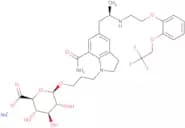
CAS :<p>Silodosin b-D-glucuronide sodium salt is a glycoconjugate of silodosin and glucuronic acid. It is a white to off-white crystalline powder that is soluble in water. Silodosin b-D-glucuronide sodium salt has been custom synthesized for the modification of saccharides and polysaccharides, which are an important part of our diet. The compound is used as a reagent for click chemistry, glycosylation, and oligosaccharide synthesis.</p>Formule :C31H39F3N3NaO10Degré de pureté :Min. 95%Couleur et forme :Off-White PowderMasse moléculaire :693.64 g/mol6'-Sialyllactose-APD-HSA
<p>6'-Sialyllactose-APD-HSA is a complex carbohydrate that belongs to the group of oligosaccharides. It has a CAS number of 102600-80-4 and it is a polysaccharide. This compound is modified with methylation, glycosylation, and click modification. It is also fluorinated and synthesized.</p>Degré de pureté :Min. 95%2-Deoxy-D-glucose-6-phosphate
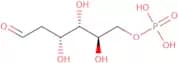
CAS :<p>2-Deoxy-D-glucose-6-phosphate is a glucose analogue that is phosphorylated by hexokinase to 2-deoxy-D-glucose. It has been shown to inhibit the activity of enzymes involved in energy metabolism, such as atp synthase and dpp IV. This drug can also inhibit the synthesis of proteins and RNA by binding to response elements, which are DNA sequences that regulate gene expression. The 2-deoxy glucose analogue has been shown to be a potent inhibitor of ventricular myocardium contractility via its ability to reduce mitochondrial membrane potential.</p>Formule :C6H13O8PDegré de pureté :Min. 95%Masse moléculaire :244.14 g/mol(2S,5S)-Bishydroxymethyl-(3R,4R)-bishydroxypyrrolidine
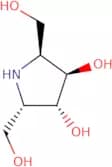
CAS :<p>(2S,5S)-Bishydroxymethyl-(3R,4R)-bishydroxypyrrolidine is a cytotoxic agent that can be used as a reagent to hydrogenolyze chloride. It is also a nucleophilic anion that can react with cisplatin to form the corresponding platinum complex. This anion has been shown to be cytotoxic against Mcf-7 cells in vitro and can inhibit DNA synthesis. (2S,5S)-Bishydroxymethyl-(3R,4R)-bishydroxypyrrolidine may also inhibit protein synthesis by reacting with anthraquinone or benzylidenation products of azasugar. The synthesis of the latter product is catalyzed by the enzyme benzylidene-pyridine dioxygenase which activates carbonyls and azasugars to form benzylic hydrazones. These reactions are sequential and have been shown to occur in</p>Formule :C6H13NO4Degré de pureté :Min. 95%Masse moléculaire :163.17 g/mol9-cis-Retinoyl b-D-glucuronide
CAS :Produit contrôlé<p>9-cis-Retinoyl b-D-glucuronide is a complex carbohydrate that is synthesized by modification of an existing saccharide. It is synthesized through the use of click chemistry, which utilizes a copper catalyst to add fluorine and methyl groups to the sugar. The sugar is then glycosylated and carbamylated in order to produce the desired product. 9-cis-Retinoyl b-D-glucuronide has been shown to have high purity, as well as fluorescence properties when it is modified with fluorine groups.</p>Formule :C26H36O8Degré de pureté :Min. 95%Masse moléculaire :476.56 g/mola-D-1,5-Difluoroglucose
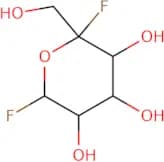
CAS :<p>a-D-1,5-Difluoroglucose is a synthetic sugar that is used in the modification of complex carbohydrates. It is fluorinated to give a stable compound that can be methylated and glucosylated. The compound has been shown to have high purity and a long shelf life.</p>Formule :C6H10F2O5Degré de pureté :Min. 95%Masse moléculaire :200.14 g/mol1,6-Anhydro-2-deoxy-2-fluoro-b-D-glucopyranose
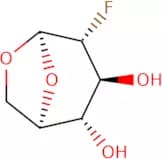
CAS :<p>1,6-Anhydro-2-deoxy-2-fluoro-b-D-glucopyranose is an analogue of 4-deoxy-4-fluoro-d-glucose that has been synthesized and characterised for the first time. The fluorine atoms on the sugar ring are replaced by hydrogen fluoride. 1,6-Anhydro-2,2,4,4,-tetraacetic acid is a dianhydride that can react with 1,6-anhydro 2,2,4,4,-tetraacetic acid to form an ester (1,6:1) or ether (1:1). It can be hydrolyzed by acids to form hydrogen fluoride and glycosyl.</p>Formule :C6H9FO4Degré de pureté :Min. 95%Masse moléculaire :164.13 g/molb-D-Thioglucose sodium salt hydrate
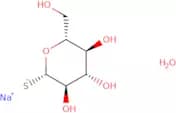
CAS :<p>b-D-Thioglucose sodium salt hydrate is a complex carbohydrate that is used as an intermediate for the synthesis of oligosaccharides and polysaccharides. It is also used in the modification of saccharide chains, such as glycosylation, and for the preparation of fluorinated carbohydrates. b-D-Thioglucose sodium salt hydrate is high purity, with no detectable impurities or degradation products. It has been modified with fluorine to form a new chemical entity that has not been previously described in the literature.</p>Formule :C6H11NaO5S·H2ODegré de pureté :Min. 95%Masse moléculaire :236.22 g/molD-Glucose-4-D
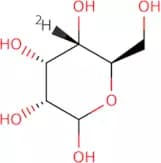
CAS :Produit contrôlé<p>D-Glucose-4-D is a deuterated form of glucose. It is a halophilic sugar that is used in the biosynthesis of lipids. D-Glucose-4-D can be synthesized chemically or by isotope effect by using d-glucose as the starting material. This compound can be used to study lipid synthesis and lipid metabolism in bacteria, such as E. coli, because it has been shown to inhibit the enzyme glycerol dehydratase, which catalyzes the conversion of glycerol to dihydroxyacetone phosphate, an intermediate in lipid biosynthesis. D-Glucose-4-D also inhibits the enzyme phosphatidate phosphohydrolase, which converts phosphatidic acid to diacylglycerol. These compounds are important for membrane lipid formation and are involved in cellular signalling pathways.</p>Formule :C6H11DO6Degré de pureté :Min. 95%Masse moléculaire :181.16 g/molRaloxifene 6-D-glucuronide D4
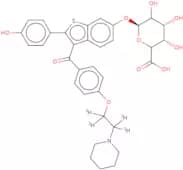
CAS :Produit contrôlé<p>Raloxifene 6-D-glucuronide D4 is a complex carbohydrate with a unique sugar modification. It is a custom synthesis that has been fluorinated, monosaccharide, and polysaccharide. It can be glycosylated and methylated as well. The desired purity level is high.</p>Formule :C34H31NO10SD4Degré de pureté :Min. 95%Masse moléculaire :653.73 g/molPhenyl 6-deoxy-6-fluoro-a-D-glucopyranoside
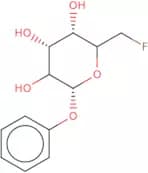
<p>Phenyl 6-deoxy-6-fluoro-a-D-glucopyranoside is a modification of the natural sugar, deoxyglucose. It is an oligosaccharide with a complex carbohydrate structure that has been modified by methylation and glycosylation. This product is synthesized from monosaccharides, and it can be fluorinated or saccharided. Phenyl 6-deoxy-6-fluoro-a-D-glucopyranoside is used in the synthesis of polysaccharides.</p>Formule :C12H15FO5Degré de pureté :Min. 95%Masse moléculaire :258.24 g/molMethyl b-D-altropyranoside
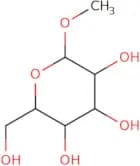
CAS :<p>Methyl b-D-altropyranoside is a methylated saccharide that can be used as a sugar substitute. It has the same sweetness as sugar and is also resistant to browning. Methyl b-D-altropyranoside is synthesized by treating an aldose or ketose with formaldehyde in the presence of sulfuric acid and an alkali. This product is water soluble, heat stable, and free from impurities such as glucose or fructose. Methyl b-D-altropyranoside can be used to modify polysaccharides and oligosaccharides, adding a methyl group to the carbon 2 position. In addition, it has been shown to have antioxidant properties due to its ability to quench reactive oxygen species (ROS).</p>Formule :C7H14O6Degré de pureté :Min. 95%Masse moléculaire :194.18 g/mol