Glycosciences
La glycosciences est l'étude des glucides et de leurs dérivés, ainsi que des interactions et des fonctions biologiques auxquelles ils participent. Ce domaine de recherche est crucial pour comprendre une grande variété de processus biologiques, y compris la reconnaissance cellulaire, la signalisation, la réponse immunitaire et le développement des maladies. La glycosciences a des applications importantes en biotechnologie, en médecine et dans le développement de nouveaux médicaments et thérapies. Chez CymitQuimica, nous proposons une large sélection de produits de haute qualité et pureté pour la recherche en glycosciences. Notre catalogue comprend des monosaccharides, des oligosaccharides, des polysaccharides, des glyconjugués et des réactifs spécifiques, conçus pour soutenir les chercheurs dans leurs études sur la structure, la fonction et les applications des glucides dans les systèmes biologiques. Ces ressources sont destinées à faciliter les découvertes scientifiques et les applications pratiques dans divers domaines des biosciences et de la médecine.
Sous-catégories appartenant à la catégorie "Glycosciences"
- Aminosucres(108 produits)
- Anticorps Glyco-Related(282 produits)
- Glycolipides(46 produits)
- Glycosaminoglycanes (GAGs)(55 produits)
- Glycosides(419 produits)
- Monosaccharides(6.624 produits)
- Oligosaccharides(3.682 produits)
- Polysaccharides(503 produits)
11046 produits trouvés pour "Glycosciences"
Trier par
Degré de pureté (%)
0
100
|
0
|
50
|
90
|
95
|
100
Methyl 1-(4'-tert-butyldimethylsilyl-6-hydroxyraloxifene)-2,3,4-tri-O-acetyl-b-D-glycopyranuronate
CAS :Methyl 1-(4'-tert-butyldimethylsilyl-6-hydroxyraloxifene)-2,3,4-tri-O-acetyl-b-D-glycopyranuronate is a modified carbohydrate. It is a synthetic saccharide that has been modified with methylation, fluorination and saccharide synthesis. This product can be custom synthesized and is available in high purity. Methyl 1-(4'-tert-butyldimethylsilyl-6-hydroxyraloxifene)-2,3,4-tri-O-acetyl-b-D--glycopyranuronate can be used in glycosylation reactions as well as Click modification reactions. CAS No: 174264–49–4.Formule :C46H55NO13SSiDegré de pureté :Min. 95%Masse moléculaire :890.08 g/mol2,3,4,6-Tetra-O-benzoyl-D-glucopyranose
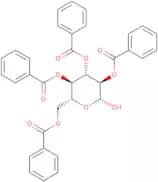
CAS :<p>2,3,4,6-Tetra-O-benzoyl-D-glucopyranose is an aldehyde that has been synthesized by the oxidation of D-glucofuranose with nitric acid. It has been shown to act as a competitive inhibitor of lipase and c-glycosidases. The acetal group in 2,3,4,6-tetra-O-benzoyl-D-glucopyranose is activated with acetyl chloride to form an acetal derivative. This compound can be used as a chemoenzymatic glycosidic bond formation method for the synthesis of various glycosides.</p>Formule :C34H28O10Degré de pureté :Min. 95%Masse moléculaire :596.6 g/mol6-O-Tosyl-D-mannose
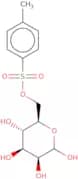
CAS :<p>6-O-Tosyl-D-mannose is a Carbohydrate, Modification, saccharide, Oligosaccharide with CAS No. 105265-64-3. It is fluorinated on the 6th carbon atom and methylated on the 3rd carbon atom. It can be used in custom synthesis and also has high purity and a custom synthesis. It can be synthesized by glycosylation or click modification.</p>Formule :C13H18O8SDegré de pureté :Min. 95%Couleur et forme :PowderMasse moléculaire :334.34 g/mol3'-Sialyl Lewis X-BSA
<p>3'-Sialyl Lewis X-BSA is a custom synthesis that is a complex carbohydrate. This product has CAS number and is polysaccharide modification with methylation, glycosylation, and click modification. The 3'-Sialyl Lewis X-BSA is fluorinated for high purity and synthetic.</p>Degré de pureté :Min. 95%Couleur et forme :White Powder3'-Sialyl-N-acetyllactosamine-BSA
<p>3'-Sialyl-N-acetyllactosamine-BSA is an oligosaccharide that is a component of the glycosylation pathway. It is synthesized from 3'-sialyllactose and N-acetylglucosamine. This compound can be modified with fluorine, methylation, or click chemistry to yield novel derivatives for use in research.</p>Degré de pureté :Min. 95%Couleur et forme :PowderLauryl glucose neopentyl glycol
CAS :Lauryl glucose neopentyl glycol is a sugar that is used in the synthesis of glycoconjugates. It is synthesized from lauryl alcohol and neopentyl glycol. Lauryl glucose neopentyl glycol can be modified with fluorine, glycosylation, methylation, or modification. This compound has been shown to have anti-inflammatory properties and to inhibit the growth of prostate cancer cells.Formule :C31H60O12Degré de pureté :Min. 95%Masse moléculaire :624.8 g/mol2-Acetamido-1,3,4,6-tetra-O-acetyl-2-deoxy-5-thio-a-D-glucopyranose
CAS :<p>2-Acetamido -1,3,4,6-tetra-O-acetyl-2-deoxy-5-thio-a-D-glucopyranose is a custom synthesis. It is an oligosaccharide and polysaccharide. It is a carbohydrate that has been modified by fluorination and a click modification. The complex carbohydrate contains one monosaccharide sugar. 2AATG can be used in the synthesis of other carbohydrates.</p>Formule :C16H23NO9SDegré de pureté :Min. 95%Masse moléculaire :405.42 g/mol1,2:3,4-Di-O-isopropylidene-6-deoxy-6-tosyl-a-D-galactopyranose
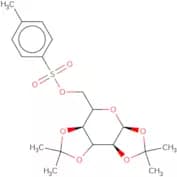
CAS :1,2:3,4-Di-O-isopropylidene-6-deoxy-6-tosyl-a-D-galactopyranose is a synthetic compound that has been modified by fluorination and glycosylation. It is used as an intermediate in the synthesis of oligosaccharides and polysaccharides. The compound has been custom synthesized to a high purity level with minimal impurities. The product is available in monosaccharide form or as a complex carbohydrate.Formule :C19H26O8SDegré de pureté :Min. 95%Masse moléculaire :414.47 g/molMethyl 2-acetamido-3-O-(2,3,4,6-tetra-O-acetyl-b-D-galactopyranosyl)-2-deoxy-4,6-O-(4-methoxybenzylidene)-a-D-galactopyranoside
CAS :Methyl 2-acetamido-3-O-(2,3,4,6-tetra-O-acetyl-b-D-galactopyranosyl)-2-deoxy-4,6-O-(4-methoxybenzylidene)-a-D-galactopyranoside is a custom synthesis of an oligosaccharide with a polysaccharide. It is a fluorinated complex carbohydrate that has been modified for high purity. Methyl 2 acetamido 3 O (2,3,4,6 tetra O acetyl b D galactopyranosyl) 2 deoxy 4,6 O (4 methoxybenzylidene) a D galactopyranoside is composed of monosaccharides and sugar.Formule :C31H41NO16Degré de pureté :Min. 95%Masse moléculaire :683.65 g/mol3-Deoxy-D-ribose
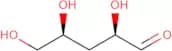
CAS :3-Deoxy-D-ribose is a monosaccharide with a molecular formula of CH(OH)CO. It is the 3-deoxy form of ribose and its pyranose ring has an oxygen atom at the 3 position. 3-Deoxy-D-ribose can be synthesized by periodate treatment of glyceric acid in the presence of hydrochloric acid, followed by hydrolysis to produce sorbose and then reaction with glycolaldehyde to produce D-glycero-D-galactopyranosyl bromide. The final step is conversion to 3-deoxyribose by reaction with aqueous ammonia. 3-Deoxyribose inhibits ribulose synthesis, which prevents the formation of an intermediate molecule required for the synthesis of fatty acids and phospholipids.Degré de pureté :Min. 95%O-(2-Azido-4,6-O-benzylidene-2-deoxy-a-D-galactopyranosyl)-N-[(9H-fluoren-9-ylmethoxy)carbonyl]-L-threonine tert-Butyl Ester
CAS :The compound is an O-linked glycosylation site-specifically modified oligosaccharide. The modification is a methylation of the hydroxyl group on the 2-position of the sugar moiety. The carbohydrate is a polysaccharide that has been fluorinated at one or more positions. It has CAS No. 195976-07-9 and was synthesized by glycosylation and methylation of L-threonine tert-butyl ester with D-galactopyranosyl chloride in presence of 4,6-O-(2,3,4,6-tetraisopropoxybenzoyl)-D-galactopyranosyl chloride (TIPB) and sodium hydrogen carbonate (NaHCO).Formule :C36H40N4O9Degré de pureté :Min. 95%Masse moléculaire :672.72 g/mol2,3,4,6-Tetra-O-acetyl-1-bromo-1-deoxy-b-D-galactopyranosyl cyanide
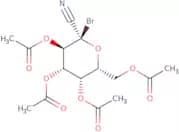
CAS :<p>2,3,4,6-Tetra-O-acetyl-1-bromo-1-deoxy-b-D-galactopyranosyl cyanide is a Carbohydrate with CAS No. 83497-42-1. It is a saccharide with the molecular formula C8H12O8 and molecular weight of 300.19 g/mol. The chemical structure of 2,3,4,6-Tetra-O-acetyl-1-bromo-, 1 -deoxy-. b-.D-.galactopyranosyl cyanide is shown in the figure below:<br>2,3,4,6,-Tetra--O--acetyl--1--bromo--1--deoxy-. b-.D-.galactopyranosyl cyanide has been shown to have fluoroquinolone resistance properties.</p>Formule :C15H18BrNO9Degré de pureté :Min. 95%Masse moléculaire :438.3 g/mol4-Deoxy-L-fucose
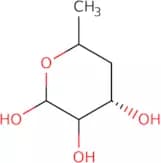
CAS :<p>4-Deoxy-l-fucose is a molecule that has been found to inhibit the synthesis of gangliosides. It is an acetylated derivative of l-fucose and can be synthesized from ethyl 4-deoxy-D-glucuronate with the help of a multivorans enzyme. This molecule is metabolically unstable and reacts with oxygen to form a divalent alcohol that can be identified by magnetic resonance spectroscopy. 4-Deoxy-l-fucose inhibits the biosynthesis of gangliosides, which are important molecules in cell signaling, through its ability to inhibit enzymes such as acetyltransferase.</p>Formule :C6H12O4Degré de pureté :Min. 95%Couleur et forme :White To Off-White SolidMasse moléculaire :148.16 g/mol1,2-O-Isopropylidene-b-L-apiose
CAS :<p>1,2-O-Isopropylidene-b-L-apiose is a carbohydrate with the molecular formula C8H10O4. It is a monosaccharide that is derived from D-mannose by methylation and glycosylation. 1,2-O-Isopropylidene-b-L-apiose has been synthetically modified to improve its properties. The chemical structure of this compound has been modified by fluorination, saccharide modification and glycosylation to increase its solubility in water.</p>Formule :C8H14O5Degré de pureté :Min. 95%Masse moléculaire :190.19 g/molHeptamaloxyloglucan
CAS :Heptamaloxyloglucan is an analog of marbofloxacin that has been shown to inhibit tumor growth and induce apoptosis in cancer cells. This compound acts as a kinase inhibitor, blocking the activity of enzymes involved in cell division and proliferation. Heptamaloxyloglucan has also been found to have anticancer properties, inhibiting the growth of cancer cells and inducing apoptosis through various mechanisms. In addition, this compound has been shown to be effective in treating urinary tract infections caused by gram-negative bacteria such as Escherichia coli and Proteus mirabilis. Heptamaloxyloglucan may also have potential therapeutic applications for other diseases such as hypertension, as it has been found to be a potent inhibitor of ACE (angiotensin-converting enzyme) activity.Formule :C40H70O33Degré de pureté :75%MinMasse moléculaire :1,079 g/molBenzyl b-D-xylopyranoside
CAS :Benzyl b-D-xylopyranoside is an inorganic compound that is used as a radioactive tracer to study the movement of fluid and macromolecules in the apical membrane of the chondrocyte. It was shown to be effective in preventing the formation of tissue-damaging acute phase proteins when administered at a time point corresponding to the onset of an acute inflammatory response. Benzyl b-D-xylopyranoside has also been shown to have regulatory effects on untreated control cells, but not on untreated control cells. This drug inhibits biosynthesis of GAGs, which are molecules that provide structural support for cells and tissues. The mechanism by which benzyl b-D-xylopyranoside exerts its effect is not yet known.Formule :C12H16O5Degré de pureté :Min. 95%Masse moléculaire :240.25 g/mol2,3,4,6-Tetra-O-acetyl-a-D-mannopyranosyl-N-Fmoc-L-serine pentafluorophenyl ester
CAS :<p>2,3,4,6-Tetra-O-acetyl-a-D-mannopyranosyl-N-Fmoc-L-serine pentafluorophenyl ester is a saccharide that has been modified using the Click chemistry. It is a polysaccharide and an oligosaccharide with a high degree of purity. The chemical formula for this compound is C22H32FN3O14PS and its molecular weight is 594.06 g/mol. This substance can be used in the synthesis of complex carbohydrates.</p>Formule :C38F5H34NO14Degré de pureté :Min. 95%Masse moléculaire :823.68 g/molAPF Sialoglycopeptide ammonium
CAS :<p>APF Sialoglycopeptide ammonium salt is a custom synthesis of sialoglycopeptides. The molecule is modified with fluorination, methylation and click modification. It contains a monosaccharide and an oligosaccharide. The saccharide is glycosylated to a complex carbohydrate. APF Sialoglycopeptide ammonium salt has CAS No.:</p>Formule :C63H107N11O29Degré de pureté :Min. 95%Couleur et forme :PowderMasse moléculaire :1,482.58 g/molUDP-β-D-glucose sodium
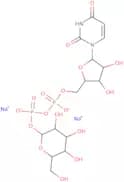
CAS :<p>UDP-β-D-glucose sodium is an oligosaccharide that can be used to synthesize glycoproteins and glycolipids. UDP-β-D-glucose sodium is a synthetic compound that contains one β-D-glucose moiety, which is attached to the molecule via a β-(1→4) linkage. This product can be custom synthesized and modified to suit customer needs. It has been shown to have high purity, chemical stability, and good solubility in water. The synthesis of UDP-β-D-glucose sodium has been modified by click chemistry to produce a variety of different products with new properties.</p>Formule :C15H22N2Na2O17P2Degré de pureté :Min. 95%Couleur et forme :PowderMasse moléculaire :610.27 g/mol3-Azido-2,3-dideoxy-1-O-(tert-butyldimethylsilyl)-b-D-arabino-hexopyranose
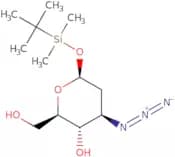
CAS :3-Azido-2,3-dideoxy-1-O-(tert-butyldimethylsilyl)-b-D-arabino-hexopyranose is a synthetic sugar with the chemical formula (C6H11NO5)n. It is a white crystalline solid that is soluble in water and slightly soluble in ethanol. 3-Azido-2,3-dideoxy-1-O-(tert-butyldimethylsilyl)-b-D-arabinohexopyranose has been used as a building block for the synthesis of various carbohydrate derivatives, such as saccharides, oligosaccharides, and polysaccharides. The chemical structure of 3 azido 2,3 dideoxy 1 O tert butyldimethylsilyl b D arabinohexopyranose may be modified using click chemistry to produce new derivatives.Formule :C12H25N3O4SiDegré de pureté :Min. 95%Masse moléculaire :303.43 g/mol





![O-(2-Azido-4,6-O-benzylidene-2-deoxy-a-D-galactopyranosyl)-N-[(9H-fluoren-9-ylmethoxy)carbonyl]-L-…](/_next/image/?url=https%3A%2Fstatic.cymitquimica.com%2Fproducts%2F3D%2Fthumb-webp%2FMA60609.webp&w=3840&q=75)