Glycosciences
La glycosciences est l'étude des glucides et de leurs dérivés, ainsi que des interactions et des fonctions biologiques auxquelles ils participent. Ce domaine de recherche est crucial pour comprendre une grande variété de processus biologiques, y compris la reconnaissance cellulaire, la signalisation, la réponse immunitaire et le développement des maladies. La glycosciences a des applications importantes en biotechnologie, en médecine et dans le développement de nouveaux médicaments et thérapies. Chez CymitQuimica, nous proposons une large sélection de produits de haute qualité et pureté pour la recherche en glycosciences. Notre catalogue comprend des monosaccharides, des oligosaccharides, des polysaccharides, des glyconjugués et des réactifs spécifiques, conçus pour soutenir les chercheurs dans leurs études sur la structure, la fonction et les applications des glucides dans les systèmes biologiques. Ces ressources sont destinées à faciliter les découvertes scientifiques et les applications pratiques dans divers domaines des biosciences et de la médecine.
Sous-catégories appartenant à la catégorie "Glycosciences"
- Aminosucres(108 produits)
- Anticorps Glyco-Related(282 produits)
- Glycolipides(46 produits)
- Glycosaminoglycanes (GAGs)(55 produits)
- Glycosides(419 produits)
- Monosaccharides(6.624 produits)
- Oligosaccharides(3.682 produits)
- Polysaccharides(503 produits)
11046 produits trouvés pour "Glycosciences"
Trier par
Degré de pureté (%)
0
100
|
0
|
50
|
90
|
95
|
100
N-Acetylneuraminic acid trimer disodium salt
<p>N-Acetylneuraminic acid trimer disodium salt is a methylated saccharide that is used in the synthesis of complex carbohydrates. It can be modified by Click chemistry to produce a variety of compounds, including oligosaccharides. N-Acetylneuraminic acid trimer disodium salt can also be fluorinated for use as an organic fluorinating agent in glycosylation reactions to make sugar derivatives. This compound has high purity and is custom synthesized to meet customer needs.</p>Formule :C33H50N3O25Na3Degré de pureté :Min. 95%Couleur et forme :White PowderMasse moléculaire :957.72 g/mol2-Bromoethyl a-L-fucopyranoside
<p>This compound is a modification of the 2-bromoethyl a-L-fucopyranoside. It is an oligosaccharide that is a carbohydrate. It is made up of many monosaccharides, which are sugar molecules linked together. This modified carbohydrate has been synthesized from other carbohydrates and then fluorinated to make it more stable.</p>Degré de pureté :Min. 95%Dimethylthexylsilyl 2,3,6-tri-O-benzyl-b-D-galactopyranoside
<p>Dimethylthexylsilyl 2,3,6-tri-O-benzyl-b-D-galactopyranoside is a synthetic oligosaccharide with a fluorinated benzene ring. It is an important intermediate for glycosylation and can be modified with methyl groups or click chemistry. This product is of high purity and has been custom synthesized. Dimethylthexylsilyl 2,3,6-tri-O-benzyl-b-D-galactopyranoside has CAS number 69422-24-2.</p>Degré de pureté :Min. 95%Phenyl 6-deoxy-6-fluoro-a-D-glucopyranoside
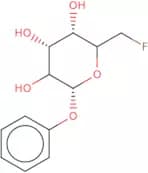
<p>Phenyl 6-deoxy-6-fluoro-a-D-glucopyranoside is a modification of the natural sugar, deoxyglucose. It is an oligosaccharide with a complex carbohydrate structure that has been modified by methylation and glycosylation. This product is synthesized from monosaccharides, and it can be fluorinated or saccharided. Phenyl 6-deoxy-6-fluoro-a-D-glucopyranoside is used in the synthesis of polysaccharides.</p>Formule :C12H15FO5Degré de pureté :Min. 95%Masse moléculaire :258.24 g/molRaloxifene 6-D-glucuronide D4
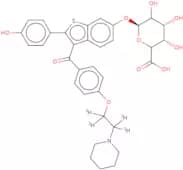
CAS :Produit contrôlé<p>Raloxifene 6-D-glucuronide D4 is a complex carbohydrate with a unique sugar modification. It is a custom synthesis that has been fluorinated, monosaccharide, and polysaccharide. It can be glycosylated and methylated as well. The desired purity level is high.</p>Formule :C34H31NO10SD4Degré de pureté :Min. 95%Masse moléculaire :653.73 g/mol9-cis-Retinoyl b-D-glucuronide
CAS :Produit contrôlé<p>9-cis-Retinoyl b-D-glucuronide is a complex carbohydrate that is synthesized by modification of an existing saccharide. It is synthesized through the use of click chemistry, which utilizes a copper catalyst to add fluorine and methyl groups to the sugar. The sugar is then glycosylated and carbamylated in order to produce the desired product. 9-cis-Retinoyl b-D-glucuronide has been shown to have high purity, as well as fluorescence properties when it is modified with fluorine groups.</p>Formule :C26H36O8Degré de pureté :Min. 95%Masse moléculaire :476.56 g/mol(2S,5S)-Bishydroxymethyl-(3R,4R)-bishydroxypyrrolidine
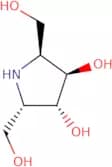
CAS :<p>(2S,5S)-Bishydroxymethyl-(3R,4R)-bishydroxypyrrolidine is a cytotoxic agent that can be used as a reagent to hydrogenolyze chloride. It is also a nucleophilic anion that can react with cisplatin to form the corresponding platinum complex. This anion has been shown to be cytotoxic against Mcf-7 cells in vitro and can inhibit DNA synthesis. (2S,5S)-Bishydroxymethyl-(3R,4R)-bishydroxypyrrolidine may also inhibit protein synthesis by reacting with anthraquinone or benzylidenation products of azasugar. The synthesis of the latter product is catalyzed by the enzyme benzylidene-pyridine dioxygenase which activates carbonyls and azasugars to form benzylic hydrazones. These reactions are sequential and have been shown to occur in</p>Formule :C6H13NO4Degré de pureté :Min. 95%Masse moléculaire :163.17 g/molMoexiprilat acyl D-glucuronide
<p>Moexiprilat acyl D-glucuronide is a modification of the parent drug moexipril. It is an oligosaccharide that is synthesized by custom synthesis and has a high purity. The CAS number for this substance is 59710-80-0. Moexiprilat acyl D-glucuronide is a modified form of moexipril. It is a carbohydrate that contains glycosyls, saccharides, and other organic compounds with a variety of chemical structures. The name "glycosyl" refers to the sugar at the end of glycosidic linkage. Moexiprilat acyl D-glucuronide can be synthesized by methylation, glycosylation, or fluorination reactions on either monosaccharides or polysaccharides.</p>Degré de pureté :Min. 95%Sulfamethoxazole b-D-glucuronide
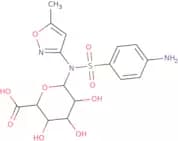
CAS :<p>Sulfamethoxazole b-D-glucuronide is a microbial conjugate that is used to treat bacterial infections. It binds to microbial cell surfaces through covalent bonds, which prevents the synthesis of proteins and DNA, leading to cell death. Sulfamethoxazole b-D-glucuronide has been shown to be activated by the enzyme acetyltransferase in bacteria and may be used as an indicator for the presence of sulfonamide resistance. This antibiotic also has a high affinity for thyroxine and analytes such as acetaminophen and sulfate.</p>Formule :C16H19N3O9SDegré de pureté :Min. 95%Masse moléculaire :429.41 g/mol7,7a-Diepialexine
CAS :<p>7,7a-Diepialexine is a molecule that has been shown to inhibit the replication of human immunodeficiency virus (HIV). This drug has been shown to inhibit the growth of bacteria in cell culture. It has been observed that 7,7a-diepialexine inhibits HIV integrase by binding to the enzyme's active site. In addition, this molecule inhibits cellular proliferation and induces apoptosis in animal models. 7,7a-Diepialexine is an enantiomer of 7,7b-diepialexine which is also a potent inhibitor of HIV integrase. The analytical method for separating these two enantiomers is not available at this time.</p>Degré de pureté :Min. 95%D-Glucose-1,6-diphosphate potassium salt
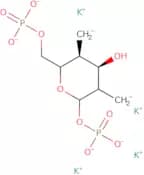
CAS :<p>D-Glucose-1,6-diphosphate potassium salt is a white crystalline powder that has a molecular weight of 594.14 g/mol and a chemical formula of C₁₀H₁₅O₃P. It is used as an intermediate in the synthesis of saccharides. D-Glucose-1,6-diphosphate potassium salt is not known to be toxic to humans or animals.</p>Formule :C6H10K4O12P2Degré de pureté :Min. 95%Masse moléculaire :492.48 g/mol3-O-b-D-Galactosylsucrose
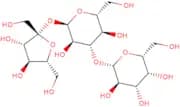
CAS :<p>3-O-b-D-Galactosylsucrose is a synthetic, fluorinated, high purity, oligosaccharide. It is a complex carbohydrate that contains an O-linked glycosylated monosaccharide. This product has been modified with a click modification. The CAS number for this product is 686717-73-7 and it can be synthesized to order.</p>Formule :C18H32O16Degré de pureté :Min. 95%Couleur et forme :PowderMasse moléculaire :504.44 g/mol2-O-Benzyl-D-glucose
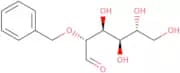
CAS :<p>2-O-Benzyl-D-glucose is a disaccharide that is an intermediate in the synthesis of benzoic acid. It is benzylated with benzaldehyde and then reacted with sodium hydroxide to form 2-O-benzylidene-D-glucose. Spectroscopy has shown that this product has an anomeric proton at δH 7.1 to 7.4 and a pyranoside group at δH 4.2 to 4.6, which are characteristic of 2-O-benzylidene-D-glucose. The sugar's molecular formula is C9H12O5, and its molecular weight is 230. The sugar has been shown to be acylated with acetate or benzoic acid as well as undergo glycosidation reactions in the presence of sulfuric acid or sodium hydroxide.</p>Formule :C13H18O6Degré de pureté :Min. 95%Masse moléculaire :270.28 g/mol3-Amino-2,3-dideoxy-D-myo-inositol
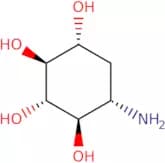
CAS :<p>3-Amino-2,3-dideoxy-D-myo-inositol (3ADMI) is a gene product that belongs to the class of chemical biology. It is an actuator that has been shown to be able to bind and activate enzymes. 3ADMI is used as a substrate in the calibration of enzyme kinetics and as an analog for aminoglycosides. The conjugates of 3ADMI have been shown to prevent viral replication by inhibiting the synthesis of DNA or RNA.</p>Formule :C6H13NO4Degré de pureté :Min. 95%Couleur et forme :White/Off-White SolidMasse moléculaire :163.17 g/molSulindac-acyl-b-D-glucuronide
CAS :<p>Sulindac-acyl-b-D-glucuronide is a high purity, custom synthesis, synthetic sugar. It is a complex carbohydrate that contains saccharide, oligosaccharides, and monosaccharides. The CAS number for this compound is 60018-36-2.</p>Formule :C26H25FO9SDegré de pureté :Min. 95%Masse moléculaire :532.54 g/molMan-9-Glc N-Glycan
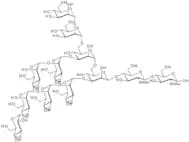
CAS :<p>Man-9-Glc N-Glycan is a synthetic carbohydrate that is a modification of the natural sugar, Man-9-GlcNAc. It can be used as an ingredient in pharmaceutical products, such as vaccines and other therapeutic agents. This product is a custom synthesis that can be produced to order.</p>Formule :C76H128N2O61Degré de pureté :Min. 95%Masse moléculaire :2,045.81 g/mol2,3,4,6-Tetra-O-acetyl-1-O-(2,3,4-tri-O-benzoyl-a-L-fucopyranosyl)-D-galactopyranoside
<p>2,3,4,6-Tetra-O-acetyl-1-O-(2,3,4-tri-O-benzoyl-a-L-fucopyranosyl)-D-galactopyranoside is a glycosylated polysaccharide that has been modified by methylation and fluorination. It is synthesized from the monosaccharide D galactopyranose with a 2,3,4,6 tetra O acetyl group at the 1 position.</p>Formule :C41H42O17Degré de pureté :Min. 95%Masse moléculaire :806.76 g/mol2-Acetamido-2-deoxy-a-D-galactopyranosyl-(N-Fmoc)-L-threonine tert-butyl ester
CAS :<p>2-Acetamido-2-deoxy-a-D-galactopyranosyl-(N-Fmoc)-L-threonine tert-butyl ester is a fluorinated carbohydrate that is synthesized from 2,3,4,6-tetraacetylorthoquinone and L-threonine tert butyl ester. It has a purity of 99%.</p>Formule :C31H40N2O10Degré de pureté :Min. 95%Masse moléculaire :600.66 g/molRutinulose
CAS :<p>A disaccharide</p>Formule :C12H22O10Degré de pureté :Min. 95%Masse moléculaire :326.3 g/mol(+)-1,4-Di-O-benzyl-D-threitol
CAS :<p>(+)-1,4-Di-O-benzyl-D-threitol is a carbohydrate which is an enantiomer of D-threitol. It has been used as a model membrane to investigate the interaction of divalent cations with the lipid bilayer. The (+) form of this compound has been shown to be catalytic in the desymmetrization of racemic mixtures of carbohydrates. This enantiomer can be readily chromatographically separated from its mirror image by chiral chromatography techniques.</p>Formule :C18H22O4Degré de pureté :Min. 95%Masse moléculaire :302.36 g/mol