Glycosciences
La glycosciences est l'étude des glucides et de leurs dérivés, ainsi que des interactions et des fonctions biologiques auxquelles ils participent. Ce domaine de recherche est crucial pour comprendre une grande variété de processus biologiques, y compris la reconnaissance cellulaire, la signalisation, la réponse immunitaire et le développement des maladies. La glycosciences a des applications importantes en biotechnologie, en médecine et dans le développement de nouveaux médicaments et thérapies. Chez CymitQuimica, nous proposons une large sélection de produits de haute qualité et pureté pour la recherche en glycosciences. Notre catalogue comprend des monosaccharides, des oligosaccharides, des polysaccharides, des glyconjugués et des réactifs spécifiques, conçus pour soutenir les chercheurs dans leurs études sur la structure, la fonction et les applications des glucides dans les systèmes biologiques. Ces ressources sont destinées à faciliter les découvertes scientifiques et les applications pratiques dans divers domaines des biosciences et de la médecine.
Sous-catégories appartenant à la catégorie "Glycosciences"
- Aminosucres(108 produits)
- Anticorps Glyco-Related(282 produits)
- Glycolipides(46 produits)
- Glycosaminoglycanes (GAGs)(55 produits)
- Glycosides(419 produits)
- Monosaccharides(6.622 produits)
- Oligosaccharides(3.682 produits)
- Polysaccharides(503 produits)
11041 produits trouvés pour "Glycosciences"
Trier par
Degré de pureté (%)
0
100
|
0
|
50
|
90
|
95
|
100
2-C-(2,3,4,6-Tetra-O-benzyl-b-D-glucopyranosyl) ethyne
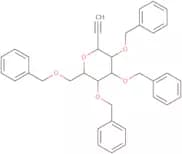
CAS :<p>2-C-(2,3,4,6-Tetra-O-benzyl-b-D-glucopyranosyl) ethyne is a synthetic monosaccharide. It has a molecular formula of C12H14O8 and a molecular weight of 302.24 g/mol. 2-C-(2,3,4,6-Tetra-O-benzyl-b-D-glucopyranosyl) ethyne is used to modify oligosaccharides and polysaccharides in the synthesis of complex carbohydrates. This chemical is also used as an intermediate in the fluorination reaction to produce polyfluorinated molecules with high purity.</p>Formule :C29H30O5Degré de pureté :Min. 95%Masse moléculaire :458.55 g/mol1,6:3,4-Dianhydro-2-O-p-toluenesulfonyl-β-D-galactopyranose
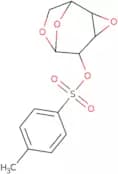
CAS :<p>1,6:3,4-Dianhydro-2-O-p-toluenesulfonyl-b-D-galactopyranose is a fluorinated monosaccharide that can be used in glycosylation reactions. This compound can be custom synthesized and is not available commercially. It has CAS No. 6167-32-4 and its molecular weight is 489.1 g/mol.</p>Formule :C13H14O6SDegré de pureté :Min. 95%Couleur et forme :PowderMasse moléculaire :298.31 g/mol2,3,4,6-Tetra-O-acetyl-b-D-glucopyranosyl-(N2-Fmoc)-L-asparagine tert-butyl ester
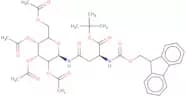
CAS :<p>2,3,4,6-Tetra-O-acetyl-b-D-glucopyranosyl-(N2-Fmoc)-L-asparagine tert-butyl ester is a glycosylation reagent that contains a reactive primary amine. It is used in the synthesis of complex carbohydrates and oligosaccharides. This compound is also used as a fluorinating agent for saccharides and sugars. 2,3,4,6-Tetra-O-acetyl-b-D-glucopyranosyl-(N2-Fmoc)-L-asparagine tert butyl ester can be custom synthesized to meet your needs. This product has CAS number 16041617 1 and it is available in high purity.</p>Formule :C37H44N2O14Degré de pureté :Min. 95%Masse moléculaire :740.75 g/mol1,2-o-Isopropylidene-β-D-fructopyranose
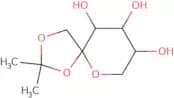
CAS :<p>1,2-O-Isopropylidene-β-D-fructopyranose is a synthetic monosaccharide. It is a fluorinated derivative of fructopyranose. This product is a modification of the alpha anomeric form of β-D-fructopyranose. It has been used as a substrate for various types of glycosylation reactions, such as methylation and click modification.</p>Formule :C9H16O6Degré de pureté :Min. 95%Masse moléculaire :220.22 g/mol1,2,5-Tri-O-acetyl-3-deoxy-3-fluoro-D-ribofuranose
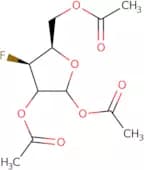
CAS :<p>1,2,5-Tri-O-acetyl-3-deoxy-3-fluoro-D-ribofuranose is a custom synthesis. It is a complex carbohydrate that can be modified with methylation and glycosylation to produce an Oligosaccharide or Polysaccharide. This molecule has been used in click chemistry to modify the sugar moiety and fluorinate the ribose group. 1,2,5-Tri-O-acetyl-3-deoxy--D--ribofuranose has CAS number 1556020-32-6 and has a purity of 99%.</p>Formule :C11H15FO7Degré de pureté :Min. 95%Masse moléculaire :278.23 g/molEthyl 2,3,4-tri-O-acetyl-b-D-glucuronide methyl ester
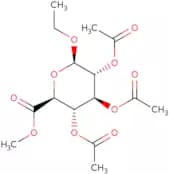
CAS :<p>Ethyl 2,3,4-tri-O-acetyl-b-D-glucuronide methyl ester is a fluorinated monosaccharide. It can be used as a synthetic intermediate for the production of oligosaccharides and polysaccharides. This product is also used in the glycosylation of sugar molecules.</p>Formule :C15H22O10Degré de pureté :Min. 95%Masse moléculaire :362.33 g/mol5-O-(t-Butyldiphenylsilyl)-1,2-O-isopropylidene-a-D-xylofuranose
CAS :<p>5-O-(t-Butyldiphenylsilyl)-1,2-O-isopropylidene-a-D-xylofuranose is a modification of the sugar xylofuranose. This compound is synthesized from 1,2-O-isopropylidene erythrose using tetrabutyldiphenylsilyl chloride and triethylamine. It is a white solid that can be used as a monosaccharide or polysaccharide in glycosylation reactions. 5-O-(t-Butyldiphenylsilyl)-1,2-O-isopropylidene -a D -xylofuranose has been found to have high purity and can be used for methylation and fluorination reactions.</p>Formule :C24H32O5SiDegré de pureté :Min. 95%Masse moléculaire :428.59 g/molMycophenolic acid acyl-b-D-glucuronide allyl ester
CAS :<p>Mycophenolic acid acyl-b-D-glucuronide allyl ester is a modification of the natural product mycophenolic acid. It is an oligosaccharide made up of a complex carbohydrate that is synthesized from monosaccharides, methylated, and glycosylated. This compound has been shown to be useful in the synthesis of polysaccharides and saccharides. Mycophenolic acid acyl-b-D-glucuronide allyl ester can be fluorinated and saccharified to increase its stability.</p>Formule :C26H32O12Degré de pureté :Min. 95%Masse moléculaire :536.53 g/molPhenyl 2,3,4,6-tetra-O-benzyl-b-D-thiogalactopyranoside
CAS :<p>The chemical name for Phenyl 2,3,4,6-tetra-O-benzyl-b-D-thiogalactopyranoside is Phenyl 2,3,4,6-tetra-O-benzyl-b-D-thiogalactopyranoside. This chemical is a Carbohydrate that is Modification and saccharide. It has the molecular formula of C12H14O8S2. Phenyl 2,3,4,6-tetra-O-benzyl-b-D-thiogalactopyranoside is an Oligosaccharide with a sugar type of Monosaccharide. The Chemical Abstracts Service (CAS) registry number for this chemical is 577861 - 19 - 1. Phenyl 2,3,4,6 tetra O benzyl b D thiogalactop</p>Formule :C40H40O5SDegré de pureté :Min. 95%Couleur et forme :PowderMasse moléculaire :632.81 g/molMethyl (methyl 3-deoxy-D-arabino-hept-2-ulopyranosid)onate-7-phosphate
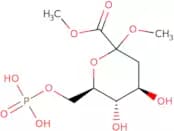
CAS :<p>Methyl (methyl 3-deoxy-D-arabino-hept-2-ulopyranosid)onate-7-phosphate is a Glycosylation, Oligosaccharide, sugar, Synthetic, Fluorination, Custom synthesis, Methylation, Monosaccharide, Polysaccharide, saccharide with CAS No. 91382-80-8. It is typically used as a modifier of complex carbohydrate. This product has high purity and can be modified.</p>Formule :C9H17O10PDegré de pureté :Min. 95%Masse moléculaire :316.2 g/molLumefantrine glucuronide - (mixture of diasteromers)
<p>Lumefantrine glucuronide is a sugar molecule that is glycosylated. It is the active form of lumefantrine and has been shown to be effective against malaria. Lumefantrine glucuronide binds to the parasite's RBCs, inhibiting the conversion of glucose into glycogen, thus preventing the production of ATP. Lumefantrine glucuronide is synthesized by attaching a sugar molecule to an amino acid backbone through an amide bond. The sugar molecule in this case is known as Glucuronic acid and it can be methylated or fluorinated. Lumefantrine glucuronide is also modified with Click chemistry, which involves attaching a reactive group to a chemical species that reacts with other chemical species at a distance. This modification allows for the attachment of polymers such as saccharides or oligosaccharides onto lumefantrine glucuronide.</p>Formule :C36H40Cl3NO7Degré de pureté :Min. 95%Masse moléculaire :705.06 g/molMethyl 2,3,6-tri-O-benzyl-b-D-glucopyranoside
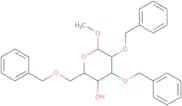
CAS :<p>Methyl 2,3,6-tri-O-benzyl-b-D-glucopyranoside is a glycoconjugate that is a synthetically modified glycosylated sugar. It is used to modify proteins by covalently attaching the sugar to an amino acid residue. Methyl 2,3,6-tri-O-benzyl-b-D-glucopyranoside has been shown to be useful for click chemistry reactions and can be used in the synthesis of polysaccharides and oligosaccharides. This compound can also be used as a substitute for glucose in the synthesis of saccharides or sugars. Methyl 2,3,6-tri-O-benzyl-b-D-glucopyranoside is insoluble in water and has a CAS number of 19488494.</p>Formule :C28H32O6Degré de pureté :Min. 95%Masse moléculaire :464.55 g/molFructononasaccharide
<p>Fructononasaccharide is a modification of oligosaccharides that is synthesized from sucrose. It is a complex carbohydrate that has been modified with methylation and glycosylation. Fructononasaccharide is used in the synthesis of polysaccharides, as well as for the production of high-purity, custom-synthesized monosaccharides and disaccharides. Fructononasaccharide can be fluorinated or saccharified to produce different compounds.</p>Formule :C54H92O46Degré de pureté :Min. 95%Couleur et forme :PowderMasse moléculaire :1,477.28 g/mol2-(Benzyloxycarbonylamino)-2-deoxy-D-galactose
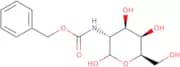
CAS :<p>2-(Benzyloxycarbonylamino)-2-deoxy-D-galactose is a synthetic, fluorinated carbohydrate. It is a monosaccharide with the chemical formula C6H11NO5 and is soluble in water. The glycosylation of 2-(benzyloxycarbonylamino)-2-deoxy-D-galactose has been shown to be more stable than that of other sugars, such as glucose or maltose. This modification can be accomplished by a click reaction. 2-(Benzyloxycarbonylamino)-2-deoxy-D-galactose can be used to modify proteins, such as antibodies and enzymes, by glycosylating amino acid residues on the protein surface.</p>Formule :C14H19NO7Degré de pureté :Min. 95%Masse moléculaire :313.3 g/molMethyl 2-acetamido-4-O-(2-acetamido-3,4,6-tri-O-acetyl-2-deoxy-b-D-glucopyranosyl)-2-deoxy-b-D-glucopyranoside
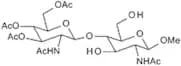
CAS :<p>Methyl 2-acetamido-4-O-(2-acetamido-3,4,6-tri-O-acetyl-2-deoxy-b-D-glucopyranosyl)-2-deoxy-b-D-glucopyranoside is a custom synthesis that is fluorinated and methylated to create an acetal. The monosaccharide is a custom synthesis that has been modified with click chemistry. This oligosaccharide is found in glycosylation reactions and can be used for the synthesis of polysaccharides. Methyl 2 acetamido 4 O-(2 acetamido 3,4,6 tri O acetyl 2 deoxy b D glucopyranosyl) 2 deoxy b D glucopyranoside has CAS Number 97242 82 5.</p>Formule :C23H36N2O14Degré de pureté :Min. 95%Masse moléculaire :564.54 g/molβ-L-Fucopyranosyl phosphate
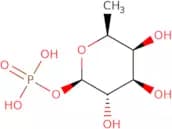
CAS :<p>b-L-Fucopyranosyl phosphate is a glycosylphosphate that is expressed on the cell surface of many organisms and is an analog of the natural sugar. It has been shown to be a competitive inhibitor, uncompetitive inhibitor, or stereoselective of glycoconjugates. b-L-Fucopyranosyl phosphate binds to the lectin receptor by binding at the monosaccharide in the terminal position, which prevents the attachment of glycoconjugates to this receptor. This binding decreases cellular adhesion and causes cells to become less adherent to other cells or surfaces. The ph optimum for b-L-fucopyranosyl phosphate is 7.5 and it can be used in vitro as a preparative hplc column eluent for lectins.</p>Formule :C6H13O8PDegré de pureté :Min. 95%Couleur et forme :PowderMasse moléculaire :244.14 g/molThioglucosides
<p>Thioglucosides are a type of sugar that is modified with a thiol group at the C-3 position. A thioglucose can be synthesized by methylation, click modification, and fluorination. Thioglucoses have been used in the past for the production of oligosaccharides and polysaccharides, as well as in complex carbohydrate research. They are also used in the production of high purity monosaccharide sugars. This product is available for custom synthesis to meet your needs.</p>Degré de pureté :Min. 95%D-Allose-1,2,3,4,5,6-13C6
CAS :<p>D-Allose is a sugar that is modified with a fluorine atom at position 6. This modification can be used to trace the origin of D-allose in complex carbohydrates such as glycogen and glycosylated proteins. The addition of a 13C6 atom allows for the identification of this sugar through mass spectrometry and nuclear magnetic resonance (NMR) analysis.</p>Formule :C6H12O6Degré de pureté :Min. 95%Couleur et forme :White PowderMasse moléculaire :186.06 g/mol1-13C-L-Arabinose
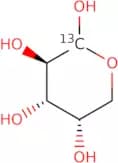
CAS :<p>1-13C-L-Arabinose is a metabolite of the sugar, L-arabinose. This compound is formed by escherichia bacteria and can be found in the urine of mice. 1-13C-L-Arabinose has been shown to inhibit the growth of escherichia coli and has a six membered ring structure.</p>Formule :CC4H10O5Degré de pureté :Min. 95%Couleur et forme :White PowderMasse moléculaire :151.13 g/molPomolic acid 28-O-b-D-glucopyranosyl ester
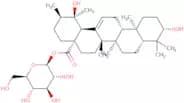
CAS :<p>Pomolic acid is a saponin isolated from the ethanol extract of Astragalus membranaceus. Pomolic acid has a nitrite reductase inhibitory effect and inhibits cell proliferation in certain cells, such as those found in the pancreas. The chemical structure of pomolic acid and its derivatives are similar to those of steroid glycosides and steroid alkaloids. It also has the ability to disrupt DNA replication and reduce insulin resistance. The use of pomolic acid in Chinese medicine formulas is reported to be effective for treating diabetes mellitus type 2, hyperlipidemia, and obesity.</p>Degré de pureté :Min. 95%