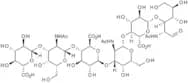
Glycosciences
La glycosciences est l'étude des glucides et de leurs dérivés, ainsi que des interactions et des fonctions biologiques auxquelles ils participent. Ce domaine de recherche est crucial pour comprendre une grande variété de processus biologiques, y compris la reconnaissance cellulaire, la signalisation, la réponse immunitaire et le développement des maladies. La glycosciences a des applications importantes en biotechnologie, en médecine et dans le développement de nouveaux médicaments et thérapies. Chez CymitQuimica, nous proposons une large sélection de produits de haute qualité et pureté pour la recherche en glycosciences. Notre catalogue comprend des monosaccharides, des oligosaccharides, des polysaccharides, des glyconjugués et des réactifs spécifiques, conçus pour soutenir les chercheurs dans leurs études sur la structure, la fonction et les applications des glucides dans les systèmes biologiques. Ces ressources sont destinées à faciliter les découvertes scientifiques et les applications pratiques dans divers domaines des biosciences et de la médecine.
Sous-catégories appartenant à la catégorie "Glycosciences"
- Aminosucres(108 produits)
- Anticorps Glyco-Related(282 produits)
- Glycolipides(46 produits)
- Glycosaminoglycanes (GAGs)(55 produits)
- Glycosides(419 produits)
- Monosaccharides(6.624 produits)
- Oligosaccharides(3.682 produits)
- Polysaccharides(503 produits)
11046 produits trouvés pour "Glycosciences"
Trier par
Degré de pureté (%)
0
100
|
0
|
50
|
90
|
95
|
100
Phenyl 2,3,6-tri-O-benzyl-b-D-thioglucopyranoside
CAS :<p>Phenyl 2,3,6-tri-O-benzyl-b-D-thioglucopyranoside is a high purity, custom synthesis sugar that has been modified with Click modification, fluorination and glycosylation. It is a synthetic compound in the form of an oligosaccharide and monosaccharide. Phenyl 2,3,6-tri-O-benzyl-b-D-thioglucopyranoside has CAS No. 97974-20-4 and can be found under Modification.</p>Formule :C33H34O5SDegré de pureté :Min. 95%Masse moléculaire :542.69 g/molPyrocatechol monoglucoside
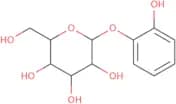
CAS :<p>Pyrocatechol monoglucoside is a phenolic compound that is found in many plants. It has an anti-thrombotic effect, inhibits bacterial growth, and has anticarcinogenic effects. Pyrocatechol monoglucoside is also hepatoprotective and can be used as a natural food preservative. It has a bitter taste and can be found in leuconostoc mesenteroides and mesenteroides strains of bacteria.</p>Degré de pureté :Min. 95%Hyaluronic acid sodium salt - Average MW 1.0 - 2.0 million Da
CAS :Hyaluronic acid sodium salt is a polymer that is made up of repeating disaccharide units of N-acetylglucosamine and glucuronic acid. It can be used in regenerative medicine to help with the healing process by supporting the growth of new tissue, as well as providing a cushioning effect against mechanical stress. This product can also be used as a food additive or supplement to help with joint health. In addition, hyaluronic acid sodium salt has been shown to improve inflammatory responses in human dermal fibroblasts.Formule :(C14H22NO11Na)nRef: 3D-H-3450
1kgÀ demander5kgÀ demander10kgÀ demander25kgÀ demander2500gÀ demander-Unit-kgkgÀ demanderD-Mannose- 4- 13C
CAS :<p>D-Mannose is a sugar that is found in many plants and animals. It can be extracted from natural sources or synthesized with the use of Click modification, fluorination, glycosylation, and methylation. D-Mannose has been shown to inhibit bacterial adhesion and prevent the formation of biofilms. In addition, it has been shown to have anti-inflammatory activities. D-Mannose is a complex carbohydrate that is composed of saccharides joined together in chains and rings.</p>Degré de pureté :Min. 95%Masse moléculaire :181.15 g/mol1-13C-L-Arabinose
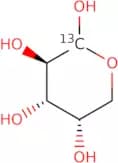
CAS :<p>1-13C-L-Arabinose is a metabolite of the sugar, L-arabinose. This compound is formed by escherichia bacteria and can be found in the urine of mice. 1-13C-L-Arabinose has been shown to inhibit the growth of escherichia coli and has a six membered ring structure.</p>Formule :CC4H10O5Degré de pureté :Min. 95%Couleur et forme :White PowderMasse moléculaire :151.13 g/mol5-Acetamino-4-hydroxy-2-(4-nitro-phenoxy)-6-(1,2,3-trihydroxy-propyl)-tetrahydro-pyran-2-carboxylic acid methyl ester
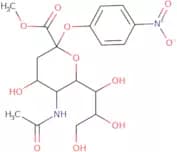
CAS :<p>5-Acetamino-4-hydroxy-2-(4-nitro-phenoxy)-6-(1,2,3-trihydroxy-propyl)-tetrahydro-pyran-2-carboxylic acid methyl ester is a synthetic glycosylated molecule that is available as custom synthesis. It is an oligosaccharide that has been modified with fluorination, saccharide modification, and click chemistry. It can be used for the synthesis of polysaccharides. It has a CAS number of 59694-35-8 and a molecular weight of 614.06 g/mol.</p>Formule :C18H24N2O11Degré de pureté :Min. 95%Masse moléculaire :444.39 g/mol(8-Ethoxycarbonyloctyl)-3,4,6-tri-O-acetyl-2-deoxy-2-phthalimido-b-D-glucopyranoside
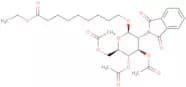
CAS :<p>(8-Ethoxycarbonyloctyl)-3,4,6-tri-O-acetyl-2-deoxy-2-phthalimido-b-D-glucopyranoside is a custom synthesis that has been modified with fluorination, methylation and acetylation. It is also a monosaccharide, which can be modified to form an oligosaccharide or polysaccharide. This product is a sugar that can be glycosylated to form complex carbohydrates.</p>Formule :C30H39NO12Degré de pureté :Min. 95%Masse moléculaire :605.63 g/molD-Allose-1,2,3,4,5,6-13C6
CAS :<p>D-Allose is a sugar that is modified with a fluorine atom at position 6. This modification can be used to trace the origin of D-allose in complex carbohydrates such as glycogen and glycosylated proteins. The addition of a 13C6 atom allows for the identification of this sugar through mass spectrometry and nuclear magnetic resonance (NMR) analysis.</p>Formule :C6H12O6Degré de pureté :Min. 95%Couleur et forme :White PowderMasse moléculaire :186.06 g/molThioglucosides
<p>Thioglucosides are a type of sugar that is modified with a thiol group at the C-3 position. A thioglucose can be synthesized by methylation, click modification, and fluorination. Thioglucoses have been used in the past for the production of oligosaccharides and polysaccharides, as well as in complex carbohydrate research. They are also used in the production of high purity monosaccharide sugars. This product is available for custom synthesis to meet your needs.</p>Degré de pureté :Min. 95%2-Acetamido-3,4,6-tri-O-acetyl-2-deoxy-a-D-galactopyranosyl-L-threonine pentafluorophenyl ester
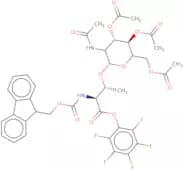
CAS :<p>This product is a modification of a complex carbohydrate that has been synthesized from D-galactose and L-threonine. It is an Oligosaccharide, Carbohydrate, Custom synthesis, Synthetic, High purity, Monosaccharide, Methylation, Glycosylation, Polysaccharide with a CAS No. 182369-94-4.<br>This product is fluorinated at the 2 position of the acetamido group. The saccharide unit has been methylated at the 2 position of the acetamido group. This product is also glycosylated at the 6 position of the acetamido group and it is an alpha-linked sugar.</p>Formule :C39H37F5N2O13Degré de pureté :Min. 95%Masse moléculaire :836.71 g/molMethyl a-L-acosamine hydrochloride
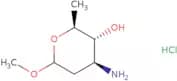
CAS :<p>Methyl a-L-acosamine hydrochloride is a custom synthesis that belongs to the class of complex carbohydrates. It has been modified with methylation, glycosylation, and carbocation modification. This product is also fluorinated and has a high purity level. It can be used as an intermediate in the production of saccharides and other products.</p>Formule :C7H15NO3·HClDegré de pureté :Min. 95%Masse moléculaire :197.66 g/mol6-O-(a-D-Galactopyranosyl)-D-mannopyranose
<p>The 6-O-(a-D-galactopyranosyl)-D-mannopyranose, also known as epimelibiose, is an oligosaccharide formed by linking an α-D-galactose molecule to a D-mannose molecule. It could be found in various natural products or glycoconjugates, such as glycolipids or glycoproteins. The configuration and linkage of sugars in such molecules often play a crucial role in their biological functions. 6-O-(a-D-galactopyranosyl)-D-mannopyranose can be used in research to modify polysaccharides and glycans. It has a role as a plant metabolite and a mouse metabolite.</p>Formule :C12H22O11Degré de pureté :Min. 95%1,2:4,5-Di-O-isopropylidene-D,L-myo-inositol
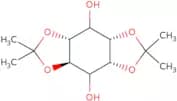
CAS :<p>1,2:4,5-Di-O-isopropylidene-D,L-myo-inositol is a custom synthesized product that has been modified to contain a fluorine atom. It is an oligosaccharide and polysaccharide. This product is used as a synthetic precursor to other products such as saccharides, carbohydrates and monosaccharides.</p>Formule :C12H20O6Degré de pureté :Min. 95%Masse moléculaire :260.28 g/mol2,3,6,2',3',4',6'-Hepta-O-benzoyl-D-lactose
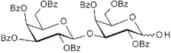
CAS :<p>2,3,6,2',3',4',6'-Hepta-O-benzoyl-D-lactose is a custom synthesis that can be modified in a variety of ways. It has a high degree of fluorination and methylation to provide protection against degradation by enzymes. The monosaccharide units are synthesized and then assembled into oligosaccharides with glycosylations. Modifications can include glycosylation at any position on the molecule as well as the addition of complex carbohydrates.<br>2,3,6,2',3',4',6'-Hepta-O-benzoyl-D-lactose is an example of a polysaccharide consisting of glucose units with other hexoses such as galactose or mannose.</p>Formule :C61H50O18Degré de pureté :Min. 95%Masse moléculaire :1,071.04 g/mol2-(Benzyloxycarbonylamino)-2-deoxy-D-galactose
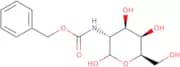
CAS :<p>2-(Benzyloxycarbonylamino)-2-deoxy-D-galactose is a synthetic, fluorinated carbohydrate. It is a monosaccharide with the chemical formula C6H11NO5 and is soluble in water. The glycosylation of 2-(benzyloxycarbonylamino)-2-deoxy-D-galactose has been shown to be more stable than that of other sugars, such as glucose or maltose. This modification can be accomplished by a click reaction. 2-(Benzyloxycarbonylamino)-2-deoxy-D-galactose can be used to modify proteins, such as antibodies and enzymes, by glycosylating amino acid residues on the protein surface.</p>Formule :C14H19NO7Degré de pureté :Min. 95%Masse moléculaire :313.3 g/molMethyl 2,3,4-tri-O-benzyl-L-rhamnopyranoside
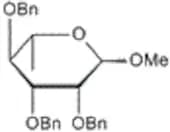
CAS :<p>Methyl 2,3,4-tri-O-benzyl-L-rhamnopyranoside is a sugar that is used in the synthesis of oligosaccharides and saccharides. This compound has been shown to be an intermediate for the synthesis of benzylidene acetone phosphate, which can be used as a precursor for polymers that have potential use in biomedical applications.</p>Formule :C28H32O5Degré de pureté :Min. 95%Masse moléculaire :448.55 g/mol2-O-Acetyl-1,3,4,6-tetra-O-benzyl-b-D-galactopyranoside
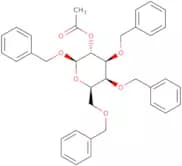
CAS :<p>2-O-Acetyl-1,3,4,6-tetra-O-benzyl-b-D-galactopyranoside is a custom synthesis that belongs to the class of complex carbohydrates. This compound contains a saccharide with a sugar group and is fluorinated at the 2 position. It has been modified by methylation on the C2 position and has an acetyl group on the C3 position.</p>Formule :C36H38O7Degré de pureté :Min. 95%Masse moléculaire :582.68 g/molFructononasaccharide
<p>Fructononasaccharide is a modification of oligosaccharides that is synthesized from sucrose. It is a complex carbohydrate that has been modified with methylation and glycosylation. Fructononasaccharide is used in the synthesis of polysaccharides, as well as for the production of high-purity, custom-synthesized monosaccharides and disaccharides. Fructononasaccharide can be fluorinated or saccharified to produce different compounds.</p>Formule :C54H92O46Degré de pureté :Min. 95%Couleur et forme :PowderMasse moléculaire :1,477.28 g/molMethyl 3,5-di-O-(p-chlorobenzoyl)-2-keto-a-D-ribofuranoside
<p>Methyl 3,5-di-O-(p-chlorobenzoyl)-2-keto-a-D-ribofuranoside is an organic compound that is a modification of an oligosaccharide. It is synthesized by the methylation and glycosylation of an aldose sugar. The modification occurs in the form of a fluorination and saccharide substitution on the original molecule. This compound has been shown to have complex carbohydrate properties, as well as being a monosaccharide and polysaccharide. It has been found to be useful in numerous applications such as drugs, industrial chemicals, and others.</p>Degré de pureté :Min. 95%Hyaluronic acid hexasaccharide
CAS :<p>Hyaluronic acid is a polysaccharide containing repeating disaccharide units of β-1,3-N-acetyl glucosamine and β-1, 4-glucuronicâ¯acid. A series of unsaturated oligosaccharides (oligouronic acids) are released from hyaluronic acid by the action of hyaluronidase on umbilical cord (Weissman, 1954). This hexasaccharide and other enzymatically produced polymer homologs have been of value in the study of hyaluronic acid metabolism in healthy and diseased tissues (Hascall, 2019).</p>Formule :C42H65N3O34Degré de pureté :Min. 95%Couleur et forme :White Off-White PowderMasse moléculaire :1,155.97 g/mol