Glycosciences
La glycosciences est l'étude des glucides et de leurs dérivés, ainsi que des interactions et des fonctions biologiques auxquelles ils participent. Ce domaine de recherche est crucial pour comprendre une grande variété de processus biologiques, y compris la reconnaissance cellulaire, la signalisation, la réponse immunitaire et le développement des maladies. La glycosciences a des applications importantes en biotechnologie, en médecine et dans le développement de nouveaux médicaments et thérapies. Chez CymitQuimica, nous proposons une large sélection de produits de haute qualité et pureté pour la recherche en glycosciences. Notre catalogue comprend des monosaccharides, des oligosaccharides, des polysaccharides, des glyconjugués et des réactifs spécifiques, conçus pour soutenir les chercheurs dans leurs études sur la structure, la fonction et les applications des glucides dans les systèmes biologiques. Ces ressources sont destinées à faciliter les découvertes scientifiques et les applications pratiques dans divers domaines des biosciences et de la médecine.
Sous-catégories appartenant à la catégorie "Glycosciences"
- Aminosucres(108 produits)
- Anticorps Glyco-Related(282 produits)
- Glycolipides(46 produits)
- Glycosaminoglycanes (GAGs)(55 produits)
- Glycosides(419 produits)
- Monosaccharides(6.624 produits)
- Oligosaccharides(3.682 produits)
- Polysaccharides(503 produits)
11046 produits trouvés pour "Glycosciences"
Trier par
Degré de pureté (%)
0
100
|
0
|
50
|
90
|
95
|
100
1,2,3-Tri-O-benzyl-4,6-O-benzylidene-b-D-galactopyranose
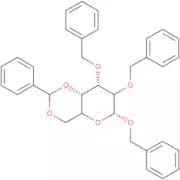
CAS :<p>1,2,3-Tri-O-benzyl-4,6-O-benzylidene-b-D-galactopyranose is a saccharide that is used as a building block for the synthesis of oligosaccharides and polysaccharides. It has been modified with fluorination, methylation, and click chemistry. 1,2,3-Tri-O-benzyl-4,6-O-benzylidene-b-D-galactopyranose is CAS No. 57783–80–9. This product can be custom synthesized to meet your needs.</p>Formule :C34H34O6Degré de pureté :Min. 95%Masse moléculaire :538.63 g/mol1,2-Dipalmitoyl-sn-glycero-3-phospho-(1'-myoinositol-4'-phosphate)
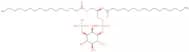
CAS :<p>1,2-Dipalmitoyl-sn-glycero-3-phospho-(1'-myoinositol-4'-phosphate) is a lipid kinase that has been shown to be localized in the cytoplasm. This enzyme is activated by receptor activity and autophagy, and plays a role in protein transport. It also activates phosphatase activity which regulates the actin cytoskeleton, and can be regulated by insulin-stimulated glucose levels. 1,2-Dipalmitoyl-sn-glycero-3-phospho-(1'-myoinositol-4'-phosphate) has been shown to have a regulatory function in epidermal growth factor (EGF)-induced cell proliferation. The physiological function of this enzyme is not yet known.</p>Formule :C41H80O16P2Degré de pureté :Min. 95%Masse moléculaire :891.01 g/mol2-Acetamido-3-O-acetyl-2-deoxy-D-glucopyranose
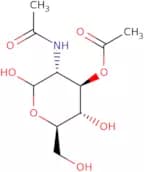
CAS :<p>2-Acetamido-3-O-acetyl-2-deoxy-D-glucopyranose is a methylated, acetylated, and fluorinated sugar that is used in the synthesis of glycosides. It is a polysaccharide with an Oligosaccharide and saccharide with Click modification that can be modified to suit your needs. The carbohydrate has high purity and can be synthesized from custom molecules. It can be synthesized from carbohydrates or sugars. This product is made synthetically for research purposes only, not for human consumption.</p>Formule :C10H17NO7Degré de pureté :Min. 95%Couleur et forme :Yellow syrup.Masse moléculaire :263.24 g/molL-Galactose-6-O-sulphate sodium salt
<p>L-Galactose-6-O-sulphate sodium salt is a modified carbohydrate that is synthesized by modifying the chemical structure of L-galactose. This modification can be accomplished using chemical reactions such as methylation, saccharide, polysaccharide, and click modification. The CAS number for this product is 68891-70-8.</p>Formule :C6H11O9SNaDegré de pureté :Min. 95%Masse moléculaire :282.2 g/molGlobo-N-tetraose-APD-HSA
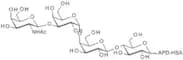
Globo-N-tetraose conjugated to HSA with acetyl-phenylenediamine spacerDegré de pureté :Min. 95%Blood group B trisaccharide-GEL
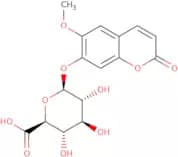
<p>Gala1-3(Fuca1-2)Gal Conjugated to BSA on Fractogel with glycosylamine formation</p>Degré de pureté :Min. 95%Scopoletin b-D-glucuronide
CAS :<p>Scopoletin b-D-glucuronide is a synthetic compound that is modified by the addition of a fluorine atom to the methyl group in scopoletin. Scopoletin b-D-glucuronide has shown antiviral activity against herpes simplex virus type 1 and 2, with an IC50 value of 1.6 μM. It also has antiviral activity against HIV type 1 and HIV type 2, with an IC50 value of 0.5 μM. This compound also inhibits viral DNA synthesis, which may be due to its inhibition of host cell protein synthesis and subsequent inhibition of viral protein synthesis. Scopoletin b-D-glucuronide has been shown to have anti-inflammatory effects in a mouse model for rheumatoid arthritis, and it may be due to its suppression of prostaglandin synthesis or interference with leukocyte chemotaxis.</p>Formule :C16H16O10Degré de pureté :Min. 95%Masse moléculaire :368.29 g/mol6-Amino-6-deoxy-L-sorbose
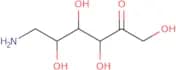
CAS :<p>6-Amino-6-deoxy-L-sorbose is a sugar that is metabolized by the body to produce energy. This compound has been shown to be an effective antidiabetic, as it may inhibit glucose production in the liver and enhance insulin sensitivity. 6-Amino-6-deoxy-L-sorbose is a nutrient that can be found in food sources such as bananas, potatoes, and soybeans. It can also be synthesized from various plant sources. The biosynthesis of this compound is dependent on a number of enzymes, including L-arabinose 1 phosphate dehydrogenase.</p>Degré de pureté :Min. 95%Ethyl 3-O-benzyl-4,6-O-benzylidene-b-D-thioglucopyranoside
<p>Ethyl 3-O-benzyl-4,6-O-benzylidene-b-D-thioglucopyranoside is a custom synthesis of an oligosaccharide with a complex carbohydrate. It has been modified with methylation and glycosylation and can be used in the production of high purity saccharides. Ethyl 3-O-benzyl-4,6-O-benzylidene-b-D-thioglucopyranoside is synthesized by the fluorination of ethyl bromoacetate with sodium fluoride followed by alkylation with benzaldehyde. This product has a CAS number and can be used for food or pharmaceutical purposes.</p>Degré de pureté :Min. 95%Dimeric Lewis X hexasaccharide-APE-HSA
<p>Dimeric Lewis X hexasaccharide-APE-HSA is a carbohydrate molecule that is a modification of a saccharide. It is an oligosaccharide sugar with a CAS number. The monosaccharide sugar in this molecule has been synthetically modified and fluorinated to yield the desired product. This complex carbohydrate has been custom synthesized for high purity and has undergone methylation and glycosylation reactions to achieve the desired modification. The final result of these modifications is a dimeric Lewis X hexasaccharide-APE-HSA, which will be used as an immunogen.</p>Degré de pureté :Min. 95%Hyaluronate biotin - Molecular Weight - 2500kDa
<p>Hyaluronate biotin is a complex carbohydrate that consists of a saccharide with a terminal sugar and methylated N-acetylglucosamine. The molecular weight of Hyaluronate biotin is 2500kDa. It can be synthesized by reacting the appropriate monosaccharides under the presence of an enzyme, such as glucose oxidase. This product has high purity and is modified using Fluorination and Click modification.</p>Degré de pureté :Min. 95%D-[4,5,6]-Fructose-13C3
CAS :<p>D-[4,5,6]-Fructose-13C3 is a potent inhibitor of the golgi alpha-mannosidases which are enzymes that catalyze the hydrolysis of mannose residues from glycoproteins. This compound has been shown to inhibit the synthesis of glycoproteins in vitro and in vivo. D-[4,5,6]-Fructose-13C3 also inhibits other chemical reactions by binding to fatty acids or proteins. In cell culture, this compound has been shown to synergistically interact with cytochalasin B, which disrupts Golgi membranes. D-[4,5,6]-Fructose-13C3 is lipophilic and can be easily detected by magnetic resonance spectroscopy (MRS). MRS can be used to monitor the inhibition of fatty acid synthesis in cells cultured with this agent.</p>Formule :C3C3H12O6Degré de pureté :Min. 95%Masse moléculaire :183.13 g/mol3-Deoxy-3-fluoro-D-myo-inositol 1,4,5-trisphosphate hexasodium salt
CAS :<p>3-Deoxy-3-fluoro-D-myo-inositol 1,4,5-trisphosphate hexasodium salt is a synthetic sugar that has been modified with fluorination and glycosylation. It is used for the synthesis of oligosaccharides and monosaccharides. 3-Deoxy-3-fluoro-D-myo-inositol 1,4,5-trisphosphate hexasodium salt is a carbohydrate that can be found in complex carbohydrates such as glycolipids and glycoproteins. The CAS number for this compound is 129365–68–0.</p>Formule :C6H8FO14P3Na6Degré de pureté :Min. 95%Masse moléculaire :553.98 g/mol6-Deoxy-6-fluoro-L-galactose
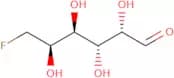
CAS :<p>6-Deoxy-6-fluoro-L-galactose is a sugar nucleotide that is extracted from the dithioacetal of l-fucose and d-galactose. It inhibits the synthesis of DNA and RNA by binding to the enzyme that catalyzes this reaction, thereby blocking these processes. 6DFLG has been shown to inhibit transformation in Escherichia coli. The mechanistic studies of 6DFLG show that it reacts with oxygen at the electrophilic site to produce an olefinic product, which then reacts with nucleophiles, such as water, to form a trackable product. This reagent can be used to determine whether or not a particular sugar is present in a sample.</p>Formule :C6H11FO5Degré de pureté :Min. 95 Area-%Couleur et forme :PowderMasse moléculaire :182.15 g/mol6-O-(2,3,4,6-Tetra-O-acetyl-a-D-mannopyranosyl)-1,2,3,4-tetra-O-benzyl-a-D-mannopyranoside
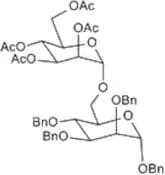
<p>6-O-(2,3,4,6-Tetra-O-acetyl-a-D-mannopyranosyl)-1,2,3,4-tetra-O-benzyl-a-D-mannopyranoside is an oligosaccharide with a complex carbohydrate structure. This chemical is a custom synthesis and it has high purity. 6-O-(2,3,4,6-Tetra-O-acetyl-a-D-mannopyranosyl)-1,2,3,4-- tetra--O--benzyl--A--mannopyranoside is used as an intermediate for the production of other compounds. The CAS number for this compound is</p>Formule :C48H54O15Degré de pureté :Min. 95%Masse moléculaire :870.93 g/molBenzyl N,N'-di-acetyl-b-chitobioside
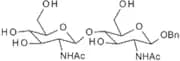
CAS :<p>Benzyl N,N'-di-acetyl-b-chitobioside is a fluorinated glycoside. It is a synthetic compound that has been modified by the addition of a benzyl group to the acetyl group at the C3 position and an N,N'-diacetyl group to the b-chitobioside. This modification has been carried out in order to improve its water solubility and bioavailability.</p>Formule :C23H34N2O11Degré de pureté :Min. 95%Couleur et forme :PowderMasse moléculaire :514.52 g/mol3-O-(2,3,4,6-Tetra-O-acetyl-b-D-galactopyranosyl)-2-azido-4,6-O-benzylidene-2-deoxy-a-D-galactopyranosyl-Fmoc serine tert-butyl este r
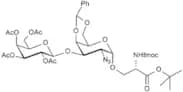
CAS :<p>Methylation of polysaccharides is the process of adding methyl groups to chemical compounds. This process can be achieved by using a variety of reagents. One type of reagent is a methyl donor, which is capable of transferring a methyl group to another molecule. The Methylation Kit contains various reagents that allow for the efficient and specific modification of polysaccharides, including carbohydrates, oligosaccharides, and saccharides. The kit includes two types of reagents: Methyl donors and Methyl acceptors. The kit also contains other additives such as solvents, buffers, and pH indicators. The 3-O-(2,3,4,6-Tetra-O-acetyl-b-D-galactopyranosyl)-2-azido-4,6-O-benzylidene-2-deoxy-a-D-galactopyranosyl Fmoc serine tert but</p>Formule :C49H56N4O18Degré de pureté :Min. 95%Masse moléculaire :988.99 g/molHyaluronate octasaccharide
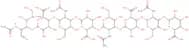
CAS :<p>Hyaluronate octasaccharide is a regulatory molecule that has been found to be useful for staining and as a chondrocyte culture supplement. Hyaluronate octasaccharide is composed of two sugar molecules: glucuronic acid and N-acetylglucosamine. The molecular weight of this compound is about 5000 Daltons, and it has been found to show high levels of proton hydrogen bonding interactions with other molecules in the extracellular matrix. It also contains oligosaccharides and disaccharides. Hyaluronate octasaccharide can be used in vitro to stimulate cell growth, which may be due to its ability to stabilize collagen and elastin fibers by binding with collagenase.</p>Formule :C56H86N4O45Degré de pureté :Min. 95%Masse moléculaire :1,535.3 g/molOlmesartan N2-glucuronide
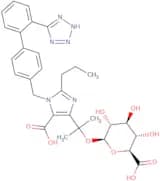
CAS :<p>Olmesartan N2-glucuronide is a methylated metabolite of olmesartan, which is an angiotensin II receptor blocker. Olmesartan glucuronide is a high purity chemical compound with CAS No. 369395-57-3. It can be custom synthesized to order and has been used in glycosylation reactions as a sugar donor or acceptor. This product is also useful for the Click modification of oligosaccharides and polysaccharides, as well as for the modification of saccharides with fluorination and other chemical reactions.</p>Formule :C30H34N6O9Degré de pureté :Min. 95%Masse moléculaire :622.63 g/mol6-Deoxy-3-C-methyl-D-gulose
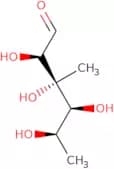
CAS :<p>6-Deoxy-3-C-methyl-D-gulose is an enantiomer of 3,6-dideoxy-D-gluconic acid. This compound has been shown to be a virulent factor in mastitis caused by the mutant strain of Escherichia coli (MT1) and to be expressed at a higher level in mastitic milk than in normal milk. 6DMG has also been shown to induce monoclonal antibody production and stimulate specific immune responses. It is thought that 6DMG damages cells, which leads to the release of intracellular components that trigger an antibody response. The biological function of 6DMG is not known, but it may play a role in the infection process by stimulating an antibody response against infectious agents.</p>Degré de pureté :Min. 95%




![D-[4,5,6]-Fructose-13C3](/_next/image/?url=https%3A%2Fstatic.cymitquimica.com%2Fproducts%2F3D%2Fthumb-webp%2FMF171832.webp&w=3840&q=75)