Glycosciences
La glycosciences est l'étude des glucides et de leurs dérivés, ainsi que des interactions et des fonctions biologiques auxquelles ils participent. Ce domaine de recherche est crucial pour comprendre une grande variété de processus biologiques, y compris la reconnaissance cellulaire, la signalisation, la réponse immunitaire et le développement des maladies. La glycosciences a des applications importantes en biotechnologie, en médecine et dans le développement de nouveaux médicaments et thérapies. Chez CymitQuimica, nous proposons une large sélection de produits de haute qualité et pureté pour la recherche en glycosciences. Notre catalogue comprend des monosaccharides, des oligosaccharides, des polysaccharides, des glyconjugués et des réactifs spécifiques, conçus pour soutenir les chercheurs dans leurs études sur la structure, la fonction et les applications des glucides dans les systèmes biologiques. Ces ressources sont destinées à faciliter les découvertes scientifiques et les applications pratiques dans divers domaines des biosciences et de la médecine.
Sous-catégories appartenant à la catégorie "Glycosciences"
- Aminosucres(108 produits)
- Anticorps Glyco-Related(282 produits)
- Glycolipides(46 produits)
- Glycosaminoglycanes (GAGs)(55 produits)
- Glycosides(419 produits)
- Monosaccharides(6.624 produits)
- Oligosaccharides(3.682 produits)
- Polysaccharides(503 produits)
11046 produits trouvés pour "Glycosciences"
Trier par
Degré de pureté (%)
0
100
|
0
|
50
|
90
|
95
|
100
Methyl-O-(2-azido-3,4-di-O-benzyl-2-deoxy-a-D-glucopyranosyl)-(1-4)-O-(2,3-di-O-benzyl-b-D-glucopyranosyluronicacid)- (1-4)-O-(2-azi do-2-deoxy-a-D-glucopyranosyl)-(1-4)-O-(3-O-benzyl-a-L-idopyranosyluronic acid)-(1-4)-3-O-benzyl- 2-benzyloxycarbonyla
CAS :<p>Maltodextrin is a polysaccharide that is made up of glucose units linked together by alpha-glycosidic bonds. Maltodextrin is commonly used as a food additive, but it also has several industrial applications. It can be used to produce escherichia coli, which is a bacterium that produces maltose and amylopectin. Maltodextrin can also be used as an animal feed supplement or as an ingredient in baby food. The glycosidic bond between the glucose units are metabolized by mouse enzymes to produce maltose and glycogen, which are both plant metabolites. Maltodextrin consists of unbranched subunits with linear chains of alpha-1,4-linked glucose residues that have alpha-1,6-linked branches at every second residue. This means that maltodextrin has a glycosidic linkage between the two glucose molecules in the chain and one of these links will always be an alpha-</p>Formule :C81H91N7O27Degré de pureté :Min. 95%Masse moléculaire :1,594.62 g/mol1,2:4,5-Di-O-isopropylidene-D-mannitol
CAS :<p>1,2:4,5-Di-O-isopropylidene-D-mannitol is a synthetic compound that is used as a non-ionic surfactant. It has been shown to have an enzymatic reaction with lipases and acetonitrile. The isomers of this compound are also synthesised from acetonitrile. 1,2:4,5-Di-O-isopropylidene-D-mannitol is found in human liver cells and can be used to synthesise polyols. This molecule forms orthoacids when it reacts with methoxyethylidene and the surfactant nonylphenoxypolyethoxyethanol (NPEE).</p>Formule :C12H22O6Degré de pureté :Min. 95%Couleur et forme :PowderMasse moléculaire :262.3 g/molLacto-N-tetraose-BSA
<p>Lacto-N-tetraose-BSA is a carbohydrate that contains four monosaccharides. It has been shown to be an autoantibody in patients with myasthenia gravis and can cause muscle weakness by binding to the muscle protein, actin. Lacto-N-tetraose-BSA has also been found to bind with nerve tissue and may be involved in the development of sclerosis. This carbohydrate is also negatively charged and agglutinates red blood cells. When used for immunofluorescence, it shows a strong reaction against glycoconjugates on the surface of neurons and nerve tissue. Lacto-N-tetraose-BSA binds specifically to bovine serum albumin (BSA) containing antibodies, which are produced by immune cells called B cells. The binding sites are located on the outer part of the molecule, near the sugar residues.</p>Degré de pureté :Min. 95%Couleur et forme :PowderMethyl (methyl 3-deoxy-D-arabino-hept-2-ulopyranosid)onate-7-(diphenyl phosphate)
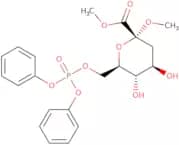
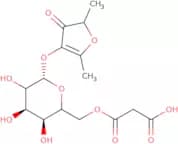
CAS :<p>Methyl (methyl 3-deoxy-D-arabino-hept-2-ulopyranosid)onate-7-(diphenyl phosphate) is a carbohydrate that belongs to the group of oligosaccharides. It is synthesized from an alditol acetate precursor and can be modified with fluorination, methylation, glycosylation, or click chemistry. Methyl (methyl 3-deoxy-D-arabino-hept-2-ulopyranosid)onate-7-(diphenyl phosphate) is used in various industrial applications as a reagent for the synthesis of complex carbohydrates. This compound has CAS No. 91382–79–5.</p>Formule :C21H25O10PDegré de pureté :Min. 95%Masse moléculaire :468.39 g/mol2.5-Dimethyl-4-hydroxy-3(2H)-furanone-b-D-glucoside-6'-malonate
CAS :<p>2.5-Dimethyl-4-hydroxy-3(2H)-furanone-b-D-glucoside-6'-malonate is a methylated monosaccharide with a molecular formula of C8H10O3 and a molecular weight of 208.18 g/mol. It is synthesized by the reaction of 3,4,5-trimethoxybenzaldehyde with 2,5-dimethylhydroquinone in the presence of sodium carbonate and malonic acid under refluxing conditions. 2.5-Dimethyl-4-hydroxy-3(2H)-furanone-b-D glucoside 6'-malonate has been used in the synthesis of oligosaccharides and polysaccharides. This product is available for custom synthesis, click modification, fluorination and saccharide modification.</p>Formule :C15H20O11Degré de pureté :Min. 95%Masse moléculaire :376.31 g/molMethyl 2,3,4-tri-O-acetyl-b-D-glucuronide methyl ester
CAS :<p>Methyl 2,3,4-tri-O-acetyl-b-D-glucuronide methyl ester is a custom synthesis chemical. It has a molecular weight of 342.13 g/mol and the abbreviation CAS No. 34213-34-8. Methyl 2,3,4-tri-O-acetyl-b-D-glucuronide methyl ester is used as a Modification chemical in Fluorination reactions and can be used to synthesize Oligosaccharides and Polysaccharides. This chemical reacts with Glycosylation reactions to form complex carbohydrates such as saccharides and sugar.</p>Formule :C14H20O10Degré de pureté :Min. 95%Masse moléculaire :348.31 g/molD-Raffinose undecaacetate
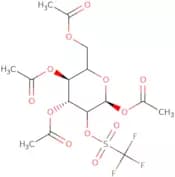
CAS :<p>D-Raffinose undecaacetate is a sweetener that is used in some chewing gum and other foods. It is a sucrose ester with the chemical formula C12H24O11. D-Raffinose undecaacetate has been shown to increase the release of insulin, which may be due to its effects on glucose uptake or modulation of taste receptors on the tongue. It has also been shown to have an anti-inflammatory effect, which may be due to its interactions with the bitter taste receptors present in tissues such as the small intestine and liver.</p>Formule :C40H54O27Degré de pureté :Min. 95%Masse moléculaire :966.84 g/mol1,3,4,6-Tetra-O-acetyl-2-O-trifluoromethanesulfonyl-b-D-talopyranose
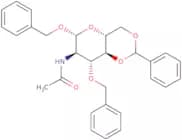
1,3,4,6-Tetra-O-acetyl-2-O-trifluoromethanesulfonyl-b-D-talopyranose (TATP) is a radiopharmaceutical that is used in positron emission tomography (PET) scans. TATP has been shown to be sensitive to changes in the body's metabolism and can be used to identify areas of inflammation or disease. TATP is a nucleophilic compound that can be hydrolyzed by basic conditions such as hydroxide ion or hydrogen peroxide. Hydrolysis of TATP yields galactose and trifluoromethanesulfonic acid. The yield of TATP from the reaction with hydroxide ion is low because it reacts quickly with water. This compound has been used as a contrast agent for imaging because it is readily taken up by cells and accumulates in areas of high metabolic activity such as tumorsFormule :C15H19F3O12SDegré de pureté :Min. 95%Masse moléculaire :480.37 g/mol2-Acetamido-1,3-di-O-benzyl-4,6-O-benzylidene-2-deoxy-b-D-glucopyranoside
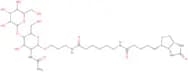
CAS :<p>2-Acetamido-1,3-di-O-benzyl-4,6-O-benzylidene-2-deoxy-b-D-glucopyranoside is a modification of a carbohydrate. It is a complex carbohydrate that has been synthesized by custom synthesis. It is an oligosaccharide with high purity and monosaccharides methylated at the hydroxyl group. The glycosylation and polysaccharide have been synthesized with fluorination and saccharides.</p>Formule :C29H31NO6Degré de pureté :Min. 95%Masse moléculaire :489.56 g/molN-Acetyl-D-lactosamine-sp-biotin
<p>N-Acetyl-D-lactosamine-sp-biotin is an oligosaccharide that is synthesized by the condensation of N-acetylglucosamine and sphingosine. It is a complex carbohydrate that can be modified with fluorination, monosaccharide, and polysaccharides. N-Acetyl-D-lactosamine-sp-biotin has been shown to have a high purity and can be used in the synthesis of glycosylation, methylation, or click chemistry.</p>Formule :C33H57N5O15SDegré de pureté :Min. 95%Couleur et forme :PowderMasse moléculaire :795.9 g/mol2,3-O-Carbonyl-4,6-O-isopropylidene-a-D-mannopyranoside
CAS :<p>2,3-O-Carbonyl-4,6-O-isopropylidene-a-D-mannopyranoside is a custom synthesis of a monosaccharide with a fluorinated methyl group. It is an oligosaccharide with a saccharide that contains an oxygen atom and two carbon atoms. This carbohydrate is polysaccharide which has glycosylation. 2,3-O-Carbonyl-4,6-O-isopropylidene-a-D-mannopyranoside is also known as CAS No. 669730 - 3,6'-diacetoxyacetone</p>Formule :C10H14O7Degré de pureté :Min. 95%Masse moléculaire :246.21 g/mol1-Methyl-2-propenylbeta-D-glucopyranoside
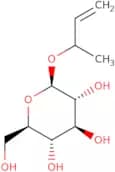
CAS :<p>1-Methyl-2-propenylbeta-D-glucopyranoside is a fluorinated carbohydrate that may be used for the modification of carbohydrates. It is a synthetic oligosaccharide that has been custom synthesized and modified with methylation, glycosylation, and click chemistry. This product is offered at high purity levels.</p>Formule :C10H18O6Degré de pureté :Min. 95%Masse moléculaire :234.25 g/molPerindoprilat acyl-b-D-glucuronide
CAS :<p>Perindoprilat acyl-β-D-glucuronide is a synthetic, high purity compound that is custom synthesized and modified. It has been prepared by the click modification of perindoprilat with 1,3-dicyclohexylcarbodiimide (DCC) and 4-dimethylaminopyridine (DMAP). This product is useful for the synthesis of saccharides and complex carbohydrates. Perindoprilat acyl-β-D-glucuronide is a white solid at room temperature. The molecular formula is C14H20N2O7 with a molecular weight of 328.32 g/mol. The CAS number is 120381-56-8.</p>Formule :C23H36N2O11Degré de pureté :Min. 95%Couleur et forme :White to off-white solid.Masse moléculaire :516.54 g/molBenzyl 2,3-O-[(1S,2S)-1,2-dimethoxy-1,2-dimethyl-1,2-ethanediyl]-4-nitrobenzoyl-a-L-xylopyranoside
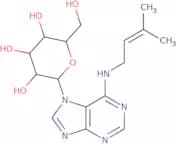
CAS :<p>This product is a custom synthesis. The structure is a complex carbohydrate with an oligosaccharide component. The product is synthesized from methylated benzyl 2,3-O-[(1S,2S)-1,2-dimethoxy-1,2-dimethyl-1,2-ethanediyl]-4-nitrobenzoyl-a-L-xylopyranoside and then modified by fluorination and click chemistry. The saccharide component consists of a monosaccharide and multiple polysaccharides.</p>Formule :C25H29NO10Degré de pureté :Min. 95%Masse moléculaire :503.5 g/molN6-Isopentenyladenine-7-glucoside
CAS :<p>N6-Isopentenyladenine-7-glucuronide is a synthetic monosaccharide that is used in the synthesis of complex carbohydrates. It is also a fluorinated compound that has been modified to form a glucuronide, which is an organic compound with a sugar and an alcohol group. N6-Isopentenyladenine-7-glucuronide can be used as a raw material for the production of oligosaccharides and polysaccharides, which are complex carbohydrates. This product can be custom synthesized to meet different requirements. It is available in high purity and the CAS number for this product is 59384-58-6.</p>Formule :C16H23N5O5Degré de pureté :Min. 95%Masse moléculaire :365.38 g/mol6-O-tert-Butyldimethylsilyl-3,4-O-carbonyl-D-galactal
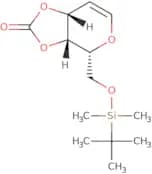
CAS :<p>6-O-tert-Butyldimethylsilyl-3,4-O-carbonyl-D-galactal is a modification of the sugar galactal. It is an oligosaccharide that can be synthesized from galactose and 6-O-tert-butyldimethylsilylchloride. It is used as a starting material for the synthesis of complex carbohydrates, as well as polysaccharides. This product has an average purity of 98% and is available in quantities of 50 grams.</p>Degré de pureté :Min. 95%10,11-Dihydro-10-hydroxycarbamazepine O-b-D-glucuronide
CAS :<p>10,11-Dihydro-10-hydroxycarbamazepine O-b-D-glucuronide is a sugar that is synthesized by the modification of 10,11-dihydrocarbamazepine. It has been shown to inhibit the growth of Mycobacterium tuberculosis in a dose dependent manner. This compound has also been shown to inhibit the synthesis of DNA and RNA in bacterial cells, which may be due to its ability to inhibit glycosylation and methylation reactions.</p>Formule :C21H22N2O8Degré de pureté :Min. 95%Masse moléculaire :430.41 g/molAcedoben-acyl-b-D-glucuronide
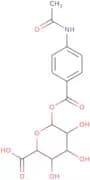
CAS :<p>Acedoben-acyl-b-D-glucuronide is a synthetic, fluorinated monosaccharide. It has been synthesized by glycosylation of the trichloroacetimidate with D-glucuronic acid and acetic anhydride. Acedoben-acyl-b-D-glucuronide is a glycoconjugate that has been modified by methylation, which stabilizes the carbohydrate moiety in the presence of metal ions. This product is also available in oligo and polysaccharide forms.</p>Formule :C15H17NO9Degré de pureté :Min. 95%Masse moléculaire :355.3 g/mol3-O-Methyl-1,2-O-(1-methylethylidene)-a-D-ribofuranose
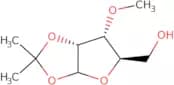
CAS :3-O-Methyl-1,2-O-(1-methylethylidene)-a-D-ribofuranose is an Oligosaccharide that is a custom synthesis. This product is manufactured by the Glycosylation and Fluorination of 3-O-methyl 1,2,-O-(1-methylethylidene) a D ribofuranose. The product is then methylated and monosaccharide and polysaccharides are synthesized. Click modification of the molecule can be performed to produce a complex carbohydrate. The product has high purity and can be modified for specific purposes.Degré de pureté :Min. 95%8-Hydroxymianserin b-D-glucuronide
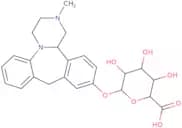
CAS :8-Hydroxymianserin b-D-glucuronide is a synthetic, fluorinated glycosylated analog of mianserin. It is a white to off-white powder that is soluble in water and methanol. This compound has been studied as a potential antihypertensive agent, but was never marketed. 8-Hydroxymianserin b-D-glucuronide is used in the synthesis of glycosylated oligosaccharides with click modification.Formule :C24H28N2O7Degré de pureté :Min. 95%Masse moléculaire :456.5 g/mol





![Benzyl 2,3-O-[(1S,2S)-1,2-dimethoxy-1,2-dimethyl-1,2-ethanediyl]-4-nitrobenzoyl-a-L-xylopyranoside](/_next/image/?url=https%3A%2Fstatic.cymitquimica.com%2Fproducts%2F3D%2Fthumb-webp%2FMB16613.webp&w=3840&q=75)