Propofol et Impuretés
124 produits trouvés pour "Propofol et Impuretés"
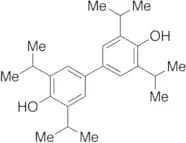
Dipropofol
CAS :Impurity Propofol EP Impurity E; Propofol USP Related Compound A
Applications Dipropofol (Propofol EP Impurity E) is a dimeric derivative of Propofol (P829750). Dipropofol is an antibacterial agent with strong activity againts Gram-positive bacteria. Dipropofol also displays antioxidant and radical scavenging activity. Propofol USP Related Compound A.
References Ogata, M. et al.: Chem. Pharm. Bull., 53, 344 (2005); Ogata, M. et al.: Biol. Pharmac. Bull., 30, 1565 (2007);Formule :C24H34O2Couleur et forme :NeatMasse moléculaire :354.533,5-Bis(1,1-dimethylethyl)-1-hydroxy-4-oxo-2,5-cyclohexadiene-1-propanoic Acid
CAS :Formule :C17H26O4Couleur et forme :NeatMasse moléculaire :294.392-Isopropenyl-6-isopropylphenol
CAS :Impurity Propofol EP Impurity B
Applications 2-Isopropenyl-6-isopropylphenol (Propofol EP Impurity B) is an alkylphenol derivative with anesthetic activity.
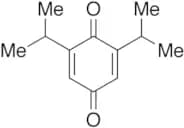
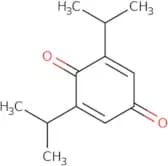
References James, R. et al.: J. Med. Chem., 23, 1350 (1980);Formule :C12H16OCouleur et forme :NeatMasse moléculaire :176.252,6-Diisopropyl-1,4-benzoquinone
CAS :Impurity Propofol EP Impurity J
Applications 2,6-Diisopropyl-1,4-benzoquinone (Propofol EP Impurity J) is a Propofol (P829750) impurity.
Not a dangerous good if item is equal to or less than 1g/ml and there is less than 100g/ml in the package
References McMahon, R., et al.: J. Med. Chem., 22, 1100 (1979), Mamada, K., et al.: Drug Metab. Dispos., 14, 509 (1986),Formule :C12H16O2Couleur et forme :NeatMasse moléculaire :192.25Propofol
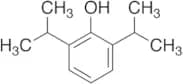
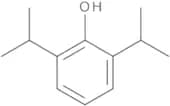
CAS :Produit contrôléApplications Propofol is an anesthetic used in veterinary medicine. Neuroprotective & Neuroresearch Products
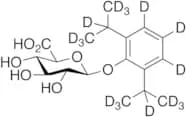
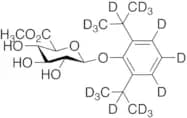
References Glen, J.B., and Hunter, S.C.: Brit. J. Anaesth., 56, 617 (1984), Kohnen, S.L., et al.: Nitric Oxide, 8, 170 (2003)Formule :C12H18OCouleur et forme :NeatMasse moléculaire :178.27Propofol-d17 β-D-Glucuronide
CAS :Produit contrôléApplications Labelled Propofol β-D-Glucuronide (P829780). Propofol β-D-Glucuronide is a metabolite of Propofol (P829750), an anesthetic used in veterinary medicine.
References Fujiwara, R., et al.: Drug Metab. Dispos., 35, 747 (2007), Soars, M., et al.: J. Pharmacol. Toxicol. Methods, 47, 161 (2002),Formule :C18H9D17O7Couleur et forme :White To Off-WhiteMasse moléculaire :371.5Propofol 4-Carboxylic Acid
CAS :Produit contrôléImpurity Propofol EP Impurity N
Applications Propofol 4-Carboxylic Acid (Propofol EP Impurity N) is a related compound of Propofol (P829750), as an antioxidant.
References Bahri, M., et al.: Biophys. Chem., 129, 82 (2007), Foti, M., et al.: J. Pharm. Pharmacol., 59, 1673 (2007), Gutierrez, M., et al.: Life Sci., 72, 2337 (2003),Formule :C13H18O3Couleur et forme :NeatMasse moléculaire :222.282-Isopropyl-6-propylphenol
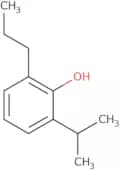
CAS :Impurity Propofol EP Impurity O
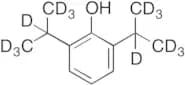
Applications 2-Isopropyl-6-propylphenol (Propofol EP Impurity O).Formule :C12H18OCouleur et forme :NeatMasse moléculaire :178.27Propofol-d14
CAS :Produit contrôléApplications Propofol-d14 is the labeled analogue of Propofol (P829750), an anesthetic used in veterinary medicine.
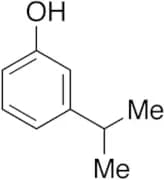
References Glen, J.B., and Hunter, S.C.: Brit. J. Anaesth., 56, 617 (1984); Kohnen, S.L., et al.: Nitric Oxide, 8, 170 (2003)Formule :C12H4D14OCouleur et forme :NeatMasse moléculaire :192.363-Isopropylphenol
CAS :Produit contrôléImpurity Propofol EP Impurity F
Stability Light Sensitive
Applications 3-Isopropylphenol (Propofol EP Impurity F) is an impurity of Propofol (P829750).
Not a dangerous good if item is equal to or less than 1g/ml and there is less than 100g/ml in the package
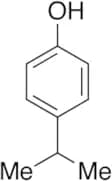
References Bahri, M., et al.: Biophys. Chem., 129, 82 (2007), Foti, M., et al.: J. Pharm. Pharmacol., 59, 1673 (2007), Vasileiou, I., et al.: Eur. J. Pharmacol., 605, 1 (2009),Formule :C9H12OCouleur et forme :BrownMasse moléculaire :136.194-Isopropylphenol
CAS :Impurity Propofol EP Impurity H
Applications 4-Isopropylphenol (Propofol EP Impurity H) is an impurity of Propofol (P829750).
Not a dangerous good if item is equal to or less than 1g/ml and there is less than 100g/ml in the package
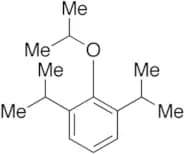
References Bahri, M., et al.: Biophys. Chem., 129, 82 (2007), Foti, M., et al.: J. Pharm. Pharmacol., 59, 1673 (2007), Vasileiou, I., et al.: Eur. J. Pharmacol., 605, 1 (2009),Formule :C9H12OCouleur et forme :WhiteMasse moléculaire :136.19Propofol Isopropyl Ether
CAS :Produit contrôléImpurity Propofol EP Impurity G; Propofol USP Related Compound C
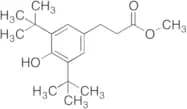
Applications Propofol Isopropyl Ether (Propofol EP Impurity G; Propofol USP Related Compound C) is an isopropyl ether derivative of the anesthetic Propofol (P829750).Formule :C15H24OCouleur et forme :Colourless To Light YellowMasse moléculaire :220.35Methyl 3-(3,5-di-tert-butyl-4-hydroxyphenyl)propionate
CAS :Produit contrôléApplications Methyl 3-(3,5-di-tert-butyl-4-hydroxyphenyl)propionate is an antioxidant that is used in polyethylene.
Not a dangerous good if item is equal to or less than 1g/ml and there is less than 100g/ml in the package
References Blazquez-Blazquez, Enrique. et al., ACS Omega. 16, 9055-9063(2020);Formule :C18H28O3Couleur et forme :NeatMasse moléculaire :292.41Propofol Glucuronide-d17 Methyl Ester
Produit contrôléApplications Labelled Propofol β-D-Glucuronide methyl ester (P829810). Propofol β-D-Glucuronide methyl ester is a precursor to metabolite Propofol β-D-Glucuronide (P829780).
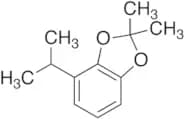
Formule :C19H11D17O7Couleur et forme :NeatMasse moléculaire :385.532,2-Dimethyl-4-isopropyl-1,3-benzodioxole
CAS :Produit contrôléImpurity Propofol EP Impurity L
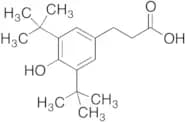
Applications 2,2-Dimethyl-4-isopropyl-1,3-benzodioxole (Propofol EP Impurity L).Formule :C12H16O2Couleur et forme :NeatMasse moléculaire :192.253,5-Di-tert-butyl-4-hydroxyphenylpropionic Acid
CAS :Applications 3,5-Di-tert-butyl-4-hydroxyphenylpropionic Acid acts as a new oxazole-pyrone antimicrobial agent. Inhibits electron transport in complex 1 of the respiratory chain. HIV-1 inihibitor.
References Kunze, B. et al.: J. Antibiot., 45, 1549 (1992); Yashuharu, I. et al.: Tetrahedron Lett., 37, 2997 (1996);Formule :C17H26O3Couleur et forme :Off-WhiteMasse moléculaire :278.392-Isopropyl-6-propylphenol
CAS :2-Isopropyl-6-propylphenol is a reactive alkylating agent that reacts with proteins and enzymes. It binds to the hydroxyl group of a protein target, which modifies the activity of the target molecule by introducing a new functional group. 2-Isopropyl-6-propylphenol has been shown to bind to the active site of several enzymes, including human serum albumin and cytochrome P450 reductase. The binding constants for these targets have been determined computationally using an algorithm based on quantum chemical calculations. These values are in good agreement with experimental data obtained from titration calorimetry experiments at different temperatures.
Formule :C12H18ODegré de pureté :Min. 95%Couleur et forme :Clear LiquidMasse moléculaire :178.27 g/mol4-Hydroxy Propofol
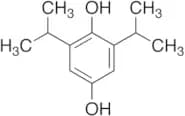
CAS :Applications A metabolite of Propofol.
References Davies, M., et al.: Biochem. J., 257, 603 (1989), Eriksson, O., et al.: Biochem. Pharmacol., 44, 391 (1992), Bryson, H., et al.: Drugs, 50, 513, (1995), Raoof, A., et al.: Eur. J. Clin. Pharmacol., 50, 91 (1996)Formule :C12H18O2Couleur et forme :NeatMasse moléculaire :194.272-Isopropylphenol
CAS :Produit contrôléImpurity Propofol EP Impurity C
Applications 2-Isopropylphenol (Propofol EP Impurity C) is an impurity of Propofol (P829750).
Not a dangerous good if item is equal to or less than 1g/ml and there is less than 100g/ml in the package
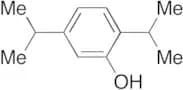
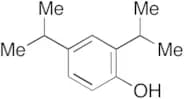
References Bahri, M., et al.: Biophys. Chem., 129, 82 (2007), Foti, M., et al.: J. Pharm. Pharmacol., 59, 1673 (2007), Vasileiou, I., et al.: Eur. J. Pharmacol., 605, 1 (2009),Formule :C9H12OCouleur et forme :NeatMasse moléculaire :136.192,4-Diisopropylphenol
CAS :Produit contrôléFormule :C12H18OCouleur et forme :ColourlessMasse moléculaire :178.272,6-Diisopropyl-1,4-benzoquinone
CAS :2,6-Diisopropyl-1,4-benzoquinone is a diphenol that reacts with a variety of organic compounds in the presence of heat. It has been used as a mesoporous material to adsorb hydrogen gas and carbon dioxide in the water treatment process. 2,6-Diisopropyl-1,4-benzoquinone is also able to react with oxygen to form an n-oxide. This compound is most often used for the manufacture of phenolic antioxidants such as dibenzoyl peroxide and pentafluorobenzoic acid. The active site on this molecule is thought to be at the double bond between carbons 6 and 7. Impurities may include anisidine and other aromatic amines that can cause reactions with hydrogen peroxide when exposed to light or certain wavelengths of radiation.Formule :C12H16O2Degré de pureté :Min. 95%Masse moléculaire :192.25 g/mol