Flavonoïdes
Les flavonoïdes sont un groupe de métabolites végétaux dotés de propriétés antioxydantes qui contribuent à la couleur des fruits et des fleurs. Ils jouent un rôle important dans la protection des plantes contre les rayons UV et les pathogènes. Les flavonoïdes sont étudiés pour leurs potentiels bienfaits pour la santé, notamment des propriétés anti-inflammatoires, antivirales et anticancéreuses. Ils font l'objet de nombreuses recherches dans les domaines de la pharmacologie, de la nutrition et de la biologie moléculaire.
Sous-catégories appartenant à la catégorie "Flavonoïdes"
- Anthocyanidines(46 produits)
- Anthocyanine(46 produits)
- Catéchine(88 produits)
- Chalcones(237 produits)
- Pterocarpans(28 produits)
2408 produits trouvés pour "Flavonoïdes"
Trier par
Degré de pureté (%)
0
100
|
0
|
50
|
90
|
95
|
100
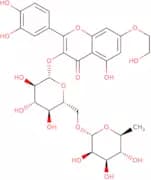
Monoxerutin
CAS :<p>Monoxerutin is a bioflavonoid derivative, which is sourced from plant-based compounds known for their beneficial effects on vascular function. Bioflavonoids are naturally occurring compounds present in various fruits, vegetables, and plants, playing a crucial role in plant defense mechanisms and offering significant health benefits when used in medicinal applications. The mode of action of Monoxerutin involves enhancing endothelial function and stabilizing capillary walls, thus improving vascular health. It achieves this by reducing capillary permeability and fragility, which in turn aids in enhancing circulation and providing anti-inflammatory benefits.</p>Degré de pureté :Min. 95%Fujikinetin
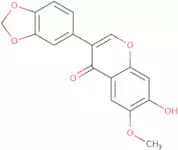
CAS :<p>Isoflavone from processed leaves and stems of Cyclopia intermedia</p>Formule :C17H12O6Degré de pureté :Min. 95%Couleur et forme :PowderMasse moléculaire :312.27 g/molDeguelin
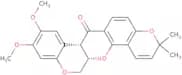
CAS :<p>Deguelin is a rotenoid, which is a naturally occurring compound derived primarily from the roots of plants in the Leguminosae family, such as Mundulea sericea and Derris species. It functions as a potent inhibitor of mitochondrial complex I, interfering with cellular respiration by blocking electron transport within the mitochondrial electron transport chain. This action leads to the inhibition of ATP production, which is essential for cellular energy.</p>Formule :C23H22O6Degré de pureté :Min. 95%Masse moléculaire :394.42 g/mol3'-Methoxydaidzein
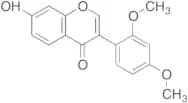
CAS :<p>3'-Methoxydaidzein is an isoflavone compound, which is typically isolated from soybean sources. This compound belongs to a class of phytoestrogens, naturally occurring plant-derived compounds with estrogenic activity. 3'-Methoxydaidzein exhibits various biological activities due to its structural similarity to human estrogens, allowing it to bind to estrogen receptors. Its mode of action primarily involves modulating estrogen receptor activity, potentially influencing gene expression in estrogen-responsive tissues.</p>Degré de pureté :Min. 95%6,7,4'-Trihydroxyflavanone
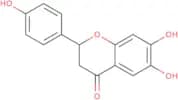
CAS :<p>6,7,4'-Trihydroxyflavanone is a naturally occurring flavonoid, which is found in various plant sources, particularly in citrus fruits and certain medicinal herbs. This compound is characterized by its presence of hydroxyl groups, enhancing its reactivity and interaction with biological systems. The mode of action of 6,7,4'-Trihydroxyflavanone primarily involves its antioxidant activity. It can scavenge free radicals and chelate metal ions, thereby reducing oxidative stress within cellular environments. This property is critical in maintaining cellular integrity and preventing damage caused by reactive oxygen species.</p>Formule :C15H12O5Degré de pureté :Min. 95%Masse moléculaire :272.25 g/molMaackiaflavanone
CAS :<p>Maackiaflavanone is a specialized flavanone, which is a type of natural compound. It is derived from the Maackia plant species, particularly found in temperate regions and known for its rich phytochemical profile. The flavanone exhibits its activity primarily through its interaction with cellular pathways associated with oxidative stress and inflammation, modulating various biochemical signals that can influence cell behavior.</p>Formule :C26H30O6Degré de pureté :Min. 95%Masse moléculaire :438.50 g/molHinokiflavone
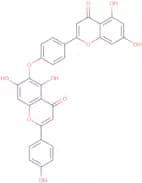
CAS :<p>A cytotoxic biflavonoid from Toxicodendron succedaneum, Juniperus sp., and Chamaecyparis obtusa (hinoki).</p>Formule :C30H18O10Degré de pureté :Min. 97 Area-%Couleur et forme :PowderMasse moléculaire :538.46 g/mol