Nucléotides
Les nucléotides sont des composés organiques qui servent de building blocks aux acides nucléiques, essentiels à la formation de l'ADN et de l'ARN. Chaque nucléotide est composé d'une base azotée, d'une molécule de sucre et d'un ou plusieurs groupes phosphate. Ces nucléotides s'assemblent pour former de longues chaînes, créant le matériel génétique qui porte et transmet l'information génétique dans tous les organismes vivants. Dans cette section, vous trouverez une large gamme de nucléotides essentiels pour la recherche en génétique, biologie moléculaire et biochimie. Ils sont fondamentaux pour étudier les processus génétiques, synthétiser des acides nucléiques et développer des outils diagnostiques et thérapeutiques. Chez CymitQuimica, nous proposons des nucléotides de haute qualité pour soutenir vos recherches scientifiques et applications, garantissant précision et fiabilité dans vos expériences.
Sous-catégories appartenant à la catégorie "Nucléotides"
2634 produits trouvés pour "Nucléotides"
Trier par
Degré de pureté (%)
0
100
|
0
|
50
|
90
|
95
|
100
4-Amino-1-(2-deoxy-α-D-erythro-pentofuranosyl)-5-methyl-2(1H)-pyrimidinone
CAS :<p>4-Amino-1-(2-deoxy-α-D-erythro-pentofuranosyl)-5-methyl-2(1H)-pyrimidinone is a novel phosphate derivative of ribonucleosides, including 2'-deoxyadenosine and 2'-deoxycytidine. 4ADP has antiviral and anticancer activities, and can be used as a substrate for the synthesis of phosphoramidites. These derivatives are modified by the introduction of substituents at the 5' position of the pentose sugar. The monophosphate form is synthesized by reacting with sodium hydroxide followed by hydrolysis with dilute acid. The diphosphate form is synthesized by reacting with phosphorus oxychloride in presence of pyridine.</p>Formule :C10H15N3O4Degré de pureté :Min. 95%Masse moléculaire :241.24 g/mol2'-O-(2-Methoxyethyl)-5-methylcytidine
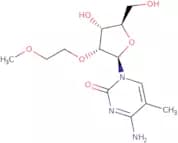
CAS :2'-O-(2-methoxyethyl)-5-methylcytidine is a novel antiviral monophosphate nucleoside that has been shown to be a potent activator of the immune system. It was synthesized by modifying a deoxyribonucleoside and phosphoramidite. 2'-O-(2-methoxyethyl)-5-methylcytidine is synthetic and can be used as an anticancer drug for the treatment of leukemia, lymphoma, and other cancers. This compound has also shown efficacy in treating diphosphate nucleotides such as HIV-1 reverse transcriptase, which is an enzyme crucial for viral replication.Formule :C13H21N3O6Degré de pureté :Min. 98 Area-%Couleur et forme :PowderMasse moléculaire :315.32 g/mol3',5'-O-(1,1,3,3-Tetraisopropyl-1,3-disiloxanediyl)guanosine
CAS :Used as a protected guanosine nucleoside in RNA synthesis. The 1,1,3,3-tetraisopropyl-1,3-disiloxanediyl (TIPDS or TBDPSi2) group acts as a bulky and selectively acid-labile protecting group for the 3' and 5' hydroxyl groups of the guanosine ribonucleoside during RNA oligonucleotide synthesis.Formule :C22H39N5O6Si2Degré de pureté :Min. 97 Area-%Couleur et forme :PowderMasse moléculaire :525.76 g/mol2',5'-Dideoxyadenosine
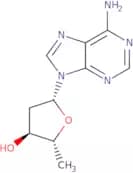
CAS :<p>2',5'-Dideoxyadenosine is a nucleotide analog that inhibits the enzyme adenylate cyclase, by binding non-competitively via the P-site</p>Formule :C10H13N5O2Degré de pureté :Min. 95%Couleur et forme :White Off-White PowderMasse moléculaire :235.25 g/moltrans-Zeatin riboside
CAS :<p>Trans-zeatin riboside is a cytokinin that is structurally related to adenosine. It has been shown to inhibit the adenosine a3 receptor, which decreases the production of reactive oxygen species in human serum and enhances the uptake of glucose. Trans-zeatin riboside also inhibits nuclear DNA fragmentation and increases water permeability in plant tissues. This chemical has been shown to stimulate photosynthetic activity in plants at an optimum concentration of 10 μg/ml. Trans-zeatin riboside should be stored at -20 degrees Celsius for long-term storage.</p>Formule :C15H21N5O5Couleur et forme :White Off-White PowderMasse moléculaire :351.36 g/mol4-Thiouridine-5'-triphosphate sodium salt - aqueous solution
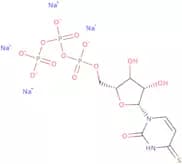
CAS :<p>4-Thiouridine-5'-triphosphate sodium salt - aqueous solution (4TUTP) is an analog of uridine and can be used as a template for the synthesis of single-stranded DNA. 4TUTP has been shown to have a high affinity for dsDNA, allowing it to form a ternary complex with DNA polymerase and single-stranded DNA template. 4TUTP can also be used to prepare samples for profiling experiments or other molecular studies. It is reactive, so should be handled with caution in order to avoid unwanted crosslinking. 4TUTP may also be used in chloroplast research.</p>Formule :C9H15N2O14P3S·xNaDegré de pureté :Min. 95 Area-%Couleur et forme :Clear LiquidMasse moléculaire :500.20 g/molCoenzyme A trilithium salt
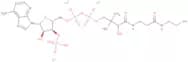
CAS :<p>Coenzyme A trilithium salt is a synthetic cofactor that is used in the synthesis of long-chain fatty acids. It is membrane permeable and has minimal toxicity, making it an attractive candidate for treating hepatic steatosis. Coenzyme A trilithium salt also activates human mitochondrial beta-oxidation by increasing the availability of substrate and enhancing the expression of genes involved in beta-oxidation. This molecule has been shown to be effective in improving the symptoms of X-linked adrenoleukodystrophy (X-ALD) by stimulating creatine kinase activity and suppressing lysosomal accumulation of long chain fatty acids.</p>Formule :C21H33Li3N7O16P3SDegré de pureté :Min. 80%Couleur et forme :White Off-White PowderMasse moléculaire :785.33 g/mol5'-O-DMT-N2-isobutyryl-2'-O-methylguanosine
CAS :5'-O-DMT-N2-isobutyryl-2'-O-methylguanosine is a nucleoside that has been synthesized using an oxime opening of the 5' position and a methylation at the 2' position. It has been shown to have an affinity for tissues in a chemotactic assay. The compound is minimised to remove non-specific binding sites, avoiding false positives on the checklist. This molecule has been analysed with fluorescence spectroscopy and microscopy techniques, which revealed that it is distributed in tissues as well as being found in dragonflies. It was also shown to be transduced by muscle cells and geochemically detected in limestone from China.Formule :C36H39N5O8Degré de pureté :Min. 95%Couleur et forme :PowderMasse moléculaire :669.74 g/mol2'-Deoxy-5'-O-DMT-2'-fluoro-5-methyluridine
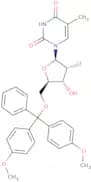
CAS :<p>This is a nucleoside analog that has antiviral properties. It is a monophosphate derivative of 2'-deoxy-5'-O-DMT-2'-fluoro-5-methyluridine and has been shown to be an activator of RNA polymerase II transcription in vitro. This compound is also a novel, high quality, high purity reagent for the synthesis of phosphoramidites. 2'-Deoxy-5'-O-DMT-2'-fluoro-5-methyluridine is CAS No. 133324-02-4 and can be used as a diphosphate or DNA nucleoside analog with antiviral properties.<br>2'-Deoxy-5'-O-DMT-2'-fluoro-5-methyluridine is synthesized by reacting 5' deoxyribose phosphate with the corresponding 2',3' or 4' fluoro amidite in the presence of a base. The ribonucle</p>Formule :C31H31FN2O7Degré de pureté :Min. 95%Couleur et forme :White PowderMasse moléculaire :562.59 g/molGuanosine-5'-[(b,γ)-imido]triphosphate sodium salt
CAS :Guanosine-5'-[(b,gamma)-imido]triphosphate sodium salt is a novel antiviral agent that has been shown to inhibit the replication of human adenovirus type 5 (AdV-5) and herpes simplex virus type 1 (HSV-1). It is phosphorylated by adenylate kinase to guanosine diphosphate. Guanosine-5'-[(b,gamma)-imido]triphosphate sodium salt is an activator for DNA polymerase alpha and DNA topoisomerase I. It also inhibits the proliferation of tumor cells in culture.Formule :C10H17N6O13P3·xNaDegré de pureté :Min. 95%Couleur et forme :White PowderMasse moléculaire :522.2 g/mol2-Chloro-N6-cyclopentyladenosine hemihydrate
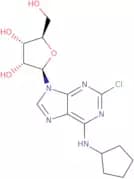
CAS :<p>2-Chloro-N6-cyclopentyladenosine hemihydrate is a synthetic adenosine analog with potential research applications</p>Formule :C15H20ClN5O4H2ODegré de pureté :Min. 98 Area-%Couleur et forme :PowderMasse moléculaire :378.81 g/mol5'-O-[Bis(4-methoxyphenyl)(phenyl)methyl]-2'-deoxy-N-isobutyrylguanosine
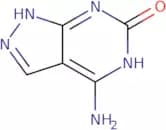
CAS :5'-O-[Bis(4-methoxyphenyl)(phenyl)methyl]-2'-deoxy-N-isobutyrylguanosine is a synthetic nucleoside that is used as a building block in the synthesis of oligonucleotides. This chemical has an electronegativity value of 1.7, which means that it is more electronegative than guanine (1.0). It also has a conjugated system and is stable under a range of conditions. 5'-O-[Bis(4-methoxyphenyl)(phenyl)methyl]-2'-deoxy-N-isobutyrylguanosine reacts with tetrazole in the presence of phosphoramidite, yielding the corresponding 5'-O-(4,4'-dimethoxytrityl)-2'-deoxy-N-isobutyrylguanosine, which can then be used toFormule :C35H37N5O7Degré de pureté :Min. 98 Area-%Couleur et forme :White PowderMasse moléculaire :639.71 g/mol4-Amino-6-hydroxypyrazolo(3,4-D)pyrimidine
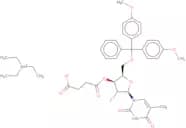
CAS :4-Amino-6-hydroxypyrazolo(3,4-D)pyrimidine is an anti-inflammatory drug that is used to treat bowel disease. It is also used as a polymer conjugate to treat cancer, and in the prevention of transplant rejection. 4-Amino-6-hydroxypyrazolo(3,4-D)pyrimidine has been shown to have antioxidant properties and may be effective in preventing inflammatory diseases such as inflammatory bowel disease. It has also been shown to act as an antihypertensive agent by inhibiting angiotensin I converting enzyme (ACE).Formule :C5H5N5ODegré de pureté :Min. 95%Masse moléculaire :151.13 g/mol1-(2'-Deoxy-5'-O-DMT-2'-fluoro-b-D-arabinofuranosyl)thymine 3'-O-succinate triethylammonium salt
<p>1-(2'-Deoxy-5'-O-DMT-2'-fluoro-b-D-arabinofuranosyl)thymine 3'-O-succinate triethylammonium salt is a compound used in the synthesis of oligonucleotides. The synthesis of such compounds often involves the use of protecting groups, such as the 4,4'-dimethoxytrityl (DMT) group, to prevent unwanted reactions during the synthesis process. The 2'-fluoro modification is of particular interest due to its potential to alter the chemical and biological properties of the resulting oligonucleotides. Fluorinated nucleosides and their analogs have been extensively studied for their antiviral and anticancer activities</p>Formule :C35H34FN2O10·C6H16NDegré de pureté :Min. 95%Masse moléculaire :763.87 g/mol6-Chloro-7-deaza-9-(b-D-ribofuranosyl)purine
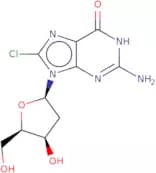
CAS :6-Chloro-7-deaza-9-(b-D-ribofuranosyl)purine is a novel nucleoside that has been shown to be an efficient activator of the transcription factor NFκB in vitro. 6-Chloro-7-deaza-9-(b-D-ribofuranosyl)purine is synthesized by phosphoramidite chemistry and purified by HPLC. It has been demonstrated to inhibit the replication of human immunodeficiency virus (HIV) in a dose dependent manner, which may be due to its ability to inhibit the synthesis of viral DNA and RNA. This product is highly pure and can be used for many purposes, including as a synthetic building block for DNA or as an antiviral drug.Formule :C11H12ClN3O4Degré de pureté :Min. 95%Couleur et forme :White PowderMasse moléculaire :285.69 g/mol8-Chloro-2'-deoxyguanosine
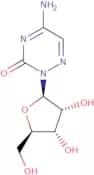
CAS :<p>8-Chloro-2'-deoxyguanosine is a reactive oxygen species that can cause oxidative damage to DNA. This compound is generated by the hypochlorous acid (HOCl) in cells and can be found in human tissues. 8-Chloro-2'-deoxyguanosine can also be generated by the HOCl in diabetic patients, where it has been shown to cause oxidative damage to DNA. 8-Chloro-2'-deoxyguanosine is a product of the reaction between hydrogen peroxide and catalase, and it is activated by HOCl. It has been shown to be carcinogenic in animal models, where it causes DNA damage that leads to cancer.</p>Formule :C10H12ClN5O4Degré de pureté :Min. 95%Couleur et forme :PowderMasse moléculaire :301.69 g/mol6-Azacytidine
CAS :6-Azacytidine is a molecule that contains a hydroxyl group and a glycosidic bond. It has been shown to inhibit the growth of mollicutes, which are non-cellular bacteria. 6-Azacytidine has also been shown to be toxic in animal tissue culture studies. The drug can be eliminated through the urine or bile after being metabolized by the liver. 6-Azacytidine is not active against human cells in cell culture, but it does show some toxicity against human liver cells.Formule :C8H12N4O5Degré de pureté :Min. 95%Couleur et forme :PowderMasse moléculaire :244.2 g/mol5'-Carboxy-2-chloro-2'-3'-O-isopropylideneadenosine
CAS :5'-Carboxy-2-chloro-2'-3'-O-isopropylideneadenosine is a monophosphate nucleoside that inhibits viral replication by inhibiting the synthesis of both DNA and RNA. This compound is used to treat cancers such as leukemia, lymphoma, and multiple myeloma. It also has antiviral properties that are active against herpes simplex virus (HSV) and human cytomegalovirus (CMV). 5'-Carboxy-2-chloro-2'-3'-O-isopropylideneadenosine is a modified nucleoside with a phosphoramidite group on the 2' position of the ribose sugar.Formule :C13H14ClN5O5Degré de pureté :Min. 95%Couleur et forme :Off-White PowderMasse moléculaire :355.74 g/molGuanosine 3',5'-cyclic monophosphate sodium salt
CAS :<p>Guanosine 3',5'-cyclic monophosphate sodium salt (cGMP) is a cyclic nucleotide that is involved in the regulation of many cellular processes. It binds to specific guanine nucleotide-binding proteins (G proteins) and activates protein kinase A, which regulates glucose metabolism and energy production. cGMP also affects neuronal death, axonal growth, and bowel disease by acting as a cyclase inhibitor or activating the immune system. It has been shown to reduce the severity of infectious diseases such as HIV and malaria by activating the immune system.</p>Formule :C10H11N5NaO7PDegré de pureté :Min. 95%Couleur et forme :PowderMasse moléculaire :367.19 g/mol5'-O-Tritylthymidine
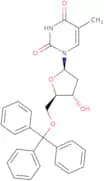
CAS :5'-O-Tritylthymidine is a nucleoside that is found in human mitochondrial DNA. It is synthesized from uridine by the enzyme thymidylate synthase and can be converted to thymine by the enzyme thymidine phosphorylase. 5'-O-Tritylthymidine has been shown to inhibit cancer cell growth, but its mechanism of action is not clear. It may inhibit xylene production. 5'-O-Tritylthymidine also causes an increase in p53 activity, which may lead to apoptosis of cancer cells.Formule :C29H28N2O5Degré de pureté :Min. 95%Masse moléculaire :484.54 g/mol





![Guanosine-5'-[(b,γ)-imido]triphosphate sodium salt](/_next/image/?url=https%3A%2Fstatic.cymitquimica.com%2Fproducts%2F3D%2Fthumb-webp%2FNG35450.webp&w=3840&q=75)
![5'-O-[Bis(4-methoxyphenyl)(phenyl)methyl]-2'-deoxy-N-isobutyrylguanosine](/_next/image/?url=https%3A%2Fstatic.cymitquimica.com%2Fproducts%2F3D%2Fthumb-webp%2FND02998.webp&w=3840&q=75)