Nucléotides
Les nucléotides sont des composés organiques qui servent de building blocks aux acides nucléiques, essentiels à la formation de l'ADN et de l'ARN. Chaque nucléotide est composé d'une base azotée, d'une molécule de sucre et d'un ou plusieurs groupes phosphate. Ces nucléotides s'assemblent pour former de longues chaînes, créant le matériel génétique qui porte et transmet l'information génétique dans tous les organismes vivants. Dans cette section, vous trouverez une large gamme de nucléotides essentiels pour la recherche en génétique, biologie moléculaire et biochimie. Ils sont fondamentaux pour étudier les processus génétiques, synthétiser des acides nucléiques et développer des outils diagnostiques et thérapeutiques. Chez CymitQuimica, nous proposons des nucléotides de haute qualité pour soutenir vos recherches scientifiques et applications, garantissant précision et fiabilité dans vos expériences.
Sous-catégories appartenant à la catégorie "Nucléotides"
2634 produits trouvés pour "Nucléotides"
Trier par
Degré de pureté (%)
0
100
|
0
|
50
|
90
|
95
|
100
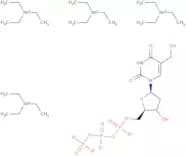
2'-Deoxy-5-hydroxymethyluridine-5'-triphosphate triethylammonium
CAS :2'-Deoxy-5-hydroxymethyluridine-5'-triphosphate triethylammonium salt (dHMUTP) is a noncompetitive inhibitor of transcriptase activity. It inhibits the synthesis of DNA by binding to RNA polymerase on the template strand, thereby blocking the progress of the enzyme along the DNA. This drug has been shown to be effective in inhibiting viral production and growth in mammalian cells, as well as cancer cell culture. Dihydrofolate reductase is required for dHMUTP to function, and it is metabolized in vivo through hydrolysis by glycosylases or antineoplastic properties by nucleotide excision repair enzymes. These enzymes are present in human cells but absent in bacteria and yeast. The drug also has antineoplastic properties due to its ability to inhibit tumor cell proliferation.Formule :C10H16N2O15P3·C6H16NDegré de pureté :Min. 70 Area-%Couleur et forme :PowderMasse moléculaire :599.36 g/mol6-Thioguanosine
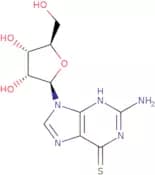
CAS :6-Thioguanosine is a purine analog that is used in the treatment of skin cancer and bowel disease. It has been shown to be an inhibitor of leukemia cells and also inhibits the growth of colon cancer cells. 6-Thioguanosine binds to the rate constant for uridine phosphorylation, which prevents the production of DNA. This drug also has an anti-inflammatory effect on bowel disease, which may be due to its ability to inhibit bcl-2 protein expression. 6-Thioguanosine is a fluorescent derivative that can be used as a substrate for x-ray diffraction data or as a biological sample in biological studies.Formule :C10H13N5O4SDegré de pureté :Min. 95%Couleur et forme :Slightly Yellow Slightly Green PowderMasse moléculaire :299.31 g/mol5,6-Dihydro-2'-deoxyuridine
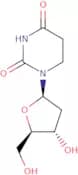
CAS :5,6-Dihydro-2'-deoxyuridine (dUrd) is a pyrimidine nucleoside that is an important component of DNA. It is phosphorylated by deoxyribonucleoside kinase to form dUrd monophosphate. This compound has been shown to inhibit the activity of catalase and other enzymes that hydrolyze hydrogen peroxide, indicating it may have antiviral properties. The enzyme activities of 5,6-dihydro-2'-deoxyuridine on simplex virus type 1 have been studied in vitro using lymphoblastoid cells. In these studies, the compounds was found to inhibit viral growth and terminate replication. 5,6-Dihydro-2'-deoxyuridine also inhibits the synthesis of DNA by inhibiting oxidative deamination reactions and termini formation in herpes simplex virus type 1. This drug has also been shown to inhibit amine oxidases in hepFormule :C9H14N2O5Degré de pureté :Min. 95%Couleur et forme :PowderMasse moléculaire :230.22 g/mol2'-Deoxy-5-ethynylcytidine
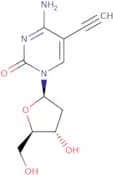
CAS :2'-Deoxy-5-ethynylcytidine is a cytosine analog that inhibits the synthesis of viral DNA and the production of new virus particles. It has been shown to inhibit herpes simplex virus type-1 (HSV-1) in cell cultures, as well as other viruses such as vaccinia and adenovirus. 2'-Deoxy-5-ethynylcytidine has also been shown to have anti-cancer properties in animal studies. This drug binds to the cellular nucleic acid, preventing transcription of viral genes into messenger RNA and preventing protein synthesis, thereby inhibiting replication of the virus. 2'-Deoxy-5-ethynylcytidine also inhibits the synthesis of cellular DNA by binding to nuclear DNA. 2'-Deoxy-5-ethynylcytidine is an analog of cytosine that binds to dna polymerase and prevents it from adding on new nucleotides, which blocks viral reproduction.Formule :C11H13N3O4Degré de pureté :Min. 95%Couleur et forme :PowderMasse moléculaire :251.24 g/mol2'-Deoxy-5-iodouridine
CAS :2'-Deoxy-5-iodouridine (IDU) is a nucleoside that inhibits viral replication by inhibiting the synthesis of viral DNA. IDU has been shown to be a potent inhibitor of murine sarcoma virus and human immunodeficiency virus (HIV). IDU also has inhibitory properties on axonal growth, which may be due to its ability to inhibit DNA polymerase II. 2'-Deoxy-5-iodouridine is biocompatible, non-toxic, and can be used in high concentrations without any acute toxicities.Formule :C9H11IN2O5Degré de pureté :Min. 95%Couleur et forme :PowderMasse moléculaire :354.1 g/mol2'-Deoxy-8-oxo-adenosine
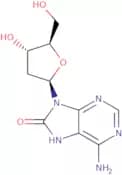
CAS :<p>2'-Deoxy-8-oxo-adenosine is a nucleoside that is a hydrogen bond donor. It is an analogue of adenosine, and has been shown to inhibit the growth of breast cancer cells. 2'-Deoxy-8-oxo-adenosine reacts with the enzyme dATP pyrophosphohydrolase to form 8-oxo-2'-deoxyadenosine, which inhibits mitochondrial DNA synthesis by preventing the incorporation of inorganic phosphate into mitochondrial DNA. This process leads to reduced ATP production, leading to cell death. The reactive properties of 2'-Deoxy-8-oxo-adenosine make it suitable for use as a probe molecule in chemical biology, as well as in biochemical studies on human serum.</p>Formule :C10H13N5O4Degré de pureté :Min. 95 Area-%Couleur et forme :PowderMasse moléculaire :267.25 g/mol8-Thioguanosine
CAS :<p>8-Thioguanosine is a purine derivative with reactive chlorine atoms. It has been shown to be a potent inhibitor of cellular targets, including monoclonal antibodies, growth factors, and transcription-polymerase chain reactions (PCR). 8-Thioguanosine binds to the antibody response by modulating the function of the B cells. This drug also has immunomodulatory effects that have been shown in animal models. 8-Thioguanosine is used as an immunosuppressant in patients undergoing bone marrow transplants and solid organ transplants.</p>Formule :C10H13N5O5SDegré de pureté :Min. 95%Couleur et forme :White PowderMasse moléculaire :315.3 g/mol2',3'-Dideoxy-3'-fluorouridine
CAS :<p>2',3'-Dideoxy-3'-fluorouridine is a synthetic analog of uridine with chemical modifications that disrupt RNA and DNA synthesis. Because of this, it’s often studied or used as an antiviral or anticancer agent.</p>Formule :C9H11FN2O4Degré de pureté :Min. 95%Couleur et forme :White PowderMasse moléculaire :230.2 g/molRibavirin 5'-monophosphate dilithium
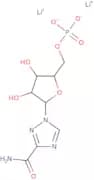
CAS :Ribavirin is a synthetic nucleoside analog that is used as an antiviral agent. Ribavirin 5'-monophosphate dilithium (RPM) is a high-quality, novel phosphoramidite monophosphate of ribavirin. It has antiviral activity against herpesviruses, adenoviruses, and poxviruses. The antiviral properties of RPM are due to its ability to inhibit viral RNA synthesis through inhibition of the viral enzyme ribonucleotide reductase. RPM is also active against DNA viruses such as human papilloma virus and Epstein-Barr virus.Formule :C8H11Li2N4O8PDegré de pureté :Min. 95 Area-%Couleur et forme :PowderMasse moléculaire :336.05 g/mol3'-Deoxyadenosine
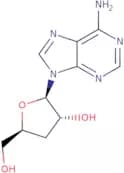
CAS :<p>3'-Deoxyadenosine is a nucleoside that is an inhibitor of adenylate cyclase. It has been shown to inhibit the growth of mouse tumor cells and induce apoptosis in HL-60 cells. 3'-Deoxyadenosine inhibits the production of pro-apoptotic protein, which may be due to its ability to activate toll-like receptor 4. 3'-Deoxyadenosine also has strong anti-inflammatory properties and can be used for the treatment of infectious diseases caused by bacteria, such as Mycobacterium tuberculosis or Streptococcus pyogenes. 3'-Deoxyadenosine binds to DNA polymerases and inhibits the replication of DNA by blocking the incorporation of deoxynucleotides into DNA. This compound has been shown to have thermodynamic data consistent with a stable secondary structure at high temperatures.br></p>Formule :C10H13N5O3Degré de pureté :Min. 98 Area-%Couleur et forme :White PowderMasse moléculaire :251.25 g/mol2',3'-Dideoxy-3'-fluoro-a-uridine
CAS :2',3'-Dideoxy-3'-fluoro-a-uridine is a synthetic nucleoside analog. This compound is a modified version of uridine. The 2' and 3' hydroxyl groups on the sugar molecule are replaced with hydrogen atoms, and a fluorine atom replaces the hydrogen at the 3' position. This molecule has potential antiviral acitivty and can be used in research applications.Formule :C9H11FN2O4Degré de pureté :Min. 95%Couleur et forme :White PowderMasse moléculaire :230.19 g/molD3-Thymidine
CAS :Produit contrôlé<p>D3-Thymidine is a substance that is formed from the monosaccharide galactose and has been used in biochemical studies. D3-Thymidine has been used as a marker for the damaged DNA of viruses, such as herpes simplex virus type 1, and for the DNA of tumor cells. It has also been used to study the effects of protonation on its function. D3-Thymidine is an unlabeled thymidine derivative that was studied using dichroism spectroscopy. This technique showed that this molecule can exist either in a single form or in two forms with different shapes, depending on its microenvironment.<br>D 3 -thymidine was first synthesized by Dr. Gertrude Buechner at the University of Wisconsin–Madison in 1957. In her experiments, she found that this molecule could be produced by hydrolyzing 2-deoxy-D-ribose with 3 molar equivalents of ammon</p>Formule :C10H11N2O5D3Degré de pureté :Min. 95%Couleur et forme :PowderMasse moléculaire :245.25 g/mol2',3',5'-Tri-O-benzoyluridine
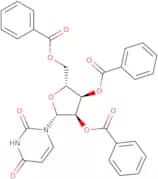
CAS :<p>2',3',5'-Tri-O-benzoyluridine is a protected form of the nucleoside uridine. Uridine is a pyrimidine nucleoside consisting of uracil as the nitrogenous base and a ribose sugar linked via a β-N-glycosidic bond at the 1′ position. The hydroxyl groups on the ribose (at positions 2′, 3′, and 5′) are protected with benzoyl groups (–O–CO–C₆H₅).</p>Formule :C30H24N2O9Degré de pureté :Min. 95%Couleur et forme :White PowderMasse moléculaire :556.52 g/mol3-Deazauridine
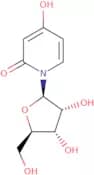
CAS :<p>3-Deazauridine is a uridine analog that inhibits the synthesis of DNA, RNA, and protein. It has been shown to inhibit the activity of 3-deazauridine synthetase in HL-60 cells. 3-Deazauridine also has significant cytotoxicity against colorectal adenocarcinoma cells and synergistic effects when used with other chemotherapeutic agents. The mechanism of action of 3-deazauridine is similar to that of other enzyme inhibitors, such as glycosidic bond formation or competitive inhibition. The sample preparation for this drug is complicated by its insolubility in water.</p>Formule :C10H13NO6Degré de pureté :Min. 97 Area-%Couleur et forme :White PowderMasse moléculaire :243.21 g/mol7-Deaza-2',3'-dideoxy-7-iodoguanosine
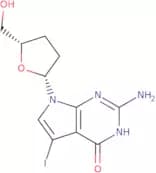
CAS :<p>7-Deaza-2',3'-dideoxy-7-iodoguanosine is a nucleoside analog that inhibits the synthesis of DNA by inhibiting the activity of DNA polymerase. It is used to treat HIV and other viral infections. The compound is also active against cancer cells and has been shown to inhibit the growth of leukemia cells. 7-Deaza-2',3'-dideoxy-7-iodoguanosine is modified with an iodine atom at the 7 position and has a novel structure. This compound is used in biological research as a substrate for the preparation of phosphate esters such as phosphoramidites for use in oligonucleotide synthesis.</p>Formule :C11H13N4O3IDegré de pureté :Min. 95%Couleur et forme :White/Off-White SolidMasse moléculaire :376.15 g/mol5'-O-Trityl-2,3'-anhydrothymidine
CAS :5'-O-Trityl-2,3'-anhydrothymidine is a nucleoside analogue that inhibits HIV reverse transcriptase by binding to the enzyme and preventing RNA chain elongation. The compound is a potent inhibitor of HIV in cell cultures and has been shown to be active against a variety of HIV isolates. 5'-O-Trityl-2,3'-anhydrothymidine has also shown antiviral activity against other RNA viruses such as SARS coronavirus and influenza virus.Formule :C29H26N2O4Degré de pureté :Min. 95%Masse moléculaire :466.53 g/mol8-Chloroinosine
CAS :Metabolite of 8-ChloroadenosineFormule :C10H11ClN4O5Degré de pureté :Min. 95%Couleur et forme :PowderMasse moléculaire :302.67 g/mol2'-Deoxy-5'-O-DMT-uridine
CAS :2'-Deoxy-5'-O-DMT-uridine is a bifunctional drug that has both antibacterial and anticancer activity. This drug is used to treat leishmania infections, which are caused by protozoan parasites. 2'-Deoxy-5'-O-DMT-uridine suppresses the growth of these organisms by inhibiting RNA synthesis and protein synthesis. It also inhibits proliferation of cancer cells in vivo by targeting cancer cells with high levels of primary amines. 2'-Deoxy-5'-O-DMT-uridine is an effective chemotherapeutic agent that can be used to treat pancreatic cancers with high rates of primary amines (e.g., insulinoma).Formule :C30H30N2O7Degré de pureté :Min. 95%Couleur et forme :PowderMasse moléculaire :530.58 g/mol2'-Deoxy-2',2'-difluoro-a-uridine
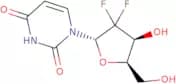
CAS :<p>2'-Deoxy-2',2'-difluoro-a-uridine is a nucleoside analog with modifications on the 2'-carbon of the ribose sugar and the pyrimidine base uracil. This compound is a synthetic derivative of uridine with two fluorine atoms attached to the 2' carbon of the sugar. The α-stereochemistry of the sugar indicates a specific configuration that influences how the molecule behaves in biological systems, including its interaction with enzymes and incorporation into nucleic acids.</p>Formule :C9H10F2N2O5Degré de pureté :Min. 95%Couleur et forme :PowderMasse moléculaire :264.18 g/mol6-Thioguanosine-5'-O-triphosphate sodium - 10mM aqueous solution
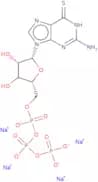
CAS :6-Thioguanosine-5'-O-triphosphate sodium salt is a nucleotide analog that inhibits the synthesis of RNA, DNA and protein. It binds to the guanine nucleotide-binding site on the enzyme RNA polymerase and blocks transcription. This leads to a decreased amount of mRNA, thereby slowing or stopping protein production. 6TGTP also has been shown to be effective in treating cancer as it inhibits enzymes involved in cellular metabolism and induces cell death. 6TGTP has been shown to have no effect on mammalian cells when incubated with 10 mM magnesium ion.Formule :C10H16N5O13P3S•NaxDegré de pureté :Min. 95%Couleur et forme :PowderMasse moléculaire :539.25 g/mol