Nucléosides
3569 produits trouvés pour "Nucléosides"
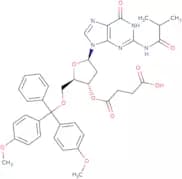
2'-Deoxy-5'-O-DMT-N2-isobutyrylguanosine 3'-O-succinate
CAS :2'-Deoxy-5'-O-DMT-N2-isobutyrylguanosine 3'-O-succinate is a nucleoside that is modified by the incorporation of an isobutyryl group at the 2' position. It has shown to be an activator of phosphoramidites and can be used as a precursor for the synthesis of nucleic acids, including DNA and RNA. 2'-Deoxy-5'-O-DMT-N2-isobutyrylguanosine 3'-O-succinate has been shown to have anticancer properties, antiviral properties, and antiinflammatory properties.Formule :C39H41N5O10Degré de pureté :Min. 95%Masse moléculaire :739.77 g/mol3,7-Dihydro-5-iodo-4-oxo-4H-pyrrolo[2,3-d]pyrimidine
CAS :3,7-Dihydro-5-iodo-4-oxo-4H-pyrrolo[2,3-d]pyrimidine is a novel antiviral drug with anticancer activity. It is an inhibitor of the enzyme ribonucleotide reductase and has been shown to inhibit the production of deoxyribonucleosides in tumor cells. It also inhibits DNA synthesis by inhibiting DNA polymerase. 3,7-Dihydro-5-iodo-4-oxo-4H-pyrrolo[2,3-d]pyrimidine is a high purity product that is available in both monophosphate and diphosphate forms.Formule :C6H4IN3ODegré de pureté :Min. 95%Masse moléculaire :261.02 g/mol5-(4-Amino-5-fluoro-2-oxo-1(2H)-pyrimidinyl)-1,3-oxathiolane-2-carboxylic acid 5-methyl-2-(1-methylethyl)cyclohexyl ester
CAS :5-(4-Amino-5-fluoro-2-oxo-1(2H)-pyrimidinyl)-1,3-oxathiolane-2-carboxylic acid 5-methylcyclohexyl ester is a novel nucleoside analog with antiviral and anticancer properties. It is an inhibitor of influenza virus replication. The compound is also active against human DNA polymerase beta, herpes simplex virus type 1 and 2, and Epstein Barr virus. This compound is synthesized as a phosphate derivative for use in phosphoramidite chemistry for the synthesis of DNA or RNA.Formule :C18H26FN3O4SDegré de pureté :Min. 95%Masse moléculaire :399.48 g/mol5'-O-DMT-2'-ethylfluoro-5-methyluridine 3'-CE phophoramidite
5'-O-DMT-2'-ethylfluoro-5-methyluridine 3'-CE phophoramidite is an antiviral agent that has been shown to inhibit the replication of HIV in cell culture and to prevent the synthesis of the virus. 5'-O-DMT-2'-ethylfluoro-5-methyluridine 3'-CE phophoramidite inhibits viral replication by acting as a competitive inhibitor of HIV reverse transcriptase and blocking viral DNA synthesis from viral RNA. It has also been shown to have anticancer properties, which may be due to its ability to suppress tumor growth through inhibition of protein synthesis.
Degré de pureté :Min. 95%Adenosine 2',3'-cyclic monophosphate-5'-monophosphate
Adenosine 2',3'-cyclic monophosphate-5'-monophosphate (AMP-CP) is a nucleotide that is the cyclic form of adenosine monophosphate. It is a modified nucleoside that is used in the synthesis of DNA and RNA, as well as in anticancer and antiviral research. The structure of AMP-CP consists of an adenosine base attached to ribose through a phosphate group at the 3' carbon position. This nucleotide can be converted to adenosine 5'-monophosphate (AMP) by phosphoramidites, which are chemical compounds consisting of an aminopropyl group joined to a phosphoryl group. AMP-CP is also known as diphosphate or deoxyribonucleosides. AMP-CP has shown antiviral activity against herpes simplex virus type 1, HIV, influenza A virus, and vesicular stomDegré de pureté :Min. 95%5-Iodo-2’-O-methylcytidine
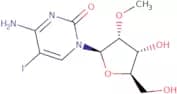
CAS :5-Iodo-2’-O-methylcytidine is a nucleoside that is used as an activator for the synthesis of ribonucleosides. It is also used in the synthesis of DNA, RNA, and phosphoramidites. 5-Iodo-2’-O-methylcytidine has shown anticancer activity against a variety of cancer cell lines. This novel nucleotide exhibits high quality and purity, with an excellent yield and low impurities. The compound has been assigned CAS No. 847650-69-5 and its physical properties have been described in detail.
Formule :C10H14IN3O5Degré de pureté :Min. 95%Masse moléculaire :383.14 g/molN-Acetyl-3',5'-O-(1,1,3,3-tetraisopropyl-1,3-disiloxanediyl)adenosine
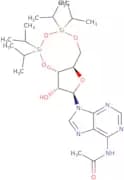
CAS :N-Acetyl-3',5'-O-(1,1,3,3-tetraisopropyl-1,3-disiloxanediyl)adenosine is a novel nucleoside analog which has been modified to improve its anticancer activity. This compound is an activator of adenosine deaminase and inhibits the proliferation of various tumor cells. It also blocks the formation of DNA by inhibiting the synthesis of ribonucleotides. N-acetyl-3',5'-O-(1,1,3,3-tetraisopropyl-1,3-disiloxanediyl)adenosine has antiviral properties and can inhibit HIV replication in vitro.Formule :C23H41N3O7Si2Degré de pureté :Min. 95%Masse moléculaire :527.76 g/mol4-(1-Benzylpiperidin-4-Ylamino)-2-(Methylthio)Pyrimidine-5-Carboxylic Acid
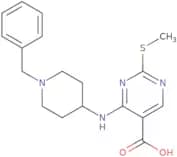
CAS :4-(1-Benzylpiperidin-4-Ylamino)-2-(Methylthio)Pyrimidine-5-Carboxylic Acid is a novel nucleoside analog that has been shown to have anticancer activity. It has also been found to have antiviral and antitumor activities. 4-(1-Benzylpiperidin-4-Ylamino)-2-(Methylthio)Pyrimidine-5-Carboxylic Acid is a nucleoside analog that is synthesized from monophosphate, diphosphate, and phosphate esters of 2-(methylthio)pyrimidine 5'-carboxylic acid. It is an analogue of the natural nucleoside uridine and has phosphorylase enzyme activity. This agent is cytotoxic against cells in culture by inhibiting DNA synthesis.Formule :C18H22N4O2SDegré de pureté :Min. 95%Masse moléculaire :358.46 g/molAdenosine 5′-diphosphoribose monosodium
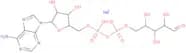
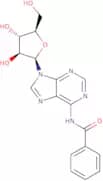
CAS :Adenosine 5′-diphosphoribose monosodium is a novel nucleotide that can be used in the synthesis of antiviral, anticancer, and anti-inflammatory drugs. Adenosine 5′-diphosphoribose monosodium is a modified form of adenosine 5′-triphosphate (ATP) with an added phosphate group at the 5′ position on the ribose sugar. It is synthesized from ATP by phosphoramidite chemistry. The CAS number for this product is 68414-18-6. Adenosine 5′-diphosphoribose monosodium has been shown to inhibit replication of human immunodeficiency virus type 1 (HIV-1) and herpes simplex virus type 1 (HSV-1).Formule :C15H23N5O14P2•NaDegré de pureté :Min. 95%Masse moléculaire :582.31 g/mol9-(b-D-Arabinofuranosyl)-N6-benzoyladenine
CAS :9-(b-D-arabinofuranosyl)-N6-benzoyladenine is a novel nucleoside analogue that has been shown to be an effective anticancer agent. It is structurally related to the natural nucleosides adenosine and guanosine, but with the addition of a benzoyl group on the 9 position. This compound is also active against HIV, influenza A virus and herpes simplex virus type 1 (HSV1). It can be used as an antiviral agent in cancer therapy due to its ability to inhibit viral replication. 9-(b-D-arabinofuranosyl)-N6-benzoyladenine inhibits the growth of tumor cells by inhibiting DNA synthesis and RNA transcription. It also binds to DNA, thereby preventing DNA synthesis and RNA transcription.
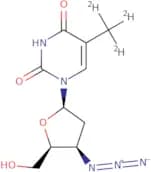
Formule :C17H17N5O5Degré de pureté :Min. 95%Masse moléculaire :371.35 g/mol3'-Azido-3'-deoxythymidine methyl-D3
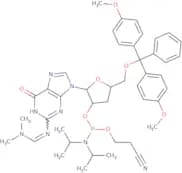
Produit contrôlé3'-Azido-3'-deoxythymidine methyl-D3 is a novel synthetic nucleoside. It is a modified version of the natural nucleoside deoxyribonucleoside, which is an essential component of DNA and RNA. 3'-Azido-3'-deoxythymidine methyl-D3 is an activator of the antiviral and anticancer properties of other drugs. It can be used as a phosphate donor in phosphoramidite synthesis to produce oligonucleotides for use in PCR amplification or in protein synthesis. 3'-Azido-3'-deoxythymidine methyl-D3 is also used as an antiviral agent because it inhibits viral replication by inhibiting viral reverse transcriptase.Formule :C10H10D3N5O4Degré de pureté :Min. 95%Masse moléculaire :270.26 g/mol3'-Deoxy-N2-DMF-5'-O-DMT-guanosine 2'-CE phosphoramidite
CAS :3'-Deoxy-N2-DMF-5'-O-DMT-guanosine 2'-CE phosphoramidite is a novel nucleoside, which is structurally similar to cytidine and has been synthesized for the first time. 3'-Deoxy-N2-DMF-5'-O-DMT-guanosine 2'-CE phosphoramidite has antiviral and anticancer activities. It inhibits the growth of viruses by inhibiting DNA synthesis. 3'-Deoxy-N2-DMF-5'-O-DMT-guanosine 2'-CE phosphoramidite also inhibits the growth of cancer cells by inhibiting RNA synthesis.Formule :C43H53N8O7PDegré de pureté :Min. 95%Masse moléculaire :824.9 g/molN6-Benzoyl-9-(a-D-mannopyranosyl)adenine
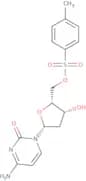
N6-Benzoyl-9-(a-D-mannopyranosyl)adenine is a novel, synthetic nucleoside analog. It is an antiviral drug that inhibits viral replication by replacing the natural substrate in DNA synthesis. N6-Benzoyl-9-(a-D-mannopyranosyl)adenine has been shown to be effective against human leukemia cells and to have anticancer properties. This drug also stimulates the immune system by triggering the production of antibodies and other immunoglobulins.Formule :C18H19N5O6Degré de pureté :Min. 95%Couleur et forme :PowderMasse moléculaire :401.37 g/mol5'-Tosyl-2'-deoxycytidine
CAS :5'-Tosyl-2'-deoxycytidine is a nucleoside with anticancer activity and is a novel derivative of cytidine. It has been shown to inhibit the proliferation of human cancer cells in culture. 5'-Tosyl-2'-deoxycytidine is also an antiviral agent that inhibits the synthesis of viral DNA by inhibiting the enzyme RNA polymerase. This product is synthetic, water soluble, and stable at pH 2.0 to 10.5, making it suitable for use in pharmaceutical formulations. The purity of this product is high and its chemical structure has been modified from cytidine to increase its stability against degradation by intracellular phosphatases.Formule :C16H19N3O5SDegré de pureté :Min. 95%Masse moléculaire :365.41 g/mol2,5'-Anhydro-5,6-didehydro-2'-deoxy-2',2'-difluorouridine
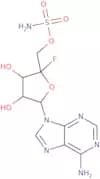
2,5'-Anhydro-5,6-didehydro-2'-deoxy-2',2'-difluorouridine is a novel ribonucleoside that has been synthesized as a phosphoramidite. It is an anticancer agent with antiviral and antiretroviral properties. The 2,5'-Anhydro-5,6-didehydro-2'-deoxy-2',2'-difluorouridine is a modified nucleoside that has the potential to be used in the treatment of certain cancers. It can also be used to inhibit viral replication by inhibiting RNA synthesis. This compound inhibits the enzyme diphosphate kinase, which converts ATP into ADP and phosphate. This leads to an accumulation of ADP in cells and inhibition of DNA synthesis.Formule :C9H10F2N2O5Degré de pureté :Min. 95%Masse moléculaire :264.18 g/mol4'-C-Fluoroadenosine 5'-sulfamate
CAS :4'-C-Fluoroadenosine 5'-sulfamate is a molecule that inhibits protein synthesis by binding to the ribosomes of bacteria. It also has anti-angiogenic effects and can be used as an antimicrobial agent against staphylococci, streptococci, and mycobacteria. 4'-C-Fluoroadenosine 5'-sulfamate has minimal toxicity in humans and is not active against Saccharomyces cerevisiae or Escherichia coli. The optimum concentration for inhibiting protein synthesis in vitro was determined to be between 100 and 500 μM. This compound is inexpensive and can be synthesized from commercially available starting materials. In cell culture assays, this compound showed antimicrobial activity against staphylococci, streptococci, and mycobacteria with MIC values ranging from 0.03 to 1 mM.br> 4'-C-Fluoroadenosine 5'-sFormule :C10H13FN6O6SDegré de pureté :Min. 95%Masse moléculaire :364.31 g/molStavudine 5'-monophosphate triethyammonium salt
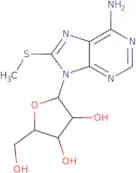
Stavudine 5'-monophosphate triethylammonium salt is a nucleoside analog that is structurally related to the natural deoxyribonucleosides. It has antiviral activity and is used in the treatment of HIV-1. Stavudine 5'-monophosphate triethylammonium salt inhibits viral replication by inhibiting DNA polymerase, which leads to a decrease in the production of new copies of the virus. This drug has also been shown to have anticancer properties, although it is not currently approved for this use. Stavudine 5'-monophosphate triethylammonium salt is synthesized in high purity and high quality, with a CAS number of 102747-23-2.Degré de pureté :Min. 95%8-Methylthioadenosine
CAS :8-Methylthioadenosine is a synthetic analogue of adenosine that has been used as a biochemical stimulator. It has been shown to inhibit uptake of fatty acids and phospholipids into cells, which may be due to the inhibition of cellular ATPase. 8-Methylthioadenosine can also be used as a precursor for other molecules, such as methylation of DNA or RNA. 8-Methylthioadenosine is synthesized from linolenic acid and phosphate in a reaction catalyzed by molecular oxygen. The synthesis is stimulated by light and heat and inhibited by cyanide. Magnetic resonance spectroscopy (NMR) was used to confirm that the molecule had the correct structure.Degré de pureté :Min. 95%5-Methylcytidine
CAS :5-Methylcytidine is a methyltransferase enzyme that catalyzes the transfer of a methyl group from S-adenosylmethionine to 5-methylcytosine. This reaction is essential for DNA replication and repair. 5-Methylcytidine has been shown to be an important factor in the regulation of mitochondrial functions, as well as other cellular processes such as protein synthesis, nuclear DNA replication, and tumor suppression. It also has been shown to inhibit the replication of murine sarcoma virus and Toll-like receptor. 5-Methylcytidine can be used in chemotherapy treatment against mouse tumors and murine sarcoma virus by preventing viral RNA synthesis with monoclonal antibodies.Formule :C10H15N3O5Masse moléculaire :257.24 g/molRef: 3D-W-201877
25gÀ demander50gÀ demander100gÀ demander250gÀ demander500gÀ demander-Unit-ggÀ demander2',3',5-Tri-O-acetyl-N1-tritylinosine
2',3',5-Tri-O-acetyl-N1-tritylinosine is a novel nucleoside with antiviral and anticancer activities. It is a modified deoxyribonucleoside, which is synthesized by the acetylation of N1-tritylinosine. It has high purity and high quality.Degré de pureté :Min. 95%

![3,7-Dihydro-5-iodo-4-oxo-4H-pyrrolo[2,3-d]pyrimidine](/_next/image/?url=https%3A%2Fstatic.cymitquimica.com%2Fproducts%2F3D%2Fthumb-webp%2FND57427.webp&w=3840&q=75)