Nucléosides
Les nucléosides sont des building blocks fondamentaux des acides nucléiques, composés d'une base azotée attachée à une molécule de sucre. Dans cette section, vous trouverez une large gamme de nucléosides essentiels pour la recherche en biologie moléculaire, biochimie et pharmacologie. Ces composés jouent des rôles cruciaux dans la synthèse de l'ADN et de l'ARN, et sont également vitaux dans divers processus métaboliques. Les nucléosides sont utilisés pour étudier le matériel génétique, développer des thérapies antivirales et anticancéreuses, et comprendre les mécanismes cellulaires. Chez CymitQuimica, nous proposons des nucléosides de haute qualité pour soutenir vos besoins en recherche et développement, garantissant pureté et fiabilité pour vos applications expérimentales.
3569 produits trouvés pour "Nucléosides"
Trier par
Degré de pureté (%)
0
100
|
0
|
50
|
90
|
95
|
100
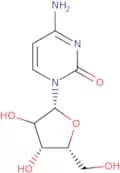
2'-13CCytidine
CAS :<p>2'-13CCytidine is a cytidine nucleoside that inhibits the synthesis of RNA and DNA in cells. It is an analog of cytarabine, which is a pyrimidine nucleoside and an antineoplastic agent. 2'-13CCytidine has been shown to be effective as an antiviral agent against HIV-1 and HSV-2, as well as an immunosuppressant for the treatment of autoimmune diseases such as rheumatoid arthritis. This drug is used in chemotherapy to inhibit cell division in leukemia.</p>Formule :CC8H13N3O5Degré de pureté :Min. 95%Masse moléculaire :244.21 g/molUridine-15N2
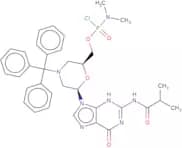
CAS :<p>Uridine-15N2 is a novel nucleoside that has antiviral, anticancer and antifungal effects. It has been shown to inhibit the growth of tumor cells by blocking the synthesis of DNA and RNA. Uridine-15N2 is synthesized from uridine-5N2 and 15N2 gas. This product is used in molecular biology research as a substrate for DNA polymerase, to study the enzymatic process of DNA replication. It can also be used as an activator for ribonuclesides or deoxyribonucleosides in organic synthesis. Uridine-15N2 is soluble in water and has a high purity.</p>Formule :C9H12N2O6Degré de pureté :Min. 95%Masse moléculaire :244.20 g/molN2-Isobutyryl-N-trityl-morpholinoguanine methyl dimethylphosphoramide chloridate
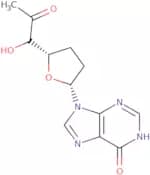
CAS :N2-Isobutyryl-N-trityl-morpholinoguanine methyl dimethylphosphoramide chloridate is a novel modified nucleoside analog with antiviral and anticancer activity. It is a phosphoramidite that is used in the synthesis of oligonucleotides and polynucleotides. N2-Isobutyryl-N-trityl-morpholinoguanine methyl dimethylphosphoramide chloridate has been shown to inhibit viral replication in vitro by inhibiting viral DNA polymerase, as well as tumor growth in vivo by inducing apoptosis. This compound has also been shown to be an activator for RNA polymerases I, II, and III.Degré de pureté :Min. 95%5'-O-Acetyl-2',3'-dideoxyinosine
CAS :<p>5'-O-Acetyl-2',3'-dideoxyinosine is a nucleoside analogue that inhibits viral replication. It is a potent activator of the immune system and has been shown to be effective against cancer cells. 5'-O-Acetyl-2',3'-dideoxyinosine was originally synthesized as an antiviral agent, but it was found to be ineffective in this function. The drug binds to the ribonucleotide reductase enzyme, which converts ribonucleotides into deoxyribonucleotides and is essential for the production of DNA. The drug blocks the conversion of ribonucleotides into deoxyribonucleotides, preventing DNA synthesis and replication. This drug has also been shown to have anticancer activity by inhibiting DNA synthesis and cell division.</p>Formule :C12H14N4O4Degré de pureté :Min. 95%Masse moléculaire :278.26 g/mol4-(Dimethoxymethyl)pyrimidine
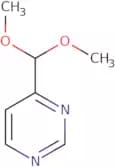
CAS :<p>4-(Dimethoxymethyl)pyrimidine is a nitrogen heterocycle that is prepared by the reaction of formamide and nitrate. This compound has been shown to inhibit the replication of viruses such as HIV, herpes simplex virus type 2 (HSV-2), or vesicular stomatitis virus (VSV). 4-(Dimethoxymethyl)pyrimidine also binds to uracil in RNA, inhibiting RNA synthesis and leading to cell death. This compound can also be used as a precursor for the preparation of 2-aminopyrimidine, which is used in the synthesis of other compounds. 4-(Dimethoxymethyl)pyrimidine is used in organic synthesis for the preparation of benzene derivatives, such as nitrobenzene. This compound can also be synthesized by reacting formamide with toluene in an ultrasonic bath.</p>Formule :C7H10N2O2Degré de pureté :Min. 95%Masse moléculaire :154.17 g/mol2'-Deoxy-5-hydroxymethylcytidine 5'-monophosphate sodium salt
CAS :2'-Deoxy-5-hydroxymethylcytidine 5'-monophosphate sodium salt (2'-dO-5HmcMP) is a nucleoside analogue that inhibits the activity of reverse transcriptase, an enzyme required for replication of HIV. This compound is phosphorylated in vivo to 2'-dO-5HmcMP monophosphate, which then competitively inhibits the binding of dNTPs to the enzyme and prevents DNA synthesis. 2'-dO-5HmcMP also has anticancer activity and has been shown to inhibit the proliferation of cells in vitro. 2'-dO-5HmcMP has no significant toxicity to humans or other mammals.Degré de pureté :Min. 95%1-(2-Deoxy- 2, 2- difluoro- b- D- xylofuranosyl)cytosine
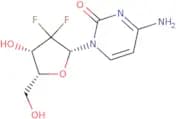
CAS :<p>1-(2-Deoxy-2,2-difluoro-beta-D-xylofuranosyl)cytosine is a nucleoside (a compound consisting of a nucleotide base linked to a sugar). It is a modified form of cytosine that has been phosphorylated at the 2’ position. 1-(2-Deoxy-2,2-difluoro-beta-D-xylofuranosyl)cytosine has antiviral and anticancer activity through its ability to inhibit viral DNA synthesis and activate the immune system. This drug also has antitumor activity due to its ability to inhibit the tumor growth factor beta (TGFB). 1-(2-Deoxy-2,2-difluoro-beta-D -xylofuranosyl)cytosine can be used in cancer treatment as an anticancer agent.</p>Formule :C9H11F2N3O4Degré de pureté :Min. 95%Masse moléculaire :263.2 g/mol2’-O-(2-Methoxyethyl)guanosine 5’-triphosphate ammonium salt
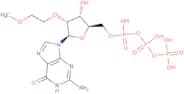
CAS :<p>2’-O-(2-Methoxyethyl)guanosine 5’-triphosphate ammonium salt (2'OMeEtGTP) is an antiviral agent that is used as a component of an antiviral drug. It inhibits the viral enzyme DNA polymerase, which prevents viral replication and transcription. This compound has been shown to have anticancer properties in vitro and in vivo in rat models. 2'OMeEtGTP is synthesized by reacting the nucleoside phosphoramidite 2'OMeEtGTP with triethylammonium phosphate (TEAP).</p>Degré de pureté :Min. 95%N2-Isobutyryl-2'-O-(2-methylacetamido)guanosine
<p>N2-Isobutyryl-2'-O-(2-methylacetamido)guanosine is a modified nucleoside with antiviral, anticancer and antiretroviral activity. It is a novel monophosphate that has been shown to be effective against hepatitis B and HIV. N2-Isobutyryl-2'-O-(2-methylacetamido)guanosine inhibits the synthesis of viral DNA by acting as an activator of DNA polymerases.</p>Degré de pureté :Min. 95%2',3'-Dideoxy-N2-isobutyrylguanosine
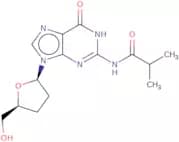
<p>2',3'-Dideoxy-N2-isobutyrylguanosine is a monophosphate that inhibits viral replication by competing with the natural substrate, diphosphate. It is synthesized in high purity and quality by our company. 2',3'-Dideoxy-N2-isobutyrylguanosine has been used as an antiviral agent to inhibit the hepatitis B virus. This product is also of interest for its potential use in cancer treatment.</p>Formule :C14H19N5O4Degré de pureté :Min. 95%Masse moléculaire :321.34 g/molPyrimidine-5-carbothioic acid amide
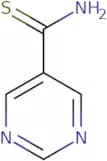
CAS :<p>Pyrimidine-5-carbothioic acid amide (PCA) is an organic compound that contains a pyrimidine ring and a carboxylic acid amide group. PCA forms crystalline solids with the molecular formula C4H10N2O4. The x-ray crystal structure of PCA has been determined, revealing the molecule to have a chair conformation with two hydrogen bonds. The molecule can be considered as stabilized by the base formation between the nitrogen atom in the pyrimidine ring and the oxygen atom in the carboxylic acid amide group. PCA has been used as a building block for other molecules, such as enamines, which are useful for computation studies. PCA is also an intermediate in chemical reactions involving nucleophilic substitution reactions and hydrogen abstraction reactions.</p>Formule :C5H5N3SDegré de pureté :Min. 95%Masse moléculaire :139.18 g/mol8-Bromo-5'-o-(dimethyoxytrityl)-N2-(dimethyl-aminomethylidene)-2'-deoxyguanosine
CAS :8-Bromo-5'-O-(dimethyoxytrityl)-N2-(dimethyl-aminomethylidene)-2'-deoxyguanosine (8-Bromo-5'-O-(DMT)-dG) is a novel nucleoside that is synthesized by reacting 8-bromo-5'-O-(dimethyoxytrityl)-2'-deoxyguanosine with dimethylaminomethylidene. It has antiviral, anticancer, and ribonucleoside activities. 8-Bromo-5'-O-(DMT)-dG is used as a building block for the synthesis of oligonucleotides, phosphoramidites, and other modified nucleosides. 8-Bromo-5'-O-(DMT)-dG is currently being developed as an anticancer drug.Formule :C34H35BrN6O6Degré de pureté :Min. 95%Masse moléculaire :703.6 g/mol5'-O-DMT-2'-O-hexylamino-5-methyluridine
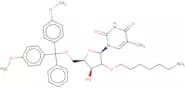
CAS :5'-O-DMT-2'-O-hexylamino-5-methyluridine is a nucleoside analog that is used in cancer treatment. It is synthesized by the chemical modification of uridine, which is converted to 5'-O-DMT-2'-O-hexylamino-5-methyluridine by reacting with 2',3'-dideoxyadenosine and 5,6,7,8,-tetrahydroisoquinoline. The monophosphate form of 5'-O-DMT-2'-O-hexylamino-5-methyluridine may be converted to the diphosphate form by phosphorylation with ATP. In addition to its anticancer effects, 5'-O-DMT-2'-O-hexylamino-5-methyluridine has antiviral and antiretroviral effects due to its inhibition of viral DNA synthesis.Formule :C37H45N3O8Degré de pureté :Min. 95%Masse moléculaire :659.79 g/mol9-(2-C-Methyl-b-D-ribofuranosyl)purine
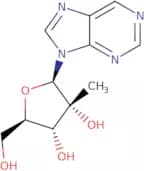
CAS :<p>9-(2-C-Methyl-b-D-ribofuranosyl)purine is a nucleoside that is used as an activator in the synthesis of phosphoramidites. 9-(2-C-Methyl-b-D-ribofuranosyl)purine has antiviral and anticancer properties, and it also inhibits the growth of bacteria. This nucleoside is synthesized from 2,4,6-trichlorophenylisocyanate and 5'-O-(4,4'-dimethoxytrityl)-beta-D-ribofuranose. The chemical name for 9-(2-C methyl b D ribofuranosyl)purine is 690269 - 86 - 4.</p>Formule :C11H14N4O4Degré de pureté :Min. 95%Masse moléculaire :266.25 g/mol2'-O-tert-Butyldimethylsilyl-5'-O-DMT-adenosine
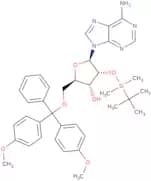
CAS :<p>2'-O-tert-Butyldimethylsilyl-5'-O-DMT-adenosine is a modified nucleoside that is used to synthesize oligonucleotides. It is a phosphoramidite, and can be used in the synthesis of DNA or RNA. 2'-O-tert-Butyldimethylsilyl-5'-O-DMT-adenosine is an antiviral agent that has been shown to have anticancer activity in animal models. It has been shown to inhibit the production of tumor necrosis factor alpha (TNFα) and serum enzymes, such as dismutase activity, in mice with lung cancer. This drug also has a toxic effect on respiratory system cells, which may be due to its ability to induce apoptosis.</p>Degré de pureté :Min. 95%Fluorescein alkynylamino-ATP - 1.0 mM solution
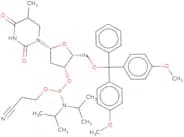
CAS :<p>Fluorescein alkynylamino-ATP is a fluorescent nucleotide analog that is used in molecular biology for the detection of DNA. It is labeled with tetramethylrhodamine, which can be detected using a fluorescence microscope. Fluorescein alkynylamino-ATP is a postsynthetic modification to DNA, which means it is added after the DNA has been synthesized. This molecule can be incorporated into the growing strand by either monoaddition or polymerase extension. Fluorescein alkynylamino-ATP binds to the 3' end of a primer during polymerase chain reaction (PCR) and can be detected using electrophoresis and sequence analysis.</p>Formule :C41H41N6O20P3Degré de pureté :Min. 95%Masse moléculaire :1,030.71 g/mol5,6-Dihydro-5'-O-DMT-thymidine 3'-CE phosphoramidite
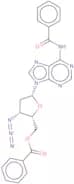
This is a synthetic DNA analogue that is used in the synthesis of oligonucleotides. It is a phosphoramidite in which the 5,6-dihydro-5'-O-DMT group has been modified to allow for incorporation into DNA and RNA. This compound has antiviral and anticancer activities.Formule :C40H51N4O8PDegré de pureté :Min. 95%Masse moléculaire :746.83 g/mol3'-Azido-N6-benzoyl-5'-O-benzoyl-2',3'-dideoxyadenosine
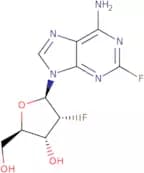
3'-Azido-N6-benzoyl-5'-O-benzoyl-2',3'-dideoxyadenosine is a novel nucleoside analogue with high purity and quality. It is a DNA activator that has been shown to be active against both RNA and DNA viruses. 3'-Azido-N6-benzoyl-5'-O-benzoyl-2',3'-dideoxyadenosine phosphorylates to the corresponding monophosphate, which inhibits viral DNA synthesis by competitive inhibition of diphosphate formation. This compound has also been shown to be an effective inhibitor of HIV replication in vitro.Formule :C24H20N8O4Degré de pureté :Min. 95%Masse moléculaire :484.47 g/mol9-(2'-Deoxy-2'-fluoro-b-D-ribofuranosyl)-2-fluoroadenine
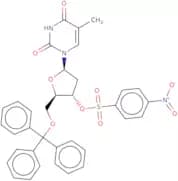
CAS :<p>9-(2'-Deoxy-2'-fluoro-b-D-ribofuranosyl)-2-fluoroadenine is a modified nucleoside that is used as an antiviral and anticancer agent. It acts as an activator for the synthesis of DNA, RNA, and protein. 9-(2'-Deoxy-2'-fluoro-b-D-ribofuranosyl)-2-fluoroadenine also inhibits the growth of cancer cells by interfering with the division process. This drug is synthesized from 9-(5'-deoxy-5'-iodo-b-D-ribofuranosyl) -2,6 difluoro adenine (diFdA). The Ribonucleosides are then prepared in a similar manner to other nucleosides by using phosphoramidites. The product is then purified using HPLC.</p>Formule :C10H11F2N5O3Degré de pureté :Min. 95%Couleur et forme :White PowderMasse moléculaire :287.23 g/mol1-(3'-O-Nosyl-5'-O-trityl-2'-deoxy-b-D-lyxofuranosyl)thymine
CAS :Ribonucleosides are nucleosides that contain ribose as their pentose sugar. Ribonuclesides are synthetic, modified ribonucleosides that have been modified to include a 2'-deoxy-b-D-lyxofuranosyl group at the 3' position. Ribonuclesides activate antiviral activity by inhibiting viral DNA synthesis and protein synthesis. They also inhibit cancer cell proliferation by inhibiting DNA synthesis and RNA synthesis.Formule :C35H31N3O9SDegré de pureté :Min. 95%Masse moléculaire :669.7 g/mol