Nucléosides
3569 produits trouvés pour "Nucléosides"
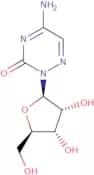
6-Azacytidine
CAS :6-Azacytidine is a molecule that contains a hydroxyl group and a glycosidic bond. It has been shown to inhibit the growth of mollicutes, which are non-cellular bacteria. 6-Azacytidine has also been shown to be toxic in animal tissue culture studies. The drug can be eliminated through the urine or bile after being metabolized by the liver. 6-Azacytidine is not active against human cells in cell culture, but it does show some toxicity against human liver cells.Formule :C8H12N4O5Degré de pureté :Min. 95%Couleur et forme :PowderMasse moléculaire :244.2 g/mol2-Chloro-N,N-dimethyl-2’C-methyladenosine
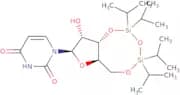
CAS :2-Chloro-N,N-dimethyl-2’C-methyladenosine is a synthetic nucleoside that inhibits viral DNA synthesis. It is a modified deoxyribonucleoside that contains a chloro group at the 2’ position of the sugar ring and a methyl group at the 3’ position. This drug has antiviral activity against herpes simplex virus type 1 (HSV-1) and herpes simplex virus type 2 (HSV-2), respiratory syncytial virus (RSV), and influenza A virus. It also displays anticancer activity in vitro. This drug inhibits cancer cell growth by interfering with DNA replication and triggering apoptosis through inhibition of protein kinase C and activation of caspases.Degré de pureté :Min. 95%3',5'-O-(1,1,3,3-Tetraisopropyl-1,3-disiloxanediyl)uridine
CAS :Used as aprotected uridine nucleoside in RNA synthesis. The 1,1,3,3-tetraisopropyl-1,3-disiloxanediyl (TIPDS or TBDPSi2) group serves as a bulky and selectively acid-labile protecting group for the 3' and 5' hydroxyl groups of the uridine ribonucleoside during RNA oligonucleotide synthesis.Formule :C21H38N2O7Si2Degré de pureté :Min. 95%Couleur et forme :White PowderMasse moléculaire :486.71 g/mol2-Methylthioadenosine
CAS :2-Methylthioadenosine is a purine nucleoside which induces necrotic cell death. It is the first of its kind to be shown to have activity against squamous carcinoma cells, and is activated by nucleoside phosphorylase in order to produce its cytotoxic form. 2-Methylthioadenosine also inhibits the transcription-polymerase chain reaction and increases oxidative injury. This drug has been shown to have receptor activity in brain cells, as well as chemotactic activity for gland cells. 2-Methylthioadenosine has been used as a model organism for polymerase chain reactions, and has been shown to inhibit p2y receptors in the human colon cancer cell line HT29.
Formule :C11H15N5O4SDegré de pureté :Min. 95%Couleur et forme :White Off-White PowderMasse moléculaire :313.34 g/molN6,7-Dimethyldeoxyadenosine
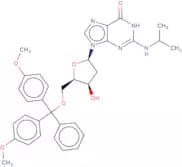
N6,7-Dimethyldeoxyadenosine is a nucleoside with antiviral and anticancer properties. It is a modified DNA monophosphate with the chemical formula C8H16N2O6P. N6,7-dimethyldeoxyadenosine has been shown to inhibit the replication of HIV and herpes simplex virus type 1 (HSV-1) in vitro. This compound also inhibits the growth of cancer cells in culture and has been suggested as an anticancer therapeutic agent.Degré de pureté :Min. 95%2'-Deoxy-5'-O-DMT-N2-isopropylguanosine
CAS :2'-Deoxy-5'-O-DMT-N2-isopropylguanosine is a nucleoside that is used as an activator for phosphoramidites in the synthesis of DNA. It is also an antiviral agent that inhibits the synthesis of RNA by inhibiting the enzyme RNA polymerase II. 2'-Deoxy-5'-O-DMT-N2-isopropylguanosine has been shown to have anticancer activity and can be used as a substitute for other nucleosides in the treatment of leukemia, lymphoma, and breast cancer. 2'-Deoxy-5'-O-DMT-N2-isopropylguanosine is synthesized from DMT and N2-(2-isopropyl)guanine.Formule :C34H37N5O6Degré de pureté :Min. 95%Masse moléculaire :611.7 g/mol2’,3’-Anhydro-7-deazaadenosine
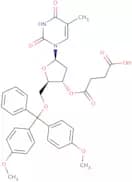
CAS :2’,3’-Anhydro-7-deazaadenosine is a modified nucleoside that is used in the treatment of viral infections. It is an antiviral drug that has been shown to have anticancer properties. 2’,3’-Anhydro-7-deazaadenosine can be synthesized from deoxyribonucleosides and diphosphates. The compound has been shown to inhibit the synthesis of DNA by binding to the enzyme DNA polymerase and blocking the formation of a phosphodiester bond between the 5' phosphate group and 3'-OH group. This may lead to inhibition of DNA replication and transcription. 2’,3’-Anhydro-7-deazaadenosine also inhibits protein synthesis by inhibiting RNA polymerase activity.Degré de pureté :Min. 95%5'-O-DMT-thymidine 3'-O-succinate triethylammonium salt
CAS :5'-O-DMT-thymidine 3'-O-succinate triethylammonium salt is a novel antiviral agent that inhibits viral replication by competing with natural nucleosides for incorporation into the viral DNA or RNA. The 5'-O-DMT group prevents the elimination of thymidine from the monophosphate form. This product has a high purity and quality, as well as potent antiviral activity against HIV and other viruses.Formule :C35H36N2O10·xC6H15NDegré de pureté :Min. 95%Couleur et forme :PowderMasse moléculaire :745.86 g/molN6-Benzoyl-5'-O-benzoyl-2'-O-tert-butyldimethylsilyladenosine 3'-CE phosphoramidite
N6-Benzoyl-5'-O-benzoyl-2'-O-tert-butyldimethylsilyladenosine 3'-CE phosphoramidite is an activator that is used to synthesize modified nucleosides. N6-Benzoyl-5'-O-benzoyl-2'-O-tert-butyldimethylsilyladenosine 3'-CE phosphoramidite has been shown to activate the synthesis of ribonucleosides, deoxyribonucleosides and other modified nucleosides. It reacts with a variety of DNA, RNA and protein substrates, including those containing phosphate groups. N6-Benzoyl-5'-O-benzoyl-2'-O-tert-butyldimethylsilyladenosine 3'-CE phosphoramidite has also been shown to have anticancer activity in vitro and in vivoFormule :C39H52N7O7PSiDegré de pureté :Min. 95%Masse moléculaire :789.95 g/mol2'-Deoxy-5'-O-pixyluridine
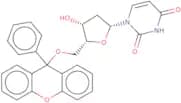
2'-Deoxy-5'-O-pixyluridine (2DPU) is a novel, synthetic nucleoside that is an active ingredient in antiviral and anticancer drugs. 2DPU has been shown to inhibit the replication of human immunodeficiency virus type 1 (HIV-1) by inhibiting the viral enzyme HIV reverse transcriptase. The phosphoramidite form of 2DPU is used as a building block for DNA synthesis and for the synthesis of other nucleosides. The monophosphate form of 2DPU is used in the synthesis of antiviral drugs, including acyclovir, zidovudine, and ribavirin.Formule :C28H24N2O6Degré de pureté :Min. 95%Masse moléculaire :484.51 g/molN4-Acetyl-5'-O-DMT-2'-O-methylcytidine
CAS :N4-Acetyl-5'-O-DMT-2'-O-methylcytidine is a cytidine analogue that has been synthesized to be used as an enzyme-linked probe. It is labelled with biotin and can be detected by binding to an antibody which has been labelled with a fluorescent tag. Cytidine analogues are synthesized on a solid phase and then cleaved from the support material. The spacer arm is added to the 5' end of the nucleotide and the 3'-OH group is modified with 2'-O-methyl groups. N4-Acetyl-5'-O-DMT-2'-O-methylcytidine has been shown to be sensitive in techniques such as solid phase synthesis, nucleic acid research, and immunoassays.Formule :C33H35N3O8Degré de pureté :Min. 95%Couleur et forme :Off-White PowderMasse moléculaire :601.65 g/molN6-Benzoyl-5'-O-DMT-adenosine
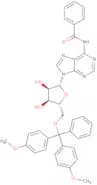
CAS :N6-Benzoyl-5'-O-DMT-adenosine is a synthetic nucleoside with antiviral activity. It is an activator of viral DNA polymerase and inhibits viral replication by inhibiting DNA synthesis in the host cell. N6-Benzoyl-5'-O-DMT-adenosine has shown anticancer activity in tumor cells, which may be due to its ability to inhibit ribonucleotide reductase and diphosphate kinase.
Formule :C38H35N5O7Degré de pureté :Min. 95%Couleur et forme :White PowderMasse moléculaire :673.73 g/mol5'-O-DMT-N2-DMF-guanosine
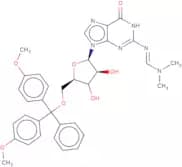
CAS :5'-O-DMT-N2-DMF-guanosine is a novel nucleoside that has been modified with an acetyl group on the 5'-hydroxyl group. This nucleoside has antiviral, anticancer and deoxyribonucleoside properties. It also activates diphosphate synthesis and inhibits protein synthesis. The drug is synthesized in high purity and quality, making it an excellent activator for phosphoramidites.Formule :C34H36N6O7Degré de pureté :(%) Min. 85%Masse moléculaire :640.69 g/mol2'-Deoxy-N2-isobutyryl-5'-O-MMT-guanosine 3'-CE phosphoramidite
2'-Deoxy-N2-isobutyryl-5'-O-MMT-guanosine 3'-CE phosphoramidite is a modified nucleoside analogue with anticancer activity. It is synthesized by reacting 2'-deoxy-N2-isobutyryl-5'-O-methylguanosine with diethyl chlorophosphate in the presence of tetrazole. This novel compound has been shown to have antiviral and antitumor activities as well as high affinity for DNA and RNA.Formule :C43H52N7O7PDegré de pureté :Min. 95%Masse moléculaire :809.91 g/mol2'-Deoxy-N2-isobutyryl-5'-O-tritylguanosine 3'-CE phosphoramidite
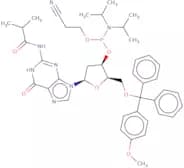
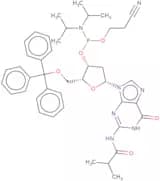
2'-Deoxy-N2-isobutyryl-5'-O-tritylguanosine 3'-CE phosphoramidite is a novel nucleoside analogue that has antiviral and anticancer properties. This compound is synthesized by the reaction of 5'-O-tritylguanosine with 2'-deoxyribonucleosides in high purity. The final product is purified by chromatography and characterized using mass spectrometry and nuclear magnetic resonance spectroscopy.Degré de pureté :Min. 95%5’(R)-C-Methyl-5-methyluridine
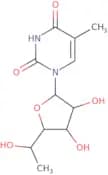
CAS :5’(R)-C-Methyl-5-methyluridine is an nucleoside and a ribonucleoside. It has antiviral, anticancer, and DNA modifying properties. This product is used in research to make phosphoramidites, diphosphates, and deoxyribonucleosides. 5’(R)-C-Methyl-5-methyluridine is also used in the production of modified oligonucleotides as well as other novel DNA compounds.
Degré de pureté :Min. 95%2'-O-Methylcytidine-5'-triphosphate sodium salt - 100mM aqueous solution
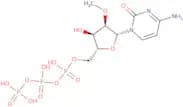
CAS :2'-O-Methylcytidine-5'-triphosphate sodium salt is a synthetic, modified nucleoside analog. It can be used as an antiviral agent and anticancer drug to inhibit viral replication and tumor growth. 2'-O-Methylcytidine-5'-triphosphate sodium salt has the ability to activate cellular DNA synthesis. This compound also inhibits RNA polymerase activity in cancer cells, which inhibits the production of proteins vital for cell division. 2'-O-Methylcytidine-5'-triphosphate sodium salt can be used as a phosphoramidite building block for the synthesis of oligonucleotides with novel structures.Formule :C10H18N3O14P3·xNaDegré de pureté :Min. 95%Couleur et forme :Clear LiquidMasse moléculaire :497.18 g/mol2-Thiouridine-5'-monophosphate triethylammonium salt - aqueous solution
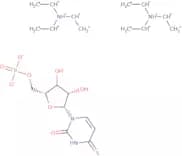
CAS :2-Thiouridine-5'-monophosphate triethylammonium salt is a synthetic nucleotide analog that inhibits the growth of cells by binding to the anticodon region, which blocks the entrance of amino acids into the ribosome. It also inhibits cell growth by preventing glycosidic bond formation and inhibiting purine metabolism. This drug has functional groups that allow it to be purified by chromatography and diffraction techniques. The drug is not active against bacteria that are resistant to glutamic acid, such as Mycobacterium tuberculosis or Mycobacterium avium complex. 2-Thiouridine-5'-monophosphate triethylammonium salt is a precursor for other drugs, such as cytidine 5'-triphosphate, which can be used in chemotherapy treatments.Formule :C21H43N4O8PSDegré de pureté :Min. 95%Couleur et forme :Clear LiquidMasse moléculaire :542.63 g/molN6-Benzoyl-5'-O-DMT-2'-O-propynyladenosine 3'-CE phosphoramidite
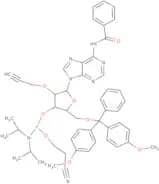
CAS :N6-Benzoyl-5'-O-DMT-2'-O-propynyladenosine 3'-CE phosphoramidite is a modified nucleoside, which is an important building block for DNA and RNA synthesis. It is synthesized by the condensation of 6-benzoyladenosine with 2'-O-propynyladenosin. The stability of this compound has been demonstrated by its resistance to hydrolysis and oxidation, while it can also be activated with a variety of activators, including NaBH4 or NaCNBH3. This novel nucleotide has shown anticancer activity in vivo and antiviral activity against HIV.
Formule :C50H54N7O8PDegré de pureté :Min. 95%Masse moléculaire :911.98 g/mol6-Chloro-7-deaza-9-(b-D-ribofuranosyl)purine
CAS :6-Chloro-7-deaza-9-(b-D-ribofuranosyl)purine is a novel nucleoside that has been shown to be an efficient activator of the transcription factor NFκB in vitro. 6-Chloro-7-deaza-9-(b-D-ribofuranosyl)purine is synthesized by phosphoramidite chemistry and purified by HPLC. It has been demonstrated to inhibit the replication of human immunodeficiency virus (HIV) in a dose dependent manner, which may be due to its ability to inhibit the synthesis of viral DNA and RNA. This product is highly pure and can be used for many purposes, including as a synthetic building block for DNA or as an antiviral drug.Formule :C11H12ClN3O4Degré de pureté :Min. 95%Couleur et forme :White PowderMasse moléculaire :285.69 g/mol