Nucléosides
3573 produits trouvés pour "Nucléosides"
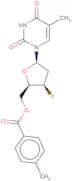
3'-Deoxy-3'-fluoro-5'-O-toluoylthymidine
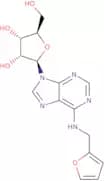
3'-Deoxy-3'-fluoro-5'-O-toluoylthymidine is a nucleoside that can be used as an antiviral and anticancer agent. It is structurally similar to thymidine, but differs by the replacement of a hydrogen atom at position 3 with a fluorine atom. The replacement of this hydrogen atom with a fluorine atom results in the removal of hydroxyl group from the 5' carbon position on the sugar ring, which is then converted into an ester moiety. 3'-Deoxy-3'-fluoro-5'-O-toluoylthymidine has been shown to inhibit DNA replication, RNA transcription and protein synthesis. This nucleoside also has been found to stimulate apoptosis in cancer cells by inhibiting DNA replication.Formule :C18H19FN2O5Degré de pureté :Min. 95%Masse moléculaire :348.43 g/molKinetin riboside
CAS :Kinetin is a plant hormone that regulates cell proliferation and differentiation. Kinetin riboside is a derivative of kinetin in which the ribose moiety has been converted to ribosyl-ribitol. Kinetin riboside has shown the ability to inhibit cancer cells by inducing apoptosis, which may be related to its ability to inhibit cyclin D2 and mitochondrial membrane potential. In addition, kinetin riboside has been shown to protect against oxidative stress and decrease mitochondrial function in cells. This compound may have therapeutic potential for cancer treatment and other diseases caused by oxidative stress or mitochondrial dysfunction.Formule :C15H17N5O5Degré de pureté :Min. 98 Area-%Couleur et forme :White PowderMasse moléculaire :347.33 g/molFmoc morpholino guanosine monomer
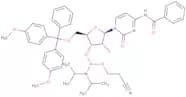
Fmoc Morpholino Guanosine Monomer is a novel and modified nucleoside with antiviral and anticancer activities. It is synthesized from the ribonucleotide, deoxyribonucleotide, and phosphoramidite. Fmoc Morpholino Guanosine Monomer is an activator of RNA polymerase and inhibits cell proliferation in vitro. This compound has been shown to be a potential candidate for treatment of viral infections such as HIV-1, herpes simplex virus type 1, or influenza A virus.Formule :C31H34ClN7O8PDegré de pureté :Min. 95%Couleur et forme :PowderMasse moléculaire :699.07 g/molN4-Benzoyl-2'-deoxy-5'-O-DMT-2'-fluoro-cytidine 3-CE phosphoramidite
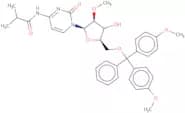
CAS :N4-Benzoyl-2'-deoxy-5'-O-DMT-2'-fluoro-cytidine 3-CE phosphoramidite is a novel nucleoside phosphoramidite that is used for the synthesis of DNA and RNA. It has anticancer properties and has been shown to inhibit the replication of HIV and herpes virus. N4-Benzoyl-2'-deoxy-5'-O-DMT-2'-fluoro-cytidine 3-CE phosphoramidite is also a potent antiviral that inhibits the production of diphosphate by inhibiting ribonucleotide reductase, an enzyme involved in DNA synthesis.Formule :C46H51FN5O8PDegré de pureté :Min. 95%Couleur et forme :White PowderMasse moléculaire :851.9 g/mol5'-O-DMT-N4-isobutyryl-2'-O-methylcytidine
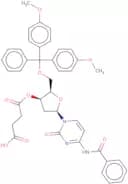
5'-O-DMT-N4-isobutyryl-2'-O-methylcytidine is a novel, synthetic nucleoside. It is a phosphoramidate prodrug of 5'-deoxy-5'-O-dimethoxytrityl-N4-isobutyrylcytidine, which is an antiviral and anticancer agent. 5'-O-DMT-N4-isobutyrylcytidine inhibits DNA synthesis by competitively inhibiting the activity of the enzyme ribonucleotide reductase (RNR).Formule :C35H39N3O8Degré de pureté :Min. 95%Masse moléculaire :629.7 g/molN4-Benzoyl-2'-deoxy-5'-O-DMT-cytidine 3'-O-succinate triethylamine salt
CAS :N4-Benzoyl-2'-deoxy-5'-O-DMT-cytidine 3'-O-succinate triethylamine salt is a synthetic antiviral agent that can be used in the treatment of HIV. This drug inhibits the viral DNA polymerase and prevents virus replication. N4-Benzoyl-2'-deoxy-5'-O-DMT cytidine 3'-O succinate triethylamine salt is a novel nucleoside analogue with a monophosphate group at the 5' position and an N4 benzoyl group at the 2' position. It is an activator of DNA synthesis, which can be used for cancer chemotherapy. The chemical name for this drug is CAS No. 74405-44-0 (free base).Formule :C41H39N3O10·C6H15NDegré de pureté :Min. 95%Couleur et forme :White Off-White PowderMasse moléculaire :834.95 g/mol5'-O-Benzoyl-2'-deoxyuridine 3'-CE phosphoramidite
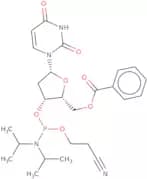
5'-O-Benzoyl-2'-deoxyuridine 3'-CE phosphoramidite is an anticancer drug that inhibits viral and tumor DNA synthesis. It is a nucleoside monophosphate with antiviral and antitumor activities. The compound is synthesized by coupling a benzoyl group to 5'-O-DMT-2'-deoxyuridine 3'-phosphate, followed by the addition of a triethylammonium salt group. The phosphoramidite is then reacted with 2,4,6-trichlorophenylisocyanate to produce the final product. This product has a CAS number of 86825-34-1.Formule :C25H33N4O7PDegré de pureté :Min. 95%Masse moléculaire :532.54 g/mol7-Methyl-2'-deoxywyosine
7-Methyl-2'-deoxywyosine is a nucleoside analogue that inhibits the growth of cells by interfering with DNA replication. It is a modified form of deoxywyosine, which is the natural precursor of DNA and RNA. 7-Methyl-2'-deoxywyosine has antiviral activity against herpes simplex virus type 1 (HSV-1) and human cytomegalovirus (CMV). This compound has shown anticancer activity in vivo and in vitro, as well as high purity and quality.Degré de pureté :Min. 95%N6-Methyl-2'-O-methyladenosine
CAS :N6-Methyl-2'-O-methyladenosine is a nucleoside that is found in DNA. In some cases, the methyl group in this molecule can be modified, which can change its biological activity. N6-Methyl-2'-O-methyladenosine has been shown to reduce the severity of bowel disease and myocardial infarcts in experimental models. The structural analysis of vessels from patients with atherosclerosis revealed that this molecule inhibits vascular calcification. It also decreases expression of MMP-9, a protein involved in nephropathy and diabetic kidney disease. N6-Methyl-2'-O-methyladenosine is able to inhibit the development of vascular injury by blocking the activation of cells and reducing inflammation through pharmacological agents that are used in experimental models for blood vessel injury.Formule :C12H17N5O4Degré de pureté :Min. 97 Area-%Couleur et forme :White PowderMasse moléculaire :295.29 g/mol3'-Amino-5'-O-p-anisoyl-2',3'-dideoxyuridine
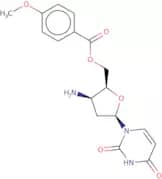
3'-Amino-5'-O-p-anisoyl-2',3'-dideoxyuridine is a novel compound that has been synthesized. This compound is a diphosphate, which can be used as an activator for the synthesis of modified nucleosides and antiviral agents. It is also a DNA phosphoramidite, which can be used in the synthesis of oligonucleotides with high purity and high quality.
Formule :C17H19N3O6Degré de pureté :Min. 95%Masse moléculaire :361.35 g/molN1-Ethylpseudouridine
CAS :N1-Ethylpseudouridine is a synthetic RNA molecule that has been shown to be an effective antiviral agent against influenza virus in cell culture. It inhibits viral replication by binding to the ribonucleic acid (RNA) of the virus and preventing its translation into protein. N1-Ethylpseudouridine is being developed as a potential treatment for influenza A and B.Degré de pureté :Min. 95%3’-b-C-Methyl-5-methyluridine
CAS :3’-b-C-Methyl-5-methyluridine is a phosphoramidite that is used as an antiviral agent. It is also known as (2’,3’)-O-(2-methoxyethyl) 5'-O-(4,4'-dimethoxytrityl)thymidine or 3’-b-C-Methyluridine. It has been shown to have anticancer properties in vitro and in vivo, and it can be used for the treatment of prostate cancer. 3’-b-C-Methyluridine is synthesized by the reaction of uracil with bis(trimethylsilyl)acetamide followed by reaction with methylamine. The synthesis of this drug was first reported in 1975.Degré de pureté :Min. 95%7-Deaza-2'-deoxy-7-iodoadenosine
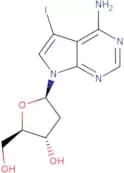
CAS :7-Deaza-2'-deoxy-7-iodoadenosine is an oligomer with a stabilized backbone that has been shown to inhibit the growth of bacteria in vitro. It binds to DNA and prevents RNA synthesis. 7-Deaza-2'-deoxy-7-iodoadenosine is a synthetic nucleotide analogue that is used as a probe for mapping RNA sequences and as an inhibitor of bacterial growth. This compound is also used in the synthesis of oligodeoxynucleotides because it has a high affinity for guanine residues, which can be incorporated into the oligonucleotide chain by chemical ligation. The octameric form of 7-deaza-2'-deoxyadenosine is most active against bacterial cells.
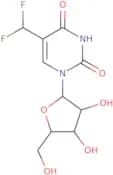
Formule :C11H13IN4O3Degré de pureté :Min. 98 Area-%Couleur et forme :White Off-White PowderMasse moléculaire :376.16 g/mol5-Difluoromethyluridine
CAS :5-Difluoromethyluridine is a nucleoside that is modified to be an activator of phosphoramidites. It is used in the synthesis of DNA and RNA, as well as in antiviral and anticancer drugs. 5-Difluoromethyluridine can also be used for the treatment of HIV or AIDS, because it inhibits HIV reverse transcriptase and human T-cell leukemia virus type 1 (HTLV-1). This drug has been shown to have high purity and quality with a CAS number of 110483-84-6.Degré de pureté :Min. 95%6- Hydroxycytidine
CAS :6-Hydroxycytidine is a modified nucleoside that is used as a building block in the synthesis of DNA. It has antiviral activity and has been shown to be effective in treating cancer cells. 6-Hydroxycytidine is also used in the production of phosphoramidites, which are used to synthesize nucleotides for DNA and RNA. 6-Hydroxyl cytidine is a novel chemical that does not have an IUPAC name. CAS No: 15477-67-5
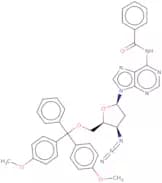
Formule :C9H13N3O6Degré de pureté :Min. 95%Masse moléculaire :259.22 g/mol3'-Azido-N6-benzoyl-5'-O-DMT-2',3'-dideoxyadenosine
3'-Azido-N6-benzoyl-5'-O-DMT-2',3'-dideoxyadenosine is a nucleoside analog and activator that inhibits the replication of DNA. It is a novel antiviral drug that has antiproliferative properties and may be useful in the treatment of cancer. 3'-Azido-N6-benzoyl-5'-O-DMT-2',3'-dideoxyadenosine is synthesized by reacting an activated phosphoramidite with 2',3'-dideoxyadenosine monophosphate to produce 3',5' dideoxythymidine 5'-monophosphate, which is then converted to 3',5' dideoxyuridine 5'-monophosphate. The last step involves the conversion of 3',5' dideoxyuridine 5'-monophosphate to 3' azidouridine 5'-monophFormule :C38H34N8O5Degré de pureté :Min. 95%Masse moléculaire :682.73 g/molN6-Benzoyl-2'-deoxy-5'-O-trityladenosine 3'-CE phosphoramidite
CAS :N6-Benzoyl-2'-deoxy-5'-O-trityladenosine 3'-CE phosphoramidite is a novel nucleoside analog that inhibits the proliferation of cancer cells. It has been shown to inhibit the proliferation of tumor cells in vitro and in vivo, as well as to induce apoptosis. The monophosphate form of this compound has been shown to be an effective antiviral agent against influenza virus. This compound also has high quality and purity.Formule :C45H48N7O5PDegré de pureté :Min. 95%Masse moléculaire :797.9 g/mol5'-Amino-2',5'-dideoxy-2'-fluorouridine
5'-Amino-2',5'-dideoxy-2'-fluorouridine is an antiviral drug that is synthesized from the natural compound 5'-deoxy-5'-amino-2',5'-dideoxyuridine. The modified deoxyribonucleosides are activated by phosphorylation and can be incorporated into DNA by DNA polymerase, which prevents viral replication. The monophosphate form of this compound is used in cancer chemotherapy to inhibit the synthesis of RNA and proteins necessary for cell division. 5'-Amino-2',5'-dideoxy-2'-fluorouridine has been shown to be a potent anticancer agent, with activity against a variety of human tumor cell lines.
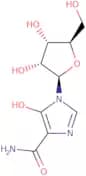
Degré de pureté :Min. 95%Mizoribine
CAS :Inhibitor of heat shock protein Hsp60; immunosuppressant
Formule :C9H13N3O6Degré de pureté :Min. 95%Couleur et forme :White PowderMasse moléculaire :259.22 g/mol5-Hydroxycytidine
CAS :5-Hydroxycytidine is a pyrimidine nucleoside that is found in DNA and RNA. It can be produced by the conversion of cytidine 5-monophosphate to cytidine 5'-diphosphate, which is then hydrolyzed to produce 5-hydroxycytidine. This conversion requires the enzyme cytidylate kinase. The structure of 5-hydroxycytidine differs from other pyrimidine nucleosides as its hydroxyl group does not have an acidic proton present. Biological functions that have been attributed to 5-hydroxydihydrocytidylic acid include its ability to inhibit translation and induce cell death in lung cells. This compound has also been shown to modify DNA duplexes and form bioconjugates with proteins or small molecules, such as fluorescein and digoxigenin. These modifications are used in analytical methods such as phase chromatography, nuclear magnetic resonance spectroscopy
Formule :C9H13N3O6Degré de pureté :Min. 95 Area-%Couleur et forme :PowderMasse moléculaire :259.22 g/mol