Nucléosides
3570 produits trouvés pour "Nucléosides"
LDA
CAS :LDA is a technique for extracting spectral features from a set of spectra. It uses the probabilistic model of discriminant analysis to discriminate between groups of spectra. LDA has been shown to outperform other techniques, such as PCA and MDA, in analyzing datasets with a small number of variables. The algorithm is incrementally updated with new data points and parameters, which makes it an attractive choice for real-time applications.
Degré de pureté :Min. 95%3'-Deoxy-3'-N-MMT-thymidine 5'-CE phosphoramidite
3'-Deoxy-3'-N-MMT-thymidine 5'-CE phosphoramidite is a modified nucleoside. It is used as an activator in the synthesis of DNA and RNA.Degré de pureté :Min. 95%N4-Acetyl-2'-deoxy-5'-O-DMT-cytidine 3'-Sp-oxazaphospholidine
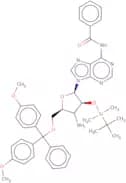
N4-Acetyl-2'-deoxy-5'-O-DMT-cytidine 3'-Sp-oxazaphospholidine is a novel antiviral drug that has been synthesized for the treatment of cancer and viral infections. This compound has been modified to increase its antiviral activity, which is due to its ability to inhibit DNA synthesis. The antiviral activity of N4-Acetyl-2'-deoxy-5'-O-DMT-cytidine 3'-Sp-oxazaphospholidine was shown in vitro using human and mouse cells infected with herpes simplex virus (HSV) type 1 and 2.Degré de pureté :Min. 95%3'-Amino-N6-benzoyl-2'-O-tert-butyldimethylsilyl-5'-O-DMT-3'-deoxyadenosine
3'-Amino-N6-benzoyl-2'-O-tert-butyldimethylsilyl-5'-O-DMT-3'-deoxyadenosine is a nucleoside that is synthesized by the modification of deoxyadenosine. It has antiviral and anticancer properties, as well as other novel applications. The synthesis of this compound can be achieved in two steps: first, the amino group is attached to the 3' carbon atom of the sugar ring by reacting with N6-(benzoyl)adenine. In the second step, a silyl group is attached to the 5' carbon atom of the sugar ring by reacting with tert-butyldimethylchlorosilane and DMT (dimethoxytrityl).Formule :C44H50N6O6SiDegré de pureté :Min. 95%Masse moléculaire :786.99 g/mol2,2'-Anhydrocytidine
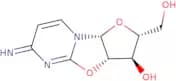
CAS :2,2'-Anhydrocytidine is a cytosine analogue that has been shown to have anticancer activity against solid tumours in mice. The mechanism of action of 2,2'-Anhydrocytidine is not fully understood, but it may be due to its ability to bind to fatty acids and tubule cells in the liver. This compound also induces the production of epidermal growth factor (EGF) and has been shown to inhibit the phase transition temperature of nuclear DNA. It can be used as a model system for hydrogen bonding interactions and chemical stability. 2,2'-Anhydrocytidine can also be used for tissue culture experiments or as a reaction solution in vivo.
Formule :C9H11N3O4Degré de pureté :Min. 95%Couleur et forme :SolidMasse moléculaire :225.2 g/mol2'-Deoxy-N2-isopropylguanosine
CAS :2'-Deoxy-N2-isopropylguanosine is a nucleoside that is synthesized from 2'-deoxy-N6-methyladenosine and isopropyl alcohol. It has antiviral and anticancer properties. The antiproliferative effects of this drug are mediated by the inhibition of DNA synthesis in cells. This compound also inhibits the activation of the transcriptional factor NF-κB, which regulates inflammatory responses in the body.Formule :C13H19N5O4Degré de pureté :Min. 95%Masse moléculaire :309.33 g/mol7-Deaza-7-iodoguanosine
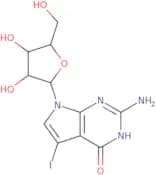
CAS :7-Deaza-7-iodoguanosine is a novel, synthetic nucleoside analog that has antiviral and anticancer activity. It is modified by the addition of a 7-deaza substituent at the 2′ position of the ribose ring. The phosphoramidite form of this compound can be used to synthesize DNA and RNA for use in research and gene therapy. 7-Deaza-7-iodoguanosine may have anticancer activity due to its ability to inhibit protein synthesis by binding to diphosphate kinase, which prevents ATP production and inhibits protein synthesis.Degré de pureté :Min. 95%5-Methoxyuridine 5′-triphosphate sodium, 85mM/L aqueous solution
CAS :Please enquire for more information about 5-Methoxyuridine 5′-triphosphate sodium, 85mM/L aqueous solution including the price, delivery time and more detailed product information at the technical inquiry form on this pageFormule :C10H17N2O16P3•NaxDegré de pureté :Min. 95%7-(Aminomethyl)-7-deazaguanosine
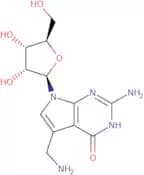
CAS :7-Aminomethyl-7-deazaguanosine is a nucleoside that is classified as a purine. It can be synthesized from 7-amino-7-deazaguanosine and sodium periodate. The chemical reactions involved in the synthesis are oxidation of the amine group on the 7-amino group to form an iminium ion and subsequent nucleophilic attack by the hydroxyl group on the N9 position of the purine ring to form an amino alcohol. This nucleoside has been shown to bind to ribosomes and inhibit protein synthesis, which suggests that it may have potential for use as an antibiotic or anticancer agent. 7-Aminomethyl-7-deazaguanosine has also been shown to cause epigenetic changes such as DNA methylation, histone modification, and alterations in chromatin structure.Formule :C12H17N5O5Degré de pureté :Min. 95%Masse moléculaire :311.29 g/mol(4-N,N-(Dipropyl-1,1-diido-2-)aminophenyl)(5'-deoxy-5'-glycylamino-2'-O-tetrahydropyranylcytidyl-3')hydrogen phosphate
This is an activator, CAS No. is not available, Anticancer, monophosphate, Deoxyribonucleosides, Novel, Synthetic, High purity, High quality, Modified. It is a nucleoside phosphoramidite that contains a modified phosphate group at the 5' position and can be used in the synthesis of oligonucleotides or polynucleotides. This compound is also an antiviral and diphosphate.Degré de pureté :Min. 95%5'-O-DMT-2'-ethylfluoro-5-methyluridine
5'-O-DMT-2'-ethylfluoro-5-methyluridine is an activated nucleotide that is used as a synthetic, nonnatural substrate for DNA polymerases. It has been shown to have anticancer and antiviral activities. 5'-O-DMT-2'-ethylfluoro-5-methyluridine is highly pure and of high quality, which makes it suitable for use in research or other applications requiring a high level of purity.Degré de pureté :Min. 95%5'-O-DMT-N2-(4-isopropylphenoxyacetyl)-2'-O-methylguanosine
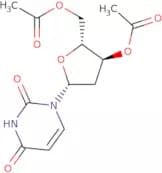
5'-O-DMT-N2-(4-isopropylphenoxyacetyl)-2'-O-methylguanosine is a synthetic nucleoside with antiviral and anticancer activity. It is a modified nucleotide that has been synthesized by the activation of 2'-deoxyadenosine monophosphate with 4-isopropylphenoxyacetic acid, followed by the addition of methylguanine methyl ester to give 5'-O-DMT-N2-(4-isopropylphenoxyacetyl)-2'-O-methylguanosine. This novel nucleoside is an activator of DNA polymerases and is used for the synthesis of DNA, RNA, and proteins. It has been shown to have anti-inflammatory properties in animal models. 5'-O-DMT-N2-(4-isopropylphenoxyacetyl)-2'-O-methylguanosine was first synthesizedDegré de pureté :Min. 95%3',5'-Di-O-acetyl-2'-deoxy-D-uridine
CAS :3',5'-Di-O-acetyl-2'-deoxy-D-uridine is a protonated nucleotide that is synthesized from uridine and acetyl coenzyme A. It has been used as a marker for nucleic acids research, because it is stable at temperatures up to 60 degrees Celsius. 3',5'-Di-O-acetyl-2'-deoxy-D-uridine has been shown to have resonances in the proton region at high field strengths and population shifts in the hydrogen bond region.Formule :C13H16N2O7Degré de pureté :Min. 95%Masse moléculaire :312.28 g/molTert-Butyl 2-Phenyl-4-(P-Tolylsulfonyloxy)-7,8-Dihydropyrido[4,3-D]Pyrimidine-6(5H)-Carboxylate
CAS :Tert-Butyl 2-Phenyl-4-(P-tolylsulfonyloxy)-7,8-dihydropyrido[4,3-D]pyrimidine-6(5H)-carboxylate is an antiviral agent that inhibits the replication of DNA and RNA. It is a phosphoramidate nucleoside analog and a novel compound that has been modified to improve its stability. Tert-butyl 2-phenyl-4-(P-tolylsulfonyloxy)-7,8-dihydropyrido[4,3-D]pyrimidine-6(5H)-carboxylate is currently being investigated for use as a drug to treat HIV/AIDS. This compound has been shown to inhibit HIV protease by binding to the active site of the enzyme and preventing it from cutting the polypeptide chain into smaller pieces. Tert butyl 2 phenyl 4Formule :C25H27N3O5SDegré de pureté :Min. 95%Masse moléculaire :481.57 g/molN4-Acetyl-5'-O-DMT-2'-O-methyl-5-methylcytidine 3'-CE phosphoramidite
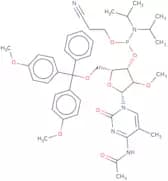
N4-Acetyl-5'-O-DMT-2'-O-methyl-5-methylcytidine 3'-CE phosphoramidite is an antiviral, anticancer and nucleoside phosphoramidite. It is a novel DNA building block with antiviral activity against HIV and Hepatitis C. The synthesis of N4-acetyl-5'-O-DMT-2'-O-methyl-5-methylcytidine 3'-CE phosphoramidite is based on the reaction of cytosine monophosphate with 2,4,6,-trimethoxybenzoyl chloride. This compound has also been shown to inhibit the proliferation of leukemia cells in vitro and has potential as a chemotherapeutic agent for cancer treatment.Formule :C43H54N5O9PDegré de pureté :Min. 95%Masse moléculaire :815.89 g/molCytidine-5'-triphosphate, lithium salt
Cytidine-5'-triphosphate, lithium salt (CTP, Li) is a monophosphate that is used as a cofactor in the synthesis of DNA and RNA. It is also used for the treatment of viral infections. CTP, Li has antiviral activity against herpes simplex virus type 1 and 2 (HSV-1 and HSV-2), varicella zoster virus (VZV), human cytomegalovirus (CMV) and Epstein-Barr virus (EBV). CTP, Li can be used to inhibit the growth of cancer cells by modifying DNA.Degré de pureté :Min. 95%5'-Ethylcarboxamido-2-iodoadenosine
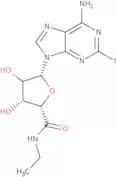
CAS :5'-Ethylcarboxamido-2-iodoadenosine is a novel antiviral drug that belongs to the class of deoxyribonucleosides. It has been shown to inhibit viral replication at the level of DNA synthesis and RNA transcription. 5'-Ethylcarboxamido-2-iodoadenosine has shown activity against cancer cells as well as antiviral activity against HIV and influenza virus. This compound has also been shown to be an activator of phosphoramidites, which are used in many industrial chemical reactions. 5'-Ethylcarboxamido-2-iodoadenosine is synthesized from 2',3'-dideoxyadenosine by replacing the 3' hydroxyl group with ethyl carboxamide group. It is then reacted with iodine to give the final product, 5'-ethylcarboxamido-2-iodoadenosine.Formule :C12H15IN6O4Degré de pureté :Min. 95%Masse moléculaire :434.19 g/molN4-p-Anisoylcytidine
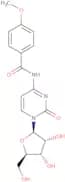
CAS :N4-p-Anisoylcytidine is a labile, crystalline, and water soluble oligoribonucleotide. It is an intermediate in the synthesis of cytidine and phenyl ring. N4-p-Anisoylcytidine can be prepared by reacting p-anisic acid with 4-benzoylcytosine. The reaction yields a mixture of products that can be purified by recrystallization or chromatography. It is hydrolyzed by acidic conditions to yield cytidine and phenyl ring. N4-p-Anisoylcytidine has been used as an intermediate in the synthesis of cytidine, which is subsequently converted to phenyl ring by reaction with benzene. This compound also has been used as an esterification agent for orthoesters.Formule :C17H19N3O7Degré de pureté :Min. 95%Masse moléculaire :377.35 g/mol5'-O-DMT-N4-isobutyryl-2'-O-methyl-5-methylcytidine
5'-O-DMT-N4-isobutyryl-2'-O-methyl-5-methylcytidine, also known as 5'-O-(4,4'-dimethoxytrityl)-N4-isobutyryl-2'-O-methyl-5-methylcytidine, is a nucleoside and nucleotide analog. It is an antiviral agent with anticancer activity. This compound has been shown to be highly active against herpes simplex virus type 1 (HSV1) in vitro. The mechanism of action is not yet fully understood but may involve modification of the viral DNA polymerase.Formule :C36H41N3O8Degré de pureté :Min. 95%Masse moléculaire :643.73 g/mol2'-Methyl-guanosine-(iBu)-succinyl-CPG; 500 Å (RNA)
2'-Methyl-guanosine-(iBu)-succinyl-CPG is a modified nucleoside with antiviral and anticancer properties. It is synthesized by the condensation of 2'-methyl-guanosine and succinic anhydride in the presence of tetrazole. The compound is a phosphoramidite, which is used as a building block for DNA synthesis.Degré de pureté :Min. 95%









![Tert-Butyl 2-Phenyl-4-(P-Tolylsulfonyloxy)-7,8-Dihydropyrido[4,3-D]Pyrimidine-6(5H)-Carboxylate](/_next/image/?url=https%3A%2Fstatic.cymitquimica.com%2Fproducts%2F3D%2Fthumb-webp%2FNB57393.webp&w=3840&q=75)