Enzymes dans les Protéines Recombinantes
Les enzymes accélèrent les réactions chimiques, agissant comme des catalyseurs biologiques, agissant sur des substrats et les transformant en différentes molécules appelées produits. Ces protéines sont indispensables dans les processus biochimiques et les applications industrielles, facilitant les réactions dans des conditions douces avec une grande spécificité et efficacité. Chez CymitQuimica, nous proposons une large sélection d'enzymes de haute qualité pour soutenir vos applications de recherche, industrielles et cliniques.
3315 produits trouvés pour "Enzymes dans les Protéines Recombinantes"
Trier par
Degré de pureté (%)
0
100
|
0
|
50
|
90
|
95
|
100
Amylase protein
<p>Alpha Amylase (Amylase, α-Amylase, 1,4-α-D-glucan glucanohydrolase, glycogenase, ptyalin; systematic name 4-α-D-glucan glucanohydrolase; EC 3.2.1.1, CAS Number [9000-90-2]) is an enzyme that catalyses hydrolysis of large polysacharides into smaller fragments. Alpha amylase targets alpha bonds of 1→4 glycosidic linkages of poly- and oligosaccharides with three or more D-glucose units. One unit of Alpha Amylase will catalyze the hydrolysis of 1.0 μmol of 2-chloro-4-nitrophenyl-α-D-maltotrioside to yield 2-chloro-4-nitrophenol per minute at 37°C. Human salivary Alpha Amylase is supplied as clear, colorless liquid solution at ≥2000U/mL, specific activity ≥200 U/mg protein. Store at -20°C on arrival.</p>Degré de pureté :Min. 95%Plasmin
CAS :<p>Plasmin, human is a serin protease which present in the blood and is involved in the cleavage of cross-linked fibrin, a process known as fibrinolysis.One unit will produce one micromole of P-Nitroanilide from D-Val-Leu-Lys-P-Nitroanilide per minute at pH 7.5 at 37°C</p>EUCODIS® CalB02 IA, engineered variant of Candida antarctica Lipase B, immobilized by adsorption on hydrophobic carrier - ELCB02IA
<p>Lipases belong to the family of esterases and naturally act on triglycerides at lipid-water interfaces. Lipases/esterases can be used as versatile tools in hydrolytic reactions, esterifications and transesterification reactions in industrial and food applications. The CalB02 IA lipase has been immobilized on a hydrophobic carrier by adsorption. The immobilized CalB02 lipase has a temperature optimum in the 40 - 50 °C range and pH optimum between pH 5 and 8.</p>eXrase DNA Endonuclease, research-grade
CAS :<p>eXrase DNA endonuclease from enGenes is a recombinant endonuclease from Serratia marcescens produced in E. coli. Effectively and efficiently degrades all forms of DNA and RNA, reducing sample viscosity without proteolytic activity. As effective and efficient as other nucleases on the market, eXrase DNA endonuclease is the most cost-effective way to improve proteins yields and improve sample handing. Presented as a ready to use colourless liquid, formulated in Tris buffer at pH 8.0 with 50 % glycerol (v/v). This research grade eXrase has low endotoxin, max 0.25 EU/kU.eXrase DNA endonuclease is suitable for the effective breakdown of nucleic acids in numerous biotech settings: • Removal of residual host DNA from biotechnological products to meet regulatory standards • Reduction of viscosity and streamlined purification in downstream processing of fermentation procedures. • Reduction of viscosity in in upstream fermentation processes • Extraction and/or synthesis of flavouring nucleotides • Enhanced bioavailability of nucleotides in specific feed products • DNA degradation for the removal or prevention of biofilm formationeXrase DNA endonuclease from enGenes is made by a proprietary microbial fermentation process utilizing Escherichia coli cells. This enzyme facilitates the hydrolysis of phosphodiester bonds in various forms of DNA and RNA, including single-stranded, double-stranded, linear, circular, or supercoiled configurations, yielding smaller oligonucleotides typically composed of 2-4 base pairs. Unit-Definition: One unit (U) of the enzyme is defined as the amount required to digest calf thymus DNA, yielding acid-soluble oligonucleotides equivalent to a ΔA260nm of 1.0 within a 30-minute timeframe at pH 8.0 and 37°C. This standardization allows for consistent measurement of enzymatic activity across different batches.</p>Aspartic acid proteinase
CAS :<p>Aspartic acid proteinase is a type of proteolytic enzyme, which originates from various biological sources including humans, fungi, and plants. It is characterized by its action via two critical aspartic acid residues in the active site, which facilitate the hydrolysis of peptide bonds in proteins. This enzyme operates optimally in acidic environments, making it crucial in processes like digestion and protein processing within cellular compartments such as lysosomes.</p>Lipase from Candida antarctica
CAS :<p>Lipase from *Candida antarctica* is an enzyme-based biocatalyst, which is derived from the yeast *Candida antarctica*. This enzyme operates via a catalytic mechanism that involves the hydrolysis of ester bonds in lipid substrates, thereby facilitating the breakdown of fats into glycerol and free fatty acids. Its catalytic efficiency and stability in various conditions make it highly versatile for industrial applications.</p>Formule :C11H9N3O2•NaCouleur et forme :PowderMasse moléculaire :233.10 g/molEUCODIS® CalB01 ICE, engineered variant of Candida antarctica Lipase B, covalent immobilization on hydrophobic carrier - ELCB01ICE
<p>Lipases belong to the family of esterases and naturally act on triglycerides at lipid-water interfaces. Lipases/esterases can be used as versatile tools in hydrolytic reactions, esterifications and transesterification reactions in industrial and food applications. The CalB01 ICE lipase has been immobilized on a hydrophobic carrier by a covalent linkage. The immobilized CalB01 lipase has a temperature optimum in the 40 - 50 °C range and pH optimum between pH 5 and 8.</p>Phosphorylase B from rabbit muscle
CAS :<p>Phosphorylase B is an enzymatic protein, specifically an isoform of glycogen phosphorylase, derived from rabbit muscle. This enzyme plays a critical role in glycogen metabolism by catalyzing the phosphorolytic cleavage of α(1→4) glycosidic bonds in glycogen, releasing glucose-1-phosphate. The rabbit muscle source provides a well-studied model due to its high enzyme activity and availability, facilitating in-depth biochemical and structural analysis.</p>Degré de pureté :Min. 95%EUCODIS® Nitrilhydratase 23, recombinant enzyme - ENH023
<p>Nitrile hydratase 23 recombinantly expressed in E. coli comes in a freeze-dried formulation. Nitrile hydratases can be utilized to convert nitriles into their corresponding amides, e.g. to produce acrylamide from acrylonitrile. Additional applications include the removal of nitriles from industrial wastewater. Our nitrile hydratases have been tested for hydrolysis of the following substrates:cyclohexanecarbonitrile, cinnamonitrile, benzonitrile, methacrylonitrile, pivalonitrile.</p>Creatinase
<p>Creatinase is an enzyme (EC 3.5.3.3) that catalyzes the conversion of creatine to sarcosine and urea.</p>Luciferase from Vibrio fischeri
CAS :<p>Luciferase enzymes sourced from Vibrio fischeri</p>Couleur et forme :PowderAminoacyl tRNA synthetase-IN-1
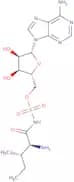
CAS :<p>Enzyme involved in protein translation and catalyzes the aminoacylation reaction</p>Formule :C16H25N7O7SDegré de pureté :Min. 95%Couleur et forme :PowderMasse moléculaire :459.48 g/moleXrase DNA Endonuclease, tech-grade
CAS :<p>eXrase DNA endonuclease from enGenes is a recombinant endonuclease from Serratia marcescens produced in E. coli. Effectively and efficiently degrades all forms of DNA and RNA, reducing sample viscosity without proteolytic activity. As effective and efficient as other nucleases on the market, eXrase DNA endonuclease is the most cost-effective way to improve proteins yields and improve sample handing. Presented as a ready to use colourless liquid, formulated in Tris buffer at pH 8.0 with 50 % glycerol (v/v). This tech grade version is our most cost effective endonuclease for R&D applications. eXrase DNA endonuclease is suitable for the effective breakdown of nucleic acids in numerous biotech settings: • Removal of residual host DNA from biotechnological products to meet regulatory standards • Reduction of viscosity and streamlined purification in downstream processing of fermentation procedures. • Reduction of viscosity in in upstream fermentation processes • Extraction and/or synthesis of flavouring nucleotides • Enhanced bioavailability of nucleotides in specific feed products • DNA degradation for the removal or prevention of biofilm formationeXrase DNA endonuclease from enGenes is made by a proprietary microbial fermentation process utilizing Escherichia coli cells. This enzyme facilitates the hydrolysis of phosphodiester bonds in various forms of DNA and RNA, including single-stranded, double-stranded, linear, circular, or supercoiled configurations, yielding smaller oligonucleotides typically composed of 2-4 base pairs. Unit-Definition: One unit (U) of the enzyme is defined as the amount required to digest calf thymus DNA, yielding acid-soluble oligonucleotides equivalent to a ΔA260nm of 1.0 within a 30-minute timeframe at pH 8.0 and 37°C. This standardization allows for consistent measurement of enzymatic activity across different batches.</p>Alcohol Oxidase - vacuum-dried powder, >0.6 units/mg solid
CAS :<p>Alcohol oxidase (EC 1.1.3.13) is an enzyme that catalyzes the following chemical reaction: a primary alcohol + O2 + H2O ⇌ an aldehyde + H2O2 One unit of alcohol oxidase will oxidize 1.0 µmole of methanol to formaldehyde per min at pH 7.5 and 25 °C.</p>Sphingomyelinase from bacillus cereus
CAS :<p>Sphingomyelinase (SMase, Sphingomyelin phosphodiesterase, systematic name sphingomyelin cholinephosphohydrolase; EC 3.1.4.12) is an enzyme that hydrolyses sphingomyelin into phosphocholine and ceramide. One unit of sphingomyelinase will hydrolyze 1.0 µmole of chromogenic substrate analogue per minute at pH 7.4 and 37 °C.</p>Degré de pureté :Min. 95%Glutathione Reductase, baker's yeast
CAS :<p>Glutathione Reductase, baker's yeast, is an enzyme derived from the yeast species *Saccharomyces cerevisiae*. This enzyme is sourced from baker's yeast, providing a renewable and consistent product for various biochemical applications. Its mode of action involves catalyzing the reduction of glutathione disulfide (GSSG) to the sulfhydryl form glutathione (GSH), using NADPH as an electron donor. This reaction is crucial for maintaining the intracellular redox balance by regenerating GSH, the primary cellular antioxidant.</p>Nitrilase
CAS :<p>Nitrilase (nitrile aminohydrolase; EC 3.5.5.1) in an enzyme that catalyzes hydrolysis of nitriles to carboxilic acids and ammonia: R-CN + 2 H2O → R-COO- + NH4+ One unit of nitrilase will yield 1.0 μmol of ammonia per minute under optimal reaction conditions using acrylonitrile as a substrate.</p>Degré de pureté :Min. 95%C. rugosa Lipase 03, CRL 3 from Candida rugosa - ELCR03
<p>Lipases belong to the family of esterases and naturally act on triglycerides at lipid-water interfaces. Lipases/esterases can be used as versatile tools in hydrolytic reactions, esterifications and transesterification reactions in industrial and food applications. The Lipase 03 from the yeast Candida rugosa has a temperature optimum in the 30 - 50 °C range and pH optimum between pH 7 and 8.</p>Lipoprotein lipase
CAS :<p>Lipoprotein lipase is a critical enzyme used to modulate lipid processing, primarily sourced from mammalian tissues. It functions by hydrolyzing triglycerides present in circulating chylomicrons and very low-density lipoproteins. This enzymatic process liberates free fatty acids, which can subsequently be utilized as energy by peripheral tissues or stored in adipose tissue. Lipoprotein lipase is pivotal in lipid metabolism, participating in maintaining homeostasis of plasma lipid levels.</p>Degré de pureté :Min. 95%