Enzymes dans les Protéines Recombinantes
Les enzymes accélèrent les réactions chimiques, agissant comme des catalyseurs biologiques, agissant sur des substrats et les transformant en différentes molécules appelées produits. Ces protéines sont indispensables dans les processus biochimiques et les applications industrielles, facilitant les réactions dans des conditions douces avec une grande spécificité et efficacité. Chez CymitQuimica, nous proposons une large sélection d'enzymes de haute qualité pour soutenir vos applications de recherche, industrielles et cliniques.
3315 produits trouvés pour "Enzymes dans les Protéines Recombinantes"
Trier par
Degré de pureté (%)
0
100
|
0
|
50
|
90
|
95
|
100
EUCODIS® Lipase 001, screening grade, recombinant, from microbial sources - EL001
<p>Lipase 01 recombinantly expressed in E. coli comes in a spray-dried formulation. It has its pH optimum at 6-7 and temp. optimum at 25-45°C. Lipases belong to the family of esterases and naturally act on triglycerides at lipid-water interfaces catalyzing hydrolytic reactions, esterifications and transesterification reactions in industrial and food applications. Lipase 01 was shown to hydrolyze p-Nitrophenyl esters of butyrate (100 % activity), octanoate (57 %), laurate (13 %), palmitate (9 %), stearate (6 %), arachidate (2 %) and behenate (0.1 %).</p>Elastase
CAS :<p>Elastase (EC 3.4. 21.36) is a serine protease that breaks down elastin fibers. One unit of Elastase release 1 nmol of p-nitrophenol per sec from BOC-L-alanine p-nitrophenyl ester at pH 6.5 and 37°C</p>Lipase CR 02
CAS :<p>Lipase CR 02 is a high-purity enzyme preparation, which is derived from the microbial fermentation of selected fungal strains. With a mechanism involving the hydrolysis of ester bonds in lipids, Lipase CR 02 facilitates the conversion of triglycerides into glycerol and free fatty acids. This catalytic activity positions it as an essential tool in various biochemical and industrial applications.</p>LacBuster® - Settle Plates, available via other suppliers in cooperation with EUCODIS® - EB010.1
<p>LacBuster® Settle Plates contain a general purpose growth medium (tryptone soya agar) supplemented with LacBuster®, a high-performing beta-lactamase to effectively neutralize beta-lactam antibiotics. The media plates are suitable for the cultivation of a wide variety of microorganisms in environmental monitoring within the pharmaceutical industry.</p>Cocarboxylase tetrahydrate
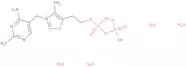
CAS :<p>Cocarboxylase tetrahydrate is a coenzyme form of vitamin B1; cofactor for enzymes involved in carbohydrate catabolism</p>Formule :C12H18N4O7P2S·4H2ODegré de pureté :Min 96%Couleur et forme :White PowderMasse moléculaire :496.37 g/molα-L-Iduronidase, recombinant, lyophilised
CAS :<p>PAIRED PRODUCTS AVAILABLE:</p>Degré de pureté :Corresponds To RequirementsCouleur et forme :PowderLacBuster™-S bulk (β-Lactamase)
CAS :<p>This product shows beta-lactamase activity against clinically relevant beta-lactam antibiotics such as penicillins, carbapenems and cephalosporins. This product may be of particular interest for laboratory teams who require the sterility testing of biological specimens or for environmental monitoring applications.</p>Mutanolysin - lyophilized powder, >4000 units/mg
CAS :<p>A N-Acetyl Muramidase enzyme that cleaves N-acetylmuramyl-β(1-4)-N-acetylglucosamine linkage in peptidoglycan within the bacterial cell wall.</p>Degré de pureté :Min. 95%Pectinase from aspergillus niger
CAS :<p>Pectin is an enzyme that breaks down pectin, a complex polysaccharide found in plant cell walls. It widely used in food and beverage, wine and brewing and textile and paper industries</p>Formule :C20H43NCouleur et forme :PowderMasse moléculaire :297.33955Dextranase
CAS :<p>Dextranase (alternative names dextran hydrolase, endo-dextranase, endodextranase, dextranase DL 2, α-D-1,6-glucan-6-glucanohydrolase, 1,6-α-D-glucan 6-glucanohydrolase, EC 3.2.1.11) is dextran-degrading enzyme that hydrolyzes the α(1→6) glycosidic linkage of dextran, cutting it into progressively shorter fragments, ultimaly producing isomaltose (a disaccharide) and glucose. One unit of dextranase will cleave dextrane to yield 1.0 μmole of isomaltose per min at pH 6.0 and 37 °C.</p>Formule :C66H56N4Degré de pureté :Min. 95%Amidase, from Pseudomonase aeruginosa, recombinant, lyophilized - EAM01
CAS :<p>Amidase is a hydrolase acting on carbon-nitrogen bonds in linear amides, and can be used in hydrolysis of amides to acids. Amidase 01 is of bacterial origin (P. aeruginosa) and has been produced in E.coli.</p>Catalase ECAT01™, EUCODIS® Patent: US 9951306 and EP2861715
<p>A proprietary potent and stable alternative to chemical neutralizers such as pyruvate - for the utilization in environmental monitoring applications. Use of catalase as a supplement in media plates offers a more effective and reliable solution for safe and secure environmental monitoring of sterilization in clean rooms, isolators or production facilities by also removing remaining traces and spots of high concentration of H2O2. Currently, agar plates for monitoring disinfection or sterilization are supplemented with pyruvate, which is consumed during the neutralization of hydrogen peroxide. One of the main benefits of this catalase is its high stability in agar media at 50°C, which allows easy preparation of media and processing into plates. Due to the high stability no special storage conditions are needed and a shelf-life of > 6 months at 4-25°C can be guaranteed.<br>Key features are:</p>Chloramphenicol acetyltransferase from escherichia coli
CAS :<p>Chloramphenicol acetyltransferase from escherichia coli (EC 2.3.1.28) detoxfies the antibiotic Chloramphenicol by attaching aceryl group. This renders chroramphenicol inactive, as it looses its ability to bind and inactivate ribosomes. One unit of Chloramphenicol acetyltransferase will convert 1 nmol of chloramphenicol and acetyl-CoA to chloramphenicol 3-acetate and CoA per min at pH 7.8 and 25 °C.</p>Degré de pureté :Min. 95%EUCODIS® Peroxidase 12, from microbial origin, recombinant
CAS :<p>Peroxidases can be utilized as enzymes catalyzing e.g. aromatic ring hydroxylation, epoxidation, halogenation, N- or S-oxidation, ether cleavage and alcohol/aldehyde oxidation reactions.</p>Penicillin amidase from escherichia coli
CAS :<p>As a member of the family of hydrolases this enzyme acts on carbon-nitrogen bonds and may be used in the commercial production of semisynthetic penicillin.</p>Degré de pureté :Min. 95%Isoamylase 5MU, from Pseudomonase sp., recombinant, lyophilized - EIA01
<p>Isoamylase (also known as debranching enzyme, systemic name glycogen α-1,6-glucanohydrolase; EC 3.2.1.68) is an enzyme from the family of carbohydrolases acting specifically on α-1,6-glucosidic branch linkages in polysaccharides such as amylopectin or glycogen, but rarely hydrolyzes such bonds in pullulan. Isoamylase has been obtained from P. amyloderamosa and has a temperature optimum in the 30 – 40 °C range and pH optimum between pH 3 and 4.</p>LacBuster™-L concentrate
CAS :<p>Beta-lactamase solution targeting beta-lactam antibiotics such as penicillins, carbapenems and cephalosporins. According to US Pharmacopeia (USP <71>) and EP, LacBusterTM-L is suitable for sterility testing methods such as membrane filtration and direct inoculation.</p>Amylase protein (Porcine)
<p>Alpha Amylase (Amylase, α-Amylase, 1,4-α-D-glucan glucanohydrolase, glycogenase, PPA; systematic name 4-α-D-glucan glucanohydrolase; EC 3.2.1.1, CAS Number [9000-90-2]) is an enzyme that catalyzes hydrolysis of large polysaccharides into smaller fragments. Alpha amylase targets alpha bonds of 1→4 glycosidic linkages of poly- and oligosaccharides with three or more D-glucose units. One unit of Alpha Amylase will catalyze the hydrolysis of 1.0 μmol of 2-chloro-4-nitrophenyl-α-D-maltotrioside to yield 2-chloro-4-nitrophenol per minute at 37°C. Porcine pancreatic Alpha Amylase is supplied as lyophilized, off-white to white powder, lyophilized from tris chloride and mannitol, pH 7.2. Activity is ≥70U/mL, specific activity ≥100 U/mg protein. Store at -20°C on arrival.</p>Degré de pureté :Min. 95%Protein kinase LATS2
CAS :<p>Protein kinase LATS2 is a serine/threonine kinase, which is a crucial component sourced intrinsically from cellular kinase cascades involved in cell regulation. This protein kinase is pivotal in the Hippo signaling pathway, which regulates cell growth, apoptosis, and stem cell renewal. LATS2 is part of the core kinase cascade that, upon activation, phosphorylates and inhibits the activity of the transcriptional co-activators YAP and TAZ, thereby controlling their transcriptional activity. This inhibition is key to maintaining proper cell proliferation and preventing uncontrolled cell growth that could lead to tumorigenesis.</p>Degré de pureté :Min. 95%