Enzymes dans les Protéines Recombinantes
3320 produits trouvés pour "Enzymes dans les Protéines Recombinantes"
EUCODIS® Nitrilhydratase 23, recombinant enzyme - ENH023
Nitrile hydratase 23 recombinantly expressed in E. coli comes in a freeze-dried formulation. Nitrile hydratases can be utilized to convert nitriles into their corresponding amides, e.g. to produce acrylamide from acrylonitrile. Additional applications include the removal of nitriles from industrial wastewater. Our nitrile hydratases have been tested for hydrolysis of the following substrates:cyclohexanecarbonitrile, cinnamonitrile, benzonitrile, methacrylonitrile, pivalonitrile.
Luciferase from Vibrio fischeri
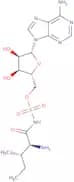
CAS :Luciferase enzymes sourced from Vibrio fischeriCouleur et forme :PowderAminoacyl tRNA synthetase-IN-1
CAS :Enzyme involved in protein translation and catalyzes the aminoacylation reactionFormule :C16H25N7O7SDegré de pureté :Min. 95%Couleur et forme :PowderMasse moléculaire :459.48 g/molAlcohol Oxidase - vacuum-dried powder, >0.6 units/mg solid
CAS :Alcohol oxidase (EC 1.1.3.13) is an enzyme that catalyzes the following chemical reaction: a primary alcohol + O2 + H2O ⇌ an aldehyde + H2O2 One unit of alcohol oxidase will oxidize 1.0 µmole of methanol to formaldehyde per min at pH 7.5 and 25 °C.Sphingomyelinase from bacillus cereus
CAS :Sphingomyelinase (SMase, Sphingomyelin phosphodiesterase, systematic name sphingomyelin cholinephosphohydrolase; EC 3.1.4.12) is an enzyme that hydrolyses sphingomyelin into phosphocholine and ceramide. One unit of sphingomyelinase will hydrolyze 1.0 µmole of chromogenic substrate analogue per minute at pH 7.4 and 37 °C.Degré de pureté :Min. 95%Glutathione Reductase, baker's yeast
CAS :Glutathione Reductase, baker's yeast, is an enzyme derived from the yeast species *Saccharomyces cerevisiae*. This enzyme is sourced from baker's yeast, providing a renewable and consistent product for various biochemical applications. Its mode of action involves catalyzing the reduction of glutathione disulfide (GSSG) to the sulfhydryl form glutathione (GSH), using NADPH as an electron donor. This reaction is crucial for maintaining the intracellular redox balance by regenerating GSH, the primary cellular antioxidant.eXrase DNA Endonuclease, tech-grade
CAS :eXrase DNA endonuclease from enGenes is a recombinant endonuclease from Serratia marcescens produced in E. coli. Effectively and efficiently degrades all forms of DNA and RNA, reducing sample viscosity without proteolytic activity. As effective and efficient as other nucleases on the market, eXrase DNA endonuclease is the most cost-effective way to improve proteins yields and improve sample handing. Presented as a ready to use colourless liquid, formulated in Tris buffer at pH 8.0 with 50 % glycerol (v/v). This tech grade version is our most cost effective endonuclease for R&D applications. eXrase DNA endonuclease is suitable for the effective breakdown of nucleic acids in numerous biotech settings: • Removal of residual host DNA from biotechnological products to meet regulatory standards • Reduction of viscosity and streamlined purification in downstream processing of fermentation procedures. • Reduction of viscosity in in upstream fermentation processes • Extraction and/or synthesis of flavouring nucleotides • Enhanced bioavailability of nucleotides in specific feed products • DNA degradation for the removal or prevention of biofilm formationeXrase DNA endonuclease from enGenes is made by a proprietary microbial fermentation process utilizing Escherichia coli cells. This enzyme facilitates the hydrolysis of phosphodiester bonds in various forms of DNA and RNA, including single-stranded, double-stranded, linear, circular, or supercoiled configurations, yielding smaller oligonucleotides typically composed of 2-4 base pairs. Unit-Definition: One unit (U) of the enzyme is defined as the amount required to digest calf thymus DNA, yielding acid-soluble oligonucleotides equivalent to a ΔA260nm of 1.0 within a 30-minute timeframe at pH 8.0 and 37°C. This standardization allows for consistent measurement of enzymatic activity across different batches.eXrase DNA Endonuclease, research-grade
CAS :eXrase DNA endonuclease from enGenes is a recombinant endonuclease from Serratia marcescens produced in E. coli. Effectively and efficiently degrades all forms of DNA and RNA, reducing sample viscosity without proteolytic activity. As effective and efficient as other nucleases on the market, eXrase DNA endonuclease is the most cost-effective way to improve proteins yields and improve sample handing. Presented as a ready to use colourless liquid, formulated in Tris buffer at pH 8.0 with 50 % glycerol (v/v). This research grade eXrase has low endotoxin, max 0.25 EU/kU.eXrase DNA endonuclease is suitable for the effective breakdown of nucleic acids in numerous biotech settings: • Removal of residual host DNA from biotechnological products to meet regulatory standards • Reduction of viscosity and streamlined purification in downstream processing of fermentation procedures. • Reduction of viscosity in in upstream fermentation processes • Extraction and/or synthesis of flavouring nucleotides • Enhanced bioavailability of nucleotides in specific feed products • DNA degradation for the removal or prevention of biofilm formationeXrase DNA endonuclease from enGenes is made by a proprietary microbial fermentation process utilizing Escherichia coli cells. This enzyme facilitates the hydrolysis of phosphodiester bonds in various forms of DNA and RNA, including single-stranded, double-stranded, linear, circular, or supercoiled configurations, yielding smaller oligonucleotides typically composed of 2-4 base pairs. Unit-Definition: One unit (U) of the enzyme is defined as the amount required to digest calf thymus DNA, yielding acid-soluble oligonucleotides equivalent to a ΔA260nm of 1.0 within a 30-minute timeframe at pH 8.0 and 37°C. This standardization allows for consistent measurement of enzymatic activity across different batches.
alpha Amylase enzyme
Alpha Amylase (Amylase, α-Amylase, 1,4-α-D-glucan glucanohydrolase, glycogenase, systematic name 4-α-D-glucan glucanohydrolase; EC 3.2.1.1, CAS Number [9000-90-2]) is an enzyme that catalyses hydrolysis of large polysacharides into smaller fragments. Alpha amylase targets alpha bonds of 1→4 glycosidic linkages of poly- and oligosaccharides with three or more D-glucose units. One unit of Alpha Amylase will catalyze the hydrolysis of 1.0 μmol of 2-chloro-4-nitrophenyl-α-D-maltotrioside to yield 2-chloro-4-nitrophenol per minute at 37°C. Human pancreatic Alpha Amylase is supplied as clear, colorless to light yellow liquid solution at ≥400U/mL, specific activity ≥100 U/mg protein.Store at 2-8 °C on arrival.Degré de pureté :Min. 95%Adenylate Kinase 1, human, recombinant
Adenylate kinase 1 (EC 2.7.4.3) catalyzes interconversion between ATP, ADP and AMP by catalyzing the following reaction: ATP + AMP ⇔ 2 ADP One unit of Adenylate kinase 1 will convert 1.0 µmol ATP and 1.0 µmol AMP to 2.0 µmol ADP per min at optimum conditions.Degré de pureté :Min. 95%Cathepsin B from human placenta
CAS :Cathepsin B is a lysosomal proteolytic enzyme of the cysteine protease family. It is present in all mammalian cells. It is essential for the intracellular protein turnover. Cathepsin B may be a useful tool in Alzheimer′s research, as it may have a role in the natural defense against the disease.Degré de pureté :Min. 95%PNPase
Specific activity: >500 units/mg-protein.Unit definition: One unit will polymerize 1.0 micro mole of ADP, releasing 1.0 micro mole of inorganic phosphate in 15 minutes at pH 9.1 at 37 °C.
Carboxypeptidase Y, from S. cerevisiae, recombinant, lyophilized - ECPY001
CAS :Carboxypeptidase Y (EC 3.4.16.1) is an exopeptidase enzyme. It hydrolyzes peptide bonds of C-terminal residues and it remains active in the presence of urea at low to moderate concentrations. One unit of the Carboxypeptidase Y will hydrolyze 1.0 μmole of a chromogenic peptide substrate, releasing C-terminal alanine and generating a light-absorbing product. Carboxypeptidase Y has been obtained from yeast S. cerevisiae, has a broad substrate specificity and can therefore be used in sequence analysis of proteins. Carboxypeptidase Y has a temperature optimum in the 20 – 30 °C range and pH optimum between pH 6 and 7.Deoxycytidine Kinase, human, recombinant
Deoxycytidine kinase (dCK, EC 2.7.1.74) is an enzyme that catalyzes the following reaction: dC + ATP → dCMP + ADP It can also use UTP as a donor of the phosphate group, and it can phosphorylate other deoxyribonucleosides (e.g. dA, dG) as well as nucleoside analogues (like clofarabine). One unit of dCK will convert 1.0 µmole of dC and ATP to dCMP and ADP per minute at pH 7.5 and 37°C.Degré de pureté :Min. 95%Serratiopeptidase
CAS :Serratiopeptidase (serratio peptidase, serratia peptidase, serrapeptidase, serratia E-15 protease, serralysin, serrapeptase; EC 3.4.24.40) is a proteolitic enzyme (proteinase) that is produced by Serratia marcescens.Degré de pureté :Min. 95%Couleur et forme :PowderCellulose catalase
Cellulose catalase is an enzyme-based product, designed specifically to act as a catalyst in the oxidative processes associated with cellulose applications. It is derived from a microbial source, where bacilli or fungi are employed to produce robust catalase enzymes in a fermentation process. The mode of action involves the catalase enzyme’s ability to facilitate the decomposition of hydrogen peroxide into water and oxygen, thereby reducing oxidative damage during cellulose processing.
Amidase, from Rhodococcus sp., recombinant, lyophilized - EAM02
CAS :Amidase (EC 3.5.1.4) is a hydrolase acting on carbon-nitrogen bonds in linear amides and can be used in the hydrolysis of amides to acids. Amidase 02 is of bacterial origin (R. erythropolis and has been produced in E.coli).Mannitol dehydrogenase from leuconostoc mesenteroides
CAS :Mannitol dehydrogenase (MDH, mannitol 2-dehydrogenase, EC 1.1.1.67) is an enzyme that catalyzes the following reaction: D-mannitol + NAD+ ⇌ D-fructose + NADH + H+ One unit of mannitol dehydrogenase will generate 1.0 μmole of D-fructose per min in the presence of NAD+ at pH 8.6 and 40°C. NAD+ is available here and NADH is available here, depending on whether you require the reaction to proceed from left to right or from righ to left, respectively.
Degré de pureté :Min. 95%Ubiquitin Conjugating enzyme E2C Human Recombinant
Ubiquitin Conjugating enzyme E2C (other names UBE2C, UBCH10, dJ447F3.2, ubiquitin conjugating enzyme E2 C; EC 2.3.2.24) is an essential mediator of mitotic destruction events and cell cycle progression. It catalyzes the destruction of cyclins A and B in conjunction with the anaphase-promoting complex, and therefore, plays an important role in the control of the cell exit from mitosis This activity is essential at then end of mitosis for the inactivation of their partner kinase Cdc2 and exit from mitosis into G1 of the next cell cycle. In addition, UBE2C bears homology to yeast PAS2, a gene that is essential for biogenesis of peroxisomes. UBE2C is useful for in vitro ubiquitinylation reactions.β-Glucanase 2, thermostable
CAS :Thermostable β-Glucanase 2 is an enzyme that hydrolases β-Glucans into glucose. One unit of β-Glucanase 2 will produce 1.0 μmole of glucose from β-glucan per minute at pH 5.8 and 70 °C.Degré de pureté :Min. 95%