Autres
6310 produits trouvés pour "Autres"
Aldol® 470 butyrate, Biosynth Patent: EP 2427431 and US 8940909
CAS :Produit contrôléAldol® 470 butyrate, a chromogenic substrate manufactured by Cymit Quimica and used for enzymatic assays that produces a yellow-orange color upon enzymatic cleavage.Formule :C27H25NO5Degré de pureté :Min. 95%Couleur et forme :PowderMasse moléculaire :443.5 g/mol5-Bromo-4-chloro-3-indoxyl myristate
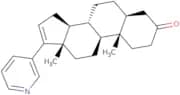
CAS :5-Bromo-4-chloro-3-indoxyl myristate is a chemiluminescent substrate that can be used in the detection of peroxide. It reacts with hydrogen peroxide to emit light, which can be detected using a luminometer. 5-Bromo-4-chloro-3-indoxyl myristate is also used for the detection of bacteria, such as Staphylococcus aureus and Escherichia coli, by staining. The compound is also used for diagnostic tests to identify diseases such as tuberculosis. 5-Bromo-4-chloro-3 indoxyl myristate is soluble in organic solvents and water, not toxic, and has a high purity level.Formule :C22H31BrClNO2Degré de pureté :Min. 98 Area-%Masse moléculaire :456.86 g/mol(5α)-17-(3-Pyridinyl)androst-16-en-3-one
CAS :Produit contrôlé(5α)-17-(3-Pyridinyl)androst-16-en-3-one is a natural metabolite of testosterone that is produced in the liver. It has been identified as an impurity in API, which can be found in drugs used for the treatment of high blood pressure and prostate cancer. (5α)-17-(3-Pyridinyl)androst-16-en-3-one is not active as a drug itself, but it can be used as a standard to study the metabolism of testosterone and other steroids.Formule :C24H31NODegré de pureté :Min. 98 Area-%Couleur et forme :White PowderMasse moléculaire :349.51 g/mol5-Bromo-4-chloro-3-indoxyl phosphate, dilithium salt hydrate
5-Bromo-4-chloro-3-indoxyl phosphate, dilithium salt hydrate is a chromogenic substrate used to detect the specific enzymatic activity of alkaline phosphatase. After cleavage, 5-bromo-4-chloro-indoxyl is released, resulting in a blue to blue-green color change in bacterial colonies or media. 5-Bromo-4-chloro-3-indoxyl phosphate, dilithium salt hydrate is used in ELISA and molecular biology assays such as lacZ reporter systems.
Formule :C8H4BrClLi2NO4P(anhydrousbasis)Degré de pureté :Min. 98 Area-%Couleur et forme :PowderMasse moléculaire :338.34 g/molCelluchrome
Celluchrome (short name for remazol brilliant blue carboxymethyl cellulose or RBB-CMC) is a chromogenic substrate for cellulases. With a higher sensitivity, RBB-CMC allows for the detection of the enzyme activity even when small amounts are present.Degré de pureté :Min. 95%Couleur et forme :PowderAldol® 470 L-alanine ester, hydrochloride, Biosynth Patent: EP 2427431 and US 8940909
CAS :Produit contrôléAldol® 470 L-alanine ester, hydrochloride is a fluorescent chemiluminescent substrate. It is a ligand with high purity and high quality, which has been patented in the European Patent Office (EP 2427431) and the United States Patent and Trademark Office (US 8940909). The product can be used for chemiluminescence, staining, fluorescence, bioluminescence, enzyme substrate and food testing. Aldol® 470 L-alanine ester, hydrochloride is an excellent fluorescent chemiluminescent substrate that can be used for conjugation to enzymes or antibodies.Formule :C26H25ClN2O5Degré de pureté :Min. 95%Couleur et forme :PowderMasse moléculaire :480.95 g/mol6-Chloro-1H-indol-3-yl octanoate
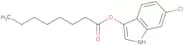
CAS :6-Chloro-1H-indol-3-yl octanoate is a fluorogenic substrate that can be used to detect enzymes such as phosphatases, lipases, esterases, and proteases. 6-Chloro-1H-indol-3-yl octanoate is a ligand for metal ions such as Cu(II), Ni(II) and Zn(II). This product has high purity and quality. It is an enzyme substrate for many enzymes such as phosphatases, lipases, esterases, and proteases. This product can be used in diagnostics of various substances including food testing, environmental testing and staining. 6CIO is a chromogenic substrate that can be used to detect bioluminescence reactions.
6CIO is CAS No. 159954-35-5.Degré de pureté :Min. 95%Masse moléculaire :293.79 g/mol5-Bromo-6-chloro-3-indoxyl-beta-D-glucopyranoside
CAS :Chromogenic substrate for β-D-glucosidase yielding a magenta precipitate. Differentiation of Salmonella spp. (negative) from other Enterobacteriaceae.Formule :C14H15BrClNO6Degré de pureté :Min. 99 Area-%Masse moléculaire :408.64 g/mol6-Bromo-2-naphthyl b-D-glucopyranoside
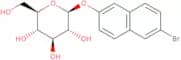
CAS :6-Bromo-2-naphthyl b-D-glucopyranoside is an enzyme substrate used in chromogenic assays with beta-glucosidases. It has been used in culture media for the identification of Legionella pneumophila.Formule :C16H17BrO6Degré de pureté :Min. 98 Area-%Couleur et forme :PowderMasse moléculaire :385.21 g/molAldol® 515 N-glutaryl-L-phenylalanine amide potassium salt, Biosynth Patent: EP 2427431 and US 8940909
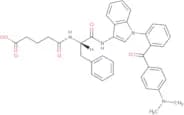
CAS :Aldol® 515 N-glutaryl-L-phenylalanine amide is a chromogenic and fluorogenic enzyme substrate used for detection of L-glutamate-phenylalanine (GluPhe)-specific peptidase activity. The colorless enzyme substrate is cleaved the GluPhe-specific peptidase, yielding development of orange-red coloration. In addition, red fluorescence is generated when Aldol® 355 fluorescence enhancer or a suitable matrix is present. Aldol® 515 N-glutaryl-L-phenylalanine amide can be used in enzyme assays and live bacterial cultures. Aldol® 515 N-glutaryl-L-phenylalanine amide is suitable for use in liquid and solid media, under aerobic as well as anaerobic conditions.
Formule :C37H35KN4O5Degré de pureté :Min. 95%Couleur et forme :PowderMasse moléculaire :654.8 g/mol2-Chloro-4-nitrophenyl β-D-cellotrioside
CAS :2-Chloro-4-nitrophenyl β-D-cellotrioside is a chromogenic substrate use in cellulase activity assays. This enzyme, which is responsible to break down cellulose, hydrolyzes 2-chloro-4-nitrophenyl beta-D-cellotrioside and releases 2-chloro-4-nitrophenol than can be quantified spectrophotometrically. The use of 2-chloro-4-nitrophenyl beta-D-cellotrioside as substrate for enzymatic assays allows detecting bacterial cellulose in urine tract infections in the biofilm state.Formule :C24H35ClNO18Degré de pureté :Min. 95%Couleur et forme :PowderMasse moléculaire :660.98 g/mol4-Nitrophenyl 2-acetamido-3-O-[2-O-a-L-fucopyranosyl-b-D-galactopyranosyl)-2-deoxy-b-D-galactopyranoside
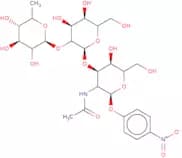
CAS :4-Nitrophenyl 2-acetamido-3-O-[2-O-a-L-fucopyranosyl-b-D-galactopyranosyl)-2-deoxyb-D-galactopyranoside is a water soluble, fluorescent probe that can be used for detecting the presence of β-(1→4) -linked galactosaminoglycans. The dye is a substrate for enzymes such as α--mannosidase, β--glucuronidase and β--galactosidase. The dye is also an excellent ligand for lectins such as concanavalin A and wheat germ agglutinin. This product is a diagnostic reagent that has been shown to have high purity and quality. It has CAS No. 93496-53-8 and can be used in food testing, bioluminescence, environmental testing, or high purity applications.
Formule :C26H38N2O17Degré de pureté :Min. 95%Masse moléculaire :650.58 g/mol5-Bromo-4-chloro-3-indoxyl-beta-D-glucuronic acid, sodium salt trihydrate
CAS :Chromogenic substrate for beta-glucuronidase (GUS) yielding blue precipitate upon cleavage. Used for identification of beta-glucuronidase. X-beta-D-glucuronide has been reported as chromogenic substrate in a number of chromogenic E. coli/ coliform culture media. About 95% of common E. coli possess beta-D-glucuronidase activity. Such chromogenic culture media are used for detection and enumeration of E. coli in food samples such as meat, dairy products and shellfish and have clinical applications in the assessment of urinary infections. It has gained international acceptance as highly accurate test for the presence of E. coli in drinking water samples. It is also used for the detection of the expression of GUS (E. coli beta-glucuronidase) gene fusion marker constructs in plants. The sodium salt has advantages over the cyclohexylammonium salt as being non-electrostatic and possessing a naturally-occurring cation.Formule :C14H18BrClNNaO10Degré de pureté :Min. 99.0 Area-%Masse moléculaire :498.65 g/mol5-Bromo-3-indoxyl caprylate
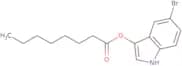
CAS :Also known as Lapis-caprylate; targeting esterase with C8 activity; Blue colorFormule :C16H20BrNO2Degré de pureté :Min. 98 Area-%Couleur et forme :PowderMasse moléculaire :338.24 g/mol2-Chloro-4-nitrophenyl b-D-maltoside
2-Chloro-4-nitrophenyl b-D-maltoside is a fluorescent substrate used in diagnostic kits. It is used to detect the presence of beta-glucuronidase enzymes, which are found in many bacteria and fungi. 2-Chloro-4-nitrophenyl b-D-maltoside has been shown to be a superior substrate for beta-glucuronidase as it can be used at lower concentrations and is more stable than other substrates. The enzyme hydrolyzes the 2,4 nitrophenyl ester bond and releases the fluorogenic product 4-(2'-hydroxyethyl)benzene diazonium chloride (HED). This product emits light under ultraviolet light, making it ideal for use in Bioluminescence Assays.Degré de pureté :Min. 95%Aldol® 470 beta-D-galactopyranoside, Biosynth Patent: EP 2427431 and US 8940909
CAS :Aldol® 470 beta-D-galactopyranoside is a chromogenic and fluorogenic enzyme substrate used for detection of beta-galactosidase activity. The colorless enzyme substrate is cleaved by lactose-utilizing bacteria grown in liquid or solid media, yielding yellow coloration and green fluorescence. Aldol® 470 beta-D-galactopyranoside can also be used in beta-galactosidase gene reporter assays or immunoassay applications (ELISA). Aldol® 470 beta-D-galactopyranoside can be used under aerobic and anaerobic conditions.Formule :C29H29NO9Degré de pureté :Min. 95 Area-%Couleur et forme :PowderMasse moléculaire :535.54 g/mol2-Fluoro-4-nitrophenyl b-D-galactopyranoside
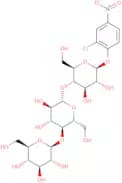
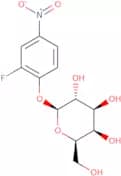
CAS :2-Fluoro-4-nitrophenyl b-D-galactopyranoside is a chromogenic substrate in enzymatic assays with β-galactosidase. Commonly abbreviated as PFONPG, it is a hydrophilic compound that can be dissolved in saline and blood samples, which makes it a suitable candidate for diagnostic applications as a gene reporter probe by simple analytic methodologies. 2-Fluoro-4-nitrophenyl b-D-galactopyranoside have been used to detect and monitor the growth of prostate tumor cells.Degré de pureté :Min. 95%Couleur et forme :PowderMasse moléculaire :319.24 g/molAldol® 455 alpha-D-maltopyranoside, Biosynth Patent: EP 2427431 and US 8940909
Aldol® 455 alpha-D-maltopyranoside is a chromogenic substrate developed by Cymit Quimica, designed for the detection of maltosidases.Formule :C33H34ClNO12Degré de pureté :Min. 95.0 Area-%Masse moléculaire :672.08 g/molAldol® 514 inositol-phosphate, ammonium salt, Biosynth Patent: EP 2427431 and US 8940909
CAS :Aldol® 514 inositol-phosphate is a chromogenic enzyme substrate used for detection of phosphatidylinositol specific phospholipase C (PI-PLC, EC 4.6.1.13). The colorless enzyme substrate is cleaved by PI-PLC positive microorganisms, yielding a red-orange color. The substrate thus enables the detection and identification of various bacteria, such as, pathogenic strains of Listeria, Clostridium, Bacillus, and Staphylococcus. Aldol® 514 inositol-phosphate is suitable for use under aerobic and anaerobic conditions.
Formule :C26H28BrClN3O10PDegré de pureté :Min. 95.0 Area-%Masse moléculaire :688.85 g/molAldol® 495 inositol-phosphate, ammonium salt, Biosynth Patent: EP 2427431 and US 8940909
CAS :Aldol® 495 inositol-phosphate is a chromogenic and fluorogenic enzyme substrate used for detection of phosphatidylinositol specific phospholipase C activity (PI-PLC, EC 4.6.1.13). The colorless enzyme substrate is cleaved by PI-PLC or PI-PLC-positive microorganisms in liquid or solid media, yielding orange color. In addition, green fluorescence is generated when a suitable matrix is present, e.g. PE-Pellets or cellulose acetate filter. Aldol® 495 inositol-phosphate is suitable for use in liquid and solid media, under aerobic as well as anaerobic conditions.Formule :C26H29ClN3O10PDegré de pureté :Min. 95.0 Area-%Masse moléculaire :609.95 g/mol