Autres
6310 produits trouvés pour "Autres"
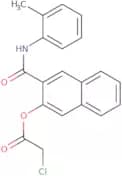
Naphthol AS-D chloroacetate
CAS :Histochemical substrate for esteraseFormule :C20H16ClNO3Degré de pureté :Min. 98 Area-%Couleur et forme :PowderMasse moléculaire :353.8 g/molAldol® 470 butyrate, Biosynth Patent: EP 2427431 and US 8940909
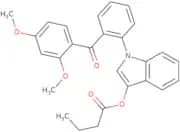
CAS :Produit contrôléAldol 470 butyrate is a chromogenic substrate for the enzyme aldolase. It can be used in diagnostics, food testing and culture media. Aldol 470 butyrate has been shown to be useful in detecting the presence of a number of different substances, including alcohols, organic acids, ketones, amines and amino acids. Aldol 470 butyrate is also an excellent ligand for determination of protein-ligand interactions. The conjugation of this product with other molecules provides an excellent tool for chemiluminescence assays. This product is also used as a fluorogenic substrate in environmental testing.Formule :C27H25NO5Degré de pureté :Min. 95.0 Area-%Masse moléculaire :443.5 g/molAldol® 470 choline phosphate, Biosynth Patent: EP 2427431 and US 8940909
CAS :Aldol® 470 choline phosphate is a chromogenic and fluorogenic enzyme substrate used for detection of phosphatidyl-choline specific phospholipase C (PC-PLC, EC 3.1.4.3) activity. The colorless product is cleaved by PC-PLC positive microorganisms in liquid or solid media, yielding a yellow color and green fluorescence. Aldol® 470 choline phosphate therefore, enables the detection and identification of PC-PLC positive pathogenic bacteria, such as, Clostridium perfringens, Pseudomonas aeruginosa, Helicobacter pylori, Legionella pneumophila, Bacillus cereus, Bacillus anthracis, Listeria monocytogenes, and others. Aldol® 470 choline phosphate can be used under aerobic and anaerobic conditions.Formule :C28H31N2O7PDegré de pureté :Min. 95 Area-%Masse moléculaire :538.53 g/mol4-Nitrophenyl palmitate
CAS :4-Nitrophenyl palmitate is a lipase-sensitive chromogenic substrate commonly used in the study of lipase and esterase activity. Its hydrolysis by lipases produces a yellow 4-nitrophenol, which can be easily detected spectrophotometrically, offering a quantitative measure of enzyme activity. This substrate is widely utilized in the screening of lipase-producing microorganisms and the optimization of enzyme-catalyzed reactions in various fields, including biotechnology and pharmaceutical research.Formule :C22H35NO4Degré de pureté :Min. 95%Couleur et forme :Off-White PowderMasse moléculaire :377.52 g/molPhosphoric acid, mono(4-nitrophenyl) ester
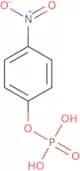
CAS :Phosphatase substrate
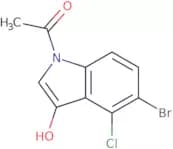
Formule :C6H6NO6PDegré de pureté :Min. 95%Couleur et forme :White PowderMasse moléculaire :219.09 g/mol5-Bromo-4-chloro-3-indoxyl-1-acetate
CAS :5-Bromo-4-chloro-3-indoxyl-1-acetate is a chromogenic substrate used to detect the specific enzymatic activity of esterase. After cleavage, 5-bromo-4-chloro-indoxyl is released, resulting in a blue to blue-green color change in bacterial colonies or media. 5-Bromo-4-chloro-3-indoxyl-1-acetate is used in bacterial esterase activity assays (e.g. Pseudomonas spp.).
Degré de pureté :Min. 95%Couleur et forme :PowderMasse moléculaire :288.52 g/mol5-Bromo-6-chloro-3-indolyl-2-acetamido-2-deoxy-a-D-glucopyranoside
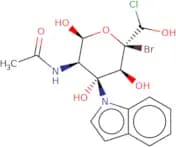
5-Bromo-6-chloro-3-indolyl-2-acetamido-2-deoxy-a-D-glucopyranoside is a chemiluminescent substrate that is used as an indicator in diagnostic tests. This compound reacts with an oxidizing agent, such as hydrogen peroxide, to generate light. It is also used as a chromogenic substrate for the detection of bioluminescence and it can be applied in culture media or food testing. 5Bromo-6Chloro-3Indolyl2Acetamido2DeoxyA1DGlucopyranoside has a CAS number, which means that it meets the standards set by the Chemical Abstracts Service. It also has a high purity and quality, making it suitable for use in laboratories.Degré de pureté :Min. 95%5-Bromo-4-chloro-3-indolyl b-L-fucopyranoside
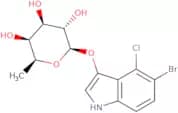
CAS :5-Bromo-4-chloro-3-indolyl β-L-fucopyranoside (X-Fuc) is a chromogenic substrate specifically designed for the identification and detection of fucosidase enzyme activity. Upon cleavage by fucosidase, it generates a blue-colored 5-Bromo-4-chloro-3-hydroxy-indole precipitate, which can be easily observed under a microscope or spectrophotometer. This feature makes X-Fuc an invaluable tool across various applications, such as biochemical analysis, histochemical staining, cell biology, and enzyme kinetic assays. By providing a fast, sensitive, and reliable readout for fucosidase activity, 5-Bromo-4-chloro-3-indolyl β-L-fucopyranoside facilitates essential research in the understanding of biological processes and the development of therapeutic interventions.Formule :C14H15BrClNO5Degré de pureté :Min. 95%Couleur et forme :White PowderMasse moléculaire :392.63 g/molAldol® 514 inositol-phosphate, ammonium salt, Biosynth Patent: EP 2427431 and US 8940909
CAS :Aldol® 514 inositol-phosphate is a chromogenic enzyme substrate used for detection of phosphatidylinositol specific phospholipase C (PI-PLC, EC 4.6.1.13). The colorless enzyme substrate is cleaved by PI-PLC positive microorganisms, yielding a red-orange color. The substrate thus enables the detection and identification of various bacteria, such as, pathogenic strains of Listeria, Clostridium, Bacillus, and Staphylococcus. Aldol® 514 inositol-phosphate is suitable for use under aerobic and anaerobic conditions.
Formule :C26H28BrClN3O10PDegré de pureté :Min. 95.0 Area-%Masse moléculaire :688.85 g/mol2-Chloro-4-nitrophenyl β-D-cellotrioside
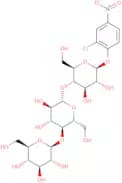
CAS :2-Chloro-4-nitrophenyl β-D-cellotrioside is a chromogenic substrate use in cellulase activity assays. This enzyme, which is responsible to break down cellulose, hydrolyzes 2-chloro-4-nitrophenyl beta-D-cellotrioside and releases 2-chloro-4-nitrophenol than can be quantified spectrophotometrically. The use of 2-chloro-4-nitrophenyl beta-D-cellotrioside as substrate for enzymatic assays allows detecting bacterial cellulose in urine tract infections in the biofilm state.Formule :C24H35ClNO18Degré de pureté :Min. 95%Couleur et forme :PowderMasse moléculaire :660.98 g/mol2-Nitrophenyl-beta-D-galactopyranoside - non-animal origin
CAS :2-Nitrophenyl-beta-D-galactopyranoside is a non-animal origin chromogenic substrate for the detection of beta-galactosidase activity. It is used in food testing, diagnostics, and environmental testing. 2-Nitrophenyl-beta-D-galactopyranoside is also used as a ligand in enzyme assays and a fluorogenic substrate for chemiluminescent reactions. This product is conjugated to HRP.Formule :C12H15NO8Degré de pureté :Min. 98 Area-%Masse moléculaire :301.25 g/molN-Acetyl-glycine p-nitroanilide
CAS :Substrate for hydrolasesFormule :C10H10N2O5Degré de pureté :Min. 95%Couleur et forme :Yellow powder.Masse moléculaire :238.2 g/molN,N,N',N'-Tetramethyl-p-phenylenediamine dihydrochloride
CAS :Reducing co-substrate for heme peroxidases; test reagent in microbiologyFormule :C10H16N2·2HClDegré de pureté :Min. 95%Couleur et forme :White PowderMasse moléculaire :237.17 g/mol4-Nitrophenyl-alpha-D-maltohexaoside
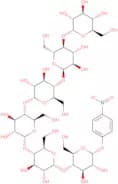
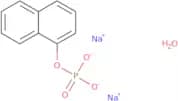
CAS :Chromogenic substrate for α-amylase yielding a yellow solution upon cleavage.Formule :C42H65NO33Degré de pureté :Min. 97.0 Area-%Masse moléculaire :1,111.97 g/mola-Naphthyl phosphate disodium salt hydrate
CAS :a-Naphthyl phosphate disodium salt hydrate is a highly water-soluble chromogenic substrate used to determine phosphatase activity in research and analytical applications, particularly for staining and differentiating acid and alkaline phosphatases.Degré de pureté :Min. 95%Couleur et forme :White PowderMasse moléculaire :268.11 g/molAldol® 470 beta-D-galactopyranoside, Biosynth Patent: EP 2427431 and US 8940909
CAS :Aldol® 470 beta-D-galactopyranoside is a chromogenic and fluorogenic enzyme substrate used for detection of beta-galactosidase activity. The colorless enzyme substrate is cleaved by lactose-utilizing bacteria grown in liquid or solid media, yielding yellow coloration and green fluorescence. Aldol® 470 beta-D-galactopyranoside can also be used in beta-galactosidase gene reporter assays or immunoassay applications (ELISA). Aldol® 470 beta-D-galactopyranoside can be used under aerobic and anaerobic conditions.Formule :C29H29NO9Degré de pureté :Min. 95 Area-%Couleur et forme :PowderMasse moléculaire :535.54 g/mol5-Bromo-4-chloro-3-indoxyl-β-D-galactopyranoside
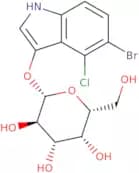
CAS :X-Gal is a chromogenic substrate for β-galactosidase, yielding a blue precipitate. X-Gal is an indicator for coliforms in culture media, as well as for the detection of coliforms (E. coli) in municipal water supplies and food products. X-Gal can be used in conjunction with the inducer IPTG, which binds and inhibits the lac repressor thus inducing β-galactosidase expression. X-Gal is the substrate of choice for blue-white selection of recombinant bacterial colonies with the lac+ genotype. Upon hydrolysis, X-Gal yields a localized, insoluble, blue precipitate, making it exceptionally useful in blotting, immunocytochemical, and ELISA assays. 5-Bromo-4-chloro-3-indoxyl-beta-D-galactopyranoside (X-beta-D-galactoside, X-Gal) is a chromogenic indicator for beta-galactosidase activity. The colorless product is cleaved by lactose-utilizing bacteria in liquid media or on agar plates and yields a blue-green colored precipitate. X-Gal can also be used as a detecting agent for beta-galactosidase activity in reporter gene assays or for identification of positive transformants on agar plates when using the α-complementation approach. Color formation is due to dimerization and oxidation of 5-bromo-4-chloro-3-hydroxyindole which results from enzymatic cleavage of X-Gal. The reaction proceeds only in the presence of oxygen, i.e. in aerobic cultures. Well detectable color bacterial colonies or liquid cultures is obtained within 16-48 h. In the presence of purified beta-galactosidase, color develops within minutes to a few hours.Formule :C14H15BrClNO6Degré de pureté :Min. 99.0 Area-%Masse moléculaire :408.64 g/mol2-Nitrophenyl b-D-xylopyranoside
CAS :Chromogenic substrates targeting beta-xylosidaseDegré de pureté :Min. 95%Couleur et forme :PowderMasse moléculaire :271.22 g/mol5-Bromo-4-chloro-3-indoxyl thymidine-3'-phosphate, cyclohexylammonium salt
CAS :5-Bromo-4-chloro-3-indoxyl thymidine (BCIT) is a chromogenic substrate that reacts with the enzyme β-galactosidase, which cleaves the BCIT to form a bromochloroindoxyl (BCI) and an indoxyl phosphate. The BCI is then detected by chemiluminescence or fluorescence. This product is used in food testing, diagnostics, environmental testing, and staining. It has been shown to be a good substrate for β-galactosidase from different sources such as calf thymus, bacteria, fungi, and plants.Formule :C24H31BrClN4O8PDegré de pureté :Min. 98 Area-%Masse moléculaire :649.87 g/molRef: 3D-B-7680
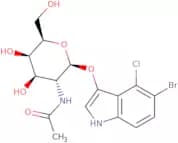
-Unit-mgmgÀ demander1gÀ demander50mgÀ demander100mgÀ demander250mgÀ demander500mgÀ demander5-Bromo-4-chloro-3-indoxyl-N-acetyl-beta-D-galactosaminide
CAS :5-Bromo-4-Chloro-3-Indoxyl-N-Acetyl-Beta-D-Galactosaminide is a chromogenic substrate for detecting beta-galactosidase and GalNAc-transferase enzymes. Upon hydrolysis by the enzyme, it produces a blue-green colored compound that can be detected visually or measured spectrophotometrically. This substrate is useful in characterizing the activity of Beta-Galactosidase and GalNAc-transferase enzymes involved in glycobiology research and diagnostic applications.Formule :C16H18BrClN2O6Degré de pureté :Min. 98 Area-%Couleur et forme :Crystalline PowderMasse moléculaire :449.68 g/mol