Autres
6302 produits trouvés pour "Autres"
4-Methyl-2-nitrophenyl b-D-galactopyranoside
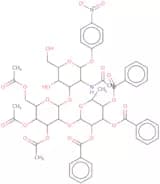
4-Methyl-2-nitrophenyl b-D-galactopyranoside is a fluorogenic substrate for β-galactosidase. It has a high purity and is of high quality. 4-Methyl-2-nitrophenyl b-D-galactopyranoside is used as an enzyme substrate in diagnostics, as a chromogenic substrate in staining, and as a conjugate in chemiluminescence. It can be used for the detection of β-galactosidase in culture media and for the detection of β-galactosidase in environmental testing. This chemical also has bioluminescent properties that make it useful for food testing.Degré de pureté :Min. 95%Masse moléculaire :315.28 g/mol4-Nitrophenyl 2-acetamido-3-O-[2-O-(2,3,4-tri-O-benzoyl-a-L-fucopyranosyl)-3,4,6-tri-O-acetyl-2-deoxy-D-galactopyranosyl]-b-D-glucop yranoside
4-Nitrophenyl 2-acetamido-3-O-[2-O-(2,3,4-tri-O-benzoyl-a-L-fucopyranosyl)-3,4,6-tri-O-acetyl-2 deoxy -D-galactopyranosyl]-b D glucopyranoside is a fluorescent substrate for the enzyme β galactosidase. It can be used to test for β galactosidase activity in food products, environmental samples and diagnostics. 4NPFAPG is a conjugate of 4 nitrophenol and 2 acetamido 3 O-[2 O-(2,3,4 tri O benzoyl a L fucopyranosyl) 3,4 6 tri O acetyl 2 deoxy D galactopyranosyl] b D glucopyranose. 4NPFAPG is water soluble and hasDegré de pureté :Min. 95%Masse moléculaire :1,089.01 g/mol5-Bromo-6-chloro-3-indolyl palmitate
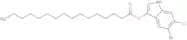
CAS :5-Bromo-6-chloro-3-indolyl palmitate is a magenta enzyme substrate that is widely used in the study of lipase and esterase enzymes. This compound consists of an indole ring with bromine and chlorine atoms at positions 5 and 6, respectively, and a palmitate moiety esterified to the indolyl ring. The palmitate group is a long-chain fatty acid, making this substrate particularly useful for investigating enzymes that hydrolyze ester bonds in lipids. Upon cleavage by lipases or esterases, 5-Bromo-6-chloro-3-indolyl palmitate releases a magenta-colored product, which can be easily detected and quantified to measure enzyme activity.
Degré de pureté :Min. 95%Masse moléculaire :484.9 g/mol6-Chloro-1H-indol-3-yl b-D-mannopyranoside
CAS :6-Chloro-1H-indol-3-yl b-D-mannopyranoside is an enzyme substrate that is used in the fluorogenic and chromogenic assays for detecting indoleamines. This compound has a conjugate, which is a fluorescent molecule that can be attached to an antibody to target specific proteins or cells. 6-Chloro-1H-indol-3-yl b-D-mannopyranoside is used as a diagnostic agent in the detection of bacterial and fungal infections. It is also used as an indicator of cell growth in culture media.Degré de pureté :Min. 95%Masse moléculaire :329.73 g/mol4-Nitrophenyl 2-acetamido-2-deoxy-6-O-trityl-b-D-glucopyranoside
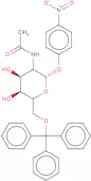
4-Nitrophenyl 2-acetamido-2-deoxy-6-O-trityl-b-D-glucopyranoside offers unmatched versatility as a chromogenic pNP substrate for detecting b-D-glucopyranosidase activity. The substrate is specifically designed to produce a yellow 4-nitrophenol product upon enzyme hydrolysis, which can be measured using absorbance spectroscopy. The unique tritylated glucopyranoside group ensures improved compound stability and selectivity while providing ease of handling. This versatile substrate is ideal for a broad range of biochemical, research, and diagnostic applications.Degré de pureté :Min. 95%Masse moléculaire :584.62 g/mol5-Bromo-4-chloro-3-indolyl N-acetyl-a-D-neuraminic acid methyl ester
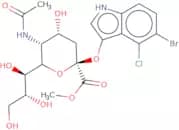
CAS :5-Bromo-4-chloro-3-indolyl N-acetyl-a-D-neuraminic acid methyl ester is a chromogenic substrate that reacts with enzymes to produce a colored product. It can be used in diagnostic tests for the detection of various bacteria, including Salmonella and Brucella, as well as for the determination of concentration in food testing or environmental testing. 5B4C3INA can also be conjugated to other substances, such as biotin or an antibody, which allows it to be used in immunoassays.Formule :C20H24BrClN2O9Degré de pureté :Min. 95%Masse moléculaire :551.77 g/molAldol® 515 L-proline amide, hydrochloride, Biosynth Patent: EP 2427431 and US 8940909
CAS :Aldol® 515 L-proline amide is a chromogenic and fluorogenic enzyme substrate used for detection of L-proline aminopeptidase activity. The colorless enzyme substrate is cleaved by L-proline aminopeptidase produced by microorganisms grown in liquid or solid media, yielding red-orange color. In addition, red fluorescence signals are generated when a fluorescence enhancer or a suitable matrix is present. Aldol® 515 L-proline amide is suitable for use under aerobic and anaerobic conditions.
Formule :C28H29ClN4O2Degré de pureté :Min. 95.0 Area-%Masse moléculaire :489.02 g/molVerapamil
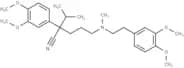
CAS :Verapamil (CP-16533-1), an oral calcium channel blocker, inhibits P-gp and CYP3A4, used for hypertension, arrhythmias, and angina research.Formule :C27H38N2O4Degré de pureté :99.61% - 99.93%Couleur et forme :OilMasse moléculaire :454.6Ref: TM-T20656
10mg34,00€25mg49,00€1mL*10mM (DMSO)52,00€50mg70,00€100mg90,00€200mg136,00€500mg219,00€4-Nitrophenyl b-D-cellobioside heptacetate
CAS :4-Nitrophenyl b-D-cellobioside heptacetate is a fluorogenic substrate that is used in food testing and environmental testing. The product is an enzyme substrate that can be used as a conjugate to produce chemiluminescence or bioluminescence. 4-Nitrophenyl b-D-cellobioside heptacetate has CAS number 69948-03-4 and is of high purity and quality. It has been shown to have good fluorescence properties, which makes it ideal for use in fluorescence microscopy applications.Degré de pureté :Min. 95%Masse moléculaire :757.65 g/mol2-Bromo-4-nitrophenyl b-D-galactopyranoside
2-Bromo-4-nitrophenyl b-D-galactopyranoside is a chemiluminescent substrate that is used for the detection of β-galactosidase activity in the biochemical reaction. It has been shown to be an excellent ligand for metal ions and can be used as a reagent in the determination of metal ions in biological systems. This product is manufactured with high purity and quality, which ensures its suitability for use in culture media, environmental testing, and diagnostics. 2-Bromo-4-nitrophenyl b-D-galactopyranoside has been tested as a fluorogenic substrate for β-galactosidase. It has also been used as a chromogenic substrate for β-galactosidase and an enzyme substrate for β-galactosidase. This product can be conjugated with other molecules such as biotin to enable rapid analysis of proteins or
Formule :C12H14BrNO8Degré de pureté :Min. 95%Masse moléculaire :380.15 g/mol2-Chloro-4-nitrophenyl 2-acetamido-2-deoxy-a-D-glucopyranoside
L-2-Chloro-4-nitrophenyl 2-acetamido-2-deoxy-a-D-glucopyranoside is a chemiluminescent substrate for the detection of aminoglycoside antibiotics. It can be used to determine the concentration of aminoglycosides in blood, urine, and serum. The chemiluminescence reaction is dependent on the presence of oxygen. This product has been shown to have a high quality and purity with environmental testing and staining properties. L-2-Chloro-4-nitrophenyl 2-acetamido-2-deoxy--a--D--glucopyranoside has also been shown to bind ligands such as porphyrins, bilirubin, or hemin with bioluminescence or chromogenic substrates in diagnostics or culture media for food testing. L--2--Chloro--4--Degré de pureté :Min. 95%Aldol® 470 L-alanine ester, hydrochloride, Biosynth Patent: EP 2427431 and US 8940909
CAS :Produit contrôléAldol® 470 L-alanine ester, hydrochloride is a chromogenic substrate that is used as a food testing reagent and enzyme substrate in diagnostics. It is also used to detect the presence of ligands in an environment. Aldol® 470 L-alanine ester, hydrochloride is used in chemiluminescence and bioluminescence reactions.Formule :C26H25ClN2O5Degré de pureté :Min. 95.0 Area-%Masse moléculaire :480.95 g/mol4-Nitrophenyl 2-O-(a-L-fucopyranosyl)-a-D-galactopyranoside
CAS :4-Nitrophenyl 2-O-(a-L-fucopyranosyl)-a-D-galactopyranoside is a chromogenic pNP enzyme substrate consisting of a fucose and galactose moieties. Upon enzymatic hydrolysis by specific fucosidases or galactosidases, it releases the highly chromogenic molecule 4-nitrophenol, which exhibits a distinct yellow color that can be monitored spectrophotometrically. This substrate is frequently used to study enzyme specificity, kinetics, and inhibition, and it plays a critical role in the investigation of carbohydrate active enzymes (CAZymes), the screening of enzyme inhibitors, and the development of novel analytical methods for the detection and quantitation of enzyme activities.Degré de pureté :Min. 95%Masse moléculaire :447.39 g/mol2-Chloro-4-nitrophenyl 2,3,4,6-tetra-O-acetyl-a-D-glucopyranoside
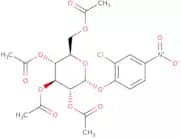
CAS :2-Chloro-4-nitrophenyl 2,3,4,6-tetra-O-acetyl-a-D-glucopyranoside is a chromogenic substrate used to characterize enzymes in biochemical assays. The substrate is cleaved by enzymes, such as esterases and glycosidases, releasing the chromogenic group, which can be detected by its yellow color.Degré de pureté :Min. 95%Masse moléculaire :503.84 g/mol6-Bromo-2-naphthyl-α-D-mannopyranoside
CAS :6-Bromo-2-naphthyl-alpha-D-mannopyranoside is a strong inhibitor of alpha-mannosidase. It has been shown to inhibit the growth of Mycobacterium tuberculosis and Streptococcus pneumoniae, which are both known to cause bacterial infections in humans. 6BNA inhibits the enzyme alpha-mannosidase, which hydrolyzes terminal α-(1,4)-linked mannose residues from oligosaccharides and glycoproteins. This drug has a high affinity for the active site of alpha-mannosidase and an IC50 value of 0.2 mM, making it an effective inhibitor.
Formule :C16H17BrO6Degré de pureté :Min. 98.0 Area-%Masse moléculaire :385.22 g/mol5-Bromo-3-indolyl a-D-galactopyranoside
5-Bromo-3-indolyl a-D-galactopyranoside is a fluorogenic substrate that can be used for the detection of beta-galactosidase activity. It is also used as an enzyme substrate in diagnostics and research, as well as a chromogenic substrate in staining. 5-Bromo-3-indolyl a-D-galactopyranoside has been shown to be an excellent conjugate for proteins, nucleic acids, and other biomolecules. This product can also be used in culture media for the cultivation of bacteria and yeast.
Formule :C14H16BrNO6Degré de pureté :Min. 95%Masse moléculaire :374.18 g/molAldol® 518 β-D-cellobioside, Biosynth Patent: EP 2427431 and US 8940909
CAS :Aldol® 518 beta-D-cellobioside is a chromogenic substrate for the detection of glycosidases. Aldol® 518 beta-D-cellobioside reacts with enzymes such as alpha-amylase, beta-galactosidase, and alpha-glucosidase to produce a fluorescent product. This product is detected by spectrophotometer, fluorometer, or luminometer. The fluorescence intensity is proportional to the concentration of the enzyme in the sample. It has been shown that Aldol® 518 beta-D-cellobioside can be used as a substitute for conventional substrates in food testing and diagnostics, such as staining and culture media. It also has applications in environmental testing and enzyme substrate assays.Formule :C35H39ClN2O12Degré de pureté :Min. 95 Area-%Masse moléculaire :715.15 g/mol4-Nitrophenyl 2-acetamido-2-deoxy-4,6-O-p-methoxybenzylidene-a-D-galactopyranoside
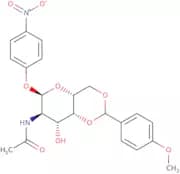
CAS :4-Nitrophenyl 2-acetamido-2-deoxy-4,6-O-p-methoxybenzylidene-a-D-galactopyranoside is a chromogenic substrate designed for the detection and quantification of enzyme activity. This methoxybenzylidene-protected compound is specifically designed to be cleaved by enzymes, releasing a yellow 4-nitrophenol product that can be easily measured spectrophotometrically. This allows for accurate and sensitive analysis of enzyme kinetics, inhibition studies, and substrate specificity determination in various applications.Degré de pureté :Min. 95%Masse moléculaire :460.43 g/molAldol® 457 β-D-galactopyranoside, Biosynth Patent: EP 2427431 and US 8940909
CAS :Aldol 457 Beta-D-galactopyranoside is a chromogenic substrate for beta-galactosidase, which is an enzyme that catalyzes the hydrolysis of the terminal galactose residue in D-galactose to form D-galactitol and D-glucose. Aldol 457 Beta-D-galactopyranoside is used as a reagent for the detection of beta-galactosidase activity in biological samples, such as cultured cells or tissues, and has been shown to be a ligand in binding studies with Galectin 1. This product is also used in diagnostic applications such as food testing, culture media, fluorogenic substrates, environmental testing and more.Formule :C24H28N2O8Degré de pureté :Min. 95.0 Area-%Masse moléculaire :472.49 g/mol3-Indolyl b-D-cellotrioside
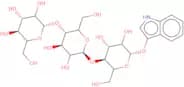
3-Indolyl b-D-cellotrioside is a chemiluminescent substrate that is used for the detection of bacterial activity. 3-Indolyl b-D-cellotrioside reacts with hydrogen peroxide to produce light, which can be detected by luminometers. This product can be used in diagnostic tests to detect the presence of bacteria in food, water, and other samples. It has been shown to have excellent performance characteristics and high purity and quality.Degré de pureté :Min. 95%Masse moléculaire :619.57 g/mol