Autres
6322 produits trouvés pour "Autres"
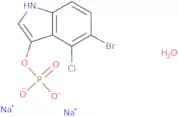
BCIP disodium salt sesquihydrate
CAS :BCIP is a dye that can be used as a substrate in a fluorometric assay to detect the presence of effector proteins. It is also used in analytical chemistry to detect phosphate, and as a reagent in diagnostic tests for mucin gene expression. BCIP has been shown to have transcriptional regulatory effects on genes encoding for proteins involved in antibody production. BCIP has been shown to act as an effector protein, which influences the amount of mRNA produced by the gene encoding for tissue culture cells. BCIP can also be used as a model system to study the regulation of transcription in vitro.
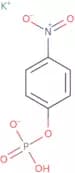
A hybridization technique using BCIP with DNA-dependent RNA polymerase II has been demonstrated and applied to analyze the mechanism of transcriptional control at the level of individual genes. The use of this technique allows for analysis at a single gene level and may allow for better understanding of transcriptional regulation.Degré de pureté :Min. 95%Masse moléculaire :388.45 g/mol4-Nitrophenyl phosphate potassium salt
CAS :4-Nitrophenyl phosphate potassium salt is a high quality, non-radioactive chemiluminescence substrate that is used in the detection of oxidase activity. This product can be used to measure the activity of peroxidase and catalase enzymes, as well as the accumulation of hydrogen peroxide. It also has been shown to be a ligand for some sulfhydryl groups and an inhibitor of phosphatases. 4-Nitrophenyl phosphate potassium salt has been tested for its ability to inhibit bacterial growth and fluorescence by staining cells. This product has also been shown to have bioluminescent properties and can be used for diagnostics or culture media.Degré de pureté :Min. 95%Masse moléculaire :257.18 g/molAldol® 515 palmitate, Biosynth Patent: EP 2427431 and US 8940909
CAS :Aldol® 515 palmitate is a high quality, non-toxic and water soluble chromogenic substrate for enzymes. It is used to detect the presence of lipase activity due to yielding a red color.
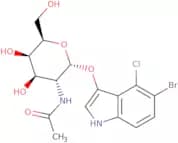
Formule :C39H50N2O3Degré de pureté :Min. 95%Couleur et forme :PowderMasse moléculaire :594.83 g/mol5-Bromo-4-chloro-3-indolyl 2-acetamido-2-deoxy-a-D-galactopyranoside
CAS :Substrate for a-N-acetyl-galactosaminidaseFormule :C16H18BrClN2O6Degré de pureté :Min. 95%Couleur et forme :White to off-white solid.Masse moléculaire :449.68 g/mol4-Nitrophenyl 2-acetamido-6-O-(2-acetamido-3,4,6-tri-O-acetyl-2-deoxy-b-D-glucopyranosyl)-3-O-(2,3,4,6-tetra-O-acetyl-b-D-galactopyr anosyl)-2-deoxy-a-D-galactopyranoside
4-Nitrophenyl 2-acetamido-6-O-(2-acetamido-3,4,6-tri-O-acetyl-2-deoxy-b-D-glucopyranosyl)-3-O-(2,3,4,6-tetra -O acetyl -b D galactopyranosyl)-2 deoxy a D galactopyranoside is a high purity fluorogenic substrate for the enzyme β galactosidase. It can be used for the detection of β galactosidase in biological samples. 4NPAG can also be used as a ligand for various types of chromogenic substrates. This product is also commonly used in diagnostics and conjugates to detect β galactosidase activity or as a culture media supplement.Degré de pureté :Min. 95%Masse moléculaire :1,001.89 g/molN-Acetyl-L-glutamine p-nitroanilide
CAS :N-Acetyl-L-glutamine p-nitroanilide is a fluorogenic substrate that can be used in the diagnosis of bacterial infections. It is a ligand that can bind to enzymes involved in the production of bioluminescence, such as luciferase, and can be used for the detection of bacteria. It is also used for food testing, environmental testing, and diagnostics. N-Acetyl-L-glutamine p-nitroanilide has high purity and high quality, which makes it suitable for conjugation with other molecules.
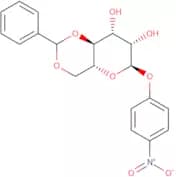
Formule :C13H15N3O6Degré de pureté :Min. 95%Couleur et forme :PowderMasse moléculaire :309.27 g/mol4-Nitrophenyl 4,6-O-benzylidene-a-D-mannopyranoside
CAS :4-Nitrophenyl 4,6-O-benzylidene-a-D-mannopyranoside is a chromogenic substrate for alpha-mannosidase and beta-glucosidase. It is used as a diagnostic tool for identifying the presence of these enzymes in certain bacteria. This product is also used in food testing, environmental testing, and bioluminescence.Degré de pureté :Min. 95%Masse moléculaire :389.36 g/molAldol® 496 acetate, Biosynth Patent: EP 2427431 and US 8940909
CAS :Aldol 496 acetate is a chromogenic substrate for the enzyme Aldolase. It is also used as a ligand to detect the presence of Aldolase in biological fluids and tissues. This product is designed for Food testing, Diagnostics, Chromogenic substrate, Staining, Enzyme substrate, Bioluminescence, Fluorogenic substrate, Chemiluminescence, and Culture media. Aldol 496 acetate is an organic chemical with high purity and high quality.Formule :C27H24N2O4Degré de pureté :Min. 95.0 Area-%Masse moléculaire :440.49 g/molAldol® 544 β-D-galactopyranoside, Biosynth Patent: EP 2427431 and US 8940909
CAS :Aldol 544 beta-D-galactopyranoside is a chromogenic substrate for the detection of beta-galactosidase activity in food testing and diagnostics. Aldol 544 beta-D-galactopyranoside is used as a conjugate to detect the presence of an enzyme, such as beta-galactosidase, in biological samples. It has been used in environmental testing and as a fluorogenic substrate for the detection of β-galactosidase activity.Formule :C33H33ClN2O7Degré de pureté :Min. 95.0 Area-%Masse moléculaire :605.08 g/mol4-Nitrophenyl b-D-cellobioside heptacetate
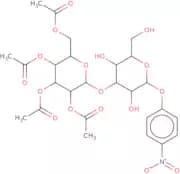
CAS :4-Nitrophenyl b-D-cellobioside heptacetate is a fluorogenic substrate that is used in food testing and environmental testing. The product is an enzyme substrate that can be used as a conjugate to produce chemiluminescence or bioluminescence. 4-Nitrophenyl b-D-cellobioside heptacetate has CAS number 69948-03-4 and is of high purity and quality. It has been shown to have good fluorescence properties, which makes it ideal for use in fluorescence microscopy applications.Degré de pureté :Min. 95%Masse moléculaire :757.65 g/mol4-Nitrophenyl 3-O-(2,3,4,6-tetra-O-acetyl-b-D-glucopyranosyl)-b-D-glucopyranoside
4-Nitrophenyl 3-O-(2,3,4,6-tetra-O-acetyl-b-D-glucopyranosyl)-b-D-glucopyranoside is a chromogenic substrate that is used to test for the presence of an enzyme. It reacts with the enzyme to produce a light signal that can be detected by a spectrophotometer. The CAS number for this compound is 832476-41-8. This compound has been tested and found to be of high quality and purity. 4NP3OBG is also suitable for use in culture media, food testing, and as a fluorogenic substrate.Degré de pureté :Min. 95%Masse moléculaire :631.54 g/mol8-Hydroxyquinoline-β-D-galactopyranoside
CAS :Chromogenic substrate for beta-D-galactosidase yielding a brown precipitate upon cleavage.Formule :C15H17NO6Masse moléculaire :307.30 g/mol4-Nitrophenyl 2,3,4-tri-O-acetyl-6-O-trityl-a-D-glucopyranoside
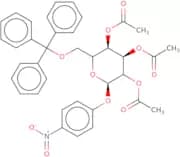
4-Nitrophenyl 2,3,4-tri-O-acetyl-6-O-trityl-a-D-glucopyranoside is a substrate for chemiluminescent assays. It is a high quality chemical that can be used in environmental testing, staining, ligand binding and bioluminescence. 4NP2T6AODG is used as a chromogenic substrate or fluorogenic substrate to detect the presence of enzymes in diagnostics and food testing. This product has CAS No. 67794-14-0 and can be purchased at high purity.Degré de pureté :Min. 95%Masse moléculaire :669.67 g/molOctyl 4-nitrophenyl hexyl phosphonate
CAS :Octyl 4-nitrophenyl hexyl phosphonate is a lipase suicide inhibitor that is a chromogenic substrate for lipases which upon enzymatic action, binds irreversibly to the lipase and inactivates it. The substrate can be used for the determination of active sites in lipases, especially in lipases preferring hydrophobic leaving groups.Degré de pureté :Min. 95%Masse moléculaire :399.46Aldol® 484 acetate, Biosynth Patent: EP 2427431 and US 8940909
CAS :Produit contrôléAldol® 484 acetate is a chromogenic substrate for carboxylesterases yielding a red precipitate. In contrast to classical indoxyl substrates, Aldol substrates work not only under aerobic but also under anaerobic conditionsFormule :C22H16ClFN2O3Degré de pureté :Min. 95.0 Area-%Masse moléculaire :410.83 g/mol2-Nitrophenyl 2-acetamido-2-deoxy-a-D-galactopyranoside
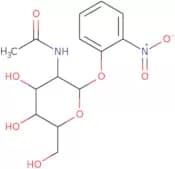
CAS :2-Nitrophenyl 2-acetamido-2-deoxy-a-D-galactopyranoside is a fluorogenic substrate that is used in enzyme assays. It can be used as a chromogenic substrate or conjugate with an enzyme to detect the presence of glucose.Degré de pureté :Min. 95%Masse moléculaire :342.3 g/mol6-Chloro-1H-indol-3-yl b-D-mannopyranoside
CAS :6-Chloro-1H-indol-3-yl b-D-mannopyranoside is an enzyme substrate that is used in the fluorogenic and chromogenic assays for detecting indoleamines. This compound has a conjugate, which is a fluorescent molecule that can be attached to an antibody to target specific proteins or cells. 6-Chloro-1H-indol-3-yl b-D-mannopyranoside is used as a diagnostic agent in the detection of bacterial and fungal infections. It is also used as an indicator of cell growth in culture media.Degré de pureté :Min. 95%Masse moléculaire :329.73 g/mol6-Bromo-2-naphthyl-α-D-mannopyranoside
CAS :6-Bromo-2-naphthyl-alpha-D-mannopyranoside is a strong inhibitor of alpha-mannosidase. It has been shown to inhibit the growth of Mycobacterium tuberculosis and Streptococcus pneumoniae, which are both known to cause bacterial infections in humans. 6BNA inhibits the enzyme alpha-mannosidase, which hydrolyzes terminal α-(1,4)-linked mannose residues from oligosaccharides and glycoproteins. This drug has a high affinity for the active site of alpha-mannosidase and an IC50 value of 0.2 mM, making it an effective inhibitor.
Formule :C16H17BrO6Degré de pureté :Min. 98.0 Area-%Masse moléculaire :385.22 g/molAldol® 515 L-proline amide, hydrochloride, Biosynth Patent: EP 2427431 and US 8940909
CAS :Aldol® 515 L-proline amide is a chromogenic and fluorogenic enzyme substrate used for detection of L-proline aminopeptidase activity. The colorless enzyme substrate is cleaved by L-proline aminopeptidase produced by microorganisms grown in liquid or solid media, yielding red-orange color. In addition, red fluorescence signals are generated when a fluorescence enhancer or a suitable matrix is present. Aldol® 515 L-proline amide is suitable for use under aerobic and anaerobic conditions.
Formule :C28H29ClN4O2Degré de pureté :Min. 95.0 Area-%Masse moléculaire :489.02 g/molAldol® 470 L-alanine ester, hydrochloride, Biosynth Patent: EP 2427431 and US 8940909
CAS :Produit contrôléAldol® 470 L-alanine ester, hydrochloride is a chromogenic substrate that is used as a food testing reagent and enzyme substrate in diagnostics. It is also used to detect the presence of ligands in an environment. Aldol® 470 L-alanine ester, hydrochloride is used in chemiluminescence and bioluminescence reactions.Formule :C26H25ClN2O5Degré de pureté :Min. 95.0 Area-%Masse moléculaire :480.95 g/mol