Autres
6310 produits trouvés pour "Autres"
4-Nitrophenyl 2-acetamido-3-O-(2-O-a-L-fucopyranosyl-b-D-galactopyranosyl)-2-deoxy-a-D-galactopyranoside
CAS :4-Nitrophenyl 2-acetamido-3-O-(2-O-a-L-fucopyranosyl-b-D-galactopyranosyl)-2,6,8,10,12-pentaoxoheptaacetic acid is a chemiluminescent substrate that is used for the detection of peroxidase and other enzymes. The reaction product is a yellow fluorescent product which can be measured using a fluorometer. It is sold as an aqueous solution at 1mg/mL in phosphate buffer at pH 7.4.
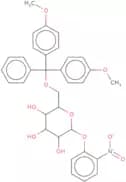
Degré de pureté :Min. 95%Masse moléculaire :650.58 g/mol2-Nitrophenyl 6-O-DMT-b-D-galactopyranoside
N-Acetyl-2-nitrophenyl 6-O-DMT-b-D-galactopyranoside is a fluorogenic substrate that is used in enzyme and chromogenic assays, including the determination of aminoglycoside activity. This product has been shown to be suitable for detection of bacterial contamination in food products and environmental samples. N-Acetyl-2-nitrophenyl 6-O-DMT-b-D-galactopyranoside reacts with aminoglycosides at the O4 position, forming a fluorescent product that can be measured using a fluorometer.Degré de pureté :Min. 95%Masse moléculaire :603.62 g/mol4-Nitrophenyl 3,4,6-tri-O-acetyl-b-D-galactopyranoside
CAS :4-Nitrophenyl 3,4,6-tri-O-acetyl-b-D-galactopyranoside is a nucleic acid molecule that has been synthesized by recombinant expression in Corynebacterium glutamicum. It is a photosynthetic molecule and can be used to study the molecular basis of photosynthesis. The 4-nitrophenyl group on the sugar moiety confers resistance to degradation by nucleases. 4NP3,4,6GalAc has been shown to be capable of binding to proteins and polypeptides that are important for photosynthesis. This compound also has marginalizing effects on C. glutamicum strains that are used as expression vectors for recombinant protein production.Degré de pureté :Min. 95%Masse moléculaire :427.36 g/mol6-Chloro-3-indolyl phosphate disodium salt
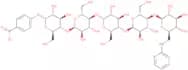
CAS :6-Chloro-3-indolyl phosphate disodium salt is a substrate for visualising alkaline phosphatase activity. It produces a red colored insoluble end product that is detected visually, when used together with nitroblue tetrazolium. The substrate system is versatile and functions in a variety of applications, including Northern, Southern, and Western blotting, in situ hybridization, ELISAs and immunohistochemistry. DMF soluble.Formule :C8H5ClNNa2O4PDegré de pureté :Min. 98 Area-%Couleur et forme :PowderMasse moléculaire :291.54 g/mol4-Nitrophenyl 6'-deoxy-6'-(2-pyridylamino)-a-D-penta-(1-4)-glucopyranoside
CAS :4-Nitrophenyl 6'-deoxy-6'-(2-pyridylamino)-a-D-penta-(1-4)-glucopyranoside is a fluorescent substrate for the enzyme beta glucosidase. It is a chemiluminescent reagent that can be used to measure beta glucosidase activity. The substrate is an excellent high quality chemical and has been tested for environmental safety, heavy metal content and staining. 4-Nitrophenyl 6'-deoxy-6'-(2-pyridylamino)-a-D-penta-(1-4)-glucopyranoside is a chromogenic substrate that can be used in diagnostic testing, such as bioluminescence or fluorogenic assay. This product can also be used as a culture media additive or food testing agent.Degré de pureté :Min. 95%Masse moléculaire :1,025.91 g/mol2-Methyl-4-nitrophenyl b-D-galactopyranoside
2-Methyl-4-nitrophenyl b-D-galactopyranoside is a chemiluminescent substrate that is used in various applications. It is a ligand that binds to the enzyme beta-galactosidase and is used in diagnostics for detecting the presence of the enzyme. 2-Methyl-4-nitrophenyl b-D-galactopyranoside has been shown to be an appropriate substrate for chemiluminescence reactions, such as those used in diagnostic or research applications. The product also has been tested for potential toxicity and found not to be toxic at concentrations up to 100mg/mL. This product can be used in a variety of applications, including food testing, bacterial culture media, and environmental testing.Degré de pureté :Min. 95%Masse moléculaire :315.28 g/mol4-Chloro-2-nitrophenyl b-D-galactopyranoside
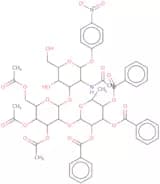
4-Chloro-2-nitrophenyl b-D-galactopyranoside is a fluorogenic substrate that is used in diagnostic testing, such as food and environmental testing. 4-Chloro-2-nitrophenyl b-D-galactopyranoside is an enzyme substrate that can be used to measure the activity of beta galactosidase. This substrate is also chromogenic, which means that it will change color when exposed to the enzyme. 4CNPGalA has been shown to be an excellent ligand for beta galactosidase and can be used in conjugation reactions with other molecules.Degré de pureté :Min. 95%Masse moléculaire :335.69 g/mol4-Nitrophenyl 2-acetamido-3-O-[2-O-(2,3,4-tri-O-benzoyl-a-L-fucopyranosyl)-3,4,6-tri-O-acetyl-2-deoxy-D-galactopyranosyl]-b-D-glucop yranoside
4-Nitrophenyl 2-acetamido-3-O-[2-O-(2,3,4-tri-O-benzoyl-a-L-fucopyranosyl)-3,4,6-tri-O-acetyl-2 deoxy -D-galactopyranosyl]-b D glucopyranoside is a fluorescent substrate for the enzyme β galactosidase. It can be used to test for β galactosidase activity in food products, environmental samples and diagnostics. 4NPFAPG is a conjugate of 4 nitrophenol and 2 acetamido 3 O-[2 O-(2,3,4 tri O benzoyl a L fucopyranosyl) 3,4 6 tri O acetyl 2 deoxy D galactopyranosyl] b D glucopyranose. 4NPFAPG is water soluble and hasDegré de pureté :Min. 95%Masse moléculaire :1,089.01 g/mol4-Nitrophenyl b-D-cellopentaoside hexadecaacetate
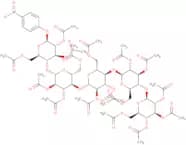
CAS :4-Nitrophenyl b-D-cellopentaoside hexadecaacetate is a fluorogenic substrate that is used to study the activity of various enzymes. It reacts with hydrolytic enzymes in the presence of hydrogen peroxide to produce light, and it can be used for food testing, environmental testing, and diagnostics. 4-Nitrophenyl b-D-cellopentaoside hexadecaacetate is a conjugate of 4-nitrophenol and cellobiose pentaacetate that has a high purity and high quality. The CAS number for this compound is 129411-66-1.Degré de pureté :Min. 95%Masse moléculaire :1,622.4 g/mol4-Nitrophenyl 2-acetamido-3,4,6-tri-O-acetyl-2-deoxy-b-D-glucopyranoside
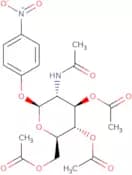
CAS :4-Nitrophenyl 2-acetamido-3,4,6-tri-O-acetyl-2-deoxy-b-D-glucopyranoside is an extracellular nucleic acid molecule that is produced by the bacterium Corynebacterium glutamicum. This compound has been shown to inhibit cancer cells by blocking the transport of glucose through the cell membrane and may be a potential drug target for cancer treatment. 4NPTAPG has also been shown to have diagnostic properties and can identify corynebacterium glutamicum strains. It is a fluorescent molecule that can be used to detect the presence of this bacterium in culture media.Degré de pureté :Min. 95%Masse moléculaire :468.41 g/mol4-Nitrophenyl 2-acetamido-2-deoxy-4,6-O-p-methoxybenzylidene-a-D-galactopyranoside
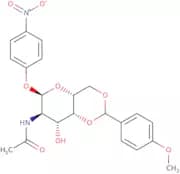
CAS :4-Nitrophenyl 2-acetamido-2-deoxy-4,6-O-p-methoxybenzylidene-a-D-galactopyranoside is a chromogenic substrate designed for the detection and quantification of enzyme activity. This methoxybenzylidene-protected compound is specifically designed to be cleaved by enzymes, releasing a yellow 4-nitrophenol product that can be easily measured spectrophotometrically. This allows for accurate and sensitive analysis of enzyme kinetics, inhibition studies, and substrate specificity determination in various applications.Degré de pureté :Min. 95%Masse moléculaire :460.43 g/molAbiraterone dimer impurity
CAS :Produit contrôléAbiraterone dimer impurity is a drug product that is used as an analytical standard for HPLC, as well as in research and development of drugs. It is also a metabolite of abiraterone and has been detected in the urine of patients receiving the drug. Abiraterone dimer impurity is found in trace amounts in abiraterone acetate but its pharmacological significance is not known. This impurity has been detected in the urine of patients receiving abiraterone acetate therapy.Formule :C43H57NO2Degré de pureté :Min. 95%Masse moléculaire :619.92 g/mol1-Naphthyl a-D-glucopyranoside
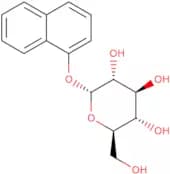
CAS :1-Naphthyl a-D-glucopyranoside is a chromogenic substrate used to detect the presence of enzymes that catalyze the hydrolysis of glycosidic bonds, such as alpha-glucosidase. When the substrate is cleaved by the enzyme, it produces a colored product that can be visualized and quantified.Degré de pureté :Min. 95%Masse moléculaire :306.31 g/mol1-Naphthyl 2-acetamido-3,4,6-tri-O-acetyl-2-deoxy-b-D-glucopyranoside
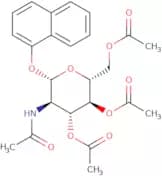
CAS :1-Naphthyl 2-acetamido-3,4,6-tri-O-acetyl-2-deoxy-b-D-glucopyranoside is a fluorogenic substrate for bacterial beta D glucosidase. It is used for measuring the enzyme activity in different types of culture media and in the detection of bacterial contamination in food and environmental samples. This product can be used to detect the presence of beta D glucosidase by measuring luminescence with a luminometer. 1NAAG can also be used as a chromogenic substrate or to conjugate with antibodies for use in immunoassays.br>Degré de pureté :Min. 95%Masse moléculaire :473.47 g/mol5-Bromo-4-chloro-3-indolyl 2-acetamido-2-deoxy-a-D-galactopyranoside
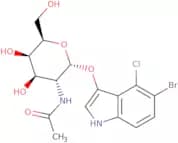
CAS :Substrate for a-N-acetyl-galactosaminidaseFormule :C16H18BrClN2O6Degré de pureté :Min. 95%Couleur et forme :White to off-white solid.Masse moléculaire :449.68 g/mol2-Nitrophenyl 2-acetamido-3,6-di-O-acetyl-4-O-[2-O-(2,3,4-tri-O-benzoyl-a-L-fucopyranosyl)]-2-deoxy-b-D-glucopyranoside
2-Nitrophenyl 2-acetamido-3,6-di-O-acetyl-4-O-[2-O-(2,3,4-tri-O-benzoyl-a-L-fucopyranosyl)]--2-deoxy--bDglucopyranoside is an acylated glucopyranoside that is used as a substrate for the enzyme β -galactosidase. When hydrolyzed by β -galactosidase, it yields a blue product that has been widely used in chemiluminescence and bioluminescence assays. It also can be used for staining and ligand binding studies.
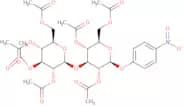
Degré de pureté :Min. 95%Masse moléculaire :884.83 g/mol4-Nitrophenyl 2,4,6-tri-O-acetyl-3-O-(2,3,4,6-tetra-O-acetyl-b-D-glucopyranosyl)-b-D-glucopyranoside
CAS :4-Nitrophenyl 2,4,6-tri-O-acetyl-3-O-(2,3,4,6-tetra-O-acetyl-β-D-glucopyranosyl)-β-D-glucopyranoside is an advanced bifunctional chromogenic pNP substrate specifically tailored for the simultaneous detection and quantification of multiple glycosidase enzymes. This dual-action substrate undergoes cleavage by two separate enzymatic reactions, which increases the range and sensitivity of detection. The resulting 4-Nitrophenol release can be easily measured spectrophotometrically, providing rapid and reliable enzyme analysis for advanced enzymology studies, enabling new discoveries in biochemistry and biotechnology.Degré de pureté :Min. 95%Masse moléculaire :757.65 g/molAldol® 450 acetate, Biosynth Patent: EP 2427431 and US 8940909
CAS :Aldol® 450 acetate is an enzyme substrate that is used in the detection of aldolase activity. Aldol® 450 acetate has been shown to be a useful alternative to the traditional bioluminescence and chemiluminescence methods for detecting aldolase activity. It has also been shown to be effective as a fluorogenic substrate for detecting aldolase activity in food products. Aldol® 450 acetate can be conjugated with other compounds, such as ligands and dyes, to enable it to detect different enzymes.
Aldol® 450 acetate has an absorption maximum at 450 nm and fluoresces blue-green under longwave UV light excitation. It is soluble in water and exhibits excellent stability at high temperatures (up to 50°C) and pH (1-14).Formule :C27H19NO3Degré de pureté :Min. 95.0 Area-%Masse moléculaire :405.44 g/mol4-Nitrophenyl 2-O-(a-L-fucopyranosyl)-a-D-galactopyranoside
CAS :4-Nitrophenyl 2-O-(a-L-fucopyranosyl)-a-D-galactopyranoside is a chromogenic pNP enzyme substrate consisting of a fucose and galactose moieties. Upon enzymatic hydrolysis by specific fucosidases or galactosidases, it releases the highly chromogenic molecule 4-nitrophenol, which exhibits a distinct yellow color that can be monitored spectrophotometrically. This substrate is frequently used to study enzyme specificity, kinetics, and inhibition, and it plays a critical role in the investigation of carbohydrate active enzymes (CAZymes), the screening of enzyme inhibitors, and the development of novel analytical methods for the detection and quantitation of enzyme activities.Degré de pureté :Min. 95%Masse moléculaire :447.39 g/molAldol® 515 palmitate, Biosynth Patent: EP 2427431 and US 8940909
CAS :Aldol® 515 palmitate is a high quality, non-toxic and water soluble chromogenic substrate for enzymes. It is used to detect the presence of lipase activity due to yielding a red color.
Formule :C39H50N2O3Degré de pureté :Min. 95%Couleur et forme :PowderMasse moléculaire :594.83 g/mol







![2-Nitrophenyl 2-acetamido-3,6-di-O-acetyl-4-O-[2-O-(2,3,4-tri-O-benzoyl-a-L-fucopyranosyl)]-2-deox…](/_next/image/?url=https%3A%2Fstatic.cymitquimica.com%2Fproducts%2F3D%2Fthumb-webp%2FEN04919.webp&w=3840&q=75)