Autres
6302 produits trouvés pour "Autres"
2,4-Dinitrophenyl b-D-cellobioside
CAS :2,4-Dinitrophenyl b-D-cellobioside is a chemiluminescent substrate that is used to detect the activity of enzymes and other proteins. It can be conjugated with an antibody or other ligand for use in diagnostic purposes. 2,4-DNPBC is a pure compound with a high quality that does not contain any other impurities. Its CAS number is 157956-96-2.Degré de pureté :Min. 95%Aldol® 484 β-D-galactopyranoside, Biosynth Patent: EP 2427431 and US 8940909
CAS :Aldol® 484 beta-D-galactopyranoside is a chromogenic enzyme substrate for beta-galactosidase activity. The colorless product is cleaved by lactose-utilizing bacteria in liquid or solid media, yielding intense red color. Aldol® 484 beta-D-galacto-pyranoside can also be used in beta-gal reporter gene assays or for identification of beta-gal positive transformants on agar. Aldol® 484 beta-D-galactopyranoside can be used under aerobic and anaerobic conditions.Formule :C26H24ClFN2O7Degré de pureté :Min. 95.0 Area-%Masse moléculaire :530.93 g/mol2-Methyl-4-nitrophenyl b-D-galactopyranoside
2-Methyl-4-nitrophenyl b-D-galactopyranoside is a chemiluminescent substrate that is used in various applications. It is a ligand that binds to the enzyme beta-galactosidase and is used in diagnostics for detecting the presence of the enzyme. 2-Methyl-4-nitrophenyl b-D-galactopyranoside has been shown to be an appropriate substrate for chemiluminescence reactions, such as those used in diagnostic or research applications. The product also has been tested for potential toxicity and found not to be toxic at concentrations up to 100mg/mL. This product can be used in a variety of applications, including food testing, bacterial culture media, and environmental testing.Degré de pureté :Min. 95%Masse moléculaire :315.28 g/molN-(4-Nitrophenyl)-D-glucopyranosylamine
N-(4-Nitrophenyl)-D-glucopyranosylamine is a conjugate that is used in food testing, environmental testing, and diagnostics. It is a fluorogenic substrate that reacts with the enzyme glucose oxidase to produce a yellow color. This product has high purity and quality and CAS No. 553-03-6. It also has bioluminescence properties.
Degré de pureté :Min. 95%2-Nitrophenyl 2-acetamido-3,4,6-tri-O-acetyl-2-deoxy-a-D-glucopyranoside
CAS :2-Nitrophenyl 2-acetamido-3,4,6-tri-O-acetyl-2-deoxy-a-D-glucopyranoside is a chromogenic substrate commonly used in enzyme assays for the detection and quantification of enzyme activity. It is a colorless substrate that is enzymatically converted into a yellowish product, the intensity of which is directly proportional to the enzyme activity present in the sample.Degré de pureté :Min. 95%Masse moléculaire :468.41 g/molAldol® 515 β-D-xylopyranoside, Biosynth Patent: EP 2427431 and US 8940909
CAS :Aldol® 515 beta-D-xylopyranoside is a chromogenic substrate that is used in food testing. It is an alternative to the more common glucose and sucrose, which are not suitable for some types of assays. Aldol® 515 beta-D-xylopyranoside is also used in diagnostics as a ligand for fluorescent antibody staining and chemiluminescence assays. It has been shown to increase the sensitivity of these tests by up to 10 times. The substrate has been tested extensively and is safe for use with a wide range of bacteria including E. coli, S. typhimurium, M. tuberculosis, and C. albicans at concentrations up to 100 mM without any inhibitory effects on growth or viability.
END>.Formule :C28H34N2O6Degré de pureté :Min. 95.0 Area-%Masse moléculaire :494.59 g/molAldol® 515 L-proline amide, hydrochloride, Biosynth Patent: EP 2427431 and US 8940909
CAS :Aldol® 515 L-proline amide is a chromogenic and fluorogenic enzyme substrate used for detection of L-proline aminopeptidase activity. The colorless enzyme substrate is cleaved by L-proline aminopeptidase produced by microorganisms grown in liquid or solid media, yielding red-orange color. In addition, red fluorescence signals are generated when a fluorescence enhancer or a suitable matrix is present. Aldol® 515 L-proline amide is suitable for use under aerobic and anaerobic conditions.
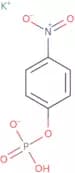
Formule :C28H29ClN4O2Degré de pureté :Min. 95.0 Area-%Masse moléculaire :489.02 g/mol4-Nitrophenyl phosphate potassium salt
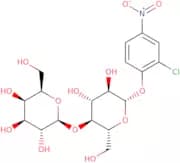
CAS :4-Nitrophenyl phosphate potassium salt is a high quality, non-radioactive chemiluminescence substrate that is used in the detection of oxidase activity. This product can be used to measure the activity of peroxidase and catalase enzymes, as well as the accumulation of hydrogen peroxide. It also has been shown to be a ligand for some sulfhydryl groups and an inhibitor of phosphatases. 4-Nitrophenyl phosphate potassium salt has been tested for its ability to inhibit bacterial growth and fluorescence by staining cells. This product has also been shown to have bioluminescent properties and can be used for diagnostics or culture media.Degré de pureté :Min. 95%Masse moléculaire :257.18 g/mol2-Chloro-4-nitrophenyl b-D-lactoside
CAS :2-Chloro-4-nitrophenyl b-D-galactopyranoside is a chromogenic enzyme substrate used to study the activity of beta-lactoside. It produces a yellow color when cleaved by the enzyme, making it a useful tool in enzyme assays and screening experiments.Degré de pureté :Min. 95%Couleur et forme :PowderMasse moléculaire :497.83 g/mol4-Nitrophenyl 2-O-(2,3,4,6-tri-O-acetyl-a-D-mannopyranosyl)-4,6-O-benzylidene-a-D-mannopyranoside
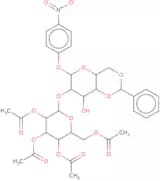
4-Nitrophenyl 2-O-(2,3,4,6-tri-O-acetyl-a-D-mannopyranosyl)-4,6-O-benzylidene-a-D-mannopyranoside is a fluorogenic substrate that is used for the detection of alpha amylase activity in food testing. It is also used as a chromogenic substrate for the detection of beta amylase activity. 4NP2ODM is a conjugate that can be used for the detection of alpha or beta amylases in environmental testing. This compound has high purity and quality and CAS No. 90105037.Degré de pureté :Min. 95%Masse moléculaire :719.64 g/mol5-Bromo-4-chloro-3-indolyl N-acetyl-a-D-neuraminic acid methyl ester
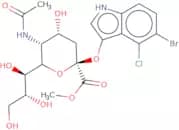
CAS :5-Bromo-4-chloro-3-indolyl N-acetyl-a-D-neuraminic acid methyl ester is a chromogenic substrate that reacts with enzymes to produce a colored product. It can be used in diagnostic tests for the detection of various bacteria, including Salmonella and Brucella, as well as for the determination of concentration in food testing or environmental testing. 5B4C3INA can also be conjugated to other substances, such as biotin or an antibody, which allows it to be used in immunoassays.Formule :C20H24BrClN2O9Degré de pureté :Min. 95%Masse moléculaire :551.77 g/mol3-Indolyl b-D-cellotrioside
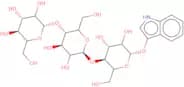
3-Indolyl b-D-cellotrioside is a chemiluminescent substrate that is used for the detection of bacterial activity. 3-Indolyl b-D-cellotrioside reacts with hydrogen peroxide to produce light, which can be detected by luminometers. This product can be used in diagnostic tests to detect the presence of bacteria in food, water, and other samples. It has been shown to have excellent performance characteristics and high purity and quality.Degré de pureté :Min. 95%Masse moléculaire :619.57 g/mol4-Nitrophenyl 3-O-(2,3,4,6-tetra-O-acetyl-b-D-glucopyranosyl)-b-D-glucopyranoside
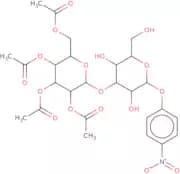
4-Nitrophenyl 3-O-(2,3,4,6-tetra-O-acetyl-b-D-glucopyranosyl)-b-D-glucopyranoside is a chromogenic substrate that is used to test for the presence of an enzyme. It reacts with the enzyme to produce a light signal that can be detected by a spectrophotometer. The CAS number for this compound is 832476-41-8. This compound has been tested and found to be of high quality and purity. 4NP3OBG is also suitable for use in culture media, food testing, and as a fluorogenic substrate.Degré de pureté :Min. 95%Masse moléculaire :631.54 g/mol1-Naphthyl a-D-glucopyranoside
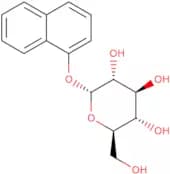
CAS :1-Naphthyl a-D-glucopyranoside is a chromogenic substrate used to detect the presence of enzymes that catalyze the hydrolysis of glycosidic bonds, such as alpha-glucosidase. When the substrate is cleaved by the enzyme, it produces a colored product that can be visualized and quantified.Degré de pureté :Min. 95%Masse moléculaire :306.31 g/mol4-Nitrophenyl b-laminaritrioside
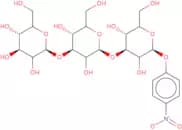
CAS :4-Nitrophenyl b-laminaritrioside is a chemiluminescent substrate that reacts with hydrogen peroxide to produce light. It is used in the detection of bacteria and other microorganisms in culture media, food testing, and diagnostics. 4-Nitrophenyl b-laminaritrioside is also used as a chromogenic or fluorogenic substrate in enzyme assays.Degré de pureté :Min. 95%Masse moléculaire :625.53 g/mol6-Bromo-2-naphthyl-α-D-mannopyranoside
CAS :6-Bromo-2-naphthyl-alpha-D-mannopyranoside is a strong inhibitor of alpha-mannosidase. It has been shown to inhibit the growth of Mycobacterium tuberculosis and Streptococcus pneumoniae, which are both known to cause bacterial infections in humans. 6BNA inhibits the enzyme alpha-mannosidase, which hydrolyzes terminal α-(1,4)-linked mannose residues from oligosaccharides and glycoproteins. This drug has a high affinity for the active site of alpha-mannosidase and an IC50 value of 0.2 mM, making it an effective inhibitor.
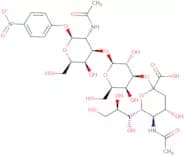
Formule :C16H17BrO6Degré de pureté :Min. 98.0 Area-%Masse moléculaire :385.22 g/mol4-Nitrophenyl (N-acetyl-a-neuraminosyl)-(2,3)-O-b-D-galactopyranosyl-(1,3)-2-acetamido-2-deoxy-b-D-galactopyranoside
CAS :4-Nitrophenyl (N-acetyl-a-neuraminosyl)-(2,3)-O-b-D-galactopyranosyl-(1,3)-2-acetamido-2-deoxy-b-D-galactopyranoside is a fluorogenic substrate that is used in the detection of enzyme activity. It reacts with a specific enzyme to produce light. This product has been shown to be useful for detecting β -galactosidase, β -glucuronidase, α -mannosidase, and lactose permeases. The product is also used in the diagnosis of urinary tract infections and other diseases. This product is not intended for use in humans or animals.Degré de pureté :Min. 95%Masse moléculaire :795.7 g/mol4-Nitrophenyl 2,3-di-O-(b-D-glucopyranosyl)-b-D-glucopyranoside
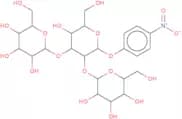
4-Nitrophenyl 2,3-di-O-(b-D-glucopyranosyl)-b-D-glucopyranoside is a chromogenic substrate that can be used to detect the presence of β-glucuronidase in human and animal tissue. The compound is also a fluoroquinolone substrate for the detection of β-lactamase activity. 4NPBG is used in diagnostics as well as food testing, due to its ability to detect bacteria in both food and water samples. 4NPBG is a chemiluminescent substrate that emits light upon hydrolysis by β-glucuronidase or β-lactamase. The compound has been shown to be an excellent ligand for binding to protein A or protein G and can be used for immunoassays such as ELISA or Western blotting.Degré de pureté :Min. 95%Masse moléculaire :625.53 g/mol4-Nitrophenyl 2-acetamido-3-azido-2,3-dideoxy-b-D-galactopyranoside
4-Nitrophenyl 2-acetamido-3-azido-2,3-dideoxy-b-D-galactopyranoside is a fluorogenic substrate for beta-galactosidase. It has been used in the detection of beta-galactosidase activity in culture media, and for the detection of beta-galactosidase activity in environmental samples. 4NPAG can be conjugated to a variety of molecules, including antibodies, proteins, nucleotides, and oligonucleotides. 4NPAG can be used as an enzyme substrate for both chromogenic and fluoroquinolone substrates.Degré de pureté :Min. 95%4-Nitrophenyl 2-acetamido-3-O-(2-O-a-L-fucopyranosyl-b-D-galactopyranosyl)-2-deoxy-a-D-galactopyranoside
CAS :4-Nitrophenyl 2-acetamido-3-O-(2-O-a-L-fucopyranosyl-b-D-galactopyranosyl)-2,6,8,10,12-pentaoxoheptaacetic acid is a chemiluminescent substrate that is used for the detection of peroxidase and other enzymes. The reaction product is a yellow fluorescent product which can be measured using a fluorometer. It is sold as an aqueous solution at 1mg/mL in phosphate buffer at pH 7.4.
Degré de pureté :Min. 95%Masse moléculaire :650.58 g/mol