Radicaux Libres et Agents Oxydants/Réducteurs
212 produits trouvés pour "Radicaux Libres et Agents Oxydants/Réducteurs"
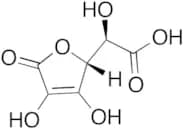
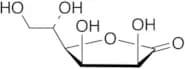
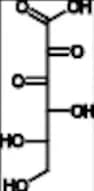
L-threo-Hex-2-enaric acid 1,4-Lactone
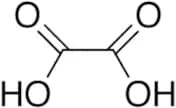
CAS :Formule :C6H6O7Couleur et forme :Off-WhiteMasse moléculaire :190.11Oxalic Acid
CAS :Applications An impurity of oxaliplatin which is a coordination complex that is used in cancer chemotherapy.A reducing agent and its conjugate base, known as oxalate (C2O42−), is a useful chelating agent for metal cations.
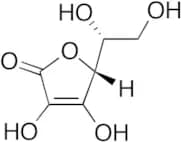
References Wheate, N., et al.: Dalton Trans., 39, 8113 (2010),Formule :C2H2O4Couleur et forme :White To Off-WhiteMasse moléculaire :90.03D(-)-Isoascorbic Acid (Erythorbic Acid)
CAS :Stability Moisture Sensitive
Applications Erythorbic Acid is used as a food additive as an antimicrobial and antioxidative agent.
References Sakagami, H. et al.: Anticanc. Res., 17, 221 (1997); Brahma, B. et al. J. Neurochem., 74, 1263 (2000);Formule :C6H8O6Couleur et forme :WhiteMasse moléculaire :176.12Potassium Dichromate
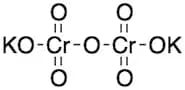
CAS :Produit contrôléApplications Potassium Dichromate is toxic if ingested, however has been used in tracing methods. Also, is used in treating patients suffering from COPD and related tracheal secretions.
Not a dangerous good if item is equal to or less than 1g/ml and there is less than 100g/ml in the package
References Frass, M. et al.: Chest., 127, 936 (2005); Mascorro, J. et al.: Stain. Technol., 50, 391 (1975);Formule :Cr2O7·2KCouleur et forme :NeatMasse moléculaire :294.18L-Gulono-1,4-lactone
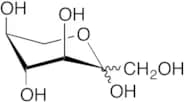
CAS :Produit contrôléApplications L-Gulono-1,4-lactone is a precursor in the biosynthesis of ascorbic acid, one of the many forms of Vitamin C.
References Wolucka, B. et al.: J. Biol. Chem., 278, 47483 (2003); Heller, R. et al.: J. Biol Chem., 274, 8254 (1999);Formule :C6H10O6Couleur et forme :White To Off-WhiteMasse moléculaire :178.14Edaravone Trimer
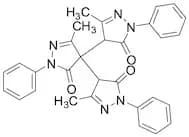
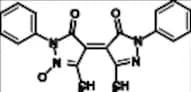
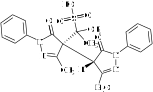
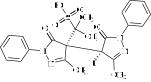
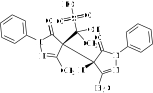
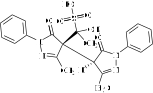
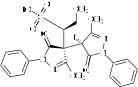
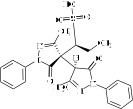
CAS :Produit contrôléFormule :C29H24N6O3Couleur et forme :NeatMasse moléculaire :504.54Bispyrazolone
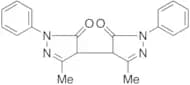
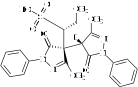
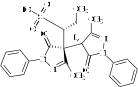
CAS :Applications Bispyrazolone is an impurity of Edaravone (E335000).
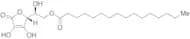
Formule :C20H18N4O2Couleur et forme :NeatMasse moléculaire :346.38Ascorbyl Palmitate
CAS :Applications Ascorbyl Palmitate is an ester formed from ascorbic acid (A786990) and palmitic acid (P144500) creating a fat soluble form of vitamin C. Ascorbyl Palmitate is also used as an antioxidant food additive.
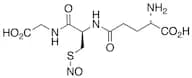
References Adhikari, P., et al.: J. Am. Oil. Chemist. Soc., 89, 1961 (2012); Kong, J., et al.: J. Food. Sci., 77, S211 (2012);Formule :C22H38O7Couleur et forme :Off-WhiteMasse moléculaire :414.53S-Nitroso-L-glutathione
CAS :Produit contrôléStability Hygroscopic
Applications A carrier of nitric oxide, relaxing smooth muscle and inhibiting platelet activation.
References Thompson, C., et al.: Toxicol., App. Pharmacol., 233, 355 (2008), Bateman, R., et al.: J. Biol. Chem., 283, 35756 (2008), Foster, M., et al.: Biochem., 48, 792 (2009),Formule :C10H16N4O7SDegré de pureté :>90%Couleur et forme :NeatMasse moléculaire :336.32