Monosaccharides
Sous-catégories appartenant à la catégorie "Monosaccharides"
- Alloses(11 produits)
- Arabinoses(21 produits)
- Erythroses(11 produits)
- Fructoses(9 produits)
- Fucoses(36 produits)
- Galactosamine(41 produits)
- Galactoses(261 produits)
- Glucoses(365 produits)
- Acides glucuroniques(52 produits)
- Glyco-substrats pour l'enzyme(78 produits)
- Guloses(6 produits)
- Idoses(4 produits)
- Inositols(15 produits)
- Lyxoses(4 produits)
- Mannoses(65 produits)
- O-Glycanes(48 produits)
- Psicoses(3 produits)
- Rhamnoses(10 produits)
- Ribos(61 produits)
- Acides sialiques(100 produits)
- Sorboses(4 produits)
- Sucres(173 produits)
- Tagatoses(4 produits)
- Taloses(8 produits)
- Xyloses(20 produits)
6088 produits trouvés pour "Monosaccharides"
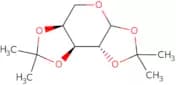
1,2:3,4-Di-O-isopropylidene-L-arabinopyranose
CAS :1,2:3,4-Di-O-isopropylidene-L-arabinopyranose is a custom synthesis of 1,2:3,4-di-O-isopropylidene arabinopyranose. It is an oligosaccharide with a glycosylation and methylation that has a high purity with a CAS number of 212069-31-3. This complex carbohydrate can be modified to create new saccharides. The modification process includes fluorination and click chemistry reactions.Formule :C11H18O5Degré de pureté :Min. 95%Couleur et forme :PowderMasse moléculaire :230.26 g/mol3-Aminopropyl α-D-glucopyranoside
CAS :3-Aminopropyl α-D-glucopyranoside is a monomer that can be used to produce polymers. It has been shown to be effective in methylation, saccharide and oligosaccharide modifications. 3-Aminopropyl α-D-glucopyranoside is an alpha glucosidase inhibitor. The compound also inhibits the action of other enzymes, such as glycosidases, which are responsible for breaking down glycogen and starch. 3-Aminopropyl α-D-glucopyranoside is a white powder with a melting point of about 150°C and boiling point of about 300°C.Formule :C9H19NO6Degré de pureté :Min. 95%Couleur et forme :PowderMasse moléculaire :237.35 g/mol1,2:3,5-Di-O-Isopropylidene-α-L-xylofuranose
CAS :1,2:3,5-Di-O-Isopropylidene-a-L-xylofuranose is a fluorinated sugar that is used as a building block in the synthesis of complex carbohydrates and oligosaccharides. It has a CAS number of 131156-47-3. 1,2:3,5-Di-O-Isopropylidene-a-L-xylofuranose is an active component in the modification of saccharide and polysaccharide structures by click chemistry. It can be modified with various functional groups such as methylation or monosaccharide to produce specific compounds. This product is available for custom synthesis.Formule :C11H18O5Degré de pureté :Min. 95%Couleur et forme :PowderMasse moléculaire :230.26 g/mol1-Deoxy-D-sorbose
D-sorbose is a diastereomer of D-xylose. It inhibits the glycolysis pathway, which stops the production of energy and leads to cell death. D-sorbose is synthesized from D-xylose by enzymatic conversion with 1,4-dihydroxybenzene. The crystalline form of D-sorbose is polymorphic and can be identified using X-ray diffraction. It has been shown to have cytotoxic effects on C. elegans and A. actinomycetes, but not on E. coli or other Gram negative bacteria. The imbalance in the ratio of these organisms may lead to an increased risk for cancer in humans.
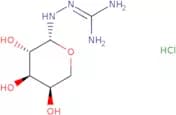
Degré de pureté :Min. 95%N1-β-D-Arabinopyranosylamino-guanidine hydrochloride
CAS :N1-b-D-arabinopyranosylamino-guanidine HCl is a modified carbohydrate. It is a synthetic monosaccharide that is custom synthesized by methylation and glycosylation. This product has high purity and can be used for modification of saccharides or oligosaccharides to create new carbohydrates with desired properties.Formule :C6H14N4O4•HClDegré de pureté :Min. 95%Couleur et forme :White to light beige solid.Masse moléculaire :242.66 g/molBenzyl 4,6-O-benzylidine-β-D-galactopyranoside
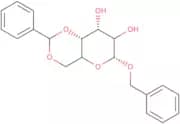
CAS :Benzyl 4,6-O-benzylidine-b-D-galactopyranoside is a benzoylated sugar. It is prepared by reacting benzoyl chloride with benzene and then with the sugar in an equimolar ratio. The reaction proceeds via a nucleophilic substitution at the 2' position of the sugar followed by an elimination of water. Benzyl 4,6-O-benzylidine-b-D-galactopyranoside reacts with dibutyltin to form a benzoylated tin compound that can be used as a catalyst for organic synthesis.Formule :C20H22O6Degré de pureté :Min. 95%Couleur et forme :White To Off-White SolidMasse moléculaire :358.39 g/molMethyl 2,3,4-tri-O-acetyl-b-D-glucopyranuronosyl azide
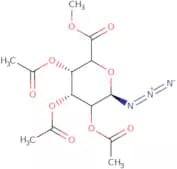
CAS :Methyl 2,3,4-tri-O-acetyl-b-D-glucopyranuronosyl azide is a fluorinated carbohydrate. It is a monosaccharide and an oligosaccharide that is synthesized from a synthetic glycosylation reaction. This product can be used in the production of polysaccharides or as a click modification to modify the sugar moiety of other molecules. Methyl 2,3,4-tri-O-acetyl-b-D-glucopyranuronosyl azide has CAS No. 67776-38-9 and is available in high purity.Formule :C13H17N3O9Degré de pureté :(%) Min. 98%Couleur et forme :White PowderMasse moléculaire :359.29 g/mol1,2,3,5,6-Penta-O-benzoyl-D-galactofuranose
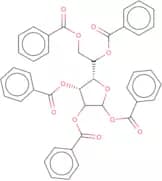
CAS :1,2,3,5,6-Penta-O-benzoyl-D-galactofuranose is a sugar that is custom synthesized and can be modified with fluorination. This product has a CAS number of 138811-45-7 and is high purity. It can be used in glycosylation, oligosaccharide synthesis, methylation, monosaccharide synthesis and polysaccharide synthesis. It is an important building block for the modification of complex carbohydrates.Formule :C41H32O11Degré de pureté :Min. 95%Couleur et forme :White PowderMasse moléculaire :700.69 g/molPhenyl-beta-D-thioglucopyranoside
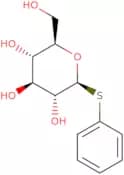
CAS :Phenyl-beta-D-thioglucopyranoside is a heterocycloalkyl compound that contains a phenyl group and a beta-D-thioglucopyranoside. It is used as an intermediate in the production of pharmaceuticals, yellow dye, and cancer drugs. Phenyl-beta-D-thioglucopyranoside binds to the cell membrane of cancer cells and induces apoptosis by inhibiting the synthesis of proteins. This compound also has alkenyl and haloalkyl groups, which may be important for its biological activity. Phenyl-beta-D-thioglucopyranoside can be crystallized in two different forms: one with a crystalline form, which is yellow; the other with a crystalline form, which is colorless.
Formule :C12H16SO5Degré de pureté :Min. 95%Couleur et forme :PowderMasse moléculaire :272.32 g/mol2,3-O-Isopropylidene-1-O-methyl-D-ribosic acid
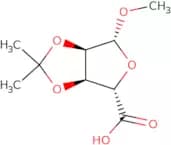
CAS :2,3-O-Isopropylidene-1-O-methyl-D-ribosic acid is a synthetic glycosylate that can be used to modify saccharides and oligosaccharides. It is a methylated form of ribose and has been shown to inhibit the glycosylation reactions of glycogen. 2,3-O-Isopropylidene-1-O-methyl-D-ribosic acid is also known to react with fluorine in order to produce a variety of fluorinated carbohydrates. This product has high purity and can be used for custom synthesis of carbohydrates. The CAS number for this product is 54622-95-6.Formule :C9H14O6Degré de pureté :Min. 95%Couleur et forme :PowderMasse moléculaire :218.2 g/mol4-Methoxyphenyl 3-O-benzyl-a-D-mannopyranoside
CAS :4-Methoxyphenyl 3-O-benzyl-a-D-mannopyranoside is a synthetic carbohydrate that has been modified with a click reaction. It is an Oligosaccharide, which is a type of Carbohydrate, and has a saccharide sequence. This product is used in the synthesis of complex carbohydrates. The product has high purity and custom synthesis capabilities.Formule :C20H24O7Degré de pureté :Min. 95%Masse moléculaire :376.4 g/mol5-O-Benzyl-D-ribose
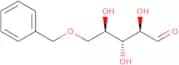
CAS :5-O-Benzyl-D-ribose is an enantiomer of D-ribose. It has been used as an antiperspirant, although it does not stop the formation of sweat, but rather reduces the amount of perspiration. 5-O-Benzyl-D-ribose is also used in the synthesis of deodorants and enantiomers for optically active pharmaceuticals. The configurations are determined by the configuration of the substituents on the benzene ring and can be either R or S. The configurations can be separated into two groups:Formule :C12H16O5Degré de pureté :Min. 95%Couleur et forme :PowderMasse moléculaire :240.25 g/mol2,3,4,6-Tetra-O-acetyl-b-D-glucopyranosyl isothiocyanate
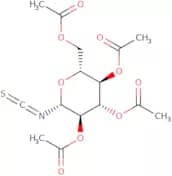
CAS :2,3,4,6-Tetra-O-acetyl-b-D-glucopyranosyl isothiocyanate (TGIT) is a compound that mimics the melanoma antigen. It has been used to identify human pathogens in biological samples and has shown to have an antibody response. TGIT has also been used as a fluorescent probe for nucleic acids in analytical methods and polymerase chain reaction. This chemical can be used as a fluorescence detector in titration calorimetry. TGIT is not acutely toxic, but can cause cell lysis when combined with trifluoroacetic acid.Formule :C15H19NO9SDegré de pureté :Min. 95%Couleur et forme :White PowderMasse moléculaire :389.38 g/mol3-Hydroxydesloratadine b-D-glucuronide sodium salt
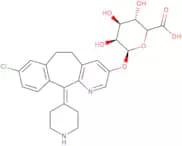
CAS :3-Hydroxydesloratadine b-D-glucuronide sodium salt is a carbohydrate that is used as an intermediate in the synthesis of saccharides. It can be modified to make it more soluble in water by adding fluorine atoms, which increases its solubility and bioavailability. 3-Hydroxydesloratadine b-D-glucuronide sodium salt is synthesized using a custom synthesis method with high purity and high yield. It has glycosylation, methylation, and click modification done on it during the synthesis process.Formule :C25H26ClN2O7·NaDegré de pureté :Min. 95%Couleur et forme :PowderMasse moléculaire :524.93 g/molEthyl 2-O-benzyl-b-D-thioglucopyranoside
Ethyl 2-O-benzyl-b-D-thioglucopyranoside is a custom synthesis product. It is an oligosaccharide that contains a saccharide monomer unit with a carbohydrate chain containing between 3 and 10 monomer units. This product has been modified to include fluorine atoms, which confers resistance to degradation by enzymes. The product has been synthesized from ethyl 2-O-benzyl-b-D-thioglucopyranoside and 2,4,5,6-tetrafluoroethanol in the presence of sodium methoxide in methanol at 120 °C for 24 hours.Degré de pureté :Min. 95%(3S, 5S) -1-Benzyl-3, 4, 5- piperidinetriol
(3S, 5S) -1-Benzyl-3, 4, 5- piperidinetriol is a custom synthesis that belongs to the group of methylated and fluorinated triols. It is a high purity compound with a monosaccharide sugar. This product can be used as an intermediate for the synthesis of complex carbohydrate compounds such as oligosaccharides and polysaccharides.Degré de pureté :Min. 95%2-Acetamido-2,6-dideoxy-L-galactose
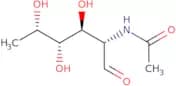
CAS :2-Acetamido-2,6-dideoxy-L-galactose (ADG) is a sugar that belongs to the group of monosaccharides. It is produced by the enzyme synthase and is found in bacteria such as type strain S. mutans and P. aeruginosa. ADG has been shown to be an inhibitor of cell lysis and can be used for the treatment of staphylococcus infections. In addition, it has shown to have anti-inflammatory properties due to its ability to inhibit hydrogen fluoride induced inflammation in mice.Formule :C8H15NO5Degré de pureté :Min. 98 Area-%Couleur et forme :PowderMasse moléculaire :205.21 g/molL-Fucose-1-phosphate disodium
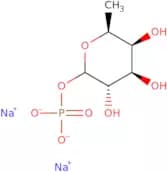
CAS :L-Fucose-1-phosphate disodium salt is a high purity, synthetic, fluorinated carbohydrate that is used to modify saccharides. This modification can be accomplished by methylation or glycosylation. L-Fucose-1-phosphate disodium salt has been shown to be useful for glycosylation reactions with click chemistry. It has been shown to have a wide range of applications including modification of oligosaccharides and polysaccharides in the field of biotechnology.
Formule :C6H13O8P•Na2Degré de pureté :Min. 95 Area-%Couleur et forme :White PowderMasse moléculaire :290.12 g/molMethyl 2,3,5-tri-O-benzoyl-α-D-arabinofuranoside
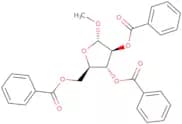
CAS :Methyl 2,3,5-tri-O-benzoyl-α-D-arabinofuranoside is an antiperspirant that prevents the formation of sweat. It is a mixture of two active ingredients: methyl 2,3,5-tri-O-benzoyl-α-D-arabinofuranoside and zinc oxide. The former inhibits the formation of sweat by binding to the protein in eccrine glands and preventing it from absorbing chloride ions. Zinc oxide reduces body odor by binding to sulfur compounds that are secreted by bacteria on skin surfaces. Methyl 2,3,5-triO-benzoyl arabinofuranoside and zinc oxide are used as a combination for their complementary effects.Formule :C27H24O8Degré de pureté :Min. 95%Couleur et forme :PowderMasse moléculaire :476.47 g/mol2-Acetamido-2,4-dideoxy-4-fluoro-D-glucopyranose
CAS :2-Acetamido-2,4-dideoxy-4-fluoro-D-glucopyranose (2ADFG) is a glycosaminoglycan that inhibits the biosynthesis of glycosaminoglycans by binding to the enzyme UDP-N-acetylglucosamine 2-epimerase. It is used in cellular control experiments to determine if cells are hepatocytes or not. This compound binds to glycosaminoglycans and prevents them from being synthesized, which leads to cell death. The binding of 2ADFG also results in a decrease in cellular protein synthesis and an increase in cellular lysosomal activity.Formule :C8H14FNO5Degré de pureté :Min. 95%Masse moléculaire :223.2 g/mol