Monosaccharides
Les monosaccharides sont la forme la plus simple des glucides et servent de building blocks fondamentaux pour les sucres plus complexes et les polysaccharides. Ces molécules de sucre unique jouent des rôles critiques dans le métabolisme énergétique, la communication cellulaire et les composants structuraux des cellules. Dans cette section, vous trouverez une large gamme de monosaccharides essentiels pour la recherche en biochimie, biologie moléculaire et glycosciences. Ces composés sont cruciaux pour étudier les voies métaboliques, les processus de glycosylation et le développement d'agents thérapeutiques. Chez CymitQuimica, nous proposons des monosaccharides de haute qualité pour répondre à vos besoins de recherche, garantissant précision et fiabilité dans vos investigations scientifiques.
Sous-catégories appartenant à la catégorie "Monosaccharides"
- Alloses(11 produits)
- Arabinoses(21 produits)
- Erythroses(11 produits)
- Fructoses(9 produits)
- Fucoses(36 produits)
- Galactosamine(41 produits)
- Galactoses(261 produits)
- Glucoses(365 produits)
- Acides glucuroniques(51 produits)
- Glyco-substrats pour l'enzyme(77 produits)
- Guloses(6 produits)
- Idoses(4 produits)
- Inositols(15 produits)
- Lyxoses(4 produits)
- Mannoses(65 produits)
- O-Glycanes(48 produits)
- Psicoses(3 produits)
- Rhamnoses(10 produits)
- Ribos(61 produits)
- Acides sialiques(100 produits)
- Sorboses(4 produits)
- Sucres(173 produits)
- Tagatoses(4 produits)
- Taloses(8 produits)
- Xyloses(20 produits)
Affichez 17 plus de sous-catégories
6090 produits trouvés pour "Monosaccharides"
Trier par
Degré de pureté (%)
0
100
|
0
|
50
|
90
|
95
|
100
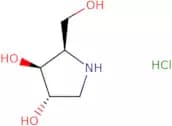
1,4-Dideoxy-1,4-imino-D-xylitol HCl
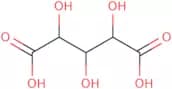
CAS :<p>1,4-Dideoxy-1,4-imino-D-xylitol HCl (DDX) is a potent inhibitor of the enzyme carboxypeptidase A2. DDX has been shown to inhibit the growth of HIV in vitro and in vivo. DDX also inhibits the production of proinflammatory cytokines and neurotrophic factors from HL60 cells. It has been shown to be a potential drug target for the treatment of infectious diseases such as alphaviruses, which produce a severe neuroinvasive disease in humans. DDX binds to dna with high affinity and specificity, but does not bind to RNA or proteins. DDX inhibits mitochondrial membrane potential by binding to ATP synthase and blocking the synthesis of ATP. DDX has also been shown to have an anti-oxidative injury effect on mitochondria, which may contribute to its inhibition of viral replication.</p>Formule :C5H11NO3·HClDegré de pureté :Min. 95%Masse moléculaire :169.61 g/molPentaric acid
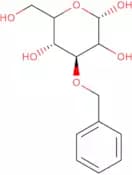
CAS :<p>Pentaric acid is a crystalline, monocarboxylic acid with a hydroxyl group. It is used as an inhibitor of corrosion in metal and as a disinfectant. Pentaric acid can be found in urine samples and has been shown to be an effective inhibitor of the enzymatic reaction that produces azobenzene, which is associated with the development of bladder cancer. This compound also inhibits the growth of bacteria. Pentaric acid is used as an additive in some detergents and soaps because it can inhibit the growth of bacteria on surfaces. <br>Pentaric acid was first synthesized by German chemist Otto Wohlert in 1834. Hydrogen ions are released when pentaric acid dissolves in water, lowering the pH level and causing corrosion to metal surfaces. The corrosion inhibition properties of pentaric acid have been known since its discovery, but its anti-bacterial properties were not discovered until recently when researchers found that pentar</p>Formule :C5H8O7Degré de pureté :Min. 95%Masse moléculaire :180.11 g/mol3-O-Benzyl-a-D-mannopyranose
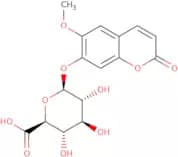
CAS :<p>3-O-Benzyl-a-D-mannopyranose is a sugar that is used in the synthesis of complex carbohydrates. It is a synthetic compound that can be fluorinated, glycosylated, or methylated to produce desired compounds. 3-O-Benzyl-a-D-mannopyranose has a CAS number of 65877-63-6 and can be used in the synthesis of oligosaccharides, monosaccharides, and saccharides. This product has high purity and is available for custom synthesis.</p>Formule :C13H18O6Degré de pureté :Min. 95%Masse moléculaire :270.28 g/molScopoletin b-D-glucuronide
CAS :<p>Scopoletin b-D-glucuronide is a synthetic compound that is modified by the addition of a fluorine atom to the methyl group in scopoletin. Scopoletin b-D-glucuronide has shown antiviral activity against herpes simplex virus type 1 and 2, with an IC50 value of 1.6 μM. It also has antiviral activity against HIV type 1 and HIV type 2, with an IC50 value of 0.5 μM. This compound also inhibits viral DNA synthesis, which may be due to its inhibition of host cell protein synthesis and subsequent inhibition of viral protein synthesis. Scopoletin b-D-glucuronide has been shown to have anti-inflammatory effects in a mouse model for rheumatoid arthritis, and it may be due to its suppression of prostaglandin synthesis or interference with leukocyte chemotaxis.</p>Formule :C16H16O10Degré de pureté :Min. 95%Masse moléculaire :368.29 g/molMethyl a-D-mannofuranoside
CAS :<p>Methyl a-D-mannofuranoside is a synthetic sugar that has been modified by the addition of fluorine at C-1 and methylation at C-2. This modification provides the compound with desired physical properties, such as increased stability and solubility. Methyl a-D-mannofuranoside can be used in the synthesis of oligosaccharides, which are complex carbohydrates consisting of three to ten monosaccharides linked together by glycosidic bonds. It is also used for click chemistry modifications.</p>Formule :C7H14O6Degré de pureté :Min. 95%Masse moléculaire :194.18 g/mol(R)-Ketoprofen b-D-glucuronide
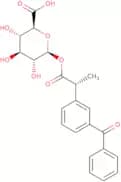
CAS :<p>(R)-Ketoprofen b-D-glucuronide is a synthetic modified sugar that is produced by the glucuronidation of ketoprofen, a nonsteroidal anti-inflammatory drug. The modification of ketoprofen with glucuronic acid can be achieved through an enzymatic process, which is catalyzed by UDP-glucuronyltransferase. This modification increases the solubility of ketoprofen and its ability to penetrate cells. (R)-Ketoprofen b-D-glucuronide has been shown to have antibacterial properties against Gram positive bacteria such as Staphylococcus aureus and Streptococcus pyogenes. It has also shown antiviral activity against HIV-1 due to its inhibition of reverse transcriptase, which is an enzyme important for viral replication.</p>Formule :C22H22O9Degré de pureté :Min. 95%Couleur et forme :White to off-white solid.Masse moléculaire :430.4 g/molMethyl 2,3-O-isopropylidene-5-O-(4-toluenesulfonyl)-b-D-ribofuranoside
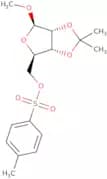
CAS :<p>Methyl 2,3-O-isopropylidene-5-O-(4-toluenesulfonyl)-b-D-ribofuranoside is a nucleoside derivative. It is a deprotected nucleoside that can be used as an alkylation agent. Methyl 2,3-O-isopropylidene-5-O-(4-toluenesulfonyl)-b-D-ribofuranoside is the sodium salt of 5'-O-(4-(methylsulfonyl)benzenesulfonate) -2'-deoxyadenosine. This compound is used in the preparation of other nucleosides, including 5'-O-(4-(methylsulfonyl)benzenesulfonate) -2'-deoxycytidine and 5'-O-(4-(methylsulfonyl)benzenesulfonate) -2'-</p>Degré de pureté :Min. 95%1,2,3,4-Tetra-O-acetyl-D-xylopyranose
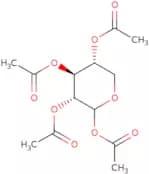
CAS :<p>1,2,3,4-Tetra-O-acetyl-D-xylopyranose is a molecule that is derived from D-xylose. It has been shown to inhibit the growth of fungi such as T. rubrum and L. candidum by acetylation of l-threonine at the C2 position. This molecule can be recycled and its inhibitory activity can be increased through acetylation of the hydroxymethyl group on the C4 position. The mechanism of inhibition is not known but it may be due to steric hindrance or peracylation.</p>Formule :C13H18O9Degré de pureté :Min. 95%Masse moléculaire :318.28 g/mola-D-Xylopyranosyl azide
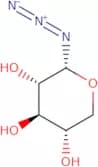
CAS :<p>a-D-Xylopyranosyl azide is a sugar that can be synthesized from the reaction of 1,2-dichloroethane with 2,3,4,6-tetra-O-acetyl-a-D-xylopyranose. This compound has a high purity and can be custom synthesized to order. It is used in glycosylation reactions to modify saccharides and oligosaccharides. It has been shown to be useful for click modification and fluorination reactions.</p>Degré de pureté :Min. 95%3-Deoxy-3-fluoro-D-fructose
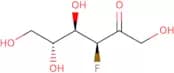
CAS :<p>3-Deoxy-3-fluoro-D-fructose is a monosaccharide that has been used as an inhibitor of glucose uptake and metabolism in the lymphocytic leukemia cell line. This compound has been shown to inhibit the glucose transporter GLUT1, which is responsible for the transport of glucose across the plasma membrane. 3-Deoxy-3-fluoro-D-fructose inhibits cancer cells by inhibiting galactitol production through inhibition of gluconeogenesis. It also inhibits oxidative phosphorylation in lymphocytic leukemia cells, leading to apoptosis. 3-Deoxy-3-fluoro-D-fructose has been shown to inhibit cancer growth by blocking glucose uptake in xenopus oocytes.</p>Degré de pureté :Min. 95%2-Deoxy-D-ribose-anilide
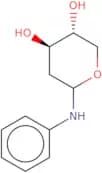
CAS :<p>2-Deoxy-D-ribose-anilide is a fluorinated monosaccharide that is used as a synthetic building block for the synthesis of oligosaccharides, polysaccharides, and other complex carbohydrates. This compound has been modified with methyl groups and click chemistry to form new types of sugars. 2-Deoxy-D-ribose-anilide is also available in high purity and can be used for glycosylation reactions.</p>Formule :C11H15NO3Degré de pureté :Min. 95%Couleur et forme :Off-White To Light (Or Pale) Yellow SolidMasse moléculaire :209.24 g/mol1,4:3,6-Dianhydro- 2- O- methyl-D- glucitol
CAS :<p>1,4:3,6-Dianhydro-2-O-methyl-D-glucitol is a modified sugar that belongs to the group of carbohydrates. It is synthesized by the modification of 1,4:3,6-dianhydro-2,5-diO-methyl D glucitol with methyl iodide and sodium methoxide. The compound is used in pharmaceuticals as an excipient and in cosmetics as a moisturizer. It has been shown to be effective against influenza A virus.</p>Formule :C7H12O4Degré de pureté :Min. 95%Masse moléculaire :160.17 g/molUDP-β-D-glucose sodium
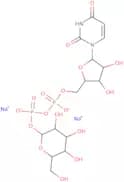
CAS :<p>UDP-β-D-glucose sodium is an oligosaccharide that can be used to synthesize glycoproteins and glycolipids. UDP-β-D-glucose sodium is a synthetic compound that contains one β-D-glucose moiety, which is attached to the molecule via a β-(1→4) linkage. This product can be custom synthesized and modified to suit customer needs. It has been shown to have high purity, chemical stability, and good solubility in water. The synthesis of UDP-β-D-glucose sodium has been modified by click chemistry to produce a variety of different products with new properties.</p>Formule :C15H22N2Na2O17P2Degré de pureté :Min. 95%Couleur et forme :PowderMasse moléculaire :610.27 g/molPalatinose monohydrate
CAS :<p>Palatinose monohydrate is a hydrogenated form of the natural disaccharide palatinose. It is often used as a solid catalyst in pharmaceutical preparations and has been shown to have a lower molecular weight than sucrose. Palatinose monohydrate may have beneficial effects on postprandial plasma glucose, protein data, and lipid metabolism. The hydrogenation process also produces fatty acids that are less reactive than those found in other sugars. Amine groups are also reduced in palatinose monohydrate, which may improve its taste. Palatinose monohydrate is not toxic at high doses and has been shown to be safe for use in toxicity studies. Surface methodology has been used to characterize the surface properties of palatinose monohydrate crystals, which can be used as a model for other sugar crystals.</p>Formule :C12H24O12Degré de pureté :Min. 95%Masse moléculaire :360.31 g/molPolyphyllin A
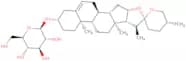
CAS :Polyphyllin A is a natural product that has been shown to have anti-oxidative effects. It has been demonstrated to inhibit the production of fatty acids by sephadex g-100, an enzyme activity by p. pastoris, and the production of antimicrobial peptides by tissue culture cells. Additionally, polyphyllin A has been shown to have anti-inflammatory properties and is used in traditional Chinese medicine for the treatment of cardiovascular diseases. Polyphyllin A also inhibits the oxidation of low density lipoprotein (LDL) cholesterol in coronary heart disease patients. Furthermore, polyphyllin A inhibits the proliferation of cancer cells such as leukemia HL-60 and K562 cells. The mechanism for this inhibition is not yet known but may be due to its ability to induce apoptosis or cause DNA damage.Formule :C33H52O8Degré de pureté :Min. 95%Masse moléculaire :576.76 g/molFenofibryl b-D-glucuronide
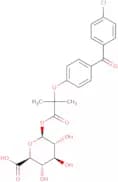
CAS :Fenofibryl b-D-glucuronide is a potential anticancer drug that has been shown to inhibit growth and induce apoptosis in human liver cancer cells. Fenofibryl b-D-glucuronide is also known to have the ability to react with covalent adducts, which may be due to its reactive nature. It is not currently known how this compound interacts with other drugs or how it affects body mass index in humans.Formule :C23H23ClO10Degré de pureté :Min. 95%Masse moléculaire :494.88 g/molb-Core-APE-HSA
<p>b-Core-APE-HSA is a custom synthesis of an oligosaccharide. This product is a complex carbohydrate with a CAS number and the molecular weight range of 500 to 10,000 Daltons. It is a polysaccharide that has been modified by methylation or glycosylation. The saccharide in this product is either glucose or mannose and it can be modified using click chemistry, fluorination, or other modifications. This product has high purity and can be synthesized using synthetic techniques such as glycosylation or Methylation.</p>Degré de pureté :Min. 95%1,2,3,5-Tetra-o-acetyl-D-xylofuranose
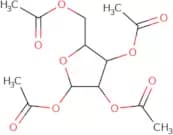
CAS :<p>1,2,3,5-Tetra-o-acetyl-D-xylofuranose is a fatty acid that is found in human red blood cells. It is used as a biochemical marker to diagnose the activity index of fatty acids in the red cell membrane. The activity index can be used to determine whether an individual has metabolic disorders such as hepatic steatosis or lc-ms/ms method. 1,2,3,5-Tetra-o-acetyl-D-xylofuranose also has antimicrobial effects against bacteria and fungi and can be used for the treatment of infectious diseases.</p>Formule :C13H18O9Degré de pureté :Min. 95%Masse moléculaire :318.28 g/molMuraglitazar acyl-b-D-glucuronide
CAS :<p>Muraglitazar acyl-b-D-glucuronide is a complex carbohydrate that has been modified with fluorination. The compound is synthesized from methylation, glycosylation, and carbamylation reactions with saccharides. The saccharide modification includes the attachment of various sugars such as glucose, galactose, and mannose. Muraglitazar acyl-b-D-glucuronide can be used in the synthesis of oligosaccharides and polysaccharides. It is also used for Click modification of sugar molecules.</p>Formule :C36H38N2O12Degré de pureté :Min. 95%Masse moléculaire :690.71 g/molThiosophorose
CAS :<p>Thiosophorose is a nutrient that is found in microalgae. It is also known as d-arabinose and has been shown to be an inactivating agent for viruses, such as HIV-1. Thiosophorose has been used in skin care products due to its ability to produce fatty acids, which are important for healthy skin. It is also useful for the production of biofuels from microalgae. This molecule can be used to catalyze the reaction between amines and triflates and it is insoluble in water. The viscosity of this compound will increase with increasing temperature.</p>Formule :C12H22O10SDegré de pureté :Min. 95%Masse moléculaire :358.4 g/mol