Monosaccharides
Sous-catégories appartenant à la catégorie "Monosaccharides"
- Alloses(11 produits)
- Arabinoses(21 produits)
- Erythroses(11 produits)
- Fructoses(9 produits)
- Fucoses(36 produits)
- Galactosamine(41 produits)
- Galactoses(261 produits)
- Glucoses(365 produits)
- Acides glucuroniques(52 produits)
- Glyco-substrats pour l'enzyme(78 produits)
- Guloses(6 produits)
- Idoses(4 produits)
- Inositols(15 produits)
- Lyxoses(4 produits)
- Mannoses(65 produits)
- O-Glycanes(48 produits)
- Psicoses(3 produits)
- Rhamnoses(10 produits)
- Ribos(61 produits)
- Acides sialiques(100 produits)
- Sorboses(4 produits)
- Sucres(173 produits)
- Tagatoses(4 produits)
- Taloses(8 produits)
- Xyloses(20 produits)
6088 produits trouvés pour "Monosaccharides"
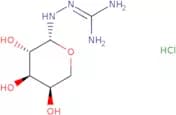
N1-β-D-Arabinopyranosylamino-guanidine hydrochloride
CAS :N1-b-D-arabinopyranosylamino-guanidine HCl is a modified carbohydrate. It is a synthetic monosaccharide that is custom synthesized by methylation and glycosylation. This product has high purity and can be used for modification of saccharides or oligosaccharides to create new carbohydrates with desired properties.Formule :C6H14N4O4•HClDegré de pureté :Min. 95%Couleur et forme :White to light beige solid.Masse moléculaire :242.66 g/molD-Lyxonic acid potassium
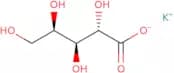
CAS :D-Lyxonic acid potassium salt is a pentitol that is a stereospecific, aldonic, and nature D-glycosylamine. It can be synthesized by reacting phenylhydrazine with glycolic acid chloride in the presence of catalytic amounts of sodium hydroxide. The yield is about 98%. This compound has been shown to have anti-inflammatory properties when it reacts with hydrogen chloride to form D-lyxonic acid chloride. It also has been shown to inhibit the growth of bacteria and fungi by binding to the cell wall and inhibiting protein synthesis.
Formule :C5H9KO6Degré de pureté :Min. 95%Couleur et forme :PowderMasse moléculaire :204.22 g/mol2,3,5-Tri-O-benzyl-L-xylofuranose
CAS :2,3,5-Tri-O-benzyl-L-xylofuranose is a sugar molecule that has been modified to inhibit glycosidases. 2,3,5-Tri-O-benzyl-L-xylofuranose is an iminosugar that inhibits the enzyme β-glucosidase and α-galactosidase. The compound is not metabolized and it binds to the enzyme's active site. 2,3,5-Tri-O-benzyl L xylofuranose has been shown to be effective at inhibiting all of the glycosidases tested in this study with inhibition potencies ranging from 0.1 mM to 10 mM. This compound also inhibits epoxides and cyclic enzymes such as azido reductase and dihydropyrimidine dehydrogenase.Formule :C26H28O5Degré de pureté :Min. 95%Couleur et forme :PowderMasse moléculaire :420.5 g/molD-Xylulose - Aqueous solution
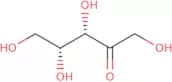
CAS :D-Xylulose is a sugar monomer found in the cell walls of bacteria. It is also present in human blood, where it is converted to xylitol. D-Xylulose has been shown to be an important component of bacterial cell wall synthesis and can be used as a probiotic for humans. The enzyme xylitol dehydrogenase catalyses the conversion of D-xylulose to xylitol. The reaction mechanism is thought to be similar to that of other enzymes in the glycolysis pathway, such as ribitol dehydrogenase, which converts ribitol to ribose 5-phosphate. This conversion can be achieved through two different methods: hydrogen fluoride or sodium hydroxide. D-Xylulose can also be used for analytical purposes, such as in the detection of trifluoroacetic acid (TFA) by gas chromatography and mass spectrometry.Formule :C5H10O5Degré de pureté :Min. 99 Area-%Couleur et forme :Clear LiquidMasse moléculaire :150.13 g/mol1,2,3,5-Tetra-O-benzoyl-a-D-xylofuranose
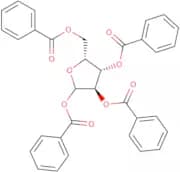
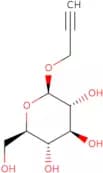
CAS :1,2,3,5-Tetra-O-benzoyl-a-D-xylofuranose is a glycosylated oligosaccharide with a tetra-O-benzoyl group at the nonreducing end. It can be synthesized by reacting benzaldehyde with 1,2,3,5-tetraacetyl xylose in the presence of sodium methoxide and acetic acid. The product can be fluorinated or methylated to produce other derivatives. This product is soluble in water and methanol and has a CAS number of 5432-87-1. It is available as a custom synthesis from catalog number SYN0000011. !-- -->!-- -->!-- -->!-- --> !-- -->!-- -->!-- -->!-- --> !-- -->!-- -->!--Formule :C33H26O9Degré de pureté :Min. 95%Couleur et forme :White PowderMasse moléculaire :566.55 g/molPropargyl β-D-glucopyranoside
CAS :A beta glycoside with an alkyne handle suitable to click chemistry
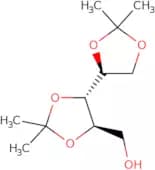
Formule :C9H14O6Degré de pureté :Min. 95%Couleur et forme :PowderMasse moléculaire :218.2 g/mol2,3:4,5-Di-O-isopropylidene-D-arabitol
CAS :2,3:4,5-Di-O-isopropylidene-D-arabitol is a synthetic sugar that is used for glycosylation, methylation, and fluorination. The compound is an oligosaccharide that has been modified with methyl groups and activated monosaccharides. 2,3:4,5-Di-O-isopropylidene-D-arabitol is white in color and has a melting point of 109°C. It can be synthesized from D-mannitol with the help of sodium methoxide in methanol. 2,3:4,5-Di-O-isopropylidene-D-arabitol is also known as 1-(2,3:4,5) triose; 1-(2,3:4)-diose; 1-(2,3:4)-triose; 1-(2,3:4)-Formule :C11H20O5Degré de pureté :Min. 95%Couleur et forme :Colorless PowderMasse moléculaire :232.27 g/mol4-Methylphenyl 2,3,4-tri-O-benzyl-β-L-thiofucopyranoside
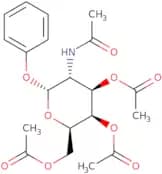
4-Methylphenyl 2,3,4-tri-O-benzyl-b-L-thiofucopyranoside is a custom synthesis of an oligosaccharide. It is a complex carbohydrate with CAS No. that belongs to the class of saccharide and sugar. Polysaccharides are made up of several monosaccharides linked together by glycosidic bonds, which are formed by the action of enzymes called glycosyltransferases or glycosidases. Glycosylation is the process in which a sugar molecule (usually glucose) is added to another molecule by means of a glycosidic bond. Carbohydrates are one type of macromolecule and they are important sources of energy in living things. They also play important roles in cell walls and as structural components in plants and animals. The chemical modification carried out on this compound is methylation, which refers to the addition of one or more methylFormule :C34H36O4SDegré de pureté :Min. 95%Masse moléculaire :540.71 g/molPhenyl 2-acetamido-3,4,6-tri-O-acetyl-2-deoxy-α-D-galactopyranoside
CAS :Phenyl 2-acetamido-3,4,6-tri-O-acetyl-2-deoxy-a-D-galactopyranoside is a sugar that is used in the synthesis of oligosaccharides and polysaccharides. This compound has an acetamido group on the phenyl ring, which reacts with the aldehyde group of galactose to form an ether bond. The glycosylation reaction can be carried out using either an acid or base catalyst. Acetal formation is also possible when this compound reacts with alcohols. Phenyl 2-acetamido-3,4,6-tri-O-acetyl-2-deoxygalactopyranoside is soluble in water and other polar solvents. It has a CAS number of 130894350 and can be found under the name Oligosaccharide, Monosaccharide, saccharide, CarbohydrateFormule :C20H25NO9Degré de pureté :Min. 95%Couleur et forme :White to off-white solid.Masse moléculaire :423.41 g/molD-ido-Heptono-1,4-lactone
D-ido-Heptono-1,4-lactone is a glycosylation product of heptose with d-ido-D-glucofuranose and is a synthetic sugar. It has an Oligosaccharide, sugar, Synthetic, Fluorination, Custom synthesis, Methylation, Monosaccharide, Polysaccharide, saccharide Click modification. It has CAS No., Modification.
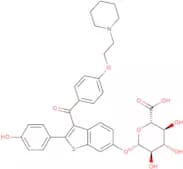
Degré de pureté :Min. 95%Raloxifene 6-D-glucuronide
CAS :Raloxifene 6-D-glucuronide is a synthetic compound that consists of the sugar raloxifene and the sugar glucuronic acid. It is a complex carbohydrate with a molecular weight of 569. Raloxifene 6-D-glucuronide is soluble in water and insoluble in most organic solvents. The compound has been modified by fluorination, which increases its stability in water, and by click modification. This compound has been shown to inhibit the activity of bacterial enzymes that are responsible for the synthesis of saccharides, such as oligosaccharides and polysaccharides.Formule :C34H35NO10SDegré de pureté :Min. 95%Couleur et forme :SolidMasse moléculaire :649.71 g/molMethyl 2,3,4-tri-O-benzyl-α-D-glucuronide benzyl ester
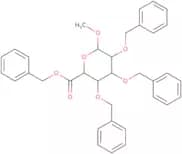
CAS :Methyl 2,3,4-tri-O-benzyl-α-D-glucuronide benzyl ester is a Carbohydrate. It is soluble in water and insoluble in alcohol. The molecular weight of Methyl 2,3,4-tri-O-benzyl-α-D-glucuronide benzyl ester is 584.1 g/mol. The CAS Registry Number for Methyl 2,3,4-tri-O-benzyl-α-D-glucuronide benzyl ester is 14279733.Formule :C35H36O7Degré de pureté :Min. 95%Couleur et forme :Colorless Clear LiquidMasse moléculaire :568.66 g/molPhenyl 2,3,4,6-tetra-O-benzyl-b-D-thioglucopyranoside
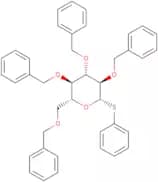
CAS :Phenyl 2,3,4,6-tetra-O-benzyl-b-D-thioglucopyranoside is a modification. It is an oligosaccharide that belongs to the class of carbohydrates. Phenyl 2,3,4,6-tetra-O-benzyl-b-D-thioglucopyranoside has a high purity and can be synthesized in a custom manner. It is a white to off white powder that has CAS No. 38184-10-0 and can be used for glycosylation or methylation reactions. It also has fluoroquinolone resistance and can be used as a complex carbohydrate in the synthesis of polysaccharides.Formule :C40H41O5SDegré de pureté :Min. 95%Couleur et forme :White Off-White PowderMasse moléculaire :632.83 g/mol4-Methoxyphenyl 3,4-di-O-benzyl-α-D-mannopyranoside
4-Methoxyphenyl 3,4-di-O-benzyl-a-D-mannopyranoside is a glycosylated, complex carbohydrate with a methylated and fluorinated saccharide. This product is available for custom synthesis and can be ordered in high purity.Degré de pureté :Min. 95%4-O-Benzyl-L-rhamnal
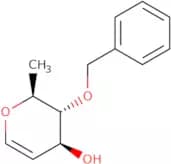
CAS :4-O-Benzyl-L-rhamnal is a functionalized, asymmetric, glycosylating agent that is used in the synthesis of glycoconjugates. 4-O-Benzyl-L-rhamnal is synthesized by the reaction of benzaldehyde with an aldehyde group on the sugar molecule. The product is then reacted with an alcohol to form a glycosidic bond. This process can be repeated until the desired number of sugar molecules are added. It can also be used to synthesize disaccharides and polysaccharides by convergent or nucleophile reactivity. 4-O-Benzyl-L-rhamnal utilizes a chiral auxiliary to produce its product, which can be used for synthesis purposes or as a starting material for other reactions.Formule :C13H16O3Degré de pureté :Min. 95%Couleur et forme :PowderMasse moléculaire :220.27 g/molD-Ribose-1-phosphate bis(cyclohexylammonium)
CAS :D-Ribose-1-phosphate bis(cyclohexylammonium) salt is a custom synthesis of D-ribose. It is a monosaccharide that has been fluorinated, methylated, and glycosylated. The chemical modification of the sugar allows for it to have properties such as high purity and custom synthesis. This product can be used in a number of applications including complex carbohydrate, glycosylation, Methylation, and click modification.Formule :C5H11O8P•(C6H13N)2Degré de pureté :Min. 97 Area-%Couleur et forme :PowderMasse moléculaire :428.46 g/molEthyl 2,3,4-tri-O-benzyl-b-L-thiofucopyranoside
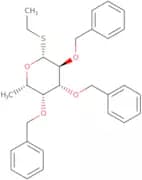
CAS :Synthetic building block. Glycosyl donor used in oligosaccharide chemistry to incorporate L-fucose into a structure.Formule :C29H34O4SDegré de pureté :Min. 98 Area-%Couleur et forme :White PowderMasse moléculaire :478.64 g/molCyanomethyl 2,3,4,6-tetra-O-acetyl-b-D-thioglucopyranoside
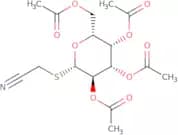
CAS :Cyanomethyl 2,3,4,6-tetra-O-acetyl-b-D-thioglucopyranoside is a synthetic glycosylation agent. It is an acetal derivative of b-D-thioglucopyranoside with a terminal methyl group at C2 and a fluorine atom at C6. This product can be used to modify saccharides and sugars in a variety of ways. It has been shown to react with various carbohydrates including polysaccharides and oligosaccharides. Synthetic glycosylations are often used in the synthesis of complex carbohydrates for use in pharmaceuticals or chemical engineering. The CAS number for this product is 61145-33-3.Formule :C16H21NO9SDegré de pureté :Min. 95%Masse moléculaire :403.41 g/mol6-Deoxy-D-lactose
CAS :6-Deoxy-D-lactose is a custom synthesized, complex carbohydrate that is an Oligosaccharide. It is a polysaccharide with a CAS number of 52689-62-0. 6-Deoxy-D-lactose has been modified by methylation and glycosylation and can be used as a Modification of saccharides. 6-Deoxy-D-lactose has been fluorinated and it can be synthesized by Click modification of sugar or high purity. 6-Deoxy-D-lactose is a white, crystalline powder that is soluble in water, ethanol, and acetone.br> 6 Deoxy Lactose (6DL) is an oligosaccharide that consists of one glucose molecule linked to one galactose molecule via alpha 1-->4 glycosidic linkage. The chemical formula for 6DL is C 12 H 22 O 11 . 6DLFormule :C12H22O10Degré de pureté :Min. 95%Couleur et forme :Off-White PowderMasse moléculaire :326.3 g/molEsculin - Anhydrous
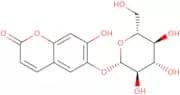
CAS :Esculin is a natural product obtained from the plant Aesculus hippocastanum. Esculin has been shown to have anti-inflammatory properties in experimental models. It also has been shown to inhibit the activity of both human and animal renin, suppressing kidney fibrosis. Esculin was found to be more effective than indomethacin in preventing the progression of renal disease induced by the model system of chronic kidney disease. Esculin also has antioxidant properties and can reduce oxidative stress caused by free radicals, which may contribute to its anti-inflammatory effects. Esculin is a coumarin derivative that can be used as a chromatographic stationary phase for separation and identification of various chemical compounds.Formule :C15H16O9Degré de pureté :Min. 98 Area-%Couleur et forme :PowderMasse moléculaire :340.28 g/mol