APIs pour la recherche et les impuretés
Sous-catégories appartenant à la catégorie "APIs pour la recherche et les impuretés"
- Acides Aminés et Dérivés(12.327 produits)
- Anthraquinones et Dérivés(402 produits)
- Dérivés du Benzimidazole et de l’Imidazole(10.413 produits)
- Dérivés des Benzodiazépines(330 produits)
- Glucides et Glycoconjugués(5.048 produits)
- Esters et Dérivés(42.243 produits)
- Acides Gras et Dérivés Lipidiques(32.383 produits)
- Flavonoïdes et Polyphénols(17.077 produits)
- Radicaux Libres et Agents Oxydants/Réducteurs(212 produits)
- Cétones et Dérivés(2.399 produits)
- Antibiotiques Naturels et Semi-Synthétiques(6.344 produits)
- Nitriles et Dérivés Cyano(3.068 produits)
- Nitrosamines et Dérivés(55 produits)
- Nucléosides et Nucléotides(3.459 produits)
- Phosphates et Phosphonates Organiques(1.198 produits)
- Sulfonates et Sulfates Organiques(10.423 produits)
- Composés Organométalliques(4.419 produits)
- Autres(6.279 produits)
- Peptides et Protéines(3.140 produits)
- Polymères et Dérivés(99 produits)
- Dérivés des Purines et Pyrimidines(8.912 produits)
- Dérivés de Quinazoline et de Quinoléine(65.802 produits)
- Quinones et Dérivés(24.347 produits)
- Sels et Dérivés d’API(81.002 produits)
- Stéroïdes et Dérivés(4.934 produits)
- Sulfamides et Dérivés(2.577 produits)
- Terpénoïdes et Dérivés(3.841 produits)
- Thiazolidinediones et Thiopyranes(2.753 produits)
- Composés β-Adrénergiques(229 produits)
58355 produits trouvés pour "APIs pour la recherche et les impuretés"
Regadenoson Impurity 28
CAS :Regadenoson Impurity 28 is an analytical standard and research and development impurity. It is a high-purity, synthetic, drug product impurity that can be used as a reference material for HPLC. This drug impurity is also available in a custom synthesis service. Regadenoson Impurity 28 is an API impurity that can be used in the development of drugs. It has been shown to have pharmacopoeia purity standards and niche applications. Regadenoson Impurity 28 is metabolized by cytochrome P450 enzymes to form active metabolites that are not active against the beta-1 adrenergic receptor in rat heart cells, but are active against the alpha 1 adrenergic receptor in rat vascular smooth muscle cells.
Formule :C10H14N6O3Degré de pureté :Min. 95%Masse moléculaire :266.26 g/molExicorilant
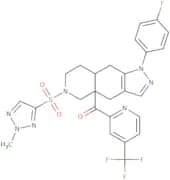
CAS :Exicorilant is an analog of capsaicin, which has been shown to have anticancer properties. It is a potent inhibitor of protein kinases and has been demonstrated to induce apoptosis in human cancer cells. Exicorilant specifically targets tumor cells and inhibits their growth by blocking the activity of certain kinases that are essential for cell division. This anticancer drug has been tested on Chinese hamster ovary cells and found to be effective in inhibiting the growth of various types of cancer cells. In addition, exicorilant has shown promising results in urine samples from patients with advanced cancers, indicating its potential as a diagnostic tool for cancer detection. Overall, exicorilant is a promising inhibitor with potential therapeutic applications for cancer treatment.
Formule :C26H23F4N7O3SDegré de pureté :Min. 95%Masse moléculaire :589.6 g/mol2-[[4-(2-Pyridylsulfamoyl)phenyl]azo]hydroxybenzene
CAS :2-[[4-(2-Pyridylsulfamoyl)phenyl]azo]hydroxybenzene is an impurity found in sulfasalazine. It is a metabolite that is formed by the P450 system in the liver. The metabolic process of 2-[[4-(2-Pyridylsulfamoyl)phenyl]azo]hydroxybenzene has been studied in detail and has been shown to be a major contributor to the pharmacokinetic profile of sulfasalazine. This substance also exhibits antimicrobial activity and inhibits the growth of bacteria, fungi, and viruses.
Formule :C17H14N4O3SDegré de pureté :Min. 95%Masse moléculaire :354.38 g/molN-(4-Amino-6,7-dimethoxyquinazol-2-yl)-N-methylpropylenediamine hydrochloride
CAS :N-(4-Amino-6,7-dimethoxyquinazol-2-yl)-N-methylpropylenediamine hydrochloride is an impurity that can be found in some commercially available drugs. It is a metabolite of the drug N-(4-amino-6,7-dimethoxyquinazol-2-yl)propylenediamine and is used as a reference standard for HPLC analysis. This compound has been shown to have antiplatelet activities.
Formule :C14H22ClN5O2Degré de pureté :Min. 95%Masse moléculaire :327.81 g/molPravastatin 6-oxo Impurity
CAS :Pravastatin 6-oxo Impurity is an impurity of Pravastatin, a drug used in the treatment of high cholesterol. The impurity has been identified through analytical methods and is characterized by HPLC analysis. This substance has been shown to be present in at least 0.1% of the drug product and may be present as a result of incomplete synthesis or a side-reaction during synthesis.
Formule :C23H34O7Degré de pureté :Min. 95%Masse moléculaire :422.51 g/mol(E/Z)-It-603
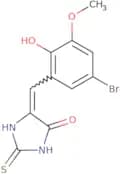
CAS :Please enquire for more information about (E/Z)-It-603 including the price, delivery time and more detailed product information at the technical inquiry form on this page
Formule :C11H9BrN2O3SDegré de pureté :Min. 95%Masse moléculaire :329.17 g/molRef: 3D-SLA16890
Produit arrêté1-[2-[2-Hydroxy-3-[[2-hydroxy-3-[2-(3-phenylpropanoyl)phenoxy]propyl]-propylamino]propoxy]phenyl]-3-phenylpropan-1-one
CAS :Arbidol is a drug molecule that interacts with protease enzymes. It has been shown to inhibit human erythrocyte chymotrypsin, trypsin, and elastase. Arbidol is also able to inhibit the growth of bacteria such as Staphylococcus aureus, Escherichia coli, and Pseudomonas aeruginosa. The molecular modelling of arbidol suggests that it binds to the active site of the enzyme by blocking hydrophobic pockets on the surface of the enzyme. The conformational change in the protease enzyme activates arbidol's binding site for an extended period of time. This prolonged interaction prevents substrate from binding to the catalytic site of the enzyme and inhibits its activity.
Formule :C39H45NO6Degré de pureté :Min. 95%Masse moléculaire :623.78 g/molm-Glimepiride impurity
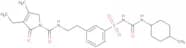
CAS :m-Glimepiride impurity is a chemical substance that belongs to the sulfonylurea family. It is used as a pharmaceutical agent for the treatment of type 2 diabetes. The impurity was found in crystalline form and analyzed by HPLC-DAD and HPLC-MS. The purity of m-Glimepiride impurity was determined to be 99%. It is not known whether this impurity has any biological activity.
Formule :C24H34N4O5SDegré de pureté :Min. 95%Masse moléculaire :490.62 g/molRef: 3D-IM25123
Produit arrêtéN-[[2-[[[4-[[[(Hexyloxy)carbonyl]amino]carbonyl]phenyl]amino]methyl]-1-methyl-1H-benzimidazol-5-yl]carbonyl]-N-2-pyridinyl-β-alanine ethyl ester
CAS :This is an analytical standard for the impurity N-[[2-[[[4-[[(hexyloxy)carbonyl]amino]carbonyl]phenyl]amino]-methyl]-1-methyl-1H-benzimidazol-5-yl]carbonyl]-N-2-pyridinyl-β-alanine ethyl ester. It has a purity of >98% by HPLC and is available in quantities of 5g.Formule :C34H40N6O6Degré de pureté :Min. 95%Masse moléculaire :628.7 g/molErlotinib-3-vinyl hydrochloride
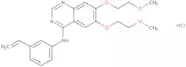
CAS :Erlotinib-3-vinyl hydrochloride is a drug product that is used in the treatment of cancer, including non-small cell lung cancer. It is an impurity standard for HPLC and analytical testing. Erlotinib-3-vinyl hydrochloride is also used as an API impurity and metabolite in metabolism studies. Erlotinib-3-vinyl hydrochloride can be synthesized from 4-(4'-vinylphenoxy)butanal, which is a natural compound obtained from plants like apple trees. This synthetic process can be done by the reduction of 4-(4'-vinylphenoxy)butanal with sodium borohydride, followed by reaction with vinyl chloride. The compound is also found as a metabolite in humans after oral administration of erlotinib, which has been shown to inhibit protein synthesis and DNA synthesis.
Formule :C22H26ClN3O4Degré de pureté :Min. 95%Masse moléculaire :431.9 g/mol4-Hydoxymethyl-5-methylimidazol
CAS :4-Hydroxymethyl-5-methylimidazol (HMMI) is a corrosion inhibitor that is used in the production of nanomaterials. It has been shown to be an effective treatment for wastewater containing hydrochloric acid and organic solvents. The reaction between HMMI and the acids in wastewater forms a complex that prevents the corrosion of metal surfaces. HMMI can be synthesized by reacting aesculus with formaldehyde in an organic solvent, such as acetone or chloroform, at room temperature. HMMI has also been shown to have antiviral potency and is used in skin care products, such as lotions and shampoos, due to its ability to penetrate the skin barrier. Magnetic resonance spectroscopy (MRS) was used to study the effect of HMMI on skin cells, while electrochemical methods were used to investigate how it inhibits viral activity.
Formule :C5H8N2ODegré de pureté :Min. 95%Masse moléculaire :112.13 g/molDehydro nicardipine hydrochloride
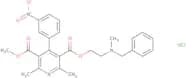
CAS :Please enquire for more information about Dehydro nicardipine hydrochloride including the price, delivery time and more detailed product information at the technical inquiry form on this page
Formule :C26H28ClN3O6Degré de pureté :Min. 95%Masse moléculaire :514 g/molCefazedone Impurity 12
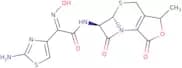
CAS :Cefazedone Impurity 12 is a drug product that has been custom synthesized for research and development purposes. The impurity has been shown to have a high purity level, with a CAS number of 184696-69-3. Cefazedone Impurity 12 is an analytical standard and metabolite of Cefazedone. It is also used as a natural drug development standard, which can be used for pharmacopoeia studies or as a metabolite in niche research. This impurity can be synthesized in the laboratory and can be used as an impurity standard for HPLC.
Formule :C8H8N2O3SDegré de pureté :Min. 95%Masse moléculaire :212.23 g/molAbt-639 hydrochloride
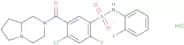
CAS :Abt-639 hydrochloride is a drug product that is used as a research and development standard. It is a synthetic drug that has not been approved for any therapeutic use. Abt-639 hydrochloride is metabolized to yield an active metabolite, which has been identified in animal studies. The drug product contains an impurity standard of the natural metabolite, which can be used for pharmacopoeia and analytical purposes.
Formule :C20H21Cl2F2N3O3SDegré de pureté :Min. 95%Masse moléculaire :492.4 g/mol(3R,5S,6E)-7-[4-(4-Fluorophenyl)-6-(1-methylethyl)-2-[methyl[(2-hydroxy-2-methylpropyl)sulfonyl]amino]-5-pyrimidinyl]-3,5-dihydroxy- 6-heptenoic acid sodium salt
CAS :(3R,5S,6E)-7-[4-(4-Fluorophenyl)-6-(1-methylethyl)-2-[methyl[(2-hydroxy-2-methylpropyl)sulfonyl]amino]-5-pyrimidinyl]-3,5-dihydroxy- 6-heptenoic acid sodium salt is a synthetic drug product. It is an impurity standard in the synthesis of Metabolism studies. The CAS number is 1714147-50-8 and the chemical name is (3R,5S,6E)-7-[4-(4-fluorophenyl)-6-(1-methylethyl)-2-[methyl[(2-hydroxy-2 methylpropyl)sulfonyl]amino]-5-pyrimidinyl]-3,5dihydroxyheptenoic acid sodium salt. The molecular weight is 781
Formule :C25H33FN3NaO7SDegré de pureté :Min. 95%Masse moléculaire :561.6 g/molAcrolein-d4
CAS :Please enquire for more information about Acrolein-d4 including the price, delivery time and more detailed product information at the technical inquiry form on this page
Formule :C3H4ODegré de pureté :Min. 95%Masse moléculaire :60.09 g/molMonobenzyl fosaprepitant
CAS :Monobenzyl fosaprepitant is a drug product that is used for research and development purposes. It is an impurity standard for the analysis of API (Active Pharmaceutical Ingredient) impurities, which are synthetic products. Monobenzyl fosaprepitant has been shown to be metabolized in vitro. The metabolism studies have shown that this compound can be hydrolyzed by esterases or glucuronidases, oxidized by cytochrome P450 enzymes, reduced by glutathione reductase, or conjugated with glucuronic acid. Monobenzyl fosaprepitant is a high-purity analytical standard and is used as a pharmacopoeia monograph material.
Formule :C30H28F7N4O6PDegré de pureté :Min. 95%Masse moléculaire :704.50 g/molCefdinir impurity E
CAS :Cefdinir impurity E is a research and development, impurity standard, custom synthesis, drug product, synthetic, high purity, pharmacopoeia, drug development and analytical standard. CAS No. 946573-41-7 is the metabolite of cefdinir. It is used to study metabolism of cefdinir in vitro and in vivo. HPLC standards are available for this compound.
Degré de pureté :Min. 95%(E)-4-Alloxycarboxyl tamoxifen
CAS :(E)-4-Alloxycarboxyl tamoxifen is a synthetic metabolite of tamoxifen. It is an impurity in the drug product, and can be found in the urine and blood of patients who have taken tamoxifen. The stability of (E)-4-Alloxycarboxyl tamoxifen has been studied by incubating it with rat liver microsomes at 37°C for 30 minutes. Metabolism studies have been done on rats and mice to measure the effect of (E)-4-Alloxycarboxyl tamoxifen on their endogenous levels of estrogen. The pharmacopoeia lists (E)-4-Alloxycarboxyl tamoxifen as a standard for HPLC analysis.
Formule :C30H33NO4Degré de pureté :Min. 95%Masse moléculaire :471.60 g/molDexamethasone-17-ketone
CAS :Produit contrôléPlease enquire for more information about Dexamethasone-17-ketone including the price, delivery time and more detailed product information at the technical inquiry form on this page
Formule :C20H25FO3Degré de pureté :Min. 95%Masse moléculaire :332.42 g/mol

![2-[[4-(2-Pyridylsulfamoyl)phenyl]azo]hydroxybenzene](/_next/image/?url=https%3A%2Fstatic.cymitquimica.com%2Fproducts%2F3D%2Fthumb-webp%2FIP27340.webp&w=3840&q=75)

![1-[2-[2-Hydroxy-3-[[2-hydroxy-3-[2-(3-phenylpropanoyl)phenoxy]propyl]-propylamino]propoxy]phenyl]-…](/_next/image/?url=https%3A%2Fstatic.cymitquimica.com%2Fproducts%2F3D%2Fthumb-webp%2FIP63820.webp&w=3840&q=75)
![N-[[2-[[[4-[[[(Hexyloxy)carbonyl]amino]carbonyl]phenyl]amino]methyl]-1-methyl-1H-benzimidazol-5-yl…](/_next/image/?url=https%3A%2Fstatic.cymitquimica.com%2Fproducts%2F3D%2Fthumb-webp%2FIGC23840.webp&w=3840&q=75)

![(3R,5S,6E)-7-[4-(4-Fluorophenyl)-6-(1-methylethyl)-2-[methyl[(2-hydroxy-2-methylpropyl)sulfonyl]am…](/_next/image/?url=https%3A%2Fstatic.cymitquimica.com%2Fproducts%2F3D%2Fthumb-webp%2FIF156830.webp&w=3840&q=75)