APIs pour la recherche et les impuretés
Les principes actifs pharmaceutiques (API) sont les substances présentes dans les médicaments qui sont responsables de leurs effets thérapeutiques. Dans cette section, vous trouverez une grande variété d'API destinés à un usage de recherche. Ces composés sont essentiels pour le développement, les tests et la validation de nouvelles formulations pharmaceutiques. Chez CymitQuimica, nous proposons des API de haute qualité pour soutenir la recherche dans la découverte et le développement de médicaments.
Sous-catégories appartenant à la catégorie "APIs pour la recherche et les impuretés"
- Acides Aminés et Dérivés(12.328 produits)
- Anthraquinones et Dérivés(405 produits)
- Dérivés du Benzimidazole et de l’Imidazole(10.438 produits)
- Dérivés des Benzodiazépines(335 produits)
- Glucides et Glycoconjugués(5.016 produits)
- Esters et Dérivés(42.240 produits)
- Acides Gras et Dérivés Lipidiques(32.395 produits)
- Flavonoïdes et Polyphénols(17.087 produits)
- Radicaux Libres et Agents Oxydants/Réducteurs(213 produits)
- Cétones et Dérivés(2.402 produits)
- Antibiotiques Naturels et Semi-Synthétiques(6.380 produits)
- Nitriles et Dérivés Cyano(3.067 produits)
- Nitrosamines et Dérivés(55 produits)
- Nucléosides et Nucléotides(3.431 produits)
- Phosphates et Phosphonates Organiques(1.202 produits)
- Sulfonates et Sulfates Organiques(10.434 produits)
- Composés Organométalliques(4.422 produits)
- Autres(6.292 produits)
- Peptides et Protéines(3.154 produits)
- Polymères et Dérivés(100 produits)
- Dérivés des Purines et Pyrimidines(8.948 produits)
- Dérivés de Quinazoline et de Quinoléine(65.966 produits)
- Quinones et Dérivés(24.349 produits)
- Sels et Dérivés d’API(79.673 produits)
- Stéroïdes et Dérivés(4.975 produits)
- Sulfamides et Dérivés(2.594 produits)
- Terpénoïdes et Dérivés(3.846 produits)
- Thiazolidinediones et Thiopyranes(2.752 produits)
- Composés β-Adrénergiques(230 produits)
Affichez 21 plus de sous-catégories
57012 produits trouvés pour "APIs pour la recherche et les impuretés"
Trier par
Degré de pureté (%)
0
100
|
0
|
50
|
90
|
95
|
100
1-{4-[(4-methyl-1,4-diazepan-1-yl)methyl]phenyl}methanamine
CAS :Masse moléculaire :233.35899353027344Aflatoxin B1 8,9-Epoxide
CAS :Produit contrôléFormule :C17H12O7Degré de pureté :>80%Couleur et forme :NeatMasse moléculaire :328.27N-(((5R)-3-(3-Fluoro-4- (4-morpholinyl)phenyl)-2-oxo- 5-oxazolidinyl)methyl) acetamide
CAS :<p>N-(((5R)-3-(3-Fluoro-4-(4-morpholinyl)phenyl)-2-oxo-5-oxazolidinyl)methyl)acetamide (LFMAPO) is an antibacterial agent that inhibits bacterial growth by binding to the active site of bacterial DNA gyrase. LFMAPO has a molecular weight of 552.2 Da and a log P value of 2.6. It was synthesized from acetamide, 3-fluoroaniline, and 4-(4-morpholinyl)benzaldehyde in 60% yield using techniques such as millimolar stoichiometry, electrophoresis method, binding constants, and molecular modeling study. The drug also has chiral properties with two stereocenters at carbons C1 and C5 that have been shown to be important for the activity of this compound against Gram positive bacteria.</p>Formule :C16H20FN3O4Degré de pureté :Min. 95%Couleur et forme :PowderMasse moléculaire :337.35 g/molCalcipotriol EP impurity E
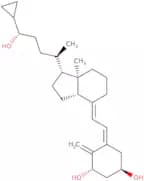
<p>Calcipotriol EP Impurity E is a synthetic impurity that is found in the calcipotriol EP API. Calcipotriol EP Impurity E is an impurity standard for HPLC and can be used in drug development, research and development, and pharmacopoeia. It has been shown to have no significant effect on the pharmacological activity of calcipotriol EP.</p>Formule :C27H42O3Degré de pureté :Min. 95 Area-%Couleur et forme :PowderMasse moléculaire :414.62 g/mol(3R)-3-Amino-1-[5,6-dihydro-3-(trifluoromethyl)-1,2,4-triazolo[4,3-α]pyrazin-7(8H)-yl]-4-(2,3,6-trifluorophenyl)-1-butanone
CAS :<p>Please enquire for more information about (3R)-3-Amino-1-[5,6-dihydro-3-(trifluoromethyl)-1,2,4-triazolo[4,3-α]pyrazin-7(8H)-yl]-4-(2,3,6-trifluorophenyl)-1-butanone including the price, delivery time and more detailed product information at the technical inquiry form on this page</p>Formule :C16H15F6N5ODegré de pureté :Min. 95%Masse moléculaire :407.31 g/molN-[2-[[[5-[(Dimethylamino)methyl]-2-furanyl]methyl]thio]ethyl]-2-nitroacetamide sodium salt
CAS :<p>2-Nitroacetamide sodium salt is an impurity of the drug N-[2-[[[5-[(dimethylamino)methyl]-2-furanyl]methyl]thio]ethyl]-2-nitroacetamide, a synthetic chemotherapeutic agent for the treatment of cancers. This compound has been shown to have metabolism studies and natural properties. It has a CAS number of 112251-56-6 and is found in the pharmacopoeia. 2-Nitroacetamide sodium salt is a custom synthesis that can be used as a reference standard for HPLC analysis. It can also be used as a drug product or metabolite in drug development.</p>Formule :C12H18N3O4SNaDegré de pureté :Min. 95%Couleur et forme :PowderMasse moléculaire :323.34 g/mol15-O-Demethyl Tacrolimus
CAS :<p>Tacrolimus is a macrolide that is used as an immunosuppressive drug. It has been shown to bind to the FK-binding protein, which in turn inhibits calcineurin. This prevents the release of IL-2, TNF-α and other cytokines. The immunosuppressive effects of tacrolimus have been evaluated using analytical methods such as coefficients, affinity, and monitoring techniques such as immunoassays and agglutination. These techniques are used to evaluate the plasma concentration of tacrolimus. Tacrolimus also binds to proteins in the blood samples and can be detected by turbidimetric or electrochemiluminescence immunoassay reagents.</p>Formule :C43H67NO12Degré de pureté :Min. 95%Masse moléculaire :789.99 g/molRotigotine Impurity 7
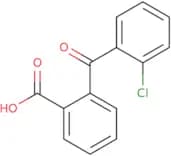
CAS :<p>Rotigotine Impurity 7 is an impurity that has been identified in the synthesis of rotigotine. Rotigotine Impurity 7 is a synthetic compound with a CAS number of 1229620-82-9. It is intended for use as an analytical standard and as a component in the manufacture of rotigotine, which is indicated for the management of Parkinson's disease. This product has not been tested in animals or humans, and it should be handled with care.</p>Formule :C21H28ClNO2SDegré de pureté :Min. 95%Masse moléculaire :393.97 g/mol2-(2-Chlorobenzoyl)benzoic acid
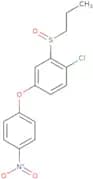
CAS :<p>Please enquire for more information about 2-(2-Chlorobenzoyl)benzoic acid including the price, delivery time and more detailed product information at the technical inquiry form on this page</p>Formule :C14H9ClO3Degré de pureté :Min. 95%Masse moléculaire :260.67 g/molPhenproxide
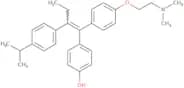
CAS :<p>Phenproxide is an analog of testosterone that has been used traditionally in Chinese medicine to treat tumors. It has been found to induce apoptosis in cancer cells by inhibiting kinases, which are enzymes that regulate cellular processes such as cell division and growth. Phenproxide has also been shown to inhibit the activity of somatostatin, a hormone that regulates the release of other hormones. This inhibition may contribute to its anti-cancer properties. In addition, Phenproxide has been shown to have an effect on hyaluronan metabolism, a substance involved in tissue repair and inflammation. It is excreted in urine and may be used as a potential biomarker for cancer diagnosis or monitoring.</p>Formule :C15H14ClNO4SDegré de pureté :Min. 95%Masse moléculaire :339.8 g/molMiproxifene
CAS :Produit contrôlé<p>Miproxifene is a potent anticancer drug that has been shown to induce apoptosis and inhibit cell cycle progression in human cancer cells. This drug has been extensively studied in Chinese hamster ovary (CHO) cells and has demonstrated significant activity against various types of cancer, including leukemia. Miproxifene acts as a protein inhibitor and has been found to be effective against several tumor cell lines. It is a promising medicinal compound for the treatment of cancer, with potential applications in both chemotherapy and radiation therapy. Miproxifene is excreted primarily through urine and is well-tolerated by patients. Its use as an anticancer agent holds great promise for the future of cancer treatment.</p>Formule :C29H35NO2Degré de pureté :Min. 95%Masse moléculaire :429.6 g/molMethiotepa
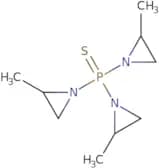
CAS :<p>Methiotepa is a potent anticancer drug that has been used for the treatment of various types of tumors. It is a Chinese hamster ovary (CHO) cell-derived analog of chitin, which inhibits the activity of protein kinase C. Methiotepa induces apoptosis in cancer cells by inhibiting DNA synthesis and repair, leading to cell death. This drug has also been shown to be a potent inhibitor of heparin-induced platelet aggregation in human blood. Methiotepa has been found to be effective against a wide range of cancers, including breast, lung, ovarian, and bladder cancer, among others. Its use as an anticancer agent may be due to its ability to inhibit the activity of various kinases and other enzymes involved in cancer cell proliferation and survival.</p>Formule :C9H18N3PSDegré de pureté :Min. 95%Masse moléculaire :231.3 g/mol7-Chloro-6-fluoro-1,4-dihydro-4-oxo-3-quinolinecarboxylic acid ethyl ester
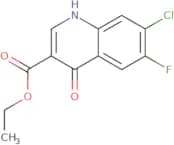
CAS :<p>7-Chloro-6-fluoro-1,4-dihydro-4-oxo-3-quinolinecarboxylic acid ethyl ester is a synthetic compound that has not been evaluated in humans. Studies have shown that the drug can be hydrolyzed to 7-chloro-6-fluoroquinoline 1,1′-(ethylenedioxy)bis(ethane), which is an impurity of norfloxacin. The ethyl esters of 7-chloroquinoline are also known to condense with formaldehyde and hydrolyze to 7-chloroquinolinic acid. This product may contain solvents such as acetone, chloroform, and alcohols that are used during the synthesis process. Decarboxylation of the drug occurs when it is heated at high temperatures in the presence of a catalyst, such as pyridine or sodium methoxide. It decarboxyl</p>Formule :C12H9ClFNO3Degré de pureté :Min. 95%Masse moléculaire :269.65 g/molN-Desmethyl trimeprazine
CAS :<p>N-Desmethyl trimeprazine is a synthetic compound, which is an impurity of the drug product. It is not active and does not possess any biological activity. It is a metabolite of the parent drug, Trimeprazine. N-Desmethyl trimeprazine has been studied for its pharmacological properties and metabolism in the body, but no conclusive results have been found. The chemical structure and purity of N-Desmethyl trimeprazine are not listed in the USP or BP. This compound can be custom synthesized on request.</p>Formule :C17H20N2SDegré de pureté :Min. 95%Masse moléculaire :284.40 g/mol




![1-{4-[(4-methyl-1,4-diazepan-1-yl)methyl]phenyl}methanamine](/_next/image/?url=https%3A%2Fstatic.cymitquimica.com%2Fproducts%2F10%2Fthumb-webp%2FF518958.webp&w=3840&q=75)


![(3R)-3-Amino-1-[5,6-dihydro-3-(trifluoromethyl)-1,2,4-triazolo[4,3-α]pyrazin-7(8H)-yl]-4-(2,3,6-tr…](/_next/image/?url=https%3A%2Fstatic.cymitquimica.com%2Fproducts%2F3D%2Fthumb-webp%2FIA183166.webp&w=3840&q=75)
![N-[2-[[[5-[(Dimethylamino)methyl]-2-furanyl]methyl]thio]ethyl]-2-nitroacetamide sodium salt](/_next/image/?url=https%3A%2Fstatic.cymitquimica.com%2Fproducts%2F3D%2Fthumb-webp%2FID57855.webp&w=3840&q=75)